
If you experienced a demotion, pay cut, schedule change, or termination after reporting discrimination, unpaid wages, safety hazards, or requesting an accommodation, California law likely protects you. Act now: document what happened, preserve every email and text, and calendar your filing deadlines. Depending on the claim, you may file with the California Civil Rights Department, the Labor Commissioner, or Cal/OSHA, and a California Employment Lawyer can help you sort out which path fits your case.
TL;DR:
- Retaliation claims in California can stem from a range of adverse actions, including demotions, schedule changes, pay cuts, or terminations following protected activities.
- Filing deadlines vary across agencies, with most claims needing to be filed within three years, but safety retaliation with Cal/OSHA must be addressed within six months.
- Protecting evidence early, such as documenting timelines and saving communications, is crucial to establishing causation and proving retaliation.
- Legal assistance is advised immediately if a termination occurs after a protected activity, deadlines are near, or there are overlapping claims involving discrimination, wages, or safety.
- Employers with five or more employees are legally required to implement anti-retaliation policies, train supervisors, and promptly investigate complaints to prevent retaliation.
Table of Contents
- What Is Workplace Retaliation Under California Law?
- What Counts as a Protected Activity in California?
- How Do You Document Retaliation to Prove Causation?
- Where Do You File a Retaliation Claim, and What Are the Deadlines?
- Agency Investigation or Private Lawsuit: What Should You Expect?
- When Should You Contact an Employment Lawyer in La Habra?
- Are There Local Protections That Matter for La Habra Workers?
- What Are Employers Required to Do to Prevent Retaliation?
- What Do People Get Wrong About Retaliation Claims?
- Quick Next Steps for a La Habra Employee Who Suspects Retaliation
- How Serendib Law Firm Can Help La Habra Employees
- Official Resources for Filing and Verifying Deadlines
- Sources
- FAQ
What Is Workplace Retaliation Under California Law?
California law defines retaliation as an adverse employment action an employer takes because an employee engaged in a legally protected activity. The California Civil Rights Department’s retaliation factsheet breaks the claim into three parts: you engaged in protected activity, your employer took an adverse action, and the two are connected by causation. The Fair Employment and Housing Act (FEHA) covers most private and public employers in California, and coverage thresholds can vary depending on the type of claim and the size of the employer.
Retaliation shows up in forms that are obvious and forms that are easy to miss. Common adverse actions include:
- Termination or forced resignation
- Demotion or a sudden negative performance review
- Reduced hours or an unfavorable schedule change
- Pay cuts or denial of a previously expected raise
- Increased scrutiny, exclusion from meetings, or a hostile shift in treatment
None of these have to happen in isolation. Employers often stack several small changes together, hoping the pattern looks like ordinary management rather than punishment for speaking up.
What Counts as a Protected Activity in California?
The Labor Commissioner’s retaliation guidance lists a wide range of activities California law shields from punishment. If your employer targeted you for doing any of the following, you likely have grounds for a claim.
- Filing a complaint with the CRD or the Labor Commissioner over discrimination, harassment, or unpaid wages
- Reporting wage theft, including unpaid overtime or missed meal breaks
- Requesting a disability accommodation or pregnancy-related accommodation
- Taking leave under the California Family Rights Act (CFRA) or Pregnancy Disability Leave (PDL)
- Reporting unsafe working conditions or refusing to perform work you reasonably believed was dangerous
- Participating in a workplace investigation or acting as a witness for a coworker’s complaint
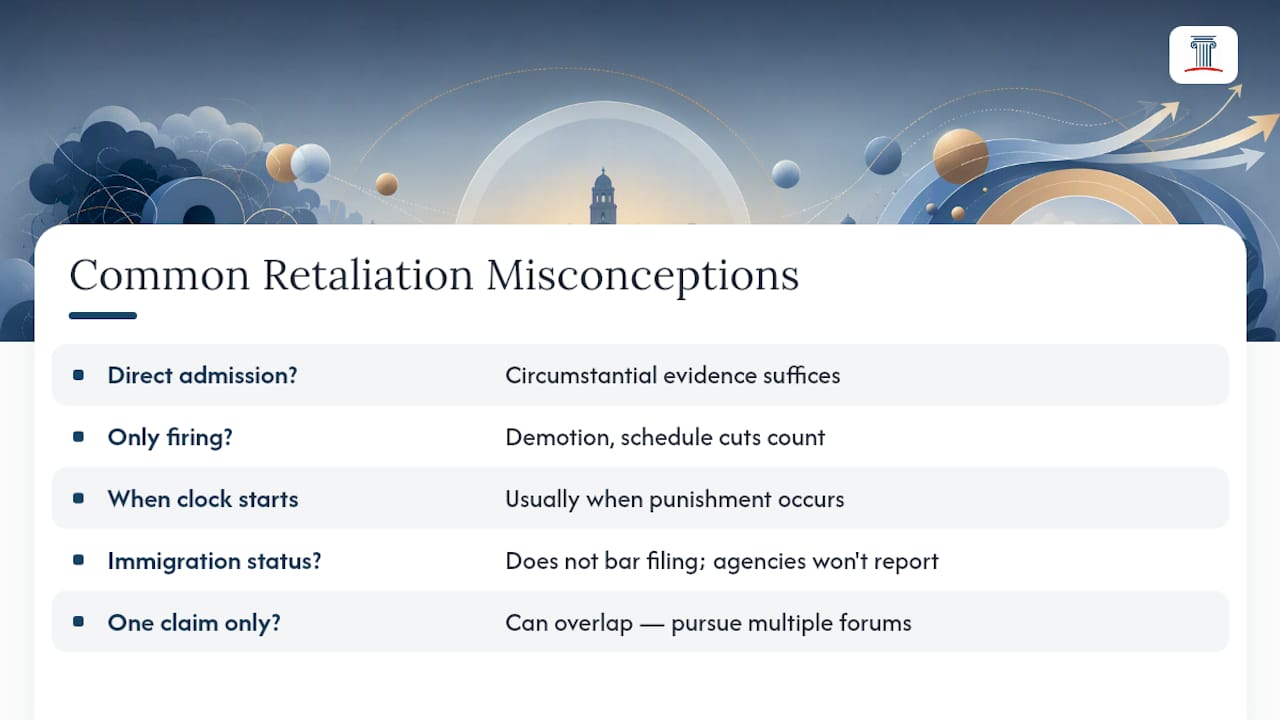
Immigration status does not bar you from filing. The Labor Commissioner’s own guidance confirms that agencies handling wage and safety retaliation complaints will not report immigration status and do not require a Social Security number to open a case. If your employer threatened to call immigration authorities after you complained, that threat itself may strengthen your retaliation claim rather than weaken it.
How Do You Document Retaliation to Prove Causation?
Proving retaliation almost always comes down to timing and paper trails. Investigators and judges look for a clear sequence: you did something protected, your employer knew about it, and then something bad happened to your job. Build that sequence deliberately.
- Write a dated timeline. Note the exact date you engaged in the protected activity, the date your supervisor or HR became aware of it, and the date of every adverse action that followed.
- Save every communication. Emails, text messages, Slack or Teams messages, and even voicemails can show intent or contradict your employer’s stated reason for the adverse action.
- Collect your employment records. Pay stubs, schedules, performance reviews, and any termination letter help establish what changed and when.
- Identify witnesses. Coworkers who saw the treatment shift or heard comments from a supervisor can corroborate your account.
- Separate direct from circumstantial evidence. A supervisor’s email saying “this is because you complained” is direct evidence. A sudden negative review two weeks after your complaint, with no prior write-ups, is circumstantial but still powerful.
Pro Tip: Write your notes the same day something happens, not weeks later. Contemporaneous notes carry far more weight than a reconstructed memory, and they’re harder for an employer’s attorney to challenge during a deposition.
Where Do You File a Retaliation Claim, and What Are the Deadlines?
Different agencies handle different types of retaliation, and each one runs on its own clock. Filing in the wrong place, or filing late, can cost you the claim entirely.
- California Civil Rights Department (CRD): Handles FEHA-based retaliation tied to discrimination, harassment, or accommodation requests. Filing is generally allowed within several years from the last adverse action, and you must receive a right-to-sue notice before filing a FEHA lawsuit in court.
- Labor Commissioner (DLSE): Handles wage-related retaliation, such as being fired for reporting unpaid overtime. The filing window is generally extended, allowing multiple years to file.
- Cal/OSHA: Handles retaliation for reporting workplace safety hazards. This deadline is shorter, typically about half a year from the adverse action.
- Workers’ Compensation Appeals Board (WCAB): Handles retaliation tied to filing a workers’ comp claim under Labor Code section 132a. The deadline is about one year.
A comparison of California filing deadlines shows just how much the clock varies by forum: FEHA and wage claims give you three years, while Cal/OSHA cuts that down to six months and WCAB claims to one year. Missing the shortest window while focused on the longest one is one of the most common ways employees lose a valid claim.
Mark the date of your adverse action, not the date of your original complaint, because most clocks start running from when the punishment occurred. If your situation involves overlapping issues, such as a safety complaint and a wage dispute, you may need to file with more than one agency to protect every angle of your case.
Agency Investigation or Private Lawsuit: What Should You Expect?
Filing with the CRD or DLSE starts an administrative process, not an automatic lawsuit. The CRD’s complaint process includes an intake interview, a jurisdictional review, and sometimes a full investigation before the agency issues a right-to-sue letter, which you need before taking a FEHA claim to court. DLSE investigations follow a similar pattern for wage retaliation, often ending in an order for back wages or penalties if the agency finds in your favor.
Remedies available through these processes, or through a private lawsuit, can include:
- Reinstatement to your former position
- Back pay and lost benefits
- Statutory penalties under the applicable Labor Code section
- Injunctive relief ordering the employer to stop the retaliatory conduct
- Recovery of attorneys’ fees in many cases
Agency caseloads can move slowly, and a private lawsuit sometimes offers broader discovery tools or faster relief depending on the facts of your case. That is one reason many employees consult an attorney before deciding whether to wait on an agency investigation or pursue litigation directly.
When Should You Contact an Employment Lawyer in La Habra?
Some situations call for legal advice immediately, not after you’ve already tried to handle things alone. Reach out to counsel right away if:
- You were just terminated and suspect it followed a complaint, accommodation request, or safety report
- A filing deadline, especially the six-month Cal/OSHA window, is approaching
- Your employer threatened your immigration status or your family after you spoke up
- Your case involves overlapping claims across CRD, DLSE, and Cal/OSHA, or a mix of discrimination and wage issues
An employment lawyer preserves evidence before it disappears, coordinates filings across multiple agencies so nothing slips through a procedural gap, and negotiates or litigates depending on what actually gets you the best outcome. You can seek legal assistance offering bilingual support, free consultations, and contingency-based representation in select employment matters, which means you can get an honest read on your case before committing to anything.
Are There Local Protections That Matter for La Habra Workers?
La Habra sits in Orange County, and while California’s state labor laws apply uniformly across every city named in this article, from Anaheim to Newport Beach, the local labor market shapes how retaliation cases actually play out here. La Habra’s economy leans heavily on retail, light manufacturing, and small to mid-size service businesses along Whittier Boulevard and Beach Boulevard, and those employers frequently operate with thin HR departments or none at all. That matters because smaller employers sometimes misunderstand their FEHA obligations, assuming rules that apply to large corporations don’t apply to them.
Orange County’s court system, including the Orange County Superior Court, handles FEHA lawsuits filed by La Habra employees once a right-to-sue notice issues from the CRD. Local wage claims typically route through the Labor Commissioner’s Santa Ana office, which serves much of northern and central Orange County. Knowing which office handles your paperwork saves time you don’t want to lose against a filing deadline.
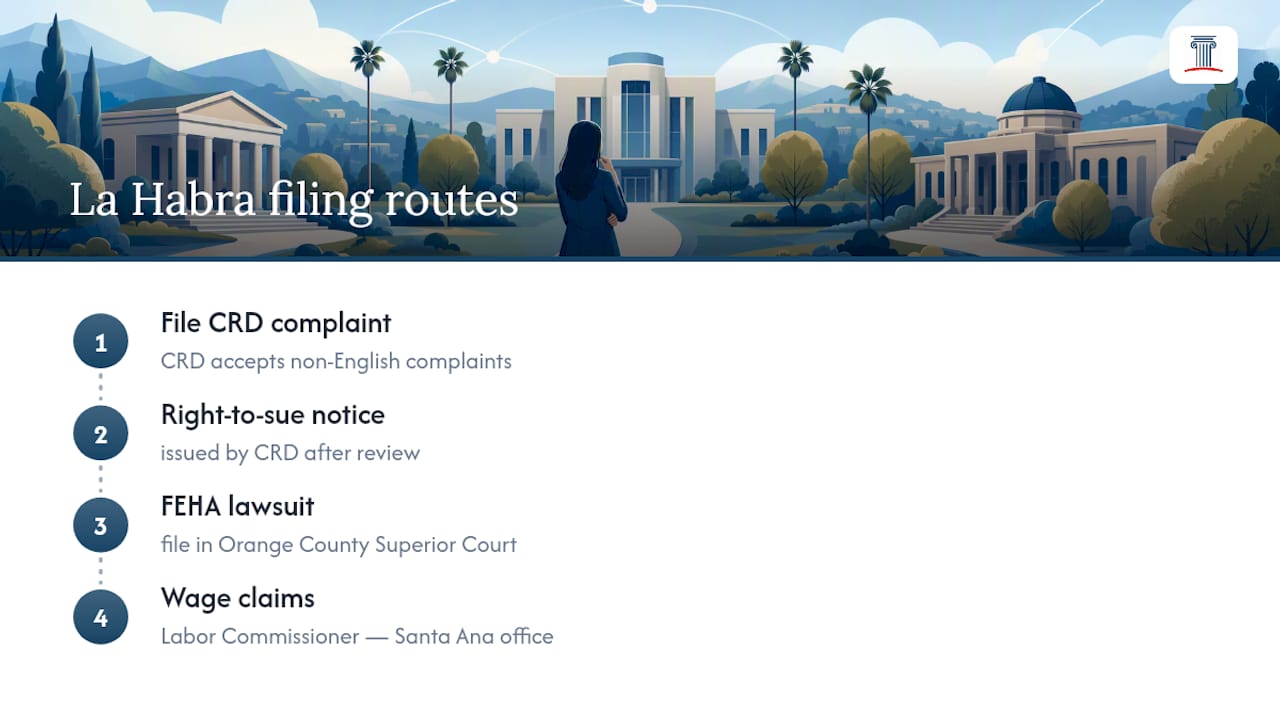
Bilingual workers in La Habra, where a significant share of residents speak Spanish at home, should know that language barriers create no exception to your rights. The CRD and DLSE both accept complaints from non-English speakers, and Serendib Law Firm’s bilingual capacity reflects a broader need across Orange County’s service and manufacturing workforce. If your employer used a language barrier to discourage you from complaining, that itself can become part of a retaliation claim, particularly if it happened right after you raised a concern.
What Are Employers Required to Do to Prevent Retaliation?
California places affirmative obligations on employers, not just prohibitions after the fact. Under FEHA, employers with five or more employees must maintain policies against discrimination and retaliation, distribute those policies to staff, and train supervisors on how to handle complaints without punishing the person who raised them.
Employers are also expected to investigate complaints promptly and keep the process reasonably confidential, rather than letting word spread through the office in a way that invites retaliation from coworkers or management. A written anti-retaliation policy that nobody follows offers little protection to the employer in a lawsuit. Courts and agencies look at what the company actually did after a complaint landed on someone’s desk, not just what the employee handbook says.
Employers who terminate or discipline a worker shortly after that worker’s protected activity carry a heavier burden of proof to show the decision was unrelated. Some California statutes create what amounts to a presumption of retaliation when the adverse action happens close in time to the protected activity, often cited around the 90-day mark. Employers who understand this tend to document performance issues carefully and consistently, well before any complaint ever surfaces, precisely because they know timing alone can sink their defense.
What Do People Get Wrong About Retaliation Claims?
A few misconceptions send employees down the wrong path before they ever reach an attorney.
“I have to prove my employer said it out loud.” Direct admissions are rare. Most retaliation claims succeed on circumstantial evidence: timing, inconsistent explanations, and a sudden shift in treatment that has no other reasonable cause.
“If I wasn’t fired, it’s not retaliation.” Demotions, schedule cuts, exclusion from projects, and even a transfer to a worse location can all qualify as adverse actions, even without a termination.
“The clock starts when I complained.” It almost always starts when the employer punished you, not when you spoke up. Confusing the two dates has cost employees valid claims that were filed too late under the wrong assumption.
“My immigration status disqualifies me.” It does not. State agencies confirm they will not question or report immigration status for people filing complaints.
“I can only file one type of claim.” Many situations involve overlapping violations, a safety complaint tangled up with a wage dispute, for example, and pursuing only one forum can leave real damages on the table.
Quick Next Steps for a La Habra Employee Who Suspects Retaliation
Start with four things: write down your timeline, calendar every relevant deadline, save every document and message tied to the situation, and talk to a lawyer before you assume your options are limited. Your immigration status will not block you from filing with the CRD or DLSE, and both agencies have processes built to protect that access. Waiting rarely helps a retaliation case. Acting early, while evidence is fresh and deadlines are still open, almost always does.
— Maya Serkova
How Serendib Law Firm Can Help La Habra Employees
Legal services provide La Habra employees a direct path to a California Employment Lawyer who understands how retaliation cases move through the CRD, the Labor Commissioner, and Cal/OSHA, without the runaround of a call center or a generic legal directory. Consultations are free, bilingual support is offered, and contingency-based representation is available in select employment matters, so cost doesn’t have to be the reason you delay calling.
Bring your timeline, any emails or texts related to the adverse action, your pay stubs or schedule records, and copies of any complaint you already filed. Legal counsel reviews those details to identify which agency deadlines apply to your situation and whether your facts support a stronger claim through a state agency, a private lawsuit, or both. If you’re weighing whether what happened to you crosses the legal line, reach out to Serendib Law Firm and get a straight answer before your filing window closes.
Official Resources for Filing and Verifying Deadlines
- CRD retaliation factsheet and intake process
- DLSE guidance on retaliation and how to file a complaint
- Relevant Labor Code sections covering wage, whistleblower, and safety retaliation
- CRD’s step-by-step complaint process
This article is general information, not a substitute for advice from a qualified lawyer. Consult a qualified legal professional about your own circumstances before acting on anything here.
Sources
- CRD Retaliation factsheet (2025)
- DLSE — Retaliation
- How to file a retaliation complaint (DLSE)
- How to file a retaliation complaint in California — Employment Law Aid
FAQ
How long do I have to file a retaliation claim in California?
It depends on the forum: generally three years for CRD (FEHA) and DLSE wage-related claims, six months for Cal/OSHA safety retaliation, and one year for WCAB workers’ comp retaliation claims.
Does my immigration status affect my right to file a complaint?
No. The Labor Commissioner and CRD both confirm they will not question or report immigration status, and you don’t need a Social Security number to file.
What’s the difference between the CRD and the Labor Commissioner?
The CRD handles retaliation tied to discrimination, harassment, or accommodation requests under FEHA, while the Labor Commissioner (DLSE) handles wage-related retaliation like being punished for reporting unpaid overtime.
Can I be fired for reporting a safety hazard at work?
No. Reporting an unsafe condition or refusing genuinely dangerous work is protected activity, and firing or demoting you for it can support a Cal/OSHA retaliation claim within the six-month filing window.
When should I talk to a California Employment Lawyer about retaliation?
Reach out as soon as you notice a pattern connecting your protected activity to an adverse action, especially if a filing deadline is approaching or your employer has threatened you.