
Audio summary
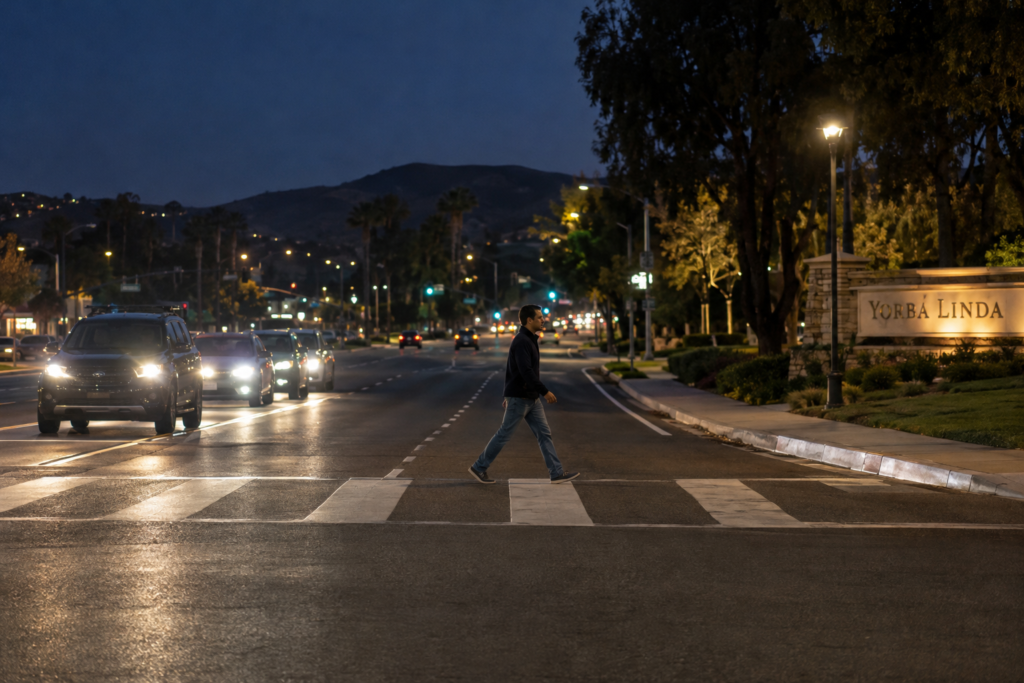
Being hit while walking at night in Yorba Linda is terrifying and confusing. Streetlights, crosswalk markings, driver speed, and even coordinated traffic signals along Imperial Highway and Yorba Linda Boulevard can all become critical pieces of evidence in a nighttime pedestrian injury claim. Understanding how that evidence works can help you protect your rights and your financial future. For background on Yorba Linda, see the Wikipedia article about Yorba Linda.
Why Nighttime Pedestrian Crashes Are Different in Yorba Linda
Nighttime changes how drivers and pedestrians interact on Yorba Linda’s main corridors. The city’s own collision analyses and traffic-safety materials recognize that fatigue, impaired driving, and darkness increase the risk of serious injuries for people walking, especially on higher-speed multi-lane roads. Local enforcement campaigns by the Orange County Sheriff’s Department have specifically focused on dangerous driver behaviors that endanger pedestrians at night.
In Yorba Linda, those risks are especially noticeable along busy arterials like Imperial Highway and Yorba Linda Boulevard, where signals are part of a coordinated regional system that can influence vehicle platooning and speeds. Residents also know that the intersection of Lakeview Avenue and Yorba Linda Boulevard has seen multiple recorded pedestrian crashes, and that gaps in sidewalks along stretches of Lakeview (now being addressed through a widening and sidewalk project) have historically pushed people to walk closer to traffic.
At the same time, Yorba Linda maintains a Street Lighting and Landscaping Maintenance District (LMAD), which funds and maintains portions of the city’s street lighting and signal infrastructure. That means the city itself can be a key player when nighttime lighting is inadequate or not maintained.
California Law: Duties Between Drivers and Pedestrians at Night
Even though visibility is reduced after dark, California law does not relax a driver’s responsibility to watch for pedestrians.
Driver duties under the basic standard of care
Judicial Council of California Civil Jury Instructions (CACI) No. 700 explains that drivers must use reasonable care when operating a vehicle. That includes:
- Keeping a proper lookout for pedestrians and obstacles in the road
- Keeping the vehicle under control at all times
- Using ordinary care to avoid injuring others in addition to obeying traffic laws
This duty applies day or night. A driver cannot excuse hitting a pedestrian by simply saying “it was dark” if a reasonably careful driver would have slowed down, used headlights properly, or paid closer attention to the roadway.
Rights of pedestrians in crosswalks
Under California law and jury instructions on crosswalk duties (such as CACI 710), there is a legal crosswalk at every intersection, whether it is marked with paint or unmarked. The California Driver Handbook and law-enforcement training materials stress that:
- Drivers must yield the right of way to pedestrians in marked or unmarked crosswalks at intersections
- Drivers must use due care for pedestrian safety even if they mistakenly think a person is “jaywalking” at an unmarked intersection
- Pedestrians still must use reasonable care for their own safety, but their presence in a crosswalk triggers a strong duty on drivers
This is important for Yorba Linda crossings where paint has faded or where intersections along Yorba Linda Boulevard or Lakeview Avenue do not have high-visibility markings. Even at those locations, the law may still treat the area as a crosswalk.
Crossing outside crosswalks and “jaywalking” at night
California Vehicle Code § 21954 addresses pedestrians outside crosswalks. It states that when people cross the road outside a marked or unmarked intersection crosswalk, they must yield to vehicles that are an immediate hazard. But the statute also makes clear that this does not relieve drivers of their continuing duty to exercise due care for pedestrians’ safety.
In other words, even if you were crossing mid-block in Yorba Linda, the driver still had a legal duty to keep a lookout and take reasonable steps to avoid hitting you. Nighttime darkness does not erase that responsibility.
How Lighting and Visibility Evidence Helps Prove Fault
Lighting and visibility are central in many nighttime pedestrian injury claims. California cases recognize that headlight and streetlight conditions matter when deciding whether a driver was negligent. In one appellate decision, the court discussed how headlight requirements are designed both to help drivers see pedestrians and to warn pedestrians of approaching vehicles, and it considered how dark it was and how visible the pedestrian would have been at a short distance.
Street lighting and dark spots
Evidence about local lighting can help show whether a reasonable driver should have seen you in time to avoid the crash. A Yorba Linda claim might look at:
- Whether nearby streetlights were working or burned out
- How much of the roadway the lights actually illuminated
- Whether tree canopies or other obstructions blocked the light
- Whether the area had a history of collisions or safety complaints
Because Yorba Linda’s LMAD is responsible for maintaining certain streetlights and traffic signals, maintenance records, inspection logs, and prior complaints can be important evidence if a crash occurred in a poorly lit section of road the city controlled.
Headlights and vehicle lighting
Courts and safety experts also look at vehicle lighting. At night, a driver’s headlights should:
- Illuminate enough of the roadway ahead to detect pedestrians in time
- Be used on appropriate settings (e.g., low vs. high beam) for conditions
- Be in proper working order and not obscured by damage or modifications
In some claims, crash reconstruction experts measure how far a particular type of headlight illuminates and compare that with where the pedestrian was standing or walking. When a driver is going too fast for the distance illuminated by their headlights, it supports an argument that they failed to use reasonable care.
Photos, video, and on-site measurements
Photos or video of the crash location taken around the same time of night can show a jury exactly how dark the scene was. Investigators may also take measurements such as:
- The exact locations of streetlights, traffic signals, and reflective signs
- Distances between crosswalks, corners, and the point of impact
- The length of the driver’s headlight beam at low and high settings
- Visibility of clothing or reflective gear at various distances
All of this helps answer a key question: under those specific nighttime conditions, would a reasonably careful driver in Yorba Linda have seen the pedestrian in time to slow or stop?
Using Crosswalk and Roadway Design Evidence
Crosswalk placement, markings, and roadway design also affect nighttime safety. California guidance on pedestrian facilities discusses treatments like better lighting, Rectangular Rapid Flashing Beacons (RRFBs), and High-Intensity Activated crossWalK (HAWK) signals at higher-risk crossing locations. Yorba Linda’s traffic safety study materials specifically mention nighttime risk factors and these types of improvements as potential tools to reduce injuries.
Marked vs. unmarked crosswalks at Yorba Linda intersections
In many parts of Yorba Linda, especially along Yorba Linda Boulevard and in central areas near Lakeview Avenue, some intersections have fully marked crosswalks with stop bars and signals, while others are unmarked. Yet California law still treats every intersection as having a legal crosswalk unless specifically closed.
Evidence here can include:
- Intersection diagrams and signal timing information from the city
- Photographs showing whether crosswalk markings were faded or missing
- Any pending capital improvement plans for that intersection
- Whether RRFBs, HAWKs, or extra lighting had been considered or installed
For example, if you were struck near Lakeview Avenue and Yorba Linda Boulevard at a corner that functions as an intersection but lacks highly visible markings, evidence about that design can support arguments that motorists should still have anticipated pedestrians in that legal crosswalk.
Local capital projects and known dangers
Current capital improvement work in Yorba Linda includes a Lakeview Avenue widening project between Oriente Drive and Bastanchury Road that will add a sidewalk and shared bike lane to complete pedestrian connectivity. Public documents like these, along with collision maps showing crash clusters, can help show when the city already knew a location posed risks to pedestrians, particularly at night.
If your crash occurred in an area that appears in prior collision analysis or along a corridor flagged for pedestrian improvements, those facts can matter in evaluating whether the municipality reasonably addressed known hazards.
Speed Evidence in Nighttime Pedestrian Injury Claims
Speed is often the other half of the visibility equation. A driver may claim they were going “under the speed limit,” but California negligence principles focus on whether the speed was reasonable for the conditions, including darkness.
Why “too fast for conditions” matters at night
Crash reconstruction and safety analysis draw on the idea that a driver must be able to stop within the distance they can see ahead—often termed an “assured clear distance ahead.” This concept, discussed in traffic-safety literature, ties together:
- Headlight range: how far the lights realistically illuminate the road
- Reaction time: how quickly a driver can respond to a visible hazard
- Stopping distance: the distance needed to brake to a complete stop
If a driver speeds along a dark stretch of Imperial Highway where their headlights only illuminate a limited distance, they may simply not have enough room to stop when a pedestrian becomes visible. That can be negligent even if the posted limit is higher.
Sources of objective speed data
In Yorba Linda nighttime pedestrian claims, attorneys may seek objective speed and movement evidence, such as:
- Police collision-reconstruction reports and diagrams
- Skid or yaw marks on the pavement and their measured lengths
- Event data recorder (EDR) downloads from the vehicle
- GPS or telematics data from rideshare, delivery, or fleet vehicles
This data can support expert opinions that the driver was traveling too fast to stop within the distance illuminated by their headlights, which strengthens your case that they failed to use reasonable care under nighttime conditions.

Evidence Checklist: What Helps Prove a Nighttime Claim
Successful nighttime pedestrian cases are evidence-intensive. The goal is to tie together lighting, crosswalk status, speed, and your injuries into a clear picture of what happened and why the driver (and possibly the city) should be held responsible.
| Evidence Type | Examples | Why It Matters at Night |
|---|---|---|
| Scene and lighting | Photos/video at same time of night; notes on working or broken streetlights; positions of signals and signs | Shows how visible you were and whether a careful driver should have seen you |
| Crosswalk and roadway design | Intersection diagrams; crosswalk markings; traffic-signal timing; collision maps; capital improvement plans | Helps prove you were in a legal crosswalk or foreseeable pedestrian path and whether the area was a known problem |
| Vehicle and speed | EDR data; skid marks; GPS logs; vehicle inspection; headlight condition | Supports arguments that the driver was going too fast for nighttime visibility and failed to maintain control |
| Law enforcement and witnesses | Police reports; citations; officer measurements; statements from bystanders or nearby businesses | Provides neutral observations about lighting, signals, driver behavior, and where you were walking |
| Medical and work records | ER records; imaging reports; treating-physician notes; timesheets; pay stubs; employer correspondence | Proves the extent of your injuries and links them to wage loss and time off work |
Step-by-Step: What to Do After a Nighttime Pedestrian Crash
If you are struck while walking at night in Yorba Linda, it is common to feel overwhelmed. When you are able, the following steps can help protect both your health and your legal claim.
- Get immediate medical care. Call 911 or go to the nearest emergency room or urgent care, even if you think your injuries are minor. Some serious conditions are not obvious right away, and prompt treatment creates important medical records.
- Call law enforcement. Ask that an officer respond and prepare a collision report. The Orange County Sheriff’s Department or CHP can document the driver’s information, witness names, lighting conditions, and apparent injuries at the scene.
- Capture the scene, if you safely can. Take photos or a short video of the area from different angles, making sure to include streetlights, traffic signals, crosswalk markings (or lack of them), and any nearby businesses or homes that may have security cameras.
- Gather contact information. Collect names and phone numbers for witnesses, nearby business owners or managers, and the driver. Note license plate numbers and insurance information.
- Preserve your clothing and personal items. Do not wash or throw away clothing or shoes worn during the crash; they may later help show visibility, points of impact, or blood patterns. Keep broken glasses, phones, or other damaged items in a safe place.
- Notify your employer. Let your employer know if you will miss work or need modified duties because of your injuries. Save all emails, texts, timesheets, and pay stubs that reflect schedule or income changes.
- Speak with a pedestrian accident attorney. Before giving detailed recorded statements or accepting a settlement, consider talking with a lawyer who handles pedestrian injury cases in Yorba Linda and understands both personal injury and employment-related wage-loss issues.
Connecting Your Injuries to Wage Loss and Time Off Work
For many nighttime pedestrian victims, the immediate worry is paying bills while recovering. An employment-focused firm like Serendib Law Firm can help connect the dots between your physical injuries and the impact on your job.
Medical documentation of work restrictions
Medical records are the backbone of a wage-loss claim. They can include:
- Diagnosis of fractures, soft-tissue injuries, or head trauma
- Functional limitations (e.g., no standing more than 30 minutes, no lifting over 10 pounds)
- Treatment plans and expected recovery timelines
- Recommendations for time off or reduced hours
These details help explain why you could not return to your job or had to reduce your hours after the crash.
Employer records and economic impact
To prove how the injury affected your paycheck, attorneys often combine medical records with:
- Timesheets showing missed shifts or reduced hours
- Pay stubs from before and after the collision
- Attendance logs or HR correspondence about leave or accommodations
- Information about lost bonuses, overtime, or advancement opportunities
In more serious cases, vocational or economic experts may help explain how long-term limitations will affect your earning capacity. This is especially important if you work in a physically demanding job and a leg, back, or head injury keeps you from returning to the same role.
When Municipal Liability May Be Part of a Yorba Linda Claim
Not every nighttime pedestrian crash is solely the driver’s fault. In some situations, the condition of public property—such as street lighting, crosswalk placement, or missing sidewalks—may also play a role.
Attorneys evaluating possible municipal liability in Yorba Linda may investigate whether:
- The city had prior notice of a dangerous crossing through crash data or citizen complaints
- Traffic studies identified the location as high-risk, especially at night
- The city had planned (but not yet completed) improvements like added lighting, RRFBs, or HAWKs at that spot
- The LMAD or other city programs were specifically responsible for the lighting or signal equipment at issue
Publicly available collision analyses, capital improvement project listings, and traffic-signal coordination documents can be key sources in these investigations. Strict time limits and procedural rules often apply to claims against public entities, so it is important to bring potential municipal issues to an attorney’s attention early.
How Serendib Law Firm Approaches Yorba Linda Nighttime Pedestrian Cases
Serendib Law Firm represents injured pedestrians throughout Orange County, including Yorba Linda. With an office in nearby Orange, the firm is familiar with the local roadway network and the types of nighttime conditions that can contribute to serious injuries along Imperial Highway, Yorba Linda Boulevard, and local collector streets.
In a nighttime pedestrian case, the firm may:
- Obtain and scrutinize police reports, scene photos, and collision diagrams
- Work with experts to analyze lighting, visibility, and driver speed
- Request city records on street lighting, traffic signals, and prior collisions
- Coordinate medical and employment documentation to fully present your wage-loss and future-earning claims
If you want to understand more about how pedestrian claims work beyond nighttime crashes, you can review the firm’s general Pedestrian Accidents page. If your injuries are part of a broader pattern of workplace disruption, the firm’s Experienced Yorba Linda Employment Law Attorneys page explains how they approach job-related disputes. For non-pedestrian traffic cases, you can also explore their Car Accidents and Experienced Yorba Linda Personal Injury Lawyers resources.
Disclaimer
This article provides general information about nighttime pedestrian injury claims in Yorba Linda and is not legal advice for your specific situation. Laws and procedures can be complex, especially where visibility, roadway design, or potential municipal liability are involved. Reading this page does not create an attorney–client relationship with Serendib Law Firm. You should consult an attorney licensed in California to obtain advice tailored to your circumstances.
FAQ: Nighttime Pedestrian Injury Claims in Yorba Linda
Does it hurt my case if I was wearing dark clothing?
Wearing dark clothing at night is one factor insurance companies like to point to, but it does not automatically defeat your claim. California drivers still have a duty to use reasonable care, keep a lookout for pedestrians, and adjust their speed to nighttime conditions. Evidence about street lighting, headlight range, driver speed, and where you were walking can show that a reasonably careful driver should have seen you in time even if your clothing was not reflective.
What if the driver says I was “jaywalking”?
First, you may not actually have been jaywalking. California law recognizes a legal crosswalk at every intersection, marked or unmarked, and drivers must yield and use due care for pedestrians there. Even if you were crossing mid-block, Vehicle Code § 21954 states that drivers still have a duty to exercise due care for pedestrian safety. Your attorney will look closely at intersection layouts, crosswalk status, and where you entered the roadway before accepting the driver’s characterization.
Can I bring a claim if a bad streetlight contributed to the crash?
Possibly. Yorba Linda’s Street Lighting and Landscaping Maintenance District and other city programs manage many local lights and signals. If a non-functioning or poorly placed streetlight contributed to your injuries, your attorney may investigate whether the city had notice of the issue, how long it existed, and whether it had been flagged in collision studies or public complaints. Claims involving public entities follow special rules and time limits, so it is important to raise this issue with counsel as soon as you can.
How do I prove the driver was going too fast for nighttime conditions?
Proof of unsafe speed often comes from a combination of sources: police reports, skid or yaw marks on the road, data from the vehicle’s event data recorder, and GPS or telematics from rideshare or delivery services. Experts can interpret this information in light of the roadway’s lighting and visibility to show that the driver could not stop within the distance their headlights illuminated, supporting a finding of negligence.
Will my lost wages be covered if I have to miss work?
Lost wages are a standard category of damages in California personal injury cases. To support them, you will generally need medical documentation of your restrictions along with employer records like timesheets, pay stubs, and HR correspondence. In more serious cases, vocational or economic experts may be needed to explain long-term impacts on your earning capacity. A firm that understands both personal injury and employment issues can help coordinate this evidence.
Where can I learn more about California rules for drivers and pedestrians?
The California Driver Handbook published by the Department of Motor Vehicles discusses laws and rules of the road, including the duties drivers owe to pedestrians and the right of way in marked and unmarked crosswalks. Reviewing those sections can give you a clearer sense of the standards that apply to drivers who hit pedestrians at night.