
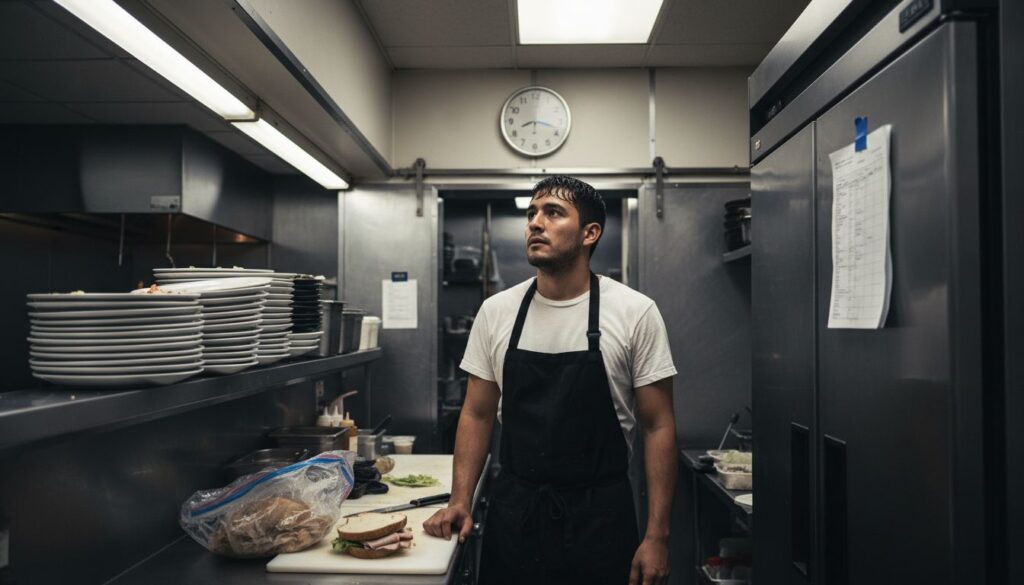
Over one million American workers face penalties and lost wages each year due to missed or improper meal breaks. California sets some of the most detailed employee meal break rules in the country, directly affecting how employers operate and protect their staff. Knowing these laws can help both employees and businesses avoid costly mistakes and ensure everyone’s rights are respected.
Table of Contents
- California Meal Break Laws Defined
- Key Meal Break Requirements For Restaurants
- Legal Obligations For Santa Ana Employers
- Consequences Of Failing To Provide Breaks
- Steps For Employees To Enforce Rights
Key Takeaways
| Point | Details |
|---|---|
| Meal Break Entitlement | Employees are entitled to a 30-minute unpaid meal break after working more than five consecutive hours, provided before the fifth hour ends. |
| Duty-Free Requirement | Employers must ensure breaks are completely duty-free, without employee duties, and cannot discourage taking these breaks. |
| Penalties for Violations | Employers may incur financial penalties, including one hour of pay for each missed meal break, and further legal repercussions for repeated violations. |
| Employee Rights Enforcement | Employees should document missed breaks and can file complaints or pursue legal action to enforce their rights under California law. |
California Meal Break Laws Defined
California employment law establishes clear guidelines for employee meal breaks, protecting workers’ rights across various industries. Meal and rest break regulations in the state mandate specific requirements that employers must follow to ensure workers receive adequate time for rest and meals during their shifts.
Under California law, employees are entitled to a 30-minute unpaid meal break when working more than five consecutive hours in a workday. This meal period must be provided no later than the end of the employee’s fifth hour of work. Employers must relieve employees of all work duties during this break, allowing them to leave the workplace if they choose. If an employee works no more than six hours in a day, they can mutually agree with their employer to waive the meal break requirement.
The legal landscape for meal breaks becomes more complex in specific industries like construction and restaurant work. For shifts longer than ten hours, employees are entitled to a second 30-minute meal break. Failure to provide these mandated breaks can result in significant financial penalties for employers, including one additional hour of pay at the employee’s regular rate for each day a compliant meal break is not provided.
Key aspects of California meal break laws include:
- 30-minute unpaid break for shifts over 5 hours
- Break must be duty-free and uninterrupted
- Employers cannot discourage or prevent employees from taking mandated breaks
- Employees can choose to waive breaks under specific conditions
- Penalties apply for consistent meal break violations
Key Meal Break Requirements for Restaurants
Restaurant meal break regulations in California impose strict guidelines designed to protect worker rights and ensure fair labor practices. Restaurant employers must carefully navigate complex meal break requirements that mandate specific protocols for scheduling and documenting employee breaks.
According to California labor regulations, restaurant workers are entitled to a 30-minute unpaid meal break when working more than five consecutive hours in a shift. This mandatory break must be provided no later than the end of the employee’s fifth hour of work. Restaurant managers must ensure employees are completely relieved of all work duties during this break, allowing them the freedom to leave the workplace if they choose. The break can be waived only under specific conditions, such as when an employee works six hours or less and mutually agrees to skip the meal period.
The complexity of meal break requirements becomes particularly pronounced in restaurant settings. Shifts longer than ten hours require a second 30-minute meal break, and failure to comply can result in significant financial penalties. Restaurants may be required to pay one additional hour of wages at the employee’s regular rate for each day a compliant meal break is not provided. This means a single missed or improperly documented meal break can quickly become a costly compliance issue for restaurant operators.
Key meal break requirements for restaurant workers include:
- 30-minute unpaid break for shifts exceeding 5 hours
- First meal break must occur before the end of the fifth working hour
- Second meal break required for shifts longer than 10 hours
- Breaks must be completely duty-free
- Employees cannot be discouraged from taking mandated breaks
- Precise documentation of break times is crucial
- Penalties apply for consistent or intentional meal break violations
Legal Obligations for Santa Ana Employers
Employers in Santa Ana face specific legal requirements when it comes to meal and rest breaks, with strict compliance standards mandated by California labor regulations. Workplace break laws impose significant responsibilities on businesses to protect employee rights and ensure fair working conditions.
Meal break regulations require Santa Ana employers to provide a 30-minute unpaid, duty-free meal period for employees working more than five consecutive hours. This mandatory break must be provided before the end of the employee’s fifth hour of work, with specific provisions for waiving the break under certain conditions. Employers cannot discourage employees from taking their legally mandated breaks, and they must create a work environment that allows workers to step away from their duties during the designated break time.

The legal consequences of failing to provide proper meal breaks can be substantial. Santa Ana employers may be required to pay one additional hour of wages at the employee’s regular rate for each day a compliant meal break is not provided. This means that even a single missed or improperly documented break can result in significant financial penalties. Employers must maintain accurate records of meal breaks and ensure that employees have genuine opportunities to take their mandated rest periods without interference or pressure.
Key legal obligations for Santa Ana employers include:
- Providing 30-minute unpaid meal breaks for shifts over 5 hours
- Ensuring breaks are completely duty-free
- Allowing employees to leave the workplace during break times
- Maintaining accurate break time documentation
- Avoiding any discouragement of mandated break periods
- Paying additional compensation for missed or interrupted breaks
- Implementing clear policies that support employee break rights
Consequences of Failing to Provide Breaks
Employers who neglect mandatory meal break requirements face serious legal and financial repercussions that can significantly impact their business. Meal break violations can trigger extensive legal challenges that extend far beyond simple monetary penalties, potentially threatening an organization’s entire operational stability.
Under California law, employers who fail to provide required meal breaks may incur substantial financial penalties, including paying one additional hour of wages at the employee’s regular rate for each meal break violation. These penalties can quickly accumulate, transforming what might seem like a minor oversight into a significant financial burden. The Private Attorneys General Act (PAGA) allows employees to sue on behalf of themselves and other similarly situated workers, which dramatically increases the potential legal exposure for non-compliant employers.
The consequences of meal break non-compliance extend beyond immediate financial penalties. Repeated violations can result in government investigations, workplace audits, and potential civil litigation. Employers might face reputational damage, increased scrutiny from labor authorities, and potential class-action lawsuits that can drain organizational resources. Moreover, employees who successfully prove systematic meal break violations may be entitled to back wages, additional compensation, and legal fee reimbursement.
Key potential consequences for employers include:
- One hour of additional pay for each meal break violation
- Potential PAGA lawsuit exposing the company to broader legal action
- Significant financial penalties accumulating over time
- Increased government workplace investigations
- Potential class-action litigation risks
- Reputational damage and loss of employee trust
- Legal fees and potential settlement costs
Steps for Employees to Enforce Rights
Employees facing meal break violations have several powerful legal strategies to protect their workplace rights and seek appropriate compensation. Navigating employee rights requires strategic and informed action to effectively challenge meal break non-compliance.
The first critical step is documenting every instance of missed or interrupted meal breaks. Employees should maintain a detailed record including dates, times, duration of work periods, and specific circumstances of each missed break. This documentation serves as crucial evidence if legal action becomes necessary. Employees can request copies of their time records from their employer, which can help substantiate claims of systematic meal break violations.
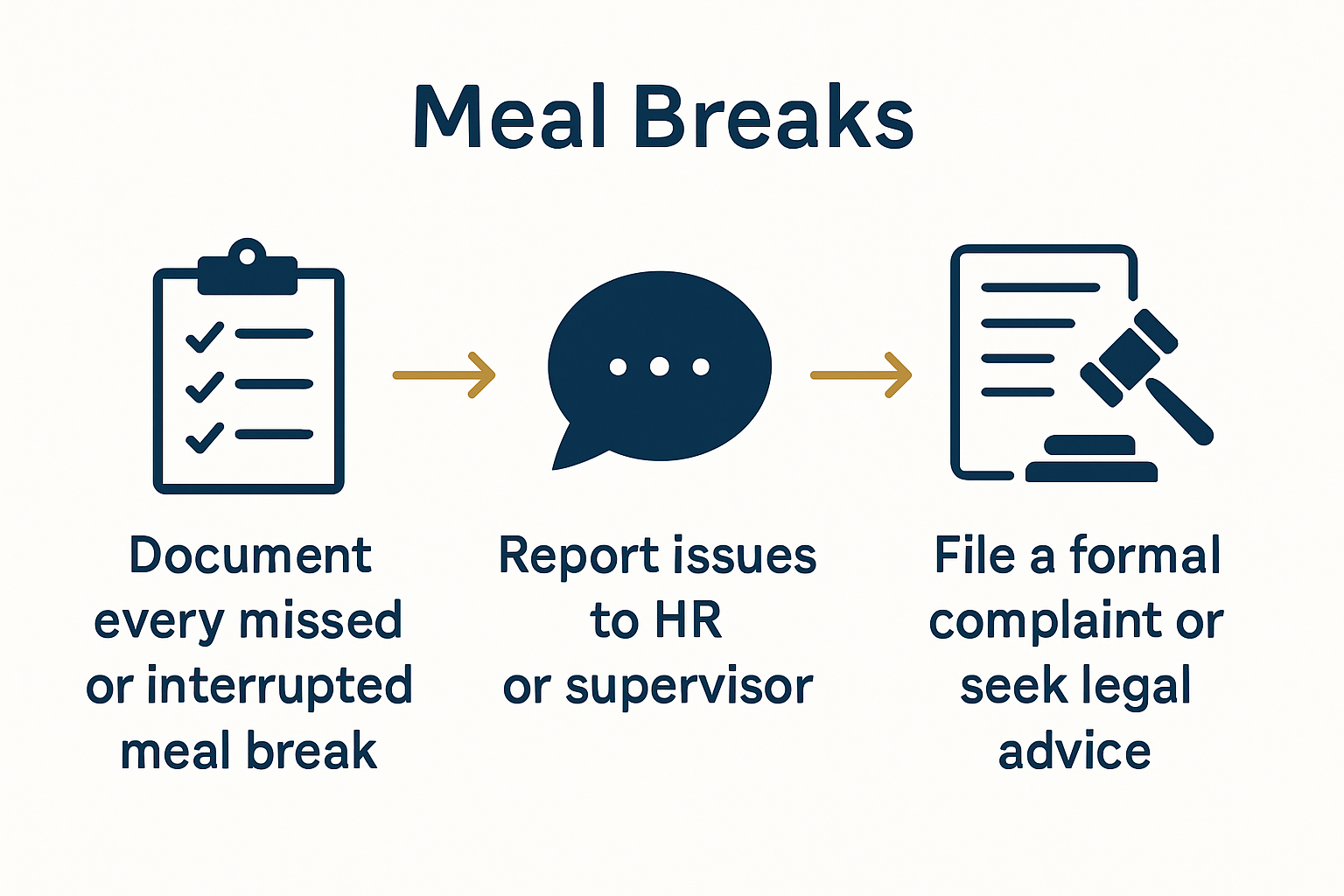
Employees have multiple avenues for enforcing their meal break rights. They can file a wage claim with the California Labor Commissioner’s Office, which investigates potential labor law violations. Alternatively, they can pursue a Private Attorneys General Act (PAGA) lawsuit, allowing them to sue on behalf of themselves and other similarly situated workers. In some cases, employees might choose to file a civil lawsuit directly against their employer to recover unpaid wages, penalties, and potential additional compensation.
Key steps for employees to enforce their meal break rights include:
- Document every missed or interrupted meal break
- Request and review time records from the employer
- File a wage claim with the Labor Commissioner’s Office
- Consider a PAGA lawsuit for broader workplace protection
- Consult with an employment law attorney for personalized guidance
- Preserve all relevant employment documentation
- Be prepared to provide detailed evidence of violations
Protect Your Rights When Employers Fail to Provide Meal Breaks in Santa Ana
If you are facing challenges because your employer is not providing the legally required meal breaks, you are not alone. California law clearly states your entitlement to uninterrupted, duty-free 30-minute meal breaks during shifts over five hours. Employers who ignore these rules put you at risk of wage violations and lost break times. Understanding your rights and the consequences employers face can empower you to take action and protect yourself.
Do not wait for these violations to impact your well-being or income further. Our experienced team at Serendib Law Firm is dedicated to fighting for employees like you across Orange County. Visit our Meal and Rest Breaks Archives | Serendib Law Firm and Wage Violations Archives | Serendib Law Firm to learn more about your rights and legal options. Contact us through https://serendiblaw.com now for a free consultation and assert your right to fair treatment at work.
Frequently Asked Questions
What are the meal break laws for employees?
Employees in California are entitled to a 30-minute unpaid meal break when working more than five consecutive hours. This break must occur before the end of the fifth working hour.
What happens if an employer fails to provide a meal break?
Employers who fail to provide required meal breaks must pay one additional hour of wages at the employee’s regular rate for each day a compliant meal break is not provided.
Can employees waive their meal break?
Yes, employees can waive their meal break if they work no more than six hours in a day and both the employee and employer mutually agree to the waiver.
What steps can employees take if their meal break rights are violated?
Employees should document missed meal breaks, request time records from their employer, and can file a wage claim with the California Labor Commissioner’s Office or consider pursuing a PAGA lawsuit to seek compensation.