
Retail workers at Starbucks and Target in Tustin recently brought workplace scheduling practices into the spotlight through viral social media complaints. Many employees expressed confusion about their legal protections and what recourse they have when facing unfair scheduling. California labor law provides robust protections for retail workers dealing with scheduling disputes, but understanding these rights requires knowing which laws apply and how to enforce them. This article explains your rights as a retail employee in Southern California, covering scheduling protections, retaliation safeguards, and practical steps to assert your workplace rights when employers violate the law.
Table of Contents
- Key takeaways
- Understanding California scheduling laws for retail workers
- Protections against retaliation for reporting scheduling complaints
- Scheduling disputes at Starbucks and Target in Tustin: What employees need to know
- How to assert your rights and seek legal support in scheduling disputes
- How Serendib Law Firm supports Tustin retail workers with employment law issues
- Frequently asked questions
Key Takeaways
| Point | Details |
|---|---|
| Scheduling protections | California law sets minimum standards for retail schedules including meal and rest breaks, reporting time pay, and predictability rules. |
| Retaliation safeguards | It is illegal for employers to punish workers who raise scheduling concerns or report violations. |
| Legal remedies | Employees have options such as filing complaints with state agencies or pursuing legal action to enforce scheduling protections. |
| Keep records | Detailed records of posted schedules, hours worked, and communications help prove violations and support remedies. |
Understanding California scheduling laws for retail workers
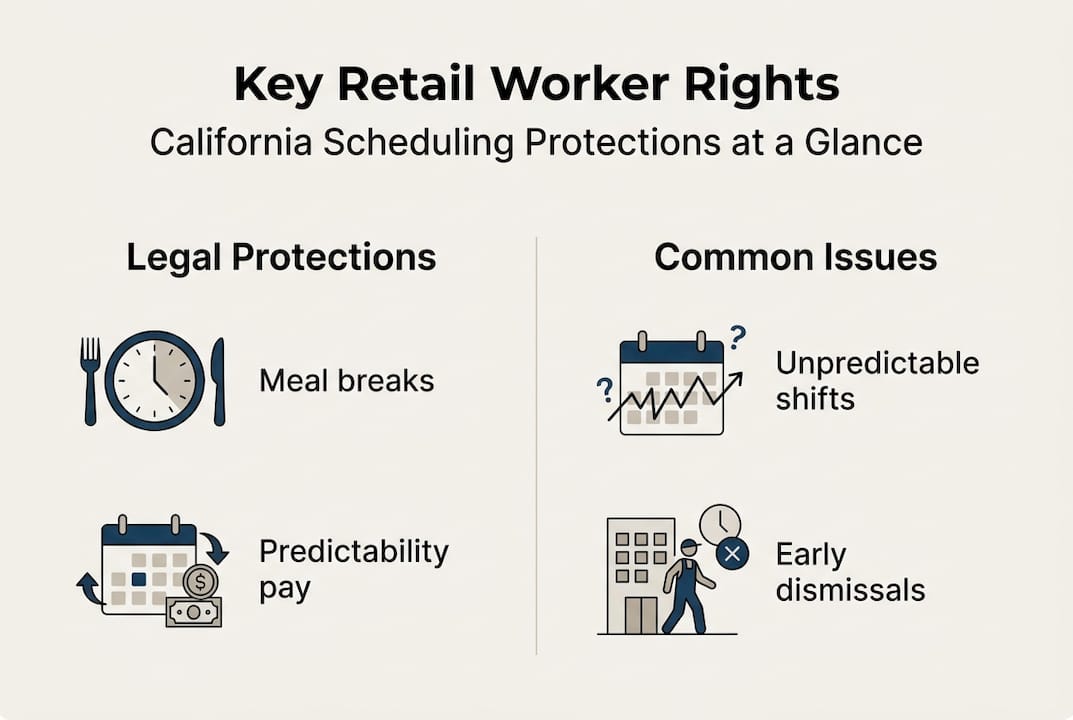
California has established comprehensive labor protections that directly impact how retail employers schedule workers. California labor codes regulate scheduling and protect retail workers in companies like Starbucks and Target, setting minimum standards that employers must follow. These laws cover meal breaks, rest periods, reporting time pay, and predictability requirements that affect your daily work schedule.
Retail employees working shifts longer than five hours must receive a 30-minute unpaid meal break. If your shift exceeds ten hours, you are entitled to a second meal period. Employers who fail to provide these breaks must pay one additional hour of wages at your regular rate for each violation. Rest breaks operate differently, with employees receiving paid 10-minute breaks for every four hours worked or major fraction thereof.
Reporting time pay protects workers who show up for scheduled shifts but get sent home early. When you report to work as scheduled but your employer provides less than half your usual shift, you must receive pay for at least half your scheduled time, with a minimum of two hours and maximum of four hours. This protection prevents employers from calling you in for short periods without adequate compensation.
Predictability pay requirements under certain local ordinances require employers to compensate workers when schedules change with insufficient notice. While not all California cities have adopted these rules, the principle reflects growing recognition that last-minute schedule changes impose real costs on workers. Employers must compensate pay discrepancies when making significant alterations to posted schedules.
Pro Tip: Keep detailed records of your posted schedules, actual hours worked, and any communications about schedule changes. Photograph posted schedules with your phone and save text messages or emails from managers. This documentation becomes critical evidence if you need to prove violations later.
Common violations at retail chains include:
- Scheduling shifts without required rest breaks between closing and opening
- Changing schedules with less than required notice
- Failing to pay reporting time when sending workers home early
- Denying meal breaks during busy periods
- Retaliating against workers who request schedule accommodations
| Violation type | Legal requirement | Common employer excuse |
|---|---|---|
| Meal breaks | 30 minutes for 5+ hour shifts | “Too busy to cover breaks” |
| Rest breaks | 10 minutes paid per 4 hours | “Step away when you can” |
| Reporting time pay | Minimum 2 hours if sent home | “Business was slow” |
| Schedule changes | Adequate notice required | “Needs of the business” |
Understanding these baseline protections helps you recognize when your employer crosses legal boundaries. The next section explains what happens when you speak up about these violations.
Protections against retaliation for reporting scheduling complaints
California law strongly prohibits employer retaliation against workers who assert their scheduling rights or report violations. Whistleblower laws protect retail employees reporting unfair scheduling practices in Tustin, making it illegal for employers to punish workers who complain about labor law violations. These protections apply whether you report issues internally to management or file formal complaints with government agencies.
Retaliation takes many forms beyond outright termination. Employers may reduce your hours, assign less desirable shifts, deny promotion opportunities, subject you to increased scrutiny, or create hostile work conditions. Any adverse employment action taken because you complained about scheduling practices constitutes illegal retaliation. The law protects both formal complaints and informal objections to supervisors.
The timing of adverse actions matters significantly in retaliation cases. When an employer takes negative action shortly after you complain about scheduling violations, this temporal proximity creates strong evidence of retaliation. Courts recognize that employers rarely admit retaliatory motives, so circumstantial evidence like suspicious timing becomes crucial.
Legal protections for retail workers extend to group complaints and collective action. When multiple employees raise concerns about scheduling practices, employers cannot single out perceived leaders for punishment. This protection encourages workers to address systemic problems together rather than suffering violations in isolation.
Pro Tip: Report scheduling violations in writing whenever possible. Send emails to your supervisor or HR department clearly stating the specific problem and requesting correction. Keep copies of all communications. If you must complain verbally, follow up with a written summary confirming what you discussed. Written records establish clear timelines if retaliation occurs.
Recognizing retaliation requires attention to these warning signs:
- Sudden negative performance reviews after complaining
- Schedule changes that make your shifts less desirable or predictable
- Exclusion from meetings, training, or opportunities previously available
- Increased monitoring or discipline for minor issues overlooked before
- Hostile comments from supervisors about being “difficult” or “not a team player”
Document every instance of potential retaliation with dates, times, witnesses, and specific details about what occurred. Note how the treatment differs from your experience before complaining and how similarly situated coworkers are treated. This evidence becomes essential when consulting with an employment attorney about your legal options.
If you experience retaliation, act quickly. California has specific deadlines for filing retaliation claims, and waiting too long can forfeit your rights. Consult an employment lawyer promptly to understand your options and preserve your ability to seek remedies. The next section examines how these protections apply specifically to Starbucks and Target workers involved in the Tustin complaints.
Scheduling disputes at Starbucks and Target in Tustin: What employees need to know
The viral complaints from Starbucks and Target workers in Tustin highlight scheduling challenges common across retail chains. Legal protections are strongly relevant to employees at Starbucks and Target facing scheduling disputes in Tustin, with precedents from similar cases at other major employers providing guidance on worker rights. Understanding how California law applies to your specific situation helps you evaluate whether your employer’s practices violate your rights.

Starbucks workers commonly face challenges with unpredictable schedules posted with minimal advance notice, making it difficult to arrange childcare, attend school, or work second jobs. The company’s scheduling software may optimize labor costs without adequately considering legal requirements for breaks and predictability. Target employees report similar issues, particularly during seasonal peaks when scheduling becomes more chaotic and management pressure intensifies.
| Company policy area | California legal requirement | Common gap |
|---|---|---|
| Schedule posting | Adequate advance notice | Posted 3-5 days before week starts |
| Shift changes | Employee consent, premium pay | Changed without asking or compensation |
| Break scheduling | Timely meal and rest breaks | Skipped during rushes |
| Minimum hours | Must honor scheduled hours | Sent home early without reporting pay |
Both companies have corporate policies that may exceed legal minimums in some areas while falling short in others. Your rights come from California law, not just company policy. When company practices violate state requirements, the law controls regardless of what internal policies say.
If you work at Starbucks or Target in Tustin and face scheduling disputes, follow these steps:
- Review your actual schedule against what was posted and any changes made without your consent.
- Calculate whether you received all required meal breaks, rest breaks, and reporting time pay.
- Document specific instances where scheduling violated California labor law or company policy.
- Report violations to your direct supervisor or store manager in writing.
- If internal reporting fails to resolve issues, escalate to corporate HR or district management.
- Consult an employment attorney if violations continue or retaliation occurs.
- Consider filing a complaint with the California Labor Commissioner if necessary.
When preparing to dispute scheduling practices, gather evidence including copies of posted schedules, your actual time records, text messages or emails about schedule changes, and names of coworkers who witnessed violations. The stronger your documentation, the more leverage you have in demanding corrections.
Many retail workers hesitate to assert their rights due to fear of retaliation or job loss. Remember that California law specifically prohibits punishment for raising legitimate scheduling complaints. Employers who retaliate face significant legal liability, and you have remedies available if they cross that line. The next section explains how to effectively assert your rights and access legal support.
How to assert your rights and seek legal support in scheduling disputes
Asserting your scheduling rights effectively requires strategic action combining self-advocacy with professional legal guidance when necessary. Experienced local employment law attorneys can assist Tustin retail workers in scheduling disputes with Starbucks and Target, providing expertise that significantly improves outcomes. Knowing when and how to escalate issues helps you protect your rights without unnecessary conflict.
Start by addressing scheduling problems directly with your immediate supervisor. Many violations result from poor management training rather than intentional lawbreaking. Clearly explain which legal requirements are being violated and request specific corrections. Give your employer a reasonable opportunity to fix problems before escalating.
If direct communication fails, document everything and escalate to higher management or corporate HR. Put complaints in writing, reference specific California labor code sections being violated, and request written responses. Corporate offices often take legal compliance more seriously than individual store managers, particularly when violations are clearly documented.
Pro Tip: When choosing an employment attorney, look for someone with specific experience in retail scheduling cases and California labor law. Ask about their success rate with cases similar to yours and whether they offer free initial consultations. Many employment attorneys work on contingency, meaning you pay nothing unless they recover compensation for you.
Consider consulting an attorney when:
- Your employer refuses to correct clear scheduling violations after written notice
- You experience retaliation after complaining about scheduling practices
- Violations are systematic and affect multiple workers
- You have suffered significant financial harm from unpaid wages or lost hours
- You are unsure whether your employer’s practices violate the law
Employment attorneys can review your situation, explain your legal options, and help you understand potential remedies. They may negotiate directly with your employer to resolve issues without litigation or file formal claims if necessary. Having legal representation signals to employers that you are serious about enforcing your rights.
Available legal remedies for scheduling violations include back pay for missed breaks and reporting time, penalties for wage violations, compensation for emotional distress from retaliation, punitive damages in egregious cases, and attorney’s fees. California law allows recovery of attorney’s fees in successful employment cases, making it financially feasible to pursue legitimate claims.
Employers must compensate pay discrepancies and face additional penalties when violations are willful or repeated. The California Labor Commissioner can investigate complaints and order employers to pay owed wages plus interest and penalties. Private lawsuits provide another avenue for recovering damages and holding employers accountable.
Take action promptly if you believe your scheduling rights are being violated. California has statutes of limitations that limit how long you can wait before filing claims. Generally, you have three years to file wage claims and one year for certain retaliation claims, though specific deadlines vary. Consulting an attorney early preserves your options and strengthens your case through proper documentation from the start.
How Serendib Law Firm supports Tustin retail workers with employment law issues
Serendib Law Firm provides dedicated legal representation for retail workers throughout Southern California facing scheduling disputes and other employment law violations. Our experienced Tustin employment law attorneys understand the unique challenges retail employees face at companies like Starbucks and Target, offering personalized guidance tailored to your specific situation. We handle cases involving unpaid wages, break violations, retaliation, wrongful termination, and other workplace rights issues.
Our firm offers free initial consultations where we review your situation, explain your legal rights, and discuss potential remedies. Many employment cases are handled on contingency, meaning you pay no attorney’s fees unless we recover compensation for you. This approach makes quality legal representation accessible regardless of your financial situation. We also serve clients in nearby communities through our Lake Forest employment law attorneys and Huntington Beach employment law attorneys, providing comprehensive coverage across Orange County.
Frequently asked questions
What rights do retail workers have regarding scheduling in California?
California law requires employers to provide meal breaks for shifts over five hours and paid rest breaks every four hours. You are entitled to reporting time pay if sent home early from scheduled shifts. Employers must follow predictability requirements and cannot change schedules arbitrarily without consequences.
Can I be fired or retaliated against for complaining about my schedule?
No, California law prohibits retaliation against employees who report scheduling violations or assert their workplace rights. Employers cannot fire you, reduce your hours, demote you, or create hostile conditions because you complained about illegal scheduling practices. If retaliation occurs, you have legal remedies including compensation for lost wages and damages.
What should I do if my employer refuses to fix scheduling issues?
Document all scheduling problems with dates, times, and specific violations. Report issues in writing to management and keep copies of all communications. If your employer continues violating the law after written notice, consult an employment attorney to explore legal options including filing claims with the Labor Commissioner or pursuing private legal action.
How can an employment lawyer help with scheduling disputes?
Employment attorneys analyze whether your employer violated California labor law, calculate unpaid wages and penalties you may be owed, and negotiate with employers to resolve disputes. They represent you in claims before the Labor Commissioner or in court if necessary. Attorneys ensure deadlines are met and your rights are fully protected throughout the process.
Where can I find legal help if I work in retail in Tustin?
Serendib Law Firm provides experienced Tustin employment law attorneys who specialize in retail worker rights and scheduling disputes. We offer free consultations to review your situation and explain your options. Our team understands California labor law and has successfully represented retail employees against major chains throughout Orange County.