
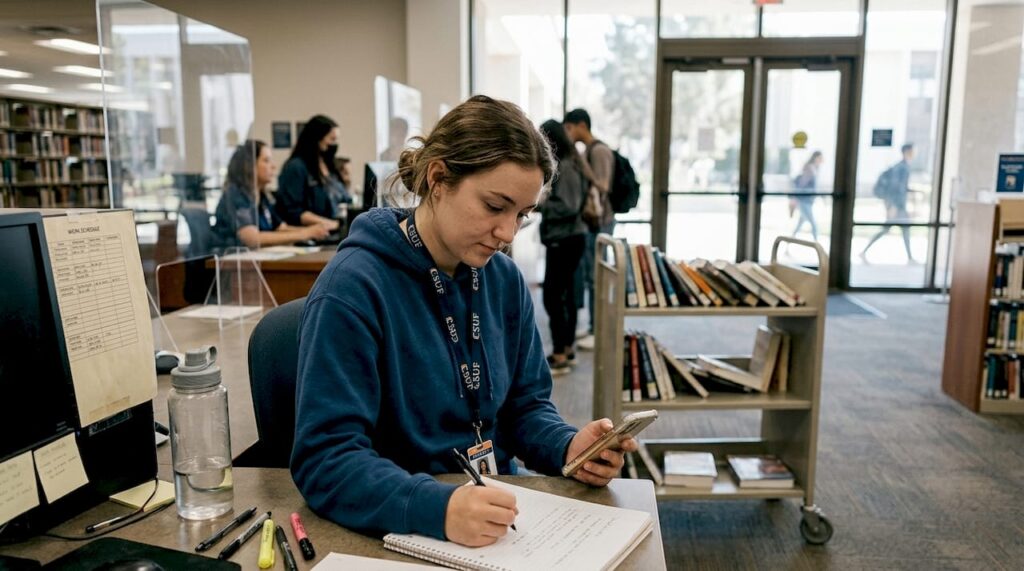
If you work on campus at California State University Fullerton, you might assume your job is straightforward and protected. But more than 40% of CSUF student workers may be affected by wage violations, ranging from unpaid overtime to outright underpayment. That number is striking, and it means the odds are real that you or someone you know has been shortchanged. This guide walks you through what wage violations look like, what California law says about your rights, how to document problems, and exactly what steps to take if something goes wrong.
Table of Contents
- What wage violations look like at CSUF
- Legal rights and protections for CSUF student workers
- How to recognize and document wage issues
- Steps to take if you experience a violation
- Systemic reform: Union actions and student advocacy
- Get help with wage violations and employment disputes
- Frequently asked questions
Key Takeaways
| Point | Details |
|---|---|
| Wage violations are common | Over 40% of CSUF student workers may face pay issues or legal violations. |
| Know your legal rights | Student workers have strong wage, overtime, and anti-retaliation protections under California law. |
| Document everything | Keep thorough records of hours, pay, and communications to protect yourself in case of disputes. |
| Action is protected | You cannot be legally punished for reporting wage problems or seeking help. |
| Help is available | Campus offices and professional attorneys are ready to support wage and employment concerns. |
What wage violations look like at CSUF
To tackle these concerns, it is crucial to understand exactly what counts as a violation and why these issues matter for your rights. A lot of student workers assume that campus jobs operate under different rules. They do not. California labor law applies to you whether you work in the library, the student union, or a research lab.
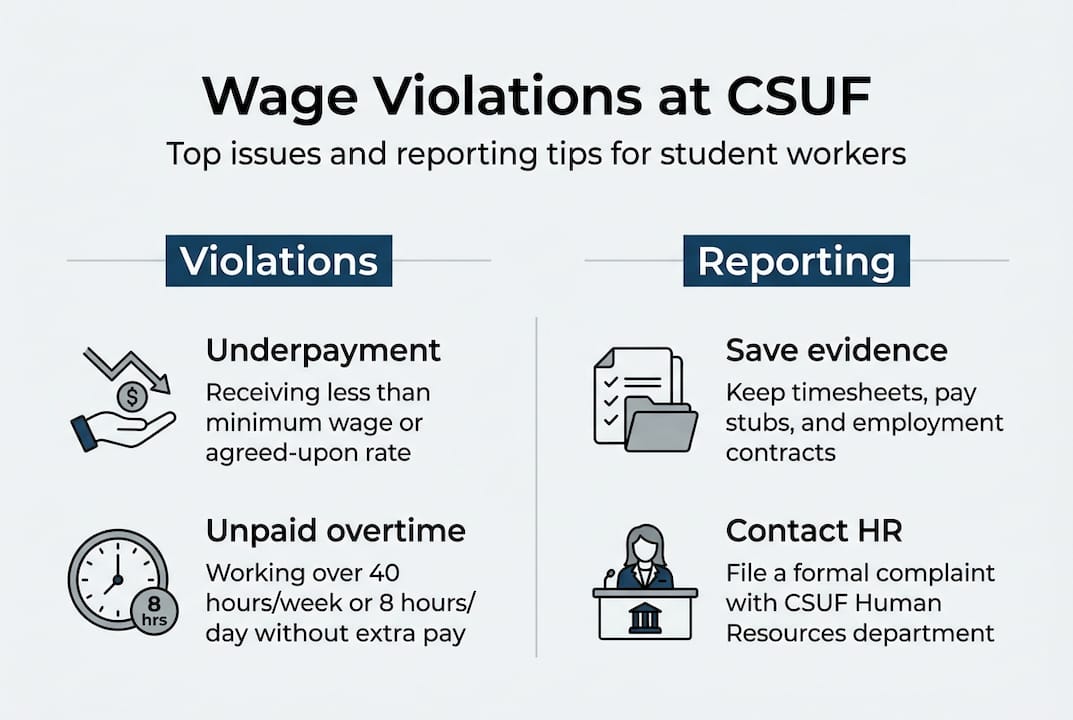
Common wage violations at CSUF include underpayment, unpaid overtime, off-the-clock work, inaccurate hour logging, and pay that falls below the state minimum wage. These are not rare edge cases. They show up regularly in campus employment settings, often because supervisors are not trained in labor law or because informal work arrangements blur the lines.
One persistent myth is that campus jobs are somehow exempt from state labor protections. They are not. Another common misconception is that if your supervisor asks you to stay under 20 hours per week to avoid triggering benefits, any extra hours you work without pay are just part of the deal. That is a violation, full stop.
| Violation type | What it means | How common |
|---|---|---|
| Underpayment | Paid less than agreed or minimum wage | Very common |
| Off-the-clock work | Working before clocking in or after clocking out | Common |
| Unpaid overtime | Not paid 1.5x for hours over 8/day or 40/week | Common |
| Inaccurate hour logs | Hours recorded incorrectly by employer | Moderate |
| Misclassification | Labeled contractor instead of employee | Underreported |
“Being a student worker does not make you a second-class employee. California law treats your wages the same as any other worker’s.”
Here is a quick list of warning signs to watch for:
- Your paycheck does not match the hours you tracked
- You are asked to finish tasks after clocking out
- Your pay rate changes without notice
- You are told you are an “independent contractor” for on-campus work
- Overtime hours appear missing from your pay stub
The intern wage violations in Fullerton context matters too. Even internship-style roles tied to academic credit can trigger wage obligations if the work primarily benefits the employer.
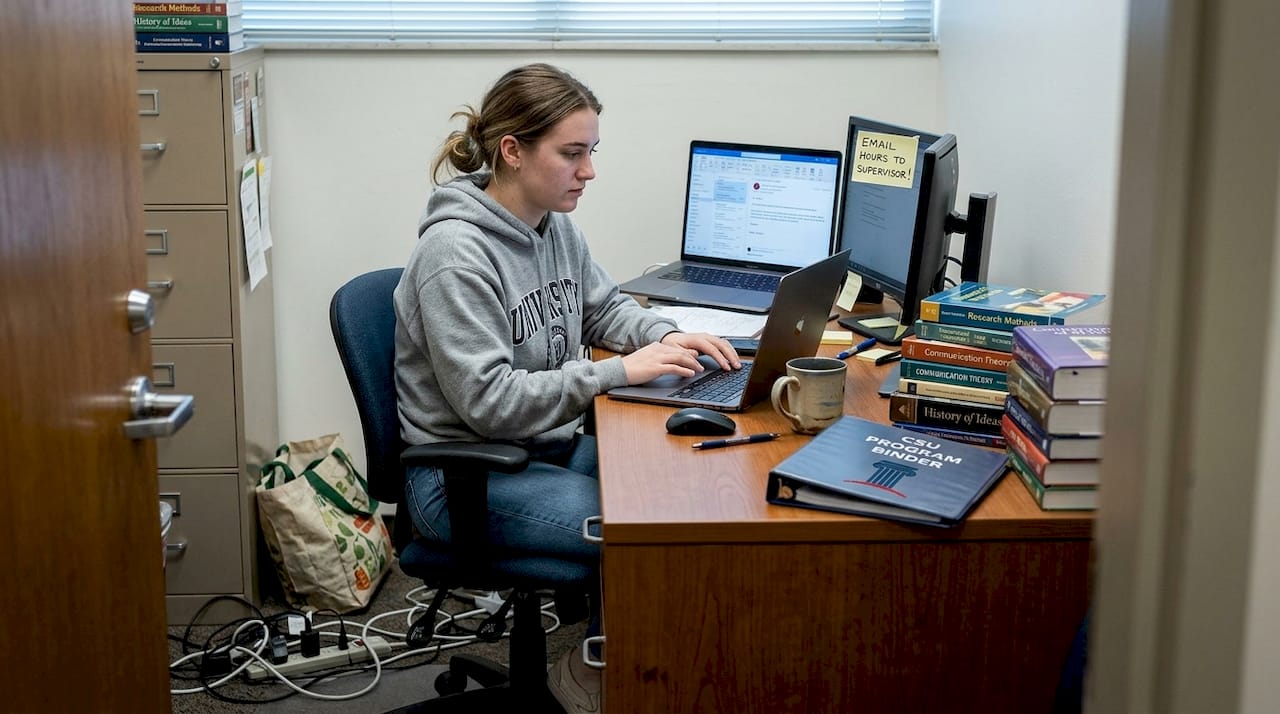
Legal rights and protections for CSUF student workers
Knowing your legal protections sets you up to recognize violations, but understanding how these rights are enforced is equally important. California gives student workers strong protections, and they apply regardless of whether your position is funded by a grant, a department budget, or federal work-study dollars.
Here is what the law guarantees you:
- Minimum wage: The California minimum wage law applies to every hour you work, no exceptions for campus roles
- Overtime pay: You earn 1.5 times your regular rate for hours over 8 in a day or 40 in a week
- Protection from misclassification: AB5 prevents employers from labeling you a contractor to avoid paying benefits or overtime. Gig worker misclassification rules apply in campus settings too
- No retaliation: If you report a wage problem, your employer cannot fire you, cut your hours, or punish you in any way
- International students: Your visa may limit your work hours, but it does not limit your wage rights. You are still entitled to full pay for every hour worked
Student worker rights at CSUF also include protection even in at-will employment situations. Being at-will means your employer can end your job without cause, but it does not mean they can retaliate against you for asserting your legal rights.
Pro Tip: Screenshot or save any text messages, emails, or scheduling apps that show your actual hours. Digital records are often more reliable than handwritten logs and carry real weight in a wage claim.
How to recognize and document wage issues
Once you know what to look for, the next step is to act if violations are found and use your evidence effectively. Documentation is everything in a wage dispute. Without records, it becomes your word against your employer’s.
Follow these steps to build a solid paper trail:
- Compare your records to your paycheck. Pull up your own notes or phone calendar and match them against your pay stub line by line.
- Save every pay stub. Even if everything looks fine now, keep them. Patterns of underpayment often only become visible over time.
- Log off-the-clock work immediately. If you are asked to keep working after clocking out, write it down the same day with the date, time, and who asked you.
- Screenshot your schedule. Work schedules posted in apps or sent by email are evidence of expected hours.
- Clarify your employment status in writing. If you are unsure whether you are classified as a student assistant or something else, ask HR in an email so you have a written response.
The student wage violation guide recommends prioritizing documentation from day one, not just after a problem surfaces. Think of it like keeping receipts. You hope you never need them, but you are glad they exist when you do.
Pro Tip: Use a free notes app to log your hours daily. Include start time, end time, any breaks, and any instructions from your supervisor. This takes two minutes and can be decisive evidence later.
If you are ever fired or have your hours cut after raising a concern, wrongful termination protections may apply to your situation.
Steps to take if you experience a violation
Understanding these steps can help you take action without fear, but broader changes are also underway across the CSU system. Here is a clear process to follow:
- Start with CSUF HR. For minor payroll errors, a direct conversation with Human Resources often resolves the issue quickly.
- Escalate to the California Labor Commissioner. For unpaid wages, missing overtime, or retaliation, file a wage claim with the Division of Labor Standards Enforcement (DLSE). You do not need an attorney to do this.
- Document retaliation immediately. If your hours are cut or you face other negative consequences after reporting, note every detail and date.
- Consult an employment attorney. For complex situations or large amounts of unpaid wages, legal advice can clarify your options fast.
- Use the right channel for discrimination. Wage issues and discrimination are handled separately. For harassment or discrimination, contact the CSUF Office for Civil Rights directly.
Penalties for wage violations are real. Under California law, violations can cost employers up to $100 per employee per pay period for minimum wage violations alone. That creates a financial incentive for employers to fix problems quickly once a formal claim is filed.
| Issue type | Where to report | Attorney needed? |
|---|---|---|
| Unpaid wages or overtime | CA Labor Commissioner (DLSE) | No |
| Retaliation for reporting | CA Labor Commissioner or court | Recommended |
| Discrimination or harassment | CSUF Office for Civil Rights | Optional |
| Misclassification | CA Labor Commissioner or court | Recommended |
For employment disputes at CSUF that involve multiple violations or retaliation, getting legal guidance early can protect your position and maximize your recovery.
Systemic reform: Union actions and student advocacy
Being aware of both your rights and these advocacy efforts means you are equipped for change, whether for yourself or the campus community. Wage violations at CSUF are not just individual problems. They reflect systemic gaps that unions and student advocates are actively working to close.
Here is what is happening across the CSU system right now:
- CSUEU bargaining: The California State University Employees Union is bargaining for student assistants systemwide, pushing for better pay rates, paid sick days, and an end to unpaid labor practices
- RA unionization: Resident Assistants at CSUF and other CSU campuses have filed petitions to unionize, citing compensation concerns and unclear work expectations
- Student forums and petitions: Campus advocacy groups have organized public forums that have drawn administrative attention to working conditions
- Policy wins: Some job classes have already gained expanded paid sick leave and holiday pay as a result of bargaining pressure
- Ongoing pressure: Systemic wage violation data continues to keep university leadership accountable
The fact that CSUF policy responses are evolving is a sign that advocacy works. But systemic change is slow. In the meantime, knowing your individual rights is your most reliable protection.
Key stat: More than 40% of CSUF student workers are estimated to have experienced some form of wage violation. That is not a fringe issue. It is a campus-wide concern that deserves serious attention.
Get help with wage violations and employment disputes
If you have read this far and recognized something in your own situation, you do not have to figure out the next step alone. The attorneys at Serendib Law Firm understand both California wage law and the specific dynamics of campus employment. Whether you are dealing with unpaid overtime, misclassification, or retaliation, a quick consultation can clarify your options and give you real confidence about what to do next. The Lake Forest employment law team and the Huntington Beach legal team are available to review your situation confidentially. Free consultations are available, and many cases are handled on contingency, meaning you pay nothing unless you win.
Frequently asked questions
Do overtime and minimum wage laws apply to CSUF student jobs?
Yes, California labor law covers minimum wage and overtime for student employees unless a very narrow exemption applies, and most campus jobs do not qualify for any exemption.
What should I do if my CSUF paycheck seems wrong?
Start by comparing your own hour records to your pay stub, then document the discrepancy and contact CSUF HR. If the issue is not resolved, file a wage claim with the California Labor Commissioner.
Can CSUF fire me for complaining about wage violations?
No. California law protects you from retaliation for reporting wage violations or cooperating with any investigation into those violations.
Where do I report discrimination or harassment at CSUF?
Contact the CSUF Office for Civil Rights and Equity. This office handles discrimination and harassment reports separately from wage claims, so use the right channel for the right issue.
Who is leading unionization for CSUF student assistants?
CSUEU is bargaining systemwide for better pay and protections for student assistants across all CSU campuses, including CSUF.
Recommended
- CSUF Student Worker Pay Disputes 2026: 40% Face Violations | Serendib Law Firm
- Campus Employment Disputes At CSUF: Student Worker Rights | Serendib Law Firm
- Intern Wage Violations in Fullerton – What Students Face | Serendib Law Firm
- Student Worker Wage Violations at CSUF – Protecting Your Rights | Serendib Law Firm