
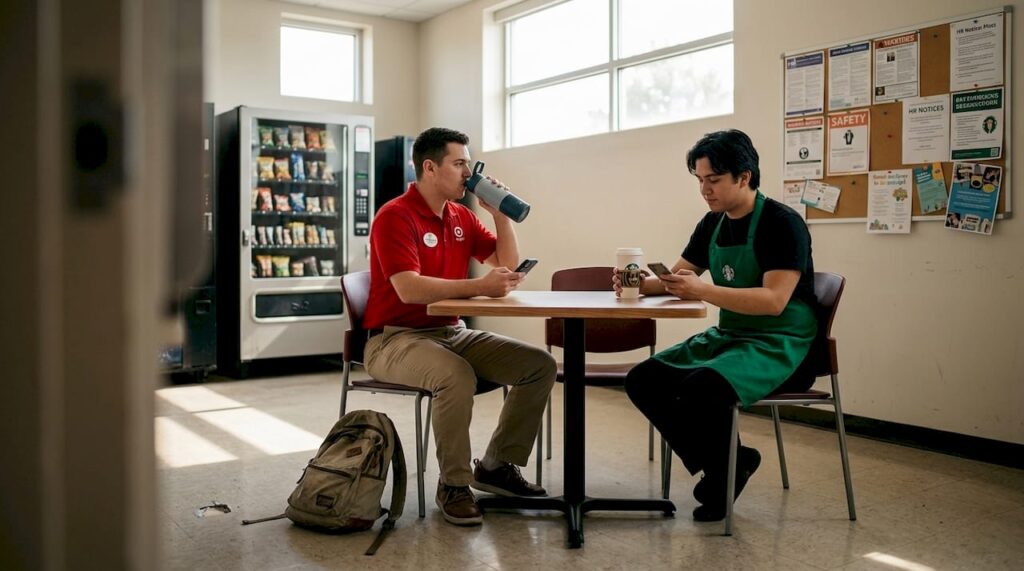
Recent viral complaints from retail workers at Target and Starbucks in Tustin highlight issues with unpredictable schedules, denied meal breaks, and sudden shift changes. These aren’t just frustrating workplace annoyances—they’re potential violations of California labor law. This guide walks you through the legal requirements for meal and rest breaks, common violations at these major retailers, what you’re owed when your rights are violated, and the practical steps you can take to protect yourself and claim the compensation you deserve.
Table of Contents
- Understanding meal and rest break laws for Tustin retail workers
- Common scheduling problems and meal break violations at Target and Starbucks in Tustin
- Penalties, pay, and what you’re owed for violations
- What to do if your scheduling or break rights are being violated
- Recent claims, legal precedents, and settlement trends
- Find support for your employment rights in Tustin
- Frequently asked questions
Key Takeaways
| Point | Details |
|---|---|
| Strict break rights | California law requires timely meal and rest breaks for every retail worker shift over 5 hours. |
| Common violations | Denied breaks, last-minute scheduling changes, and on-call meal periods are frequent legal breaches in Tustin. |
| You can claim penalties | Workers are owed one extra hour’s pay per missed break, and cumulative fines can be substantial. |
| Action steps matter | Document violations, report properly, and consult legal help to ensure your rights are enforced. |
| Precedent supports workers | Recent statewide court cases and settlements show that Tustin retail workers’ claims are enforceable. |
Understanding meal and rest break laws for Tustin retail workers
With the basics laid out, let’s unpack exactly what California law guarantees you as a Tustin retail employee facing these workplace pressures.
California Labor Code requires retail employees to receive a 30-minute unpaid meal break for shifts over 5 hours, a second break for over 10 hours, and paid 10-minute rest breaks every 4 hours or major fraction. These aren’t suggestions or company policies—they’re legal requirements that apply to every retail worker in Tustin, whether you’re stocking shelves at Target or making lattes at Starbucks.
Your employer must completely relieve you of all duties during meal breaks. That means you can’t be asked to monitor the register, watch for shoplifters, or respond to customer questions. If you’re required to stay on the premises or remain available, that’s not a valid meal break. Rest breaks, while shorter, follow the same rule: you must be free from work obligations for the full 10 minutes.
Pro Tip: If your manager tells you to keep your radio on during breaks “just in case,” that’s not a legal break. You’re entitled to be completely off duty.
Here’s how California’s requirements compare to what you might see elsewhere:
| Requirement | California (Tustin) | Federal Standard |
|---|---|---|
| Meal break (5+ hours) | 30 min unpaid, required | Not required |
| Meal break (10+ hours) | Second 30 min unpaid | Not required |
| Rest breaks | 10 min paid per 4 hours | Not required |
| On-call during breaks | Prohibited | No protection |
| Penalty for violations | 1 hour premium pay | None |
While California doesn’t mandate predictability pay like some cities, reporting time pay does apply. If you show up for a scheduled shift and get sent home early, you’re entitled to at least half your scheduled hours (minimum 2 hours, maximum 4 hours) at your regular rate.
Key points about your Tustin meal and rest break rights:
- Meal breaks must start before the end of your fifth hour of work
- Rest breaks should fall in the middle of each work period when possible
- You cannot waive your meal break unless your shift is 6 hours or less
- Employers cannot pressure you to skip breaks to “be a team player”
- Break violations accumulate—each missed break is a separate violation
Understanding these rules helps you recognize when Starbucks and Target worker rights are being violated, which happens more often than most employees realize.
Common scheduling problems and meal break violations at Target and Starbucks in Tustin
Now that you know what rights you have, let’s look at what’s actually happening inside Tustin’s Target and Starbucks stores.

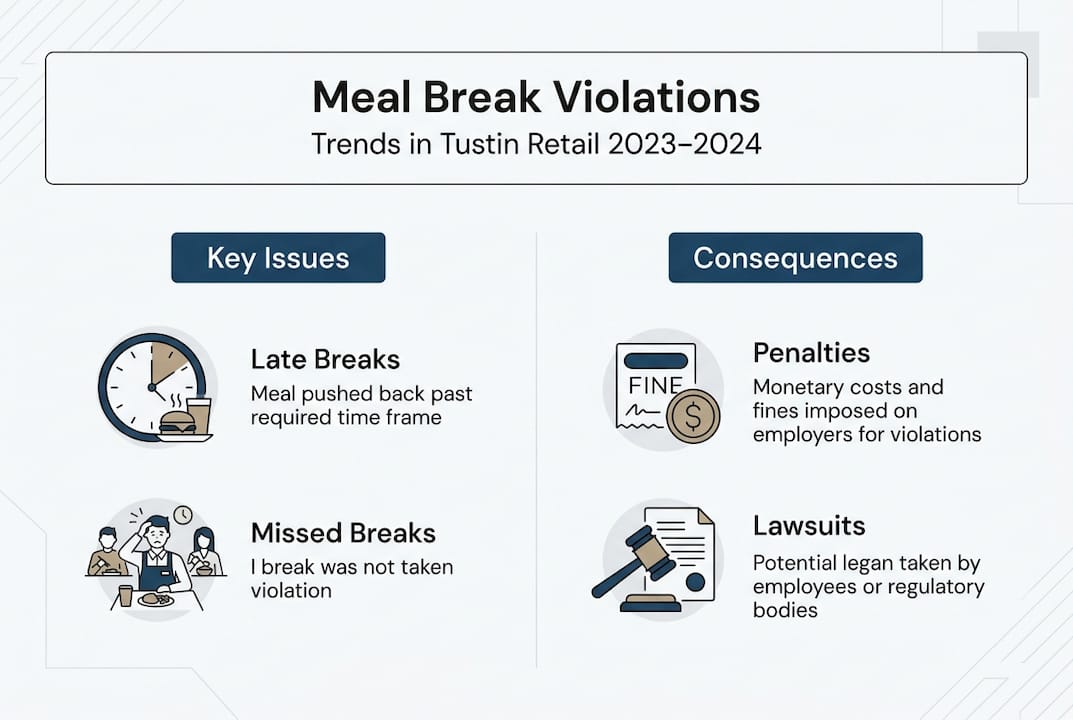
Retail workers report denied meal breaks during busy times, last-minute schedule changes, and being required to be on-call during breaks. These patterns aren’t random—they reflect systemic issues that affect workers across both chains.
The most common violation is the delayed or denied meal break. Managers tell employees they’re “too busy” to take their 30 minutes, or they’re called back from break to help with a rush. Sometimes workers are told to eat while working the register or to keep their apron on and stay visible to customers. None of these scenarios constitute a legal meal break.
“I was scheduled for a 6-hour shift but told I couldn’t take my meal break until hour 5.5 because we were understaffed. By the time I clocked out for break, my shift was almost over. This happened three times in two weeks.” — Tustin Target employee
Clopening shifts create another serious problem. When you close the store at 11 PM and open at 6 AM the next day, you’re not getting adequate rest between shifts. While California doesn’t mandate specific hours between shifts, this practice often leads to missed breaks and exhaustion that makes it harder to advocate for your rights.
Other worker complaints in Tustin include:
- Being told to remain “available” during rest breaks to answer questions
- Meal breaks interrupted multiple times for “quick” tasks
- Schedules changed with less than 24 hours notice
- Sent home after 2 hours when scheduled for 8, without reporting time pay
- Pressure to work through breaks during holiday rushes
Starbucks faces particular scrutiny for break violations. Recent settlements show the company has paid millions to resolve claims that managers systematically denied breaks during peak hours. Target has faced similar accusations, with workers reporting that understaffing makes it nearly impossible to take breaks without leaving the floor uncovered.
Improper classification is another tactic that denies workers their rights. Some employees are misclassified as supervisors or given misleading titles that suggest they’re exempt from break requirements. In reality, if you’re paid hourly and don’t have genuine management authority, you’re entitled to all meal and rest breaks regardless of your job title.
According to Tustin break law enforcement data, retail violations have increased 34% since 2023, with meal break denials representing the largest category of complaints.
Penalties, pay, and what you’re owed for violations
These workplace violations mean more than frustration—they also come with financial consequences for both employees and employers.
Violations require one hour of premium pay per missed break, with cumulative penalties that can reach thousands of dollars per employee. This isn’t a suggestion—it’s the legal remedy California provides when employers fail to provide required breaks.
Here’s how the math works. If you earn $18 per hour and your employer denies you one meal break and one rest break in a single shift, you’re owed two additional hours of pay at $18 per hour, totaling $36 for that day. If this happens three times per week over a year, you’re owed $5,616 in premium pay alone.
Pro Tip: Premium pay is calculated at your regular rate, not overtime rate, even if the violation occurs during overtime hours. Keep detailed records of your hourly rate for each pay period.
The penalties compound quickly:
| Violation Frequency | Breaks Missed Per Week | Annual Premium Pay Owed |
|---|---|---|
| Occasional | 1 | $936 |
| Regular | 3 | $2,808 |
| Systematic | 5 | $4,680 |
| Severe | 10 | $9,360 |
Based on $18/hour wage, 52 weeks
Beyond individual claims, employers face additional consequences. Missed rest break penalties can trigger Private Attorneys General Act (PAGA) lawsuits, where one employee sues on behalf of all affected workers. These cases have resulted in settlements exceeding $1 million for single store locations.
Reporting time pay adds another layer. If you’re scheduled for an 8-hour shift but sent home after 2 hours, you’re entitled to 4 hours of pay (half your scheduled shift). If this happens repeatedly, those hours add up quickly.
Calculating what you’re owed:
- Count every missed or interrupted meal break (30 minutes or less)
- Count every missed rest break (less than 10 minutes)
- Multiply total violations by your hourly rate
- Add any reporting time pay for early dismissals
- Include interest from the date of each violation
Class action lawsuits provide another avenue for recovery. When multiple employees experience the same violations, they can join together to hold employers accountable. Recent workers’ penalty pay rights cases have resulted in settlements that provide back pay, penalties, and changes to company policies.
Employers who retaliate against workers for asserting their break rights face additional penalties, including wrongful termination claims and emotional distress damages. California law protects your right to take legally required breaks without fear of discipline or reduced hours.
What to do if your scheduling or break rights are being violated
Knowing your rights isn’t enough—here’s how to act if you experience violations at work.
Documentation is your strongest tool. Every time a break is denied, delayed, or interrupted, write down the date, time, duration, who was involved, and what happened. Note whether you were told you couldn’t take a break, called back early, or required to remain available. Save these records outside of work—don’t rely on company systems that could be deleted.
Follow these steps to protect your rights:
- Document everything immediately. Use your phone to record details while they’re fresh. Include witness names if coworkers saw what happened.
- Report violations through company channels first. Most large retailers have HR hotlines or online reporting systems. Make your report in writing and keep a copy.
- Request your personnel file and pay records. California law gives you the right to inspect these documents. Look for patterns of missed breaks or unpaid premium pay.
- File a complaint with the Labor Commissioner. If internal reporting doesn’t resolve the issue, escalate to the state agency that enforces labor law violations.
- Consult an employment attorney. For repeated or systematic violations, legal representation can help you recover all owed wages and penalties.
Pro Tip: Take photos of schedules, time clock records, and any written communications about breaks. Digital evidence is harder for employers to dispute.
When reporting internally, be specific. Instead of saying “I don’t get breaks,” say “On January 15, 2026, I was denied my meal break during my 6-hour shift. Manager Sarah told me we were too busy and I needed to stay on the floor. This is the third time this month.”
If you’re concerned about retaliation, know that California law prohibits employers from punishing workers who assert their rights. Retaliation can include reduced hours, poor performance reviews, undesirable shifts, or termination. Document any negative treatment that follows your complaint.
The employment arbitration process may apply if your employer requires arbitration agreements. However, California has limited the enforceability of these agreements for certain claims, and PAGA actions cannot be forced into arbitration.
Precedent from Starbucks break cases confirms that employees who document violations and follow proper reporting procedures have strong legal standing. Courts have consistently ruled in favor of workers when employers fail to provide required breaks.
Recent claims, legal precedents, and settlement trends
With a plan for what you can do, the final piece is understanding how other workers have succeeded in these types of cases.
While no specific lawsuits have been reported at Tustin locations, Target and Starbucks have faced similar claims statewide, with settlements up to $35 million. These cases establish important precedents that protect Tustin workers experiencing the same violations.
Starbucks has faced particularly intense scrutiny. A 2023 settlement required the company to pay $15 million to California workers for systematic meal and rest break violations. The case revealed company policies that discouraged managers from allowing breaks during peak hours, creating a culture where violations were routine rather than exceptional.
Target has settled multiple class actions related to:
- Denied meal and rest breaks during inventory and holiday periods
- Off-the-clock work requirements before and after shifts
- Failure to pay reporting time when employees were sent home early
- Retaliation against workers who complained about break violations
“The evidence showed that Target’s scheduling system made it nearly impossible for employees to take breaks during understaffed shifts, creating systematic violations across hundreds of stores.” — California Court of Appeal decision
These CA-wide claims at Target and Starbucks mirror the complaints from Tustin workers. The patterns are identical: understaffing leads to denied breaks, managers prioritize customer service over legal compliance, and workers are told violations are temporary when they’re actually ongoing.
Recent labor law trends show increasing enforcement and larger settlements. The California Labor Commissioner has prioritized retail break violations, conducting targeted investigations of major chains. This increased scrutiny means employers face greater risk when they ignore the law.
An important court decision clarified that employers cannot round break times or require employees to be “on call” during rest periods. This ruling strengthened worker protections and made it easier to prove violations.
Settlement trends indicate that workers who document violations and pursue claims typically recover:
- Full premium pay for all missed breaks
- Interest from the date of each violation
- Attorney fees and costs
- Policy changes that prevent future violations
The success of these cases demonstrates that Tustin retail workers have strong legal standing when they experience similar violations. You’re not alone, and the law is on your side.
Find support for your employment rights in Tustin
If you recognize these patterns in your own experience, knowledge is just the first step—here’s how to protect your rights.
Working with experienced employment law attorneys can make the difference between accepting ongoing violations and recovering the compensation you deserve. Legal representation levels the playing field when you’re facing a major corporation with extensive legal resources.
Many employment attorneys offer free consultations to evaluate your case. During this meeting, you can discuss the specific violations you’ve experienced, review your documentation, and understand your options for recovery. Most cases are handled on a contingency basis, meaning you don’t pay unless you recover compensation.
Employment mediation provides another path to resolution. This process allows you to negotiate directly with your employer, often resulting in faster settlements without the time and expense of litigation. Mediation can be particularly effective when you want to continue working for the company while resolving past violations.
Don’t wait until small violations become bigger problems. The statute of limitations for wage claims is typically three years, but documenting violations as they occur strengthens your case significantly. Early action also prevents ongoing harm and ensures you’re not leaving money on the table.
When you consult a Tustin employment attorney, bring all documentation you’ve collected: schedules, time records, pay stubs, written communications, and your personal notes about each violation. This information helps attorneys assess the strength of your case and estimate potential recovery.
Frequently asked questions
What meal and rest break rules apply to Target and Starbucks employees in Tustin?
California law requires a 30-minute meal break for shifts over 5 hours and a paid 10-minute rest break every 4 hours or major fraction thereof. These requirements apply to all retail workers regardless of employer.
Do I have to be completely relieved of work during my meal break?
Yes, your employer must relieve you of all duties and cannot keep you on-call during meal breaks. Any work-related requirement invalidates the break.
What should I do if I’m denied a break or scheduled with less than 8 hours between shifts?
Document every violation and report it to your manager first; escalate to the Labor Commissioner or consult a local employment attorney if issues persist. Keep detailed records of dates, times, and circumstances.
How much can I be paid for each meal or rest break violation?
You are owed one additional hour of pay at your regular rate for each violation by law. These penalties accumulate for every missed break throughout your employment.
Recommended
- Retail worker rights after Starbucks and Target Tustin complaints | Serendib Law Firm
- Meal and Rest Break Violations Impact Hospitality Workers
- Meal Break Violations in Stanton Warehouses: Your Legal Rights | Serendib Law Firm
- Tustin Break-Time Law Violations Impact Restaurant Staff | Serendib Law Firm