

TL;DR:
- Older workers in Huntington Beach surf retail face subtle age discrimination despite legal protections. Taking documentation and consulting legal support are crucial steps to address workplace bias. Cultural change and employee advocacy are key to combating age discrimination in the industry.
Surf retail in Huntington Beach has a well-documented history of gender-based workplace disputes, but age discrimination quietly affects older employees in ways that rarely make headlines. If you work in a surf shop and feel sidelined because of your age, you are not imagining things, and you are not alone. California law offers real, enforceable protections for workers 40 and older, whether you stock shelves at a boardshort boutique or manage inventory at a major surf brand outlet. This guide walks you through exactly what counts as age discrimination, how local surf culture shapes your daily experience, and what practical steps you can take right now to protect your career.
Table of Contents
- What counts as age discrimination in surf retail?
- How Huntington Beach’s surf work culture impacts older employees
- Steps to take if you suspect age discrimination
- What outcomes can you expect from a claim?
- Why age discrimination claims are still rare in surf retail and what really needs to change
- Get support for your claim: Next steps with local attorneys
- Frequently asked questions
Key Takeaways
| Point | Details |
|---|---|
| Understand your rights | California law protects employees age 40+ from age discrimination even in surf retail settings. |
| Document everything | Keep a detailed record of all incidents if you suspect age bias to strengthen your case. |
| Cultural bias persists | Surf retail’s youth-oriented culture can hide age discrimination, so awareness and vigilance are critical. |
| Legal support matters | Consulting a local employment attorney raises your chances of a successful claim and protects your rights. |
What counts as age discrimination in surf retail?
Age discrimination is not just about being fired. Under California’s Fair Employment and Housing Act, commonly called FEHA, it is illegal for any employer with five or more employees to treat workers differently because of their age if they are 40 or older. That protection covers hiring, firing, promotions, scheduling, training opportunities, and even the way a manager speaks to you in front of coworkers.
Surf retail adds a layer of complexity because the industry prizes a youthful image. A store might not say out loud that it prefers younger staff, but the bias shows up in quieter ways. Consider these common patterns that can qualify as age discrimination:
- Consistently scheduling older employees for fewer hours after a younger hire joins the team
- Passing over experienced staff for assistant manager roles in favor of younger, less qualified candidates
- Making comments like “we need fresh energy” or “our customers want to relate to staff” when discussing staffing decisions
- Excluding older workers from product training or brand ambassador events
- Pushing out a long-term employee through sudden, unexplained performance reviews
A useful way to understand the landscape is to compare age and gender discrimination cases in local surf retail:
| Factor | Age discrimination | Gender discrimination |
|---|---|---|
| Legal threshold | Workers 40 and older | Any gender |
| Common surf retail trigger | “Youth culture” staffing preferences | “Bro culture” management behavior |
| Visibility of claims | Low, rarely publicized | Higher, some major verdicts |
| Burden of proof | Pattern of treatment or direct evidence | Similar, but retaliation cases are common |
The comparison matters because surf industry cases have historically leaned toward gender-related disputes rather than age. Understanding age discrimination definitions under California law helps you identify whether your situation fits the legal standard before you take any action.
History shows these challenges are not new. A California age discrimination challenge was successfully brought in 1984 when lifeguard Thomas Zahn fought mandatory retirement at age 60 and won. That case established that California takes age-based employment restrictions seriously, even in beach and surf contexts.
Pro Tip: Keep a personal log of any age-related comments or changes to your schedule or duties. Written records created close to the time of an incident carry far more weight than memory alone when you later speak with an attorney.
How Huntington Beach’s surf work culture impacts older employees
Understanding the law is the first step, but local surf retail culture often shapes what older employees actually experience day-to-day. The surf industry has built its commercial identity around youth, athleticism, and a particular social image. That identity does not disappear at the store level. It filters into hiring decisions, shift assignments, and even the informal social dynamics that determine who gets promoted.
This is sometimes called the “youth premium,” the unspoken assumption that younger staff are more relatable to customers, more aligned with the brand, and more worth investing in. You might feel this when a new 22-year-old hire gets sent to trade shows while you, with ten years of product knowledge, stay behind to manage returns.
“The surf industry’s biggest legal battles have centered on gender retaliation and bro culture dynamics rather than age, but that does not mean older workers are unaffected. It may simply mean they feel less empowered to speak up.”
The Birdwell $3.68 million retaliation verdict is a striking example of how surf industry workplace culture can produce serious legal consequences, even when the specific claim is gender-based rather than age-based. It signals that courts and juries take surf retail workplace culture seriously.
Here are specific ways age bias surfaces in Huntington Beach surf stores:
- Older employees assigned to back-of-house tasks while younger staff interact with customers
- Management framing scheduling cuts as “business slowdowns” that disproportionately affect senior staff
- Social exclusion from team outings or brand events that informally influence who gets noticed for advancement
- Subtle pressure to “keep up” with younger coworkers in ways that are physically or socially unrealistic
Understanding your worker rights in retail settings gives you a clearer picture of what employers are legally required to do, regardless of the store’s brand identity. And if you experience pushback after raising concerns, workplace retaliation protections exist specifically to prevent employers from punishing employees who speak up.
Few official age claims arise in surf retail partly because older workers often internalize the culture’s messaging. They assume the bias is just “how things are” rather than recognizing it as something the law prohibits.
Steps to take if you suspect age discrimination
Now that you understand why age bias may be overlooked, let’s cover exactly what you should do if you think you’re affected. Acting methodically from the start protects your legal options and strengthens any future claim.
- Document everything immediately. Write down dates, times, what was said, who was present, and how the incident affected your employment. Do this within 24 hours while details are fresh.
- Save written evidence. Keep copies of emails, text messages, performance reviews, and any written communication that shows a pattern of differential treatment based on age.
- Identify witnesses. Note the names of coworkers who observed incidents. Their accounts can corroborate your experience later.
- Report internally first. Bring your concerns to HR or a supervisor above the person involved. This creates a paper trail and gives the employer a chance to respond. Document this report too.
- File an external complaint if needed. You can file with the California Civil Rights Department (formerly DFEH) or the Equal Employment Opportunity Commission (EEOC). Filing preserves your legal rights and starts the official clock.
- Consult an employment attorney. An attorney can assess whether your situation meets the legal standard, advise on timing, and help you avoid mistakes that could weaken your claim.
The 1984 case of Thomas Zahn, who challenged mandatory retirement at age 60 in California and prevailed, is a reminder that individuals who document their situations and pursue their rights can succeed even against institutional resistance.
Pro Tip: Do not resign before speaking with an attorney. Quitting can complicate a constructive dismissal claim, and an attorney can help you understand whether staying or leaving better serves your legal position.
Exploring legal remedies for age bias gives you a clearer picture of what outcomes are realistically available. And if you are ready to talk to someone, finding a local employment attorney who knows Orange County retail cases can make a significant difference in how your claim is handled.
What outcomes can you expect from a claim?
Having outlined what actions to take, it’s essential to know where those actions might lead and what to expect for your career and the workplace. Age discrimination claims in California can produce several types of relief depending on the facts of your case.
| Remedy type | What it means for you |
|---|---|
| Back pay | Wages lost due to wrongful termination or demotion |
| Reinstatement | Return to your former position |
| Front pay | Compensation for future lost earnings if reinstatement is not feasible |
| Emotional distress damages | Compensation for psychological harm caused by discrimination |
| Policy changes | Employer required to update hiring or scheduling practices |
| Attorney fees | In successful cases, the employer may pay your legal costs |
Realistic expectations matter. Not every claim results in a large verdict, and many cases settle before trial. Settlements often include confidentiality agreements, which is why individual surf retail age cases rarely appear in public records. That absence of data does not mean claims fail. It often means they resolve quietly.
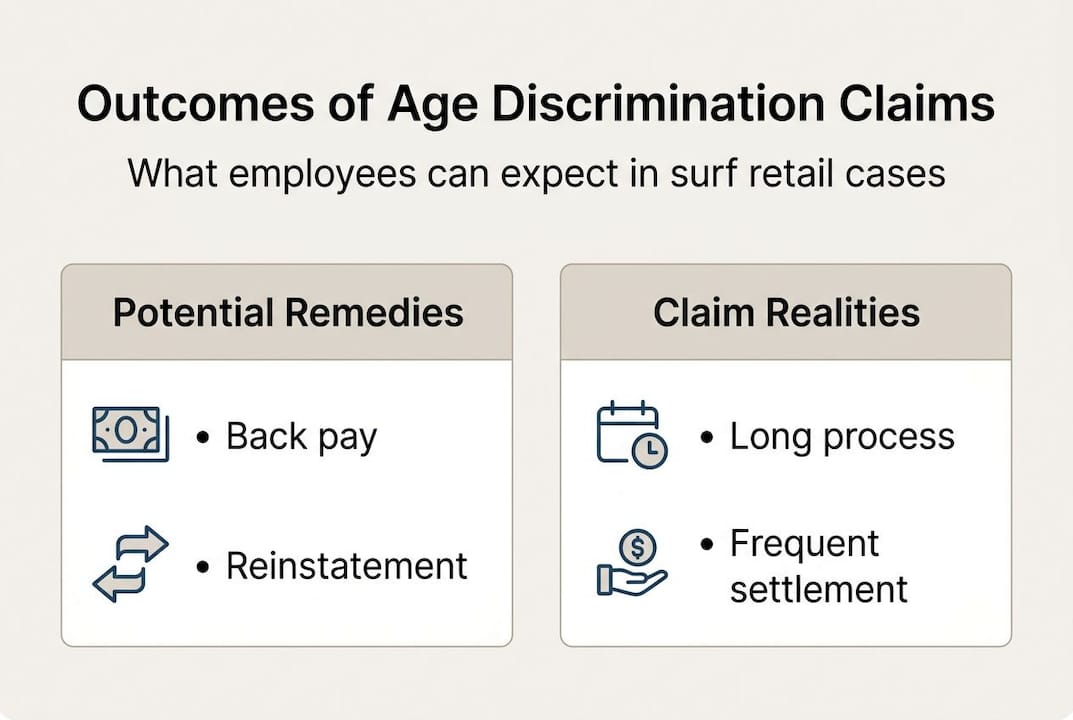
Timeframes can be long. From filing a complaint to resolution, a case may take anywhere from several months to a few years. Challenges include proving intent, gathering enough documentation, and demonstrating a pattern rather than a single incident.
A successful case does more than compensate one employee. When Thomas Zahn won his age discrimination case in 1984, it sent a message about how California treats age-based employment restrictions. A successful claim in a Huntington Beach surf store today can prompt policy reviews, management training, and cultural shifts that protect every older worker in that organization.
Key outcomes to keep in mind:
- Monetary compensation is the most common result
- Reinstatement is possible but not always practical depending on workplace relationships
- Employer policy changes can benefit coworkers who never filed a claim
- A strong case can be built even without a single dramatic incident if the pattern is clear
Reviewing wrongful termination outcomes in the Huntington Beach area gives you a realistic benchmark for what similar cases have achieved.
Why age discrimination claims are still rare in surf retail and what really needs to change
Looking at the data honestly, surf retail’s legal spotlight has focused almost entirely on gender. The Birdwell retaliation verdict is a landmark case, but it reflects a pattern of gender-based disputes, not age. Age claims remain largely invisible in this industry, and we think that invisibility is itself a problem worth naming.
The silence is not accidental. Surf retail culture rewards conformity to a youthful image so consistently that older workers often absorb the message before they can name it as discrimination. They reduce their own hours voluntarily. They stop applying for promotions. They tell themselves the culture just isn’t for them anymore. That internalized narrative is exactly what employers who practice age bias count on.

Legal action matters, but culture change matters just as much. Older employees in surf retail bring product expertise, customer loyalty, and institutional knowledge that younger staff simply cannot replicate. When stores lose those workers to quiet pushout, they lose competitive advantages they may not even recognize. Speaking up, whether through HR, a union, a legal complaint, or even a direct conversation with management, is an act of employee self-advocacy that benefits everyone on the team, not just the person raising the concern.
Get support for your claim: Next steps with local attorneys
If you suspect age discrimination, trusted legal support can help you protect your rights and strengthen your claim. The Huntington Beach employment attorneys at Serendib Law Firm understand the local retail landscape and the specific cultural dynamics that shape surf industry workplaces. We offer free consultations so you can understand your options before committing to any course of action. Whether you are still employed and considering your next move or have already been terminated, speaking with an attorney early gives you the clearest picture of what your case could achieve. Our team also serves clients in surrounding communities, and our Lake Forest employment attorneys are equally prepared to help Orange County retail workers assert their rights.
Frequently asked questions
What laws protect me from age discrimination in Huntington Beach surf retail?
California’s Fair Employment and Housing Act and federal law both prohibit age discrimination for workers 40 and older in retail settings, a protection that has been enforced in California beach workplaces since at least 1984.
Can I be fired for reporting age discrimination?
No, it is illegal for your employer to retaliate against you for making a good faith discrimination complaint, and surf industry retaliation cases confirm that courts take retaliation claims seriously regardless of the type of discrimination reported.
What should I document when I suspect age bias?
Write down dates, descriptions of incidents, and the names of any witnesses, and keep copies of emails and written performance reviews as close to the time of each incident as possible.
How long do I have to file an age discrimination claim in California?
You must generally file within three years of the discriminatory act with the California Civil Rights Department or within 300 days with the EEOC, so acting promptly after any incident is critical.