

TL;DR:
- Over 60% of US executives will face compensation disputes during their careers.
- Proper documentation of communications is crucial in protecting against legal disputes.
- Early legal consultation enhances the chances of a favorable outcome in termination or dispute cases.
Many executives and senior employees at Newport Beach investment firms quietly assume that compensation disputes and wrongful terminations happen somewhere else, to someone else. The reality is sharply different. Over 60% of US executives will face a bonus or compensation dispute at some point in their career, and the firms lining Pacific Coast Highway are no exception. California’s employment laws govern every one of these situations, regardless of how prestigious or well-resourced your employer is. This guide walks you through the key issues, legal standards, and practical steps you need to protect your rights and your financial future.
Table of Contents
- Understanding executive compensation disputes in investment firms
- What constitutes wrongful termination under California law
- Practical steps when facing a dispute or termination
- Real cases and emerging trends in Newport Beach investment firms
- What most executives miss in compensation and termination battles
- Find your legal ally in executive disputes
- Frequently asked questions
Key Takeaways
| Point | Details |
|---|---|
| Disputes are common | Over half of U.S. executives encounter compensation or termination issues in their careers. |
| Know California law | General state employment laws—not just local precedent—govern Newport Beach executive disputes. |
| Document everything | Careful record-keeping is crucial for successful outcomes in disputes and claims. |
| Specialized legal help | Consulting a Newport Beach employment law specialist improves your position and outcome. |
Understanding executive compensation disputes in investment firms
Compensation disputes in Newport Beach investment firms rarely start with a dramatic confrontation. More often, they begin with a quiet disagreement over numbers, a missed payment, or a clause buried deep in an employment contract. Understanding the most common triggers is the first step toward protecting yourself.
The four most frequent dispute categories are:
- Performance-based conflicts: Disagreements over whether targets were actually met, and who gets to decide.
- Calculation disputes: Differing interpretations of how bonuses, carried interest, or profit-sharing formulas are applied.
- Timing and payment issues: Delays, deferrals, or outright failures to pay compensation that was already earned.
- Forfeiture and clawbacks: Employers attempting to recover previously paid compensation, often citing vague contract language.
Each of these scenarios has a distinct legal resolution path. The table below outlines the most common dispute types and how they are typically addressed under California law.
| Dispute type | Primary legal theory | Typical resolution path |
|---|---|---|
| Performance target disagreement | Breach of contract | Negotiation, arbitration, litigation |
| Bonus calculation error | Breach of contract, wage claim | Labor Commissioner, civil suit |
| Delayed or withheld payment | California Labor Code violation | DLSE claim, civil litigation |
| Clawback enforcement | Contract interpretation | Arbitration, declaratory relief |
Common executive bonus disputes including performance-based conflicts, calculation disagreements, timing issues, and clawbacks are resolved primarily through breach of contract claims, though California’s Labor Code adds additional protections for earned wages. The distinction matters because wage claims carry stronger remedies, including waiting time penalties.
One thing that surprises many executives is how much weight courts place on written communications. Emails confirming bonus structures, calendar invites for performance reviews, and even text messages from a supervisor can become critical evidence. Executive pay dispute lessons from high-profile cases consistently show that the side with better documentation wins more often than the side with the better argument.
Pro Tip: Start a dedicated folder, digital or physical, where you save every piece of compensation-related communication. Do this from day one, not after a dispute begins.
What constitutes wrongful termination under California law
California is an at-will employment state. That means your employer can, in theory, let you go for any reason or no reason at all. But that principle has significant limits, and those limits matter enormously for executives and employees at investment firms.
Wrongful termination in California is illegal when it violates the Fair Employment and Housing Act, public policy, whistleblower protections, or constitutes discrimination or retaliation. For high-earners in finance, available remedies include back pay, front pay, emotional distress damages, and in egregious cases, punitive damages.
Common scenarios that give rise to wrongful termination claims in investment firms include:
- Being fired after reporting securities violations or regulatory misconduct
- Termination following a complaint about unpaid bonuses or wage theft
- Dismissal connected to a protected characteristic such as age, race, gender, or disability
- Retaliation after participating in an internal HR investigation
- Termination shortly after taking protected medical or family leave
“In the finance sector, wrongful termination claims often intersect with compensation disputes. An executive fired just before a bonus vests faces both a retaliation claim and a breach of contract claim simultaneously, and the combined leverage is significant.”
The timing of a termination is often the most telling detail. Losing your job two weeks before a major bonus payment is not a coincidence a court will easily overlook. Employment contract protections embedded in your offer letter or severance agreement can also define additional rights beyond what California law provides by default.

Pro Tip: From the moment you sense trouble, start keeping a written timeline of every adverse action, every changed responsibility, and every conversation with HR or management. Dates and specifics are everything.
Practical steps when facing a dispute or termination
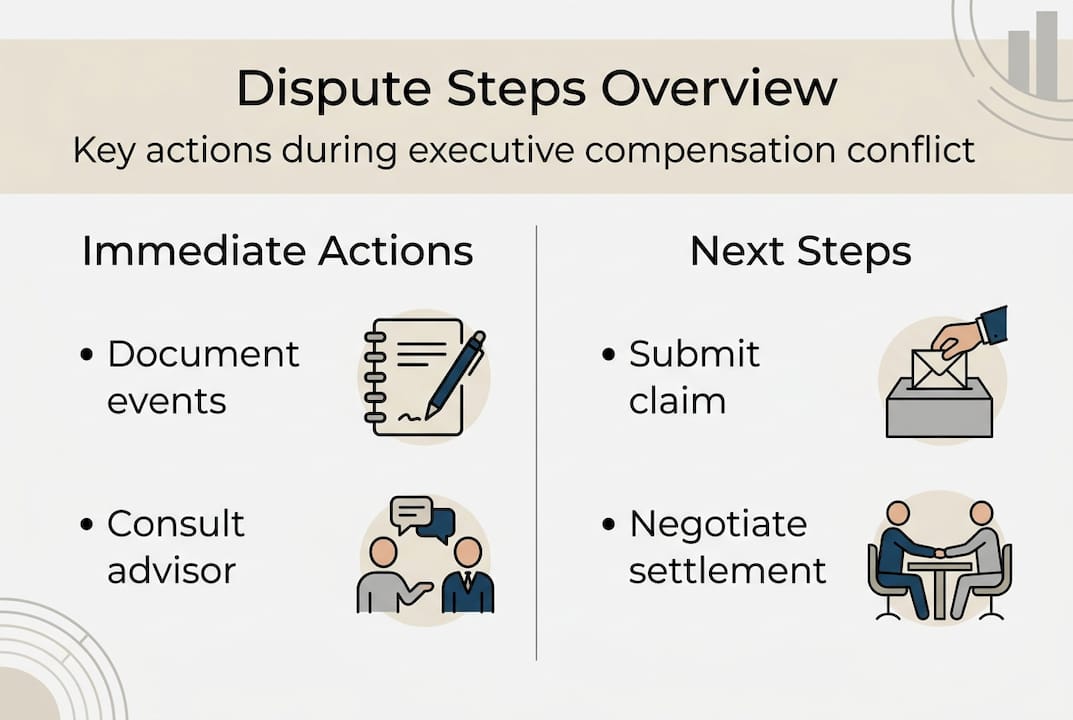
Knowing your rights is important. Acting on them correctly and in the right sequence is what actually determines outcomes. Here is a straightforward sequence to follow if you find yourself in a dispute or facing termination.
- Document immediately. Save all emails, contracts, offer letters, performance reviews, and any communications about compensation or your role. Back them up outside company systems.
- Review your employment contract. Look for arbitration clauses, non-compete provisions, clawback terms, and any language defining cause for termination.
- Avoid signing anything under pressure. Severance agreements often include broad releases of claims. Once signed, those rights are typically gone.
- Report through proper channels if applicable. If your termination involves retaliation or discrimination, document your HR report and keep a copy.
- Consult a qualified attorney early. California has strict statutes of limitations. Waiting too long can eliminate viable claims entirely.
The table below shows how the timing of key actions affects your legal position.
| Action | Timing | Legal impact |
|---|---|---|
| Document adverse actions | Immediately | Preserves evidence, strengthens claims |
| Consult an attorney | Within days of termination | Identifies claims before deadlines pass |
| File DFEH/CRD complaint | Within 3 years (FEHA claims) | Required before filing civil suit |
| File wage claim with DLSE | Within 3 years (wages) | Triggers investigation and penalties |
| File civil lawsuit | Varies by claim type | Must follow administrative exhaustion |
Newport Beach employment law specialists who understand the local investment firm landscape can identify which claims apply and which deadlines govern your situation. Many work on contingency, meaning you pay nothing unless you recover. After HR reports, the legal clock often starts running faster than people realize, which is why early consultation is not optional.
Real cases and emerging trends in Newport Beach investment firms
Publicly reported executive compensation or wrongful termination cases tied specifically to Newport Beach investment firms are relatively rare. Most disputes are resolved through private arbitration or confidential settlements, which keeps them out of court records and off the public radar. That said, the broader enforcement landscape in Orange County offers important lessons.
The SEC’s action against Engaged Capital, a Newport Beach-based investment advisor, for concealing a SPAC conflict of interest illustrates how fiduciary failures at the firm level create ripple effects for executives and employees. While that case focused on regulatory violations rather than compensation disputes, it demonstrates the kind of institutional pressure that often precedes internal employment conflicts.
Key lessons from Orange County enforcement actions and trends:
- Regulatory scrutiny increases internal pressure. When a firm faces SEC or DOJ attention, executives often become targets for internal blame-shifting, raising retaliation risks.
- Confidentiality clauses are common but not absolute. Whistleblower protections under Dodd-Frank and California law can override certain non-disclosure agreements.
- Arbitration is nearly universal in finance. Most investment firm employment contracts require arbitration, which changes strategy significantly compared to civil litigation.
- Remote work has complicated jurisdiction. Executives who worked remotely across state lines during recent years face new questions about which state’s law applies.
The Goldman Sachs case lessons from the Newport Beach market reinforce a consistent pattern: executives who act early, document thoroughly, and engage experienced counsel consistently achieve better outcomes than those who wait and hope the situation resolves itself.
With 60% or more of executives facing compensation disputes during their careers, the statistical reality is that these situations are not rare events. They are predictable professional risks that reward preparation.
What most executives miss in compensation and termination battles
After working through these cases, one pattern stands out above all others: executives consistently underestimate the importance of real-time documentation. Most people treat documentation as something you do after a problem surfaces. By then, critical evidence has already disappeared, been deleted, or been contradicted by the employer’s version of events.
Employers win cases that should have been losers simply because the employee had no contemporaneous record. A verbal promise about a bonus, an assurance that your job was safe, a manager’s explanation for a demotion, none of these carry weight without a written record made at the time.
There is also a misplaced trust in company assurances. Executives who have spent years building relationships with firm leadership often believe those relationships will protect them. They rarely do when money or liability is on the line. The firm’s legal team is not your advocate.
The other critical mistake is waiting too long to get legal advice. Many executives consult an attorney only after they have already signed a severance agreement or made damaging statements to HR. At that point, options narrow considerably. If you are facing termination or sensing that a dispute is forming, the right time to call an attorney is before anything is signed, not after.
Pro Tip: Build a documentation habit into your normal work routine. Save compensation-related emails weekly, note verbal commitments in follow-up messages, and review your contract annually. This takes minutes and can be worth hundreds of thousands of dollars.
Find your legal ally in executive disputes
If you are navigating a compensation dispute or facing termination at a Newport Beach investment firm, the decisions you make in the first days matter more than almost anything that follows. Experienced Newport Beach employment attorneys who understand the local investment market can assess your claims, identify your strongest leverage, and guide you through negotiation, mediation, or arbitration with a clear strategy. At Serendib Law, we represent executives and employees in Orange County with the kind of focused, personalized advocacy that high-stakes disputes demand. Free consultations are available, and contingency-based representation is offered in qualifying cases. Reach out before you sign anything.
Frequently asked questions
What counts as wrongful termination in a Newport Beach investment firm?
Wrongful termination occurs when your firing violates California’s FEHA, public policy, or whistleblower and retaliation protections, even if you were technically an at-will employee.
What should I do first if my executive compensation is withheld?
Document all related communications, review your contract for applicable terms, and consult a Newport Beach employment attorney before negotiating or accepting any settlement. Bonus disputes often involve multiple overlapping legal theories, and early advice shapes your entire strategy.
Are most executive disputes in Newport Beach investment firms public?
No. The vast majority of executive compensation and termination disputes in Newport Beach are resolved through private arbitration or confidential settlements and never appear in public court records.
What damages can executives seek in wrongful termination cases?
Executives may pursue back pay, front pay, emotional distress compensation, and punitive damages in certain cases. High-earners in finance often have significant damages tied to unvested compensation and future earning capacity.
Recommended
- Executive Pay Disputes: Newport Beach Lessons From Goldman Sachs | Serendib Law Firm
- Executive Bonus Disputes: Protecting Newport Beach Contracts | Serendib Law Firm
- Experienced Newport Beach Employment Law Attorneys
- Sexual Harassment Claims in Newport Beach Firms – Legal Steps and Protections | Serendib Law Firm
One Response