

TL;DR:
- Wrongful termination includes violations of statutes, contracts, or public policy, especially under FEHA protections.
- Immediate legal consultation and documentation are critical to preserve rights and strengthen cases.
- Local attorneys with regional knowledge significantly improve outcomes in executive wrongful termination disputes.
Most executives assume a well-drafted employment contract makes them untouchable. That assumption is wrong, and it costs people their careers and their leverage every year. Wrongful termination claims hit senior employees just as hard as rank-and-file workers, sometimes harder, because the stakes are higher and the legal terrain is more complex. Whether you are a VP, a director, or a C-suite officer at a Villa Park firm, understanding your actual rights under California law is not optional. It is the difference between walking away with nothing and securing the outcome you deserve.
Table of Contents
- What counts as wrongful termination for executives?
- Unique challenges for executives in Villa Park
- How executive wrongful termination cases proceed
- Critical factors that strengthen (or weaken) your case
- A critical perspective: Why acting fast and hiring local counsel changes everything
- Connect with leading Villa Park employment law attorneys
- Frequently asked questions
Key Takeaways
| Point | Details |
|---|---|
| Executives can face wrongful termination | Having an executive contract does not fully protect against being wrongfully terminated. |
| California laws favor employees | Local statutes and FEHA offer executives more protection than general federal laws. |
| Immediate action is critical | Statutory limits mean executives must pursue claims quickly with proper legal guidance. |
| Evidence and counsel matter most | Documenting everything and retaining local, specialized attorneys are the keys to a successful case. |
What counts as wrongful termination for executives?
Wrongful termination does not simply mean being fired unfairly. It means being fired in a way that violates a statute, a contract, or established public policy. For executives, the legal grounds are broader than most people realize, and California’s Fair Employment and Housing Act (FEHA) sits at the center of most claims.
Under FEHA, employers cannot terminate employees based on protected characteristics. These include race, gender, age, disability, religion, national origin, sexual orientation, and pregnancy status. A termination that appears performance-based on paper may actually be driven by one of these factors, and courts look past surface explanations when the evidence tells a different story.
Villa Park executives often face wrongful termination due to retaliation, discrimination, contract breaches, and protected leave violations. Retaliation is particularly common at the executive level because senior employees are more likely to report misconduct, flag compliance failures, or push back against board decisions. When a termination follows closely after protected activity, that timing alone can be powerful evidence.
What makes an executive case different from a standard worker’s claim? Several things:
- Contract complexity: Executive employment contracts often include severance clauses, non-compete provisions, and arbitration agreements that shape how disputes unfold.
- Compensation structures: Stock options, deferred compensation, and bonuses complicate the damages calculation significantly.
- Confidentiality pressures: Employers often use NDAs to discourage executives from pursuing claims.
- Reputational risk: Both sides have more to lose, which changes negotiation dynamics entirely.
Common employer tactics include manufacturing performance improvement plans (PIPs) shortly before termination, restructuring roles to eliminate a position, or citing budget cuts while simultaneously hiring replacements. If you have seen any of these patterns, your instincts may be correct. Consulting an attorney who handles retaliation claims legal help at the executive level is the right next move.
Pro Tip: Keep a personal log of every performance review, promotion, commendation, and disciplinary action. If a sudden negative narrative appears in your file, that log becomes your most powerful counter-evidence.
Unique challenges for executives in Villa Park
Villa Park sits in Orange County, California, which means California employment law governs your claim. This matters enormously because California offers some of the strongest worker protections in the country, and executives benefit from them just as much as any other employee.
California provides stronger employee protections under FEHA compared to Illinois, and local statutes tighten claim timeframes considerably. If you are comparing notes with a colleague in Illinois, understand that the two systems work very differently.
| Factor | California (Villa Park) | Illinois (DuPage County) |
|---|---|---|
| Statute of limitations | 1 to 3 years depending on claim type | 2 to 5 years depending on claim type |
| Primary protection law | FEHA | Illinois Human Rights Act |
| At-will doctrine | Yes, with broad exceptions | Yes, with narrower exceptions |
| Arbitration trends | Common in private sector contracts | Common in public sector cases |
| Typical settlement range | Varies widely by damages | Example: $550K public sector settlement |
California’s at-will doctrine sounds employer-friendly, but the exceptions swallow much of the rule. FEHA, public policy violations, implied contract claims, and the covenant of good faith all create pathways for wrongful termination claims that do not exist in many other states.
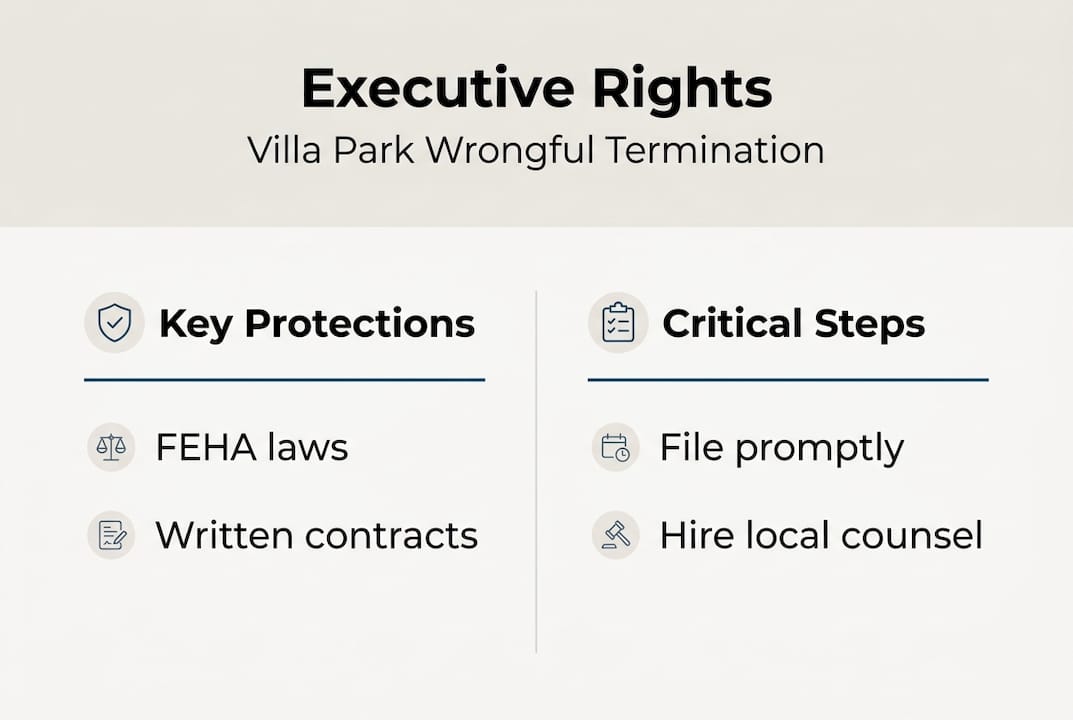
Speed is not optional in California. Missing a filing deadline ends your case regardless of its merit. The Department of Fair Employment and Housing (now the Civil Rights Department) has specific timelines, and some claims require an administrative complaint before you can file in court. Local discrimination lawyers in Villa Park understand these procedural steps and can prevent costly mistakes.
Pro Tip: Do not assume your arbitration clause eliminates your rights. California courts have invalidated arbitration agreements that are unconscionable or that waive statutory rights. Have an attorney review yours before assuming litigation is off the table.
Local law firm specialization also matters. A firm that regularly handles executive contract disputes in Orange County will know the local judges, understand regional employer patterns, and have a realistic read on settlement values in your specific market.
How executive wrongful termination cases proceed
Knowing the general process helps you make smarter decisions at every stage. Here is what a typical executive wrongful termination claim looks like from start to finish.
- Document everything immediately. Before you do anything else, preserve emails, performance reviews, meeting notes, and any communications related to your termination. Do not delete anything, and do not rely on your employer to preserve records.
- Consult an employment attorney. Early advice shapes every decision that follows. Villa Park law attorneys can assess your contract, identify your strongest claims, and advise on whether to file administratively or move directly.
- File an administrative complaint if required. FEHA discrimination and retaliation claims typically require a complaint with the California Civil Rights Department before you can sue in court.
- Enter negotiation or mediation. Many executive cases resolve at this stage. Employers often prefer confidential settlements to public litigation, and that preference creates leverage for you.
- Proceed to arbitration or litigation. If settlement fails, your case moves to arbitration (if your contract requires it) or to court. Employment law experts who have handled similar executive disputes know how to build a case that holds up under scrutiny.
“The biggest mistake executives make is waiting. They assume the situation will resolve itself, or they feel embarrassed to admit they were fired. Every week of delay weakens your position.”
California wrongful termination statutes run between 1 and 3 years depending on the claim type, and contingency fee arrangements are common, meaning you may not need to pay upfront legal fees. That removes one of the biggest barriers executives face when deciding whether to act.

Typical case duration ranges from several months for negotiated settlements to two or more years for fully litigated matters. The earlier you engage counsel, the more options you have.
Critical factors that strengthen (or weaken) your case
Successful cases often hinge on written contracts, contemporaneous documentation, and prompt filing. Understanding what courts and arbitrators look for gives you a real advantage.
| Strengthening factors | Weakening factors |
|---|---|
| Written employment contract with specific terms | Vague or verbal agreements only |
| Documented positive performance history | Recent formal performance warnings |
| Clear timeline linking termination to protected activity | Long gap between protected activity and termination |
| Preserved communications showing employer intent | Deleted or missing records |
| Prompt filing within statutory deadlines | Delayed action past filing windows |
Here is what arbitrators and judges scrutinize most closely in executive cases:
- The paper trail: Employers build termination narratives over time. If your file suddenly shows problems that were never raised in prior reviews, that inconsistency matters.
- Comparator evidence: Were similarly situated employees treated differently? If a younger, less experienced colleague kept a role you lost, that comparison is relevant.
- Timing: A termination that follows a complaint, a leave request, or a protected disclosure by days or weeks raises immediate questions.
- Employer communications: Internal emails discussing your role, your compensation, or your complaints before your termination can be devastating for the employer if they reveal discriminatory thinking.
Avoid the most common mistakes executives make: signing severance agreements without legal review, assuming non-disparagement clauses prevent you from filing claims, and failing to document best practices from the moment you sense trouble. Your instincts about what is happening in your workplace are usually right. Trust them enough to act.
A critical perspective: Why acting fast and hiring local counsel changes everything
Here is something most executives do not hear until it is too late: your contract is not your protection. Your attorney is.
We see it repeatedly. A senior executive gets terminated, spends weeks processing what happened, consults a general practice attorney who handles everything from estate planning to traffic tickets, and finally contacts an employment specialist three months later. By then, evidence has disappeared, witnesses have moved on, and the employer’s legal team has had a head start building their defense.
The executives who achieve the best outcomes are the ones who treat their termination like a legal emergency from day one. They call Villa Park legal experts within days, not months. They preserve every document before returning company equipment. They say nothing to HR without understanding the implications.
Local counsel is not a luxury. An attorney who knows Orange County’s employment landscape, understands how local employers typically respond to claims, and has relationships within the regional legal community brings advantages that a distant generalist simply cannot replicate. Jurisdiction-specific knowledge changes outcomes. Act on it.
Connect with leading Villa Park employment law attorneys
If you are an executive facing termination or recently let go from a Villa Park firm, the next step is a direct conversation with attorneys who handle exactly these situations. At Serendib Law Firm, our employment law team works with executives across Orange County, including clients served by our Lake Forest employment attorneys and Huntington Beach employment lawyers. We review contracts, assess claims, and move quickly because timing matters. Free consultations are available, and we handle select cases on contingency. You do not have to navigate this alone, and you should not wait to find out where you stand.
Frequently asked questions
How quickly should an executive file a wrongful termination claim in Villa Park?
Act immediately. California claim statutes allow as little as 1 to 3 years depending on claim type, and some require administrative filings before that window closes.
What types of damages are possible in executive wrongful termination cases?
Executives may recover back pay, compensatory damages, and in some cases punitive damages. A public sector settlement in Illinois reached $550K, including $299K in back pay and $225K in compensatory damages, illustrating the real financial stakes.
Do executive contracts in Villa Park waive all wrongful termination rights?
No. FEHA protects executives against discrimination and retaliation regardless of contract terms, and California courts will not enforce clauses that strip away statutory rights.
Is arbitration required for executive wrongful termination in Villa Park?
Not always. Arbitration clauses are common in executive contracts, but California courts have voided agreements that are unconscionable or that waive protected statutory rights. Review your contract with counsel before assuming anything.
Why choose a local Villa Park employment law attorney for executive cases?
Local attorneys understand Orange County procedures, FEHA nuances, and regional employer behavior patterns, all of which can significantly shift the outcome of an executive wrongful termination case.
Recommended
- Executive Employment Contracts—Villa Park Wrongful Termination Risks | Serendib Law Firm
- Employment Contract Disputes: Protecting Executives in Villa Park | Serendib Law Firm
- Experienced Villa Park Employment Law Attorneys
- Experienced Villa Park Workplace Retaliation Lawyers
- Labor Law Audit Services | Compliance Experts Nestlers