

TL;DR:
- Kaiser employees in Southern California face retaliation risks after reporting workplace safety or regulatory violations.
- California law provides strong protections, allowing claims within three years of retaliation incidents.
- Early legal consultation and thorough documentation significantly improve chances of success in retaliation cases.
Many Kaiser Permanente employees in Southern California search for legal help near Fountain Valley, only to discover that no Kaiser facility exists directly in that city. The closest Kaiser sites are in Fontana, Baldwin Park, and Woodland Hills, roughly 50 miles away. Yet the legal stakes are very real. A landmark $41.5M verdict was awarded to a Kaiser nurse who reported unsafe staffing levels, and a Kaiser pharmacist reached a tentative settlement in February 2026 for whistleblower retaliation. If you work at a Kaiser facility and believe you have faced retaliation, this guide explains how to recognize it, what laws protect you, and exactly what steps to take.
Table of Contents
- Understanding healthcare retaliation: What it is and how it happens
- Legal protections for healthcare whistleblowers in California
- Case benchmarks: Kaiser Permanente retaliation lawsuits in Southern California
- Next steps: Reporting retaliation and seeking legal help
- A fresh perspective: What most Kaiser employees miss about retaliation cases
- How experienced local attorneys help Kaiser employees fight retaliation
- Frequently asked questions
Key Takeaways
| Point | Details |
|---|---|
| Retaliation is actionable | Healthcare workers reporting violations have strong legal protections against workplace retaliation. |
| Kaiser cases set precedents | Recent multimillion-dollar verdicts show the effectiveness of legal action for retaliation claims. |
| Documentation is critical | Keeping thorough records and evidence increases your chances of winning a retaliation case. |
| Deadlines matter | You must file your claim within three years with the Civil Rights Department or court to preserve your rights. |
| Legal guidance pays off | Early consultation with experienced employment attorneys can tip the balance toward a successful outcome. |
Understanding healthcare retaliation: What it is and how it happens
Retaliation in a healthcare setting happens when an employer punishes a worker for doing something legally protected. That punishment can take many forms, and it does not always look like a firing. Sometimes it is a sudden demotion, a shift change designed to isolate you, exclusion from meetings, or a pattern of negative performance reviews that started only after you raised a concern.
The most common triggers for retaliation at large healthcare organizations like Kaiser include:
- Reporting unsafe patient staffing levels
- Flagging violations of state or federal health regulations
- Disclosing controlled substance mishandling
- Complaining about workplace discrimination or harassment
- Cooperating with a government investigation
Retaliation often follows protected activity like reporting patient safety violations. The connection between burnout and retaliation risk is not accidental. When nurses and pharmacists are stretched thin, they are more likely to raise alarms, and that makes them targets. A striking 96% nurse burnout rate has been reported in Southern California Kaiser facilities, a figure directly linked to elevated retaliation risks.
Understanding worker burnout and retaliation as interconnected problems is essential. Burnout pushes employees to speak up. Speaking up, without legal protection in place, can expose them to employer backlash. Recognizing the early signs of retaliation, such as sudden exclusion from team communications or unexplained changes in your schedule, gives you time to act before the situation worsens.
If you suspect retaliation, consult Fountain Valley retaliation lawyers who understand the specific dynamics of healthcare workplace disputes.
Pro Tip: Document every communication and incident right away. Save emails, memos, text messages, and performance reviews with timestamps. This paper trail becomes your most powerful evidence if you file a claim.
Legal protections for healthcare whistleblowers in California
Once you recognize retaliation, the next step is understanding what the law actually says. California offers some of the strongest whistleblower protections in the country, and healthcare workers benefit from several overlapping statutes.
California Labor Code Section 1102.5 prohibits retaliation for reporting suspected violations of any law, rule, or regulation. Importantly, the law does not require that the person you reported to was unaware of the violation. You are protected simply for making the disclosure in good faith.
Protected activities under California law include:
- Reporting patient safety concerns to a supervisor or government agency
- Disclosing illegal recording or surveillance practices
- Flagging controlled substance irregularities
- Filing a complaint about workplace discrimination under FEHA (the Fair Employment and Housing Act)
- Refusing to participate in activity you reasonably believe is unlawful
“California law strongly protects healthcare whistleblowers. Timely filing is crucial, because missing a deadline can eliminate your right to recover damages entirely.”
Here is a quick summary of the key statutes and their scope:
| Statute | What it covers | Filing deadline |
|---|---|---|
| Labor Code 1102.5 | Reporting any legal violation | 3 years (Civil Rights Dept.) |
| FEHA | Discrimination and retaliation | 3 years (Civil Rights Dept.) |
| Health & Safety Code 1278.5 | Patient care complaints | As short as 6 months and up to 3 years |
| Labor Code 6310 | Workplace safety reports | As short as 6 months and up to 3 years |
Exploring the full scope of whistleblower protections available to healthcare workers can reveal options you did not know existed. The Anaheim retaliation attorneys at our firm regularly guide Kaiser employees through these statutes and help them identify the strongest legal path forward.
Case benchmarks: Kaiser Permanente retaliation lawsuits in Southern California
Legal rights matter most when you can see them applied in real cases. Two recent Kaiser cases set powerful benchmarks for what is possible when employees pursue retaliation claims with strong evidence and skilled legal counsel.
| Case | Employee | Facility | Allegation | Outcome |
|---|---|---|---|---|
| Gatchalian v. Kaiser | Maria Gatchalian, RN | Woodland Hills | Fired after reporting unsafe staffing | $41.5M verdict (2023) |
| Nguyen v. Kaiser | Lin Nguyen, pharmacist | Baldwin Park | Whistleblower retaliation | Tentative settlement (Feb 2026) |
These cases reveal a consistent pattern. Kaiser’s legal defense typically argues that adverse actions were based on performance issues or policy violations, not retaliation. That is exactly why documentation and timing matter so much. When an employee can show that negative reviews or termination followed closely after a protected report, the employer’s argument weakens significantly.
Here is how a typical retaliation case moves from start to finish:
- Employee engages in a protected activity, such as reporting a safety concern
- Employer takes an adverse action, such as demotion or termination
- Employee documents the connection between the report and the adverse action
- Employee consults an attorney and files with the California Civil Rights Department
- Investigation or litigation proceeds, often leading to settlement or trial
- Verdict or settlement is reached
Multimillion verdicts and settlements are achievable, but they require strong evidence, clear timelines, and experienced legal representation. Working with Fountain Valley employment lawyers who know the healthcare industry gives your case a measurable advantage. The worker burnout and retaliation landscape at Kaiser is well documented, and attorneys familiar with these cases know how to frame your story effectively.

Next steps: Reporting retaliation and seeking legal help
Knowing your rights is only useful if you act on them. Here is a practical roadmap for Kaiser employees who believe they are facing retaliation.
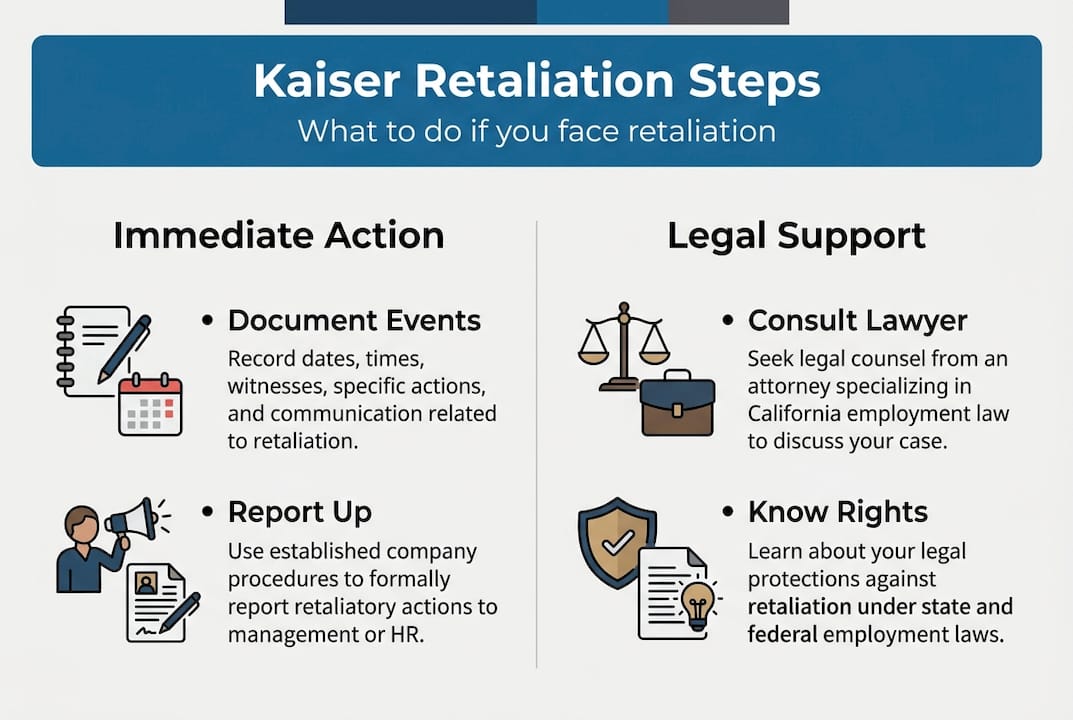
- Document everything immediately. Write down dates, times, names, and descriptions of every incident. Save all written communications.
- Report internally if safe to do so. Notify your supervisor or HR in writing. Keep copies of all responses.
- Escalate to the California Civil Rights Department. If internal reporting fails or is unsafe, file a formal complaint with the state agency.
- Consult an employment attorney. An attorney can evaluate your evidence, identify legal theories, and advise on strategy before you take further steps.
- File within the deadline. File with the CA Civil Rights Dept within 3 years, or pursue a direct court action within the applicable statute of limitations.
When choosing an attorney, look for:
- Specific experience with healthcare retaliation and Kaiser cases
- A contingency fee arrangement so you pay nothing unless you win
- A proven track record with FEHA and Labor Code claims
- Bilingual staff if English is not your primary language
- Clear communication about timelines and realistic outcomes
Pro Tip: Start building your timeline the moment you suspect retaliation. Courts and investigators look closely at the gap between your protected activity and the employer’s adverse action. A short gap strengthens your claim. Waiting too long to document can make that connection harder to prove.
Connecting with local retaliation attorneys who understand healthcare whistleblower protections is often the single most important step you can take after experiencing adverse action at work.
A fresh perspective: What most Kaiser employees miss about retaliation cases
Here is something most articles will not tell you: reporting a problem does not automatically protect you. Many employees believe that the act of filing a complaint creates a legal shield around them. It does not. Protection depends on how, when, and to whom you reported, and whether you can prove the connection between your report and what happened next.
The cases that fail most often are not the ones with weak facts. They are the ones where employees waited too long, kept no records, or assumed their employer would act in good faith. Kaiser is a sophisticated organization with experienced legal teams. Winning against that requires preparation, not just courage.
What the worker burnout insights from recent cases show is that early legal consultation changes outcomes. An attorney who reviews your situation before you file anything can help you avoid missteps that are very difficult to correct later. Most multimillion verdicts you read about involved employees who acted quickly and strategically, not just employees who had a strong moral case.
The uncomfortable truth is that most retaliation cases settle quietly, without headlines. That is not a bad outcome. A well negotiated settlement can restore your financial stability and protect your career. Strong legal guidance is what tips the balance between a dismissed claim and a meaningful recovery.
How experienced local attorneys help Kaiser employees fight retaliation
If you are a Kaiser employee in Southern California facing retaliation, the distance between you and the right legal help may be shorter than you think. At Serendib Law Firm, we work with healthcare workers across the region, including those near Lake Forest and Huntington Beach, who are navigating complex retaliation claims against large employers like Kaiser. Our team offers free consultations, contingency fee arrangements, and bilingual support in English and Spanish. We know how these cases are built and how Kaiser defends them. Reaching out early gives you the best chance at a meaningful outcome. Contact us today to discuss your situation.
Frequently asked questions
Is there a Kaiser facility in Fountain Valley?
No Kaiser Permanente facility exists directly in Fountain Valley. The nearest Kaiser locations are in Fontana, Baldwin Park, and Woodland Hills, approximately 50 miles away.
What types of protected activities can trigger retaliation claims?
Reporting patient safety concerns, illegal activity, discrimination, or regulatory violations are all protected under California law. California Labor Code Section 1102.5 prohibits retaliation for disclosing any suspected legal violation in good faith.
How long do I have to file a retaliation claim in California?
Employees generally have up to 3 years to file with the California Civil Rights Department or pursue a direct court action, depending on the specific statute involved.
What evidence is needed to prove retaliation at Kaiser?
Key evidence includes documented reports, the timing of adverse actions relative to your protected activity, written policies, and witness statements. Courts also look at pretextual reasons and disparate treatment to establish the employer’s true motive.
Can I afford to hire a lawyer for a Kaiser retaliation case?
Yes. Many employment attorneys in California handle retaliation cases on contingency fee arrangements, meaning you pay nothing unless your case results in a win or settlement.