

TL;DR:
- Pregnancy discrimination in universities often involves subtle actions like denial of accommodations and exclusion.
- California law offers strong protections, including job and leave rights, for pregnant employees.
- Immediate documentation and legal consultation are crucial steps when facing workplace discrimination.
Pregnancy discrimination is more common in academic workplaces than most people expect. If you work at Chapman University in Orange and you’ve been denied accommodations, pushed off projects, or treated differently since announcing your pregnancy, you are not alone. Many employees feel uncertain about whether what they’re experiencing is actually illegal, or they worry that speaking up will make things worse. This guide breaks down exactly what pregnancy discrimination looks like, which laws protect you, how to spot warning signs on campus, and what concrete steps you can take to protect your career and your rights.
Table of Contents
- Understanding pregnancy discrimination in the workplace
- Legal protections for pregnant employees at Chapman University
- How to recognize pregnancy discrimination at Chapman University
- Steps to take if you experience discrimination at Chapman University
- Why most university employees underestimate pregnancy discrimination risks
- How legal support empowers Chapman University employees
- Frequently asked questions
Key Takeaways
| Point | Details |
|---|---|
| Know your rights | Federal and state laws protect employees at Chapman University against pregnancy discrimination. |
| Watch for subtle bias | Discrimination can take many forms and sometimes appears as minor policy changes or workload shifts. |
| Document everything | Keep records of interactions and requests to support your case if you need to take action. |
| Act promptly | Filing complaints and legal claims has strict deadlines, so do not delay if you experience issues. |
Understanding pregnancy discrimination in the workplace
Pregnancy discrimination happens when an employer treats you unfavorably because of pregnancy, childbirth, or a related medical condition. At a university like Chapman, it can look very different from what people imagine. It is not always a supervisor saying something overtly hostile. Often, it is quieter and harder to name.
Common examples include:
- Denial of accommodations such as extra bathroom breaks, modified lifting requirements, or a temporary schedule change
- Unfair workload changes like suddenly being assigned less desirable courses or research duties after announcing a pregnancy
- Hostile or dismissive comments from supervisors or colleagues about your ability to perform your role
- Retaliation after requesting leave or reporting a concern to HR
- Exclusion from meetings, committees, or professional opportunities that affect your career advancement
As the EEOC guidelines make clear, federal and California laws prohibit discrimination based on pregnancy, childbirth, or related medical conditions. This means your employer cannot legally treat you worse than a non-pregnant employee in a comparable situation.
At the state level, California’s Fair Employment and Housing Act (FEHA) goes even further than federal law, covering employers with five or more employees and requiring reasonable accommodations. If you’ve experienced pregnancy discrimination in Santa Ana or nearby cities, the same protections apply throughout Orange County.
“Discrimination doesn’t have to be loud to be illegal. A pattern of small, unfair actions can be just as harmful as a single egregious incident.”
One area that surprises many employees is light duty denials. If your doctor recommends modified duties and your employer refuses without a valid reason, that refusal may constitute discrimination under California law.
Pro Tip: Keep a private written record of any workplace interactions that feel off, even if you’re not sure they’re illegal. Dates, names, and specific details matter enormously if you later decide to file a complaint.
Legal protections for pregnant employees at Chapman University
Understanding which laws protect you is the foundation of any discrimination claim. As a Chapman University employee, you are covered by a layered set of federal and California state protections.
California pregnancy leave laws are among the strongest in the country. Here is a comparison of the key laws that apply to you:
| Law | Coverage | Leave Duration | Who Qualifies |
|---|---|---|---|
| Title VII (federal) | Employers with 15+ employees | Varies | All employees |
| FMLA (federal) | Employers with 50+ employees | Up to 12 weeks | 12 months of service |
| FEHA (California) | Employers with 5+ employees | Varies | Most employees |
| PDL (California) | Employers with 5+ employees | Up to 4 months | Disabled by pregnancy |
| CFRA (California) | Employers with 5+ employees | Up to 12 weeks | 12 months of service |
The Pregnancy Disability Leave (PDL) law is especially important. It allows you to take up to four months of leave if your pregnancy or a related condition physically disables you, and your job must be protected during that time. California’s FEHA protections for educators apply regardless of whether you are a full-time faculty member, an adjunct instructor, or a staff employee.
Key protections you are entitled to include:
- Reasonable accommodations for pregnancy-related conditions, including modified duties and schedule changes
- Job protection during pregnancy disability leave and CFRA leave
- Reinstatement to the same or a comparable position after leave
- Protection from retaliation for requesting or taking leave
Chapman University, as a large private employer in California, is required to comply with all of these laws. Understanding the types of related leaves available to you can help you plan your situation and know what to demand from your employer.
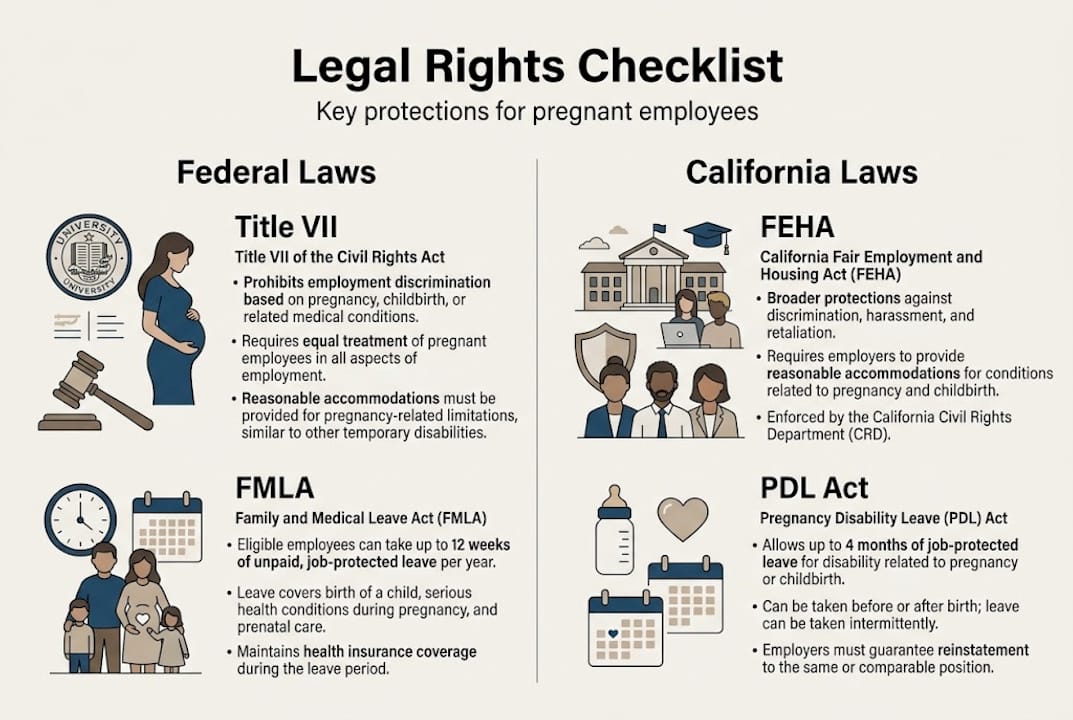
As California’s FEHA broadly protects pregnancy-related employment issues, even employees who do not qualify for FMLA may still have strong state-level protections. Do not assume federal law is your only option.
How to recognize pregnancy discrimination at Chapman University
Spotting discrimination is not always straightforward. Some of the most damaging forms are subtle and build over time. Knowing what to look for gives you a real advantage.
Here are the most common ways discrimination shows up in a university setting:
- Changes to job assignments after announcing your pregnancy, such as being moved off a high-profile research project or having your course load altered without explanation
- Negative performance evaluations that appear suddenly after you request accommodations or announce your pregnancy
- Exclusion from key meetings or departmental decisions that affect your role
- Increased scrutiny or micromanagement that was not present before your pregnancy
- Denial of leave requests or delays in processing accommodation paperwork
Subtle warning signs are often harder to address but equally important:
- Colleagues who previously collaborated with you now avoid working with you
- Your supervisor suddenly documents minor mistakes that were previously overlooked
- Policy changes that seem neutral but disproportionately affect pregnant employees
- Informal exclusion from social or professional events
Retaliation is a serious concern. EEOC charge statistics show that a significant percentage of pregnancy-related complaints involve retaliation or denial of practical accommodations. Retaliation can happen after you report a concern, request leave, or simply ask for an accommodation.
If you work in Orange and notice these patterns, understanding Orange CA pregnancy discrimination trends can help you contextualize your experience. Similarly, if you’ve faced pushback after taking CFRA leave, learning about Orange pregnancy retaliation protections is a smart next step.
Pro Tip: If you suspect discrimination, start a private log outside of work systems. Use a personal email or notebook to record dates, what was said, who was present, and how it affected your work.
Steps to take if you experience discrimination at Chapman University
Knowing your rights matters, but taking the right steps at the right time is what protects them. Here is a clear plan to follow.
Immediate actions:
- Document everything. Write down every incident with dates, times, locations, and names. Save relevant emails, texts, or messages to a personal device.
- Request accommodations in writing. Do not rely on verbal conversations. Email your supervisor or HR so there is a record.
- Report to HR. File a formal written complaint with Chapman’s HR department. Keep a copy for yourself.
- Consult an employment attorney. Before signing anything or accepting any settlement, get legal advice.
- File an external complaint if needed. You can file with the California Civil Rights Department (CRD) or the EEOC.
| Agency | Deadline to File | What They Handle |
|---|---|---|
| California Civil Rights Department | 3 years from last act | State law violations (FEHA, PDL) |
| EEOC (federal) | 300 days from last act | Federal law violations (Title VII) |
| Chapman University HR | Per internal policy | Internal grievance resolution |
Deadlines matter. As the California Civil Rights Department explains, internal complaints and legal claims must be filed promptly because statutes of limitations apply. Missing a deadline can permanently bar your claim, no matter how strong it is.
If you are considering a formal claim, understanding the accommodation lawsuits steps involved can help you prepare and set realistic expectations for the process.
Pro Tip: Even if you are not ready to file a claim, consulting an attorney early is free at many firms and can help you understand whether what you’re experiencing crosses the legal line.
Why most university employees underestimate pregnancy discrimination risks
Here is something we see repeatedly: employees at universities like Chapman often assume they are safer from discrimination than workers in other industries. The reasoning makes sense on the surface. Academic institutions tend to have progressive reputations, robust HR departments, and written equity policies. But those things do not automatically translate into fair treatment on the ground.
The uncomfortable truth is that HR departments work for the university, not for you. Their job is to manage risk for the institution, which is not always the same as protecting your rights. Relying solely on internal processes without understanding your legal options can leave you exposed.
Understanding understanding leave options and your full range of protections is not just useful, it is necessary. Academic culture can also create informal pressure to minimize complaints or push through difficulties to protect your professional reputation. That pressure is real, but it should never stop you from asserting rights the law guarantees you.
How legal support empowers Chapman University employees
If you are a Chapman University employee facing pregnancy discrimination, working with an experienced employment attorney can make a real difference. At Serendib Law Firm, we help university employees navigate everything from internal HR complaints to formal litigation. Our Orange law attorneys understand the specific dynamics of academic workplaces and know how to build strong cases under both California and federal law. Whether you need help requesting accommodations, responding to retaliation, or filing a claim, our Lake Forest employment law attorneys offer confidential consultations to help you understand your options and take the right next step.
Frequently asked questions
What should I do first if I suspect pregnancy discrimination at Chapman University?
Documentation and prompt reporting are key steps recommended by the EEOC. Start by writing down all relevant interactions and reporting your concerns to HR in writing, keeping a copy for yourself.
Are adjunct or part-time faculty also protected under pregnancy discrimination laws?
Yes. FEHA and Title VII extend protections to a broad range of employees, including part-time and adjunct faculty at universities like Chapman.
How long do I have to file a discrimination claim in California?
You generally have three years from the last act of discrimination to file with the California Civil Rights Department, as outlined by updated time limits in state law.
What kinds of accommodations must Chapman University provide during my pregnancy?
Chapman must provide reasonable accommodations such as modified duties, schedule adjustments, and additional breaks. As California employers are required to accommodate pregnancy, refusal is only permitted if it creates genuine undue hardship.
Recommended
- Pregnancy Discrimination and Light Duty Denials: Santa Ana Guide | Serendib Law Firm
- Orange Pregnancy Retaliation: CFRA Leave Rights Defended
- Pregnancy Discrimination in Fullerton Schools: How the FEHA Protects Educators | Serendib Law Firm
- Pregnancy Discrimination and Types of Related Leaves | Serendib Law Firm