

TL;DR:
- California overtime laws require pay after 8 hours daily, with double time after 12 hours.
- Common violations include off-the-clock work, misclassification, and skipped meal breaks.
- Proper documentation and legal action are essential to recovering unpaid wages.
You clock out after a 10-hour shift, but your paycheck only reflects eight hours. Sound familiar? Thousands of warehouse workers across Stanton lose hundreds, sometimes thousands, of dollars each year because of quiet, systematic overtime violations. Employers count on you not knowing the rules. They use confusing scheduling, informal instructions, and misclassification to avoid paying what you’ve legally earned. This guide breaks down exactly how California overtime law protects you, what violations look like on the warehouse floor, how to document your case, and what steps to take when you’re ready to recover your money.
Table of Contents
- How overtime law really works for Stanton warehouse jobs
- Top overtime violations in Stanton logistics and warehouse jobs
- How to document your hours and build a strong claim
- Reporting violations and recovering lost overtime pay
- Why vigilance matters: Lessons from Stanton and beyond
- Get expert help for your warehouse overtime claim
- Frequently asked questions
Key Takeaways
| Point | Details |
|---|---|
| California overtime is stronger | You earn overtime after 8 hours in a day or 40 in a week, not just weekly like federal law. |
| Common employer violations | Off-the-clock work, false exemptions, and misclassifying hours cheat workers out of their rights. |
| Document everything | Detailed personal records are your best defense—keep all timecards, logs, and evidence. |
| Claims bring real results | You can confidentially file for back pay and penalties, with strong protections against retaliation. |
How overtime law really works for Stanton warehouse jobs
California doesn’t follow the same overtime rules as the rest of the country, and that difference matters a lot for warehouse workers. Under federal law, the Fair Labor Standards Act (FLSA) only requires overtime pay after 40 hours in a workweek. California goes further. California overtime law requires 1.5x pay after 8 hours per day or 40 hours per week, with double time kicking in after 12 hours in a single day. That daily threshold is the key distinction most workers don’t know about.
This matters enormously in logistics. Warehouse shifts often run 9, 10, or even 12 hours, especially during peak seasons. Under California law, those extra hours must be compensated at a higher rate, even if your total weekly hours haven’t crossed 40 yet. Most Stanton warehouse and logistics workers are covered by these state protections, regardless of whether they’re paid hourly or on a piece-rate basis.
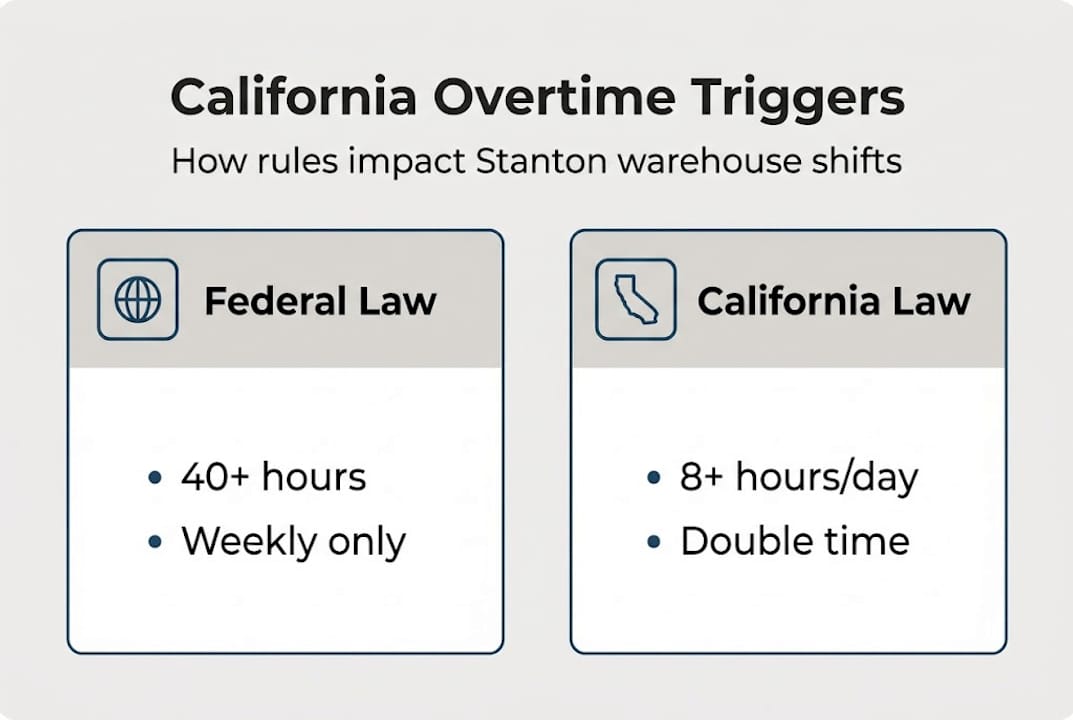
| Overtime trigger | Federal FLSA | California law |
|---|---|---|
| Daily overtime (1.5x) | None | After 8 hours/day |
| Weekly overtime (1.5x) | After 40 hours | After 40 hours |
| Double time | None | After 12 hours/day |
| 7th consecutive day | None | Full shift at 1.5x, over 8 hrs at 2x |
Here’s a number that should stop you: 1 in 3 California workers encounter overtime problems at some point in their employment. In high-volume distribution environments like those in Stanton, that rate climbs even higher.
Who is covered? Most hourly warehouse employees, forklift operators, loaders, pickers, packers, and logistics support staff qualify for these protections. Supervisors and salaried workers may be exempt, but the label doesn’t always match the legal definition. Employers sometimes misclassify workers to avoid paying overtime. You can learn more about overtime rights in Stanton and how to tell if your job classification is accurate.
Pro Tip: Even if your employer calls you a “team lead” or gives you a small salary bump, that doesn’t automatically make you exempt from overtime. The law looks at your actual job duties, not just your title.
Common overtime triggers warehouse workers often miss include:
- Working through meal breaks without pay
- Mandatory pre-shift meetings or safety briefings
- Clocking out before completing required closing tasks
- Being asked to stay late “just this once” repeatedly
Understanding wage violations in warehouses starts with knowing these triggers exist.
Top overtime violations in Stanton logistics and warehouse jobs
Understanding the laws is step one, but what about the tactics employers use to avoid paying what you’ve earned? The violations showing up most often in Stanton warehouses fall into a few consistent patterns, and once you know what to look for, they’re hard to miss.
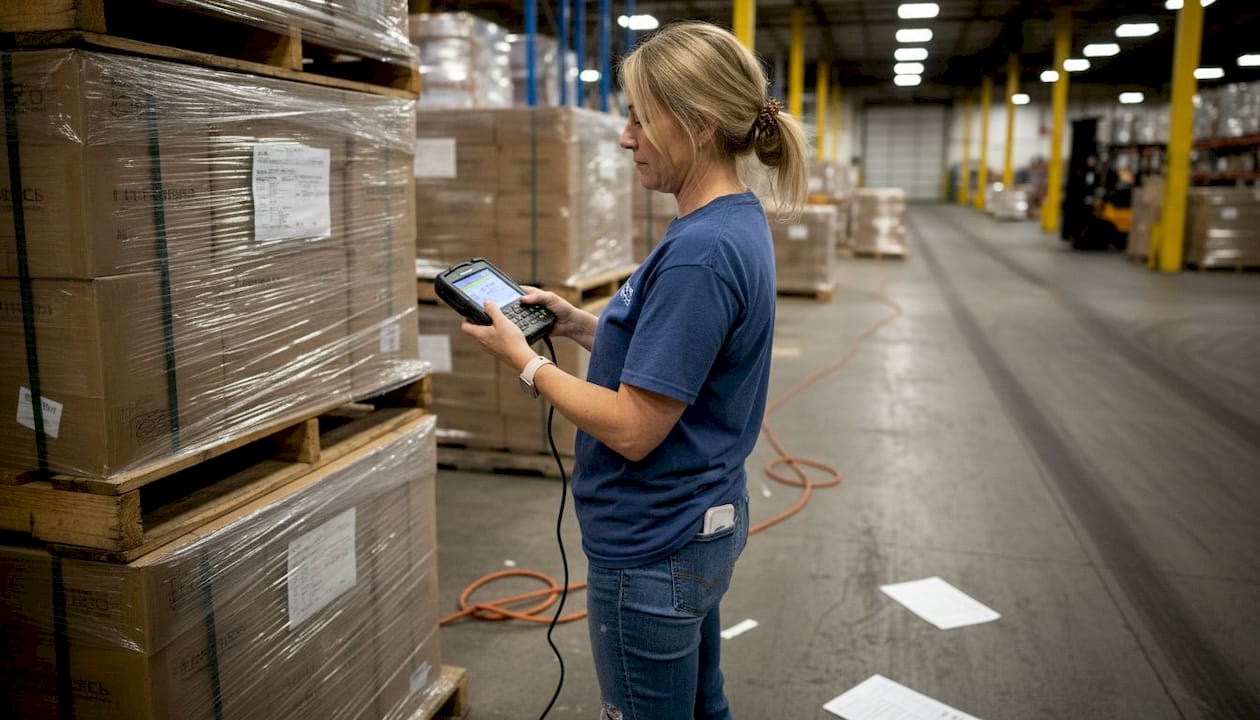
Off-the-clock work is the most common. This happens when workers are asked to do inventory counts, equipment checks, or safety walkthroughs before clocking in, or when they’re expected to finish paperwork and clean up after clocking out. Common overtime violations in Stanton logistics include exactly these pre and post-shift tasks. Every minute of that work is compensable time under California law.
Improper hour averaging is another widespread tactic. An employer might schedule you for 10 hours on Monday and only 6 hours on Wednesday, then claim your “average” doesn’t trigger overtime. That’s not how California law works. Each day stands on its own for the purpose of calculating daily overtime.
Misclassification as exempt is more subtle but just as costly. Workers labeled as assistant managers, lead associates, or supervisors may be denied overtime under the assumption they’re exempt. But misclassification in logistics is a recognized problem across Orange County, and many of these workers are legally entitled to overtime pay.
| Violation type | What it looks like | What to watch for |
|---|---|---|
| Off-the-clock work | Pre-shift tasks, post-shift cleanup | Unpaid minutes before/after punching |
| Hour averaging | Uneven schedules presented as “balanced” | Daily hours over 8 not paid at 1.5x |
| Exempt misclassification | Supervisor title without real authority | Performing same tasks as hourly staff |
| Meal break violations | Skipped or interrupted breaks | No premium pay for missed breaks |
Orange County has seen a notable surge in wage claims. Nearby Garden Grove reported a 25% increase in claims in recent years, suggesting a regional pattern that extends directly into Stanton. Meal break violations in warehouses often accompany overtime issues and can add significant value to your claim.
Pro Tip: If your supervisor asks you to start pulling orders, checking inventory, or moving equipment before you’ve clocked in, that is work time. Document it immediately, even a quick note in your phone with the date and duration helps.
If you work for a large fulfillment operation, Amazon warehouse wage issues follow similar patterns and have resulted in significant recoveries for workers who took action.
How to document your hours and build a strong claim
If you’ve spotted an issue, it’s time to secure the evidence. This is the step most workers skip, and it’s the one that matters most when a claim goes to dispute.
Here’s a step-by-step approach to building your documentation:
- Collect every pay stub. Pay stubs show your recorded hours and pay rate. Discrepancies between what you worked and what’s listed are your starting point.
- Keep copies of your time cards. Whether digital or paper, preserve every record of your clocked hours. If you only have access to a physical card, photograph it before turning it in.
- Write a daily log. Each day, note when you actually started working, when you clocked in, when you clocked out, and when you actually stopped working. Even a notes app on your phone works.
- Save all schedules. Employer-issued schedules show what hours you were assigned. Compare these against your actual time records.
- Preserve text messages and emails. If a supervisor texted you to come in early or stay late, that message is evidence. Screenshot and back it up outside your work device.
Evidence needed for a strong claim includes personal records of hours, pay stubs, schedules, and logs of extra tasks. Courts and labor agencies give significant weight to consistent, contemporaneous records, meaning notes you made at the time, not reconstructed later.
Other powerful but often overlooked evidence includes:
- Witness statements from coworkers who observed the same practices
- Security badge swipe records showing when you entered and exited the facility
- GPS or delivery logs if your job involves any driving
- Handwritten notes from supervisors about tasks to complete
Pro Tip: Back up all digital records to a personal cloud account or email them to yourself. If you’re terminated or lose access to work systems, you’ll still have your evidence.
One more critical point: the law prohibits your employer from retaliating against you for asserting your rights. Protection from employer retaliation is built into both California and federal law. If you’re demoted, scheduled for fewer hours, or fired after raising concerns, that retaliation itself may be a separate legal claim.
Reporting violations and recovering lost overtime pay
With your documentation ready, here’s the process for moving forward and getting what you’re owed.
You have three main options for filing a claim:
- US Department of Labor, Wage and Hour Division. You can call 1-866-4USWAGE to file a confidential complaint. Federal investigators can pursue claims under the FLSA on your behalf at no cost to you.
- California Labor Commissioner’s Office (DLSE). This is often the better route for California workers because state law provides stronger protections. You file a wage claim, and the agency investigates your employer.
- Private lawsuit. You can also file directly in court, either individually or as part of a class action wage case if multiple coworkers experienced the same violations. Private lawsuits can recover more, including attorney fees paid by the employer.
Workers can file confidential claims with the US DOL or CA Labor Commissioner, and private lawsuits are possible under the FLSA and California Labor Code for back pay, liquidated damages, and penalties.
Here’s what you can recover:
- Back pay: Every unpaid overtime hour you can document
- Liquidated damages: Often equal to the amount of back pay owed, effectively doubling your recovery
- Civil penalties: California imposes additional penalties on employers who willfully violate wage laws
- Attorney fees: In most successful cases, your employer pays your legal costs
The time limit matters. You have a 3-year statute of limitations to claim back pay, liquidated damages, and penalties under California law. Don’t wait. Every month you delay is a month of potential recovery you may lose. Learn more about the local overtime claim process and how it applies to your situation.
Why vigilance matters: Lessons from Stanton and beyond
Here’s what we’ve observed working with Orange County warehouse workers: overtime violations aren’t random mistakes. They’re patterns. The same tactics appear across facilities, across companies, and across zip codes. When 1 in 3 California workers face overtime issues, and nearby Garden Grove shows a 25% surge in claims, that’s not a coincidence. It’s a regional pattern rooted in the economics of logistics.
The uncomfortable truth is that complacency is an employer’s best tool. Workers who assume “it’s just how it works here” or “I don’t want to cause trouble” are the ones who lose the most money over time. We’ve seen workers recover years of back pay simply because they kept a consistent log and reached out early.
Organization is power. Workers who document regularly, talk to coworkers, and contact an attorney sooner rather than later consistently see better outcomes. A deep-dive into Stanton overtime claims shows that the strongest cases aren’t always the most dramatic ones. They’re the ones with the clearest paper trail. Start yours today.
Get expert help for your warehouse overtime claim
If you’ve recognized any of these violations in your own workplace, you don’t have to figure out the next step alone. At Serendib Law, our employment attorneys work with warehouse and logistics workers across Orange County, including Stanton, to recover unpaid overtime. We handle both individual and group claims, often on a contingency basis, meaning you pay nothing unless we win. A free consultation can help you understand exactly what your case is worth and what your options are. Whether you’re ready to file an overtime claim or just need answers, our team is ready to help. You can also explore Lake Forest employment law help to learn more about our broader services across the region.
Frequently asked questions
What is considered working off the clock in a Stanton warehouse job?
Any work done before or after your shift, like inventory, waiting, or equipment prep, must be paid and counts as overtime if it pushes you over daily or weekly limits. Off-the-clock tasks are one of the most common violations in Stanton logistics.
How long do I have to file a claim for unpaid overtime?
You have up to three years from the date of the violation to file for unpaid overtime, including back pay and damages. Acting quickly preserves more of your potential recovery.
Can my employer fire me for filing an overtime claim?
No. Both California and federal law prohibit retaliation against workers who report or file wage claims. If your employer retaliates, that becomes a separate legal claim in your favor.
What kind of proof do I need for my claim?
Keep every time card, pay stub, schedule, and log of extra tasks. Photos of handwritten records, text messages from supervisors, and witness statements from coworkers all strengthen your case significantly.