

TL;DR:
- Retaliation can include subtle actions like negative reviews or exclusion, not just firing.
- California law offers strong protections, requiring only that retaliation be a contributing factor.
- Early documentation and legal guidance are crucial for successfully pursuing whistleblower retaliation claims.
Reporting financial wrongdoing at your accounting firm takes courage. But many employees in Yorba Linda discover that doing the right thing can trigger swift and painful consequences from their employer. The belief that legal protections automatically shield you from retaliation is one of the most dangerous misconceptions in employment law. The reality is that retaliation happens every day, even in regulated, professional environments like accounting firms. Knowing what retaliation looks like, which laws protect you, and how to document what is happening can be the difference between a successful claim and a dismissed one. This guide walks you through all of it.
Table of Contents
- Understanding whistleblower retaliation in Yorba Linda accounting firms
- Common forms and signs of retaliation in accounting workplaces
- Legal protections and reporting channels for whistleblowers
- Documenting and responding to retaliation: Practical steps
- A candid perspective: What most guides miss about whistleblower retaliation
- Connect with trusted employment law advocates in Orange County
- Frequently asked questions
Key Takeaways
| Point | Details |
|---|---|
| Retaliation takes many forms | Adverse actions such as demotion, firing, and workplace hostility are all forms of retaliation. |
| California laws favor employees | California offers stronger protections and an easier proof standard than federal law. |
| Prompt documentation matters | Keeping timely records and evidence is key to building a successful retaliation claim. |
| Multiple reporting channels | You can file complaints internally, with the Labor Commissioner, or DFEH. |
| Professional support helps | Legal guidance from local employment attorneys strengthens your case and ensures protection. |
Understanding whistleblower retaliation in Yorba Linda accounting firms
Retaliation is not just getting fired. That is the first thing most employees get wrong. When you report suspected fraud, tax irregularities, billing errors, or any other workplace misconduct at your accounting firm, your employer may respond in ways that are far more subtle than termination. Understanding the full scope of what counts as retaliation is essential before you can protect yourself.
In California, retaliation is broadly defined. It includes any adverse action taken against an employee because they engaged in a protected activity, such as reporting a legal violation. Retaliation mechanics include termination, demotion, hostile work environments, and reputation undermining, and employees must document patterns and file complaints promptly. This matters because a single negative comment from a supervisor may not be actionable on its own, but a series of documented changes in treatment can build a compelling case.
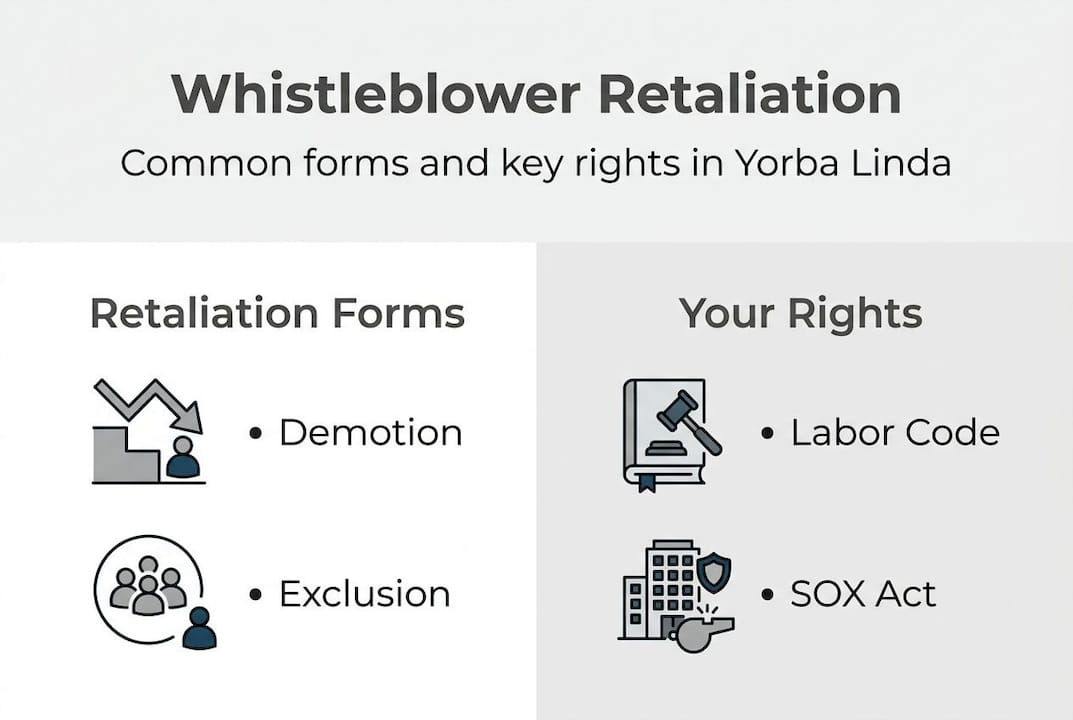
For employees at Yorba Linda accounting firms, the risks are real. Smaller firms often lack formal HR departments, which means there is less oversight when managers retaliate. There may be no internal grievance process, no compliance officer, and no clear chain of reporting. That creates an environment where retaliation can go unchecked longer than it would at a large corporation.
California law offers stronger protections than federal law in several key ways. The state’s proof threshold is lower, meaning you do not need to prove that retaliation was the sole reason for adverse action. You only need to show it was a contributing factor. This makes whistleblower complaints in Yorba Linda more viable than employees often assume.
Here is what retaliation can look like in an accounting firm setting:
- Sudden negative performance reviews after years of strong evaluations
- Being excluded from client meetings or key projects
- Reassignment to less desirable duties without explanation
- Colleagues being told to avoid you
- Threats, intimidation, or increased scrutiny of your work
- Denial of promotions or raises that others receive
The California Labor Commissioner and the Department of Fair Employment and Housing (DFEH, now the Civil Rights Department) both handle retaliation complaints. Consulting a general whistleblower retaliation guide can help you understand which agency fits your situation best.
Common forms and signs of retaliation in accounting workplaces
Now that we have defined retaliation, let’s look at how it actually shows up day to day in accounting offices. Recognizing it early is critical, because the longer you wait to document and report, the harder your claim becomes to prove.
The most common forms of retaliation in accounting workplaces follow a predictable pattern. After an employee reports something, whether it is a billing discrepancy, a client fraud concern, or an internal policy violation, the employer’s response often starts small. A slightly cooler tone from management. Being left off a meeting invite. A minor criticism buried in an otherwise positive review. These shifts feel personal, but they are often strategic.

Adverse actions following a report are subject to California’s lower proof threshold compared to federal standards, which means even subtle patterns of treatment changes can support a legal claim. This is why documenting early matters so much.
Common retaliation signs to watch for in accounting firms:
- Sudden workload changes: Being overloaded with impossible deadlines or stripped of meaningful work
- Negative evaluations: Performance reviews that contradict your prior record without new justification
- Social exclusion: Being left out of team lunches, office communications, or informal discussions
- Reputation attacks: Colleagues hearing negative things about your work ethic or character from management
- Increased scrutiny: Unusual auditing of your work, timesheets, or client interactions
- Demotion or title change: Losing seniority, responsibilities, or compensation without cause
If you suspect wage theft retaliation is part of the picture, that adds another layer of legal exposure for your employer. Accounting firm employees who report unpaid overtime or misclassification are also protected under California wage laws.
Pro Tip: Start a private, date-stamped log the moment you notice a change in how you are being treated. Write down what happened, who was involved, and any witnesses. Keep this log outside of company systems, such as a personal email draft or a secure notes app.
Seeking retaliation lawyer guidance early, even before you file a formal complaint, can help you understand whether what you are experiencing meets the legal threshold for a claim.
Legal protections and reporting channels for whistleblowers
Having identified retaliation, it is crucial to understand your legal shield and reporting avenues. Two major frameworks protect accounting firm employees: the Sarbanes-Oxley Act (SOX) and California state law.
SOX applies specifically to employees of publicly traded companies and their contractors, which can include accounting firms that audit or serve public companies. Under SOX, auditors require reasonable belief of a securities violation to be protected, and even internal reports to a supervisor, without filing with a government agency, can qualify for protection. This is an important edge case that many employees overlook.
California Labor Code Section 1102.5 is the state’s primary whistleblower protection statute. It covers employees who report suspected violations of any law, not just securities fraud. The proof standard is more favorable to employees, and remedies include reinstatement, back pay, and damages.
Here is a comparison of your main reporting options:
| Reporting channel | Jurisdiction | Key protection | Filing deadline |
|---|---|---|---|
| California Labor Commissioner | State | Labor Code 1102.5 | 3 years from retaliation |
| Civil Rights Department (CRD) | State | FEHA protections | 3 years from act |
| OSHA (SOX complaints) | Federal | SOX Section 806 | 180 days from retaliation |
| Internal report to supervisor | Internal | SOX still applies | Document immediately |
Steps to take when reporting retaliation:
- Identify which law applies to your situation (SOX, Labor Code, or both)
- Gather your documentation before filing
- Choose your reporting channel based on the table above
- File within the applicable deadline
- Consult an attorney before or immediately after filing
For employees at accounting firms covered by 2026 whistleblower protection laws, the landscape has continued to evolve in favor of employees. Reviewing retaliation comparisons across cities can also help you understand how local practices differ across Southern California.
The GAO’s recent SOX recovery data confirms that whistleblower claims are not just symbolic. Real recoveries happen, and they can be substantial.
Documenting and responding to retaliation: Practical steps
After understanding protections, the next step is building and pursuing your retaliation case effectively. Documentation is the foundation of every successful claim. Without it, even a clear pattern of retaliation becomes difficult to prove.
Here is how to build a solid record:
- Start immediately: The moment you suspect retaliation, begin documenting. Courts and agencies look at timelines closely.
- Save everything: Emails, performance reviews, meeting notes, and text messages all count as evidence.
- Note witnesses: If a colleague observed a negative interaction, write their name and what they saw.
- Track pattern changes: Compare your treatment before and after your report. Specific dates matter.
- Keep records off company devices: Use personal storage to protect your documentation.
Here is a comparison of documentation types and their legal impact:
| Documentation type | Legal value | Notes |
|---|---|---|
| Date-stamped emails | High | Direct evidence of adverse action |
| Personal journal entries | Moderate | Supports timeline; corroboration helps |
| Witness statements | High | Strengthens pattern evidence |
| Performance review copies | High | Shows before/after contrast |
| Text messages | High | Preserve screenshots with metadata |
Pro Tip: File your complaint as soon as you have enough documentation to support a pattern. Waiting too long can push you past the filing deadline and weaken your claim.
SOX-related recoveries in California have reached millions of dollars in individual cases, and nationally, the VA settled 71 whistleblower cases between 2019 and 2023. These numbers show that pursuing a claim is worth the effort when the evidence is solid.
For employees in Yorba Linda, documenting your retaliation case with the help of an attorney from the start gives you the best chance of a favorable outcome.
A candid perspective: What most guides miss about whistleblower retaliation
Most legal guides focus on the mechanics: what laws apply, where to file, what deadlines to meet. That information is necessary, but it misses something important. Retaliation in small, local accounting firms is often harder to detect and prove than in large corporations, and the emotional toll is real.
In a tight-knit Yorba Linda firm with 10 or 20 employees, retaliation can feel like social pressure rather than a legal violation. You may question whether you are imagining it. That self-doubt is exactly what makes small-firm retaliation so effective and so damaging.
The reality of whistleblower retaliation is that prompt action and self-advocacy matter more than most guides admit. Waiting to see if things improve rarely works. Employers who retaliate rarely stop on their own.
Seeking legal advice early, even if you are not sure you have a case, is often the most important step you can take. An attorney can help you assess the situation objectively before your filing window closes. Do not wait for the retaliation to escalate before reaching out.
Small business retaliation risks in Yorba Linda are real, and the California Labor Commissioner and Civil Rights Department are available to help. You do not have to navigate this alone.
Connect with trusted employment law advocates in Orange County
If you are an accounting firm employee in Southern California who has experienced retaliation after reporting wrongdoing, you deserve legal representation that understands both the law and the local landscape. At Serendib Law Firm, we work with employees across Orange County who are facing exactly these challenges. Whether you need guidance on employment law in Lake Forest, support from a Huntington Beach employment attorney, or a broader consultation through our Orange County legal team, we offer free consultations and handle select cases on contingency. Reach out today to protect your rights before a filing deadline passes.
Frequently asked questions
What counts as whistleblower retaliation in Yorba Linda accounting firms?
Retaliation includes termination, demotion, hostile work environments, negative evaluations, exclusion from projects, and reputation damage following a report of workplace wrongdoing. It does not have to be a single dramatic act to be legally actionable.
What legal protections exist for whistleblowers in California accounting firms?
California Labor Code Section 1102.5 and SOX both protect employees, with state law requiring less proof than federal regulations. Under SOX, auditors need reasonable belief of a violation, and even internal reports qualify for protection without a formal agency filing.
How do I document retaliation for a legal claim?
Save emails, keep date-stamped personal records of workplace changes, and note any witnesses to negative treatment. Document patterns and file promptly to stay within California’s three-year filing window.
Are retaliation settlements common in California?
SOX recoveries in California have reached millions of dollars in individual cases, and nationally, dozens of whistleblower cases are settled each year, though many resolutions are kept confidential by agreement.
Where should I report retaliation in Yorba Linda accounting firms?
Complaints can be filed with the California Labor Commissioner or the Civil Rights Department (formerly DFEH), and internal reports are also protected under certain laws like SOX. Consulting an attorney before filing helps you choose the right channel.