
TL;DR:
- Most unpaid for-profit internships in California violate state labor law unless specific educational and non-displacement criteria are met.
- Public sector and nonprofit internships are more likely to be legally unpaid if they focus on education and civic service.
- Students should document work hours, tasks, and communications early to protect their rights and consider legal help if wage violations occur.
Many students and recent graduates across Orange County accept unpaid internships without questioning whether those positions are actually legal. The reality is striking: most unpaid internships at for-profit companies in California violate state labor law unless very specific conditions are met. California presumes interns are employees by default, which means you could be entitled to at least $16.50 per hour in 2026, overtime pay, and other protections, even if your offer letter says “internship.” This article breaks down exactly how the law works, where exceptions exist, and what steps you can take right now to protect yourself.
Table of Contents
- Understanding California’s primary beneficiary test for interns
- Legal exceptions: Government and nonprofit internships in Orange County
- Spotting and documenting rights violations in unpaid positions
- How unpaid internships impact fairness and career outcomes
- What most students in Orange County miss about unpaid internships
- Get legal help with internship issues in Orange County
- Frequently asked questions
Key Takeaways
| Point | Details |
|---|---|
| Know intern wage tests | Most for-profit unpaid internships in Orange County fail legal tests and must pay minimum wage. |
| Government/nonprofit exceptions | Public and nonprofit internships are usually legal when designed for learning or volunteering. |
| Document everything | If you suspect a violation, keep records of hours, tasks, and communications as evidence. |
| File claims for remedies | You can recover wages by filing a claim with California’s DLSE if your rights are violated. |
| Unpaid internship risks | Unpaid internships limit access for less privileged students and reduce chances of job offers. |
Understanding California’s primary beneficiary test for interns
California and federal courts use what’s called the “primary beneficiary test” to decide whether an unpaid intern is actually an employee who must be paid. The name sounds technical, but the concept is straightforward: who gets more out of this arrangement, you or the company? If the company is extracting productive labor from you, you’re an employee. If you’re genuinely there to learn, the equation may be different.
Courts look at seven factors when applying this test:
- Whether the internship offers training similar to an educational environment
- Whether the experience benefits the intern primarily, not the business
- Whether the intern displaces a regular employee (doing work that a paid staff member would otherwise do)
- Whether the employer gets an immediate advantage from the intern’s work
- Whether the intern is guaranteed a job at the end of the program
- Whether both parties understand the internship is unpaid
- Whether the internship is tied to formal education, such as receiving academic credit
No single factor controls the outcome. Courts weigh all seven together. But here’s the key point: the more productive work you do, the harder it is for a company to justify not paying you. If you’re answering phones, managing spreadsheets, or serving customers on a for-profit company’s behalf, you almost certainly pass the threshold into employee territory.
According to data on internship opportunities at public agencies, California presumes interns are employees, and most for-profit internships fail the primary beneficiary test. Public sector positions in Orange County, such as those through county government, are more likely to qualify as legitimate unpaid programs because they’re structured around education and community service rather than profit.
Nationally, fewer than 60% of internships are paid, which means a substantial portion of students are either in legally compliant unpaid programs or unknowingly working for free in violation of the law. If you’re in Orange County studying at a university or recently graduated, your internship may fall into the second category.
Students working in cities like Fullerton often encounter this issue firsthand. Cases involving Fullerton intern wage violations reveal how common it is for students to work substantial hours without compensation they’re legally owed. Similarly, students attending Cal State Fullerton may not realize that CSUF wage rights violations can apply to off-campus internship placements tied to their coursework.

Pro Tip: Before you start any unpaid internship at a for-profit company, ask the employer to explain exactly how the position meets the primary beneficiary test. A legitimate employer will have a clear answer. If they can’t provide one, that’s a signal worth taking seriously.
Legal exceptions: Government and nonprofit internships in Orange County
The rules change significantly depending on the type of organization you’re interning with. California law and federal Fair Labor Standards Act (FLSA) guidelines recognize important distinctions between for-profit companies, government agencies, and nonprofit organizations.
Here’s a practical comparison:
| Internship type | Unpaid allowed? | Key conditions | Risk level |
|---|---|---|---|
| For-profit company | Rarely | Must pass all 7 primary beneficiary factors | High |
| Government agency | Yes, common | Must be voluntary and educational | Low |
| Nonprofit organization | Sometimes | Educational purpose, no displacement of paid workers | Moderate |
| Academic credit program | Often yes | Requires formal academic enrollment | Low to moderate |
Orange County government offers unpaid internships for students and recent graduates through agencies like the District Attorney’s Office and the Auditor-Controller. These programs succeed legally because they fall under public sector flexibility: the work is primarily educational, structured around civic learning goals, and not designed to generate profit for the county. These are the internships where “unpaid” can be genuine and legal.
Nonprofit organizations occupy a middle ground. If a nonprofit can demonstrate that the intern isn’t replacing a paid employee and the experience is genuinely educational, unpaid arrangements may hold up. But if a nonprofit is using unpaid interns to run core operations that would otherwise require paid staff, they may also face legal exposure.
A few important things to watch out for regardless of the organization type:
- Academic credit alone does not make an unpaid internship legal. It’s a supporting factor, not a magic exemption.
- You cannot legally waive your right to minimum wage, even in writing. Any document you sign agreeing to work for free is unenforceable if the position legally qualifies you as an employee.
- Nonprofits in California that misclassify interns as volunteers have faced enforcement actions from the California Labor Commissioner’s office.
If you’re uncertain whether your position at a local nonprofit or government agency is set up correctly, consider reaching out through free legal consultations in Orange County to get a quick read on your situation before anything escalates. And if you’ve already experienced pressure or mistreatment for raising questions about your pay, resources on Orange workplace harassment may also be relevant.
Spotting and documenting rights violations in unpaid positions
Knowing your rights is step one. Being able to prove a violation if one occurs is step two. Many students lose potential claims not because their legal position is weak, but because they didn’t keep records.
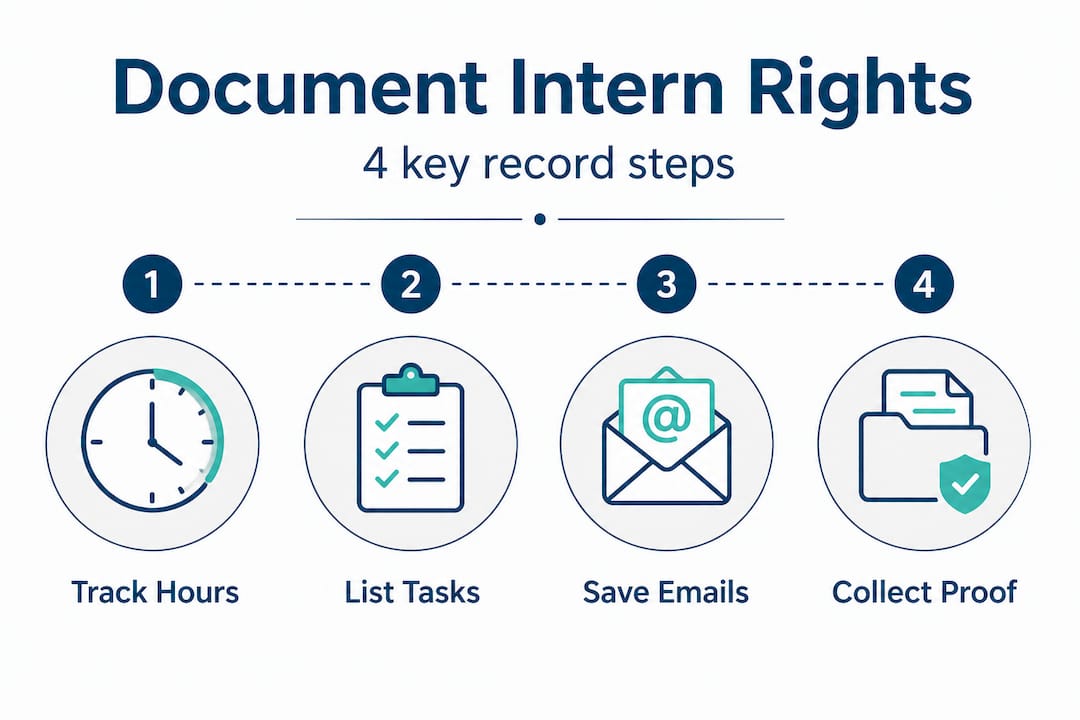
Here’s a practical numbered list of what to do from day one of any internship you’re unsure about:
- Start a log immediately. Record your start and end times every day. Use your phone, a spreadsheet, or a notes app. Anything with a timestamp is useful.
- Write down your tasks. What did you actually do each day? If you were doing work a regular employee would do, document it specifically.
- Save all communications. Keep copies of emails, texts, Slack messages, and any written instructions from supervisors.
- Document any promises made. If a supervisor told you this unpaid role could lead to a paid position or is “great for your resume,” write it down with the date.
- Note if anyone was displaced. Did a paid intern or employee leave right before you arrived? That’s a potential indicator of displacement.
The California Division of Labor Standards Enforcement, known as the DLSE, is the state agency that handles wage claims. According to DLSE guidance, students and graduates in Orange County should verify whether their internship meets the primary beneficiary test, prefer roles with academic credit or government and nonprofit affiliations if working unpaid, document hours and tasks whenever a violation is suspected, and file a DLSE claim to pursue legal remedies.
“The absence of public enforcement cases targeting unpaid intern violations in Orange County doesn’t mean violations aren’t happening. It often means interns don’t know they can report them.”
This is important context: California enforcement via DLSE typically addresses wage theft broadly, including situations like car wash workers or farm laborers who are underpaid, but the mechanism works the same way for interns. The fact that you haven’t heard of Orange County internship cases being prosecuted doesn’t mean the law doesn’t apply to you.
Learning to spot wage violations early is a skill that pays off throughout your career. And if you raise concerns internally and face pushback from your employer, you have legal retaliation protections that prohibit your employer from punishing you for asking about your wages. Students at California universities who’ve been through unpaid positions may also find that CSUF wage violation protections provide a useful framework for understanding broader student worker rights.
How unpaid internships impact fairness and career outcomes
This conversation goes beyond just individual wage disputes. Unpaid internships create a structural problem in the job market that harms students who can’t afford to work for free.
“Unpaid internships function as a hidden filter. They screen out students based on family income, not talent.”
The numbers back this up. According to research on unpaid internships and inequality, these arrangements exacerbate inequality by primarily benefiting students from privileged financial backgrounds. Nationally, only about 50 to 60% of internships are paid, and students who complete unpaid internships statistically receive fewer job offers than those who completed paid ones. That’s a counterintuitive finding: unpaid internships, despite their prevalence, often don’t deliver the career advantage students are led to expect.
Here’s what this means practically for students in Orange County:
- Students who need to support themselves financially during school simply cannot afford to work 20 to 40 hours a week without pay. This eliminates talented candidates from competitive industries before they even begin.
- Students who can afford to take unpaid roles often have family support networks, professional connections, or existing wealth that already give them career advantages. The unpaid internship compounds those advantages.
- When companies rely heavily on unpaid labor, they reduce entry-level paid positions, making it even harder for graduates to find that first paying job.
- Research consistently shows that paid interns are more likely to receive a job offer after graduation than unpaid interns, even when both groups complete the same type of work.
For Orange County students at universities like UCI, Chapman, or Cal State Fullerton, these stakes are real. Many students take on unpaid internships in fields like marketing, media, legal services, and entertainment because they’re told it’s necessary for breaking into those industries. But if those internships are with for-profit companies and fail the primary beneficiary test, they’re not just unfair, they’re illegal. You may be entitled to back pay for every hour you worked.
What most students in Orange County miss about unpaid internships
Here’s the perspective that rarely gets discussed in career centers or orientation sessions: the internship culture in Orange County normalizes illegal labor arrangements, and students are conditioned to accept them as a rite of passage.
Most students assume that if a company offers an “internship,” it must be legal. That assumption is simply wrong, and it costs students real money. The typical for-profit unpaid internship in California fails the primary beneficiary test. That means the student is legally an employee and deserves at least $16.50 per hour in 2026, plus overtime if they worked more than eight hours in a day or 40 hours in a week.
What students miss most often is not the law itself but the documentation step. Even students who vaguely know their rights don’t keep records. They don’t save emails. They don’t log hours. And then six months later, when they want to file a claim, they’re working from memory against a company that has HR records, timesheets, and attorneys.
The second thing students miss is that filing a DLSE claim doesn’t require a lawyer. It’s an administrative process, and the agency investigates on your behalf. But having an attorney review your situation before you file significantly improves the quality of your claim, especially when it comes to calculating back wages, penalties, and interest.
We’ve seen cases involving Fullerton intern violations where students worked an entire semester without pay at for-profit companies, then discovered they had strong claims, but had no documentation to support them. The lesson is simple: treat your internship like a job even if they’re not treating you like an employee.
Get legal help with internship issues in Orange County
If you’ve read this far and you’re questioning whether your internship is legal or wondering whether you’re owed back wages, that instinct deserves a real answer. Employment law attorneys who work with students and recent graduates can review the specifics of your internship arrangement and tell you clearly where you stand.
Whether you’re based in Lake Forest, Huntington Beach, or anywhere else in the county, the right legal guidance is accessible. Lake Forest employment lawyers and Huntington Beach employment law attorneys at Serendib Law Firm offer free consultations so you can get answers without financial pressure. If your case has merit, the firm can help you file a DLSE claim, calculate what you’re owed, and pursue recovery. The experienced Orange law attorneys at Serendib Law Firm are familiar with how these cases work locally and can advise you in English or Spanish.
Frequently asked questions
How can I tell if my Orange County internship should be paid?
If you’re doing productive work for a for-profit company and the company benefits more than you do from the arrangement, you likely qualify as an employee and should be paid. California presumes interns are employees at for-profit businesses by default.
What wage am I entitled to if my unpaid intern position fails the legal test?
You must be paid at least the California minimum wage of $16.50/hr in 2026, plus overtime, and you may also be eligible for additional penalties under state labor law.
Are government and nonprofit internships exempt from wage rules in Orange County?
Many are, yes. Orange County government internships through agencies like the District Attorney’s Office qualify under public sector flexibility, provided they are voluntary and educational in nature.
How should I document an internship I think breaks wage laws?
Keep a daily log of hours worked and specific tasks completed, and save all written communications. This evidence is critical if you need to file a DLSE claim for unpaid wages.
What does filing a DLSE claim involve?
You submit your evidence to the California Division of Labor Standards Enforcement, which then investigates your employer and can order them to pay back wages and penalties owed to you.