
TL;DR:
- Most U.S. employers now use sophisticated, often invisible, workplace monitoring tools.
- California employees have legal rights including data disclosures and protection against retaliation.
- Employees should proactively understand rights, document concerns, and consult attorneys before disputes escalate.
Three out of four U.S. employers now use monitoring tools, and the surveillance technology market is projected to reach $4.6 billion in 2026. Yet most employees assume their workplace activities remain largely private. That gap between assumption and reality puts workers at a real disadvantage, especially in California, where the law is more protective than most states but only if you know how to invoke it. If you work in Lake Forest, understanding how your employer monitors you, what the law requires, and what you can do about it is no longer optional knowledge. It is essential self-protection.
Table of Contents
- Understanding employee monitoring in modern workplaces
- Legal protections and privacy rights for Lake Forest employees
- Hidden risks and potential pitfalls: What employees often miss
- How to protect yourself: Practical steps for Lake Forest employees
- Why most privacy concerns are underestimated: Hard truths from local legal experts
- Get support for your employment privacy concerns
- Frequently asked questions
Key Takeaways
| Point | Details |
|---|---|
| Monitoring is widespread | Three-quarters of U.S. companies monitor employees, including many in Lake Forest. |
| California laws offer protection | Lake Forest employees have rights under CCPA and employment law, including disclosure and anti-retaliation safeguards. |
| Hidden risks from AI tools | AI monitoring can introduce bias and legal risks, so employees should stay informed and proactive. |
| Actively safeguard privacy | Request disclosures, document practices, and consult with an employment lawyer to protect your rights. |
Understanding employee monitoring in modern workplaces
Workplace monitoring is not new. Employers have tracked timesheets and phone calls for decades. What is new is the scale, the sophistication, and the invisibility of modern monitoring tools. Today’s surveillance goes far beyond a badge reader at the door or a camera in the parking lot.
What modern monitoring actually looks like
Lake Forest employers, like companies across Orange County, now use a wide range of technologies to track employee behavior. Here is a breakdown of the most common categories:

| Monitoring type | What it tracks | Common tools used |
|---|---|---|
| Screen monitoring | Real-time screenshots, active windows | Hubstaff, ActivTrak, Teramind |
| Email and chat scanning | Keywords, attachments, external contacts | Microsoft Purview, Proofpoint |
| System and network logs | Login times, websites visited, file access | Cisco Umbrella, Splunk |
| AI-based productivity scoring | Keystrokes, idle time, output metrics | Aware, Time Doctor |
| Location tracking | GPS, check-ins, badge swipes | Teletrac Navman, BambooHR |
AI-powered tools represent the newest and most controversial layer of this monitoring landscape. These platforms do not just record data. They interpret it, flagging employees whose behavior patterns fall outside a defined “normal” range. An AI system might mark you as low-productivity because you spend significant time on a video call rather than typing. These assessments can influence performance reviews, scheduling, and even termination decisions, often without any human review in between.
Why do employers use these tools? The stated reasons are legitimate: protecting sensitive client data, ensuring regulatory compliance, measuring output in remote or hybrid work arrangements, and deterring misconduct. A company handling health records or financial data in Lake Forest has real obligations to prevent unauthorized access, and monitoring is one tool for meeting those obligations.
For employees navigating these realities, Lake Forest employment law guidance can clarify when employer monitoring crosses a legal line. Similarly, if you work remotely, the rules around remote work monitoring are worth understanding specifically, since California does not distinguish between office and home-based work environments when it comes to employee protections.
The key takeaway: monitoring is pervasive, increasingly AI-driven, and often invisible to employees. Many workers in Lake Forest do not realize how much data their employer collects on a given workday, or how that data is used.
Legal protections and privacy rights for Lake Forest employees
California is one of the strongest states in the country for employee privacy rights. That is worth saying plainly, because many employees underestimate their legal standing. The California Consumer Privacy Act, known as the CCPA, and various provisions of California labor law combine to create a framework that puts real limits on what employers can do and real obligations on what they must disclose.
What the CCPA means for you
The CCPA gives California employees rights over their personal information, including the right to know what data is being collected, the right to request disclosure of that data, and the right to know whether it is being shared with third parties. Employers who are subject to the CCPA, generally those with significant revenue, large data operations, or 50 or more employees must provide workers with a written privacy notice at or before the time of hire.
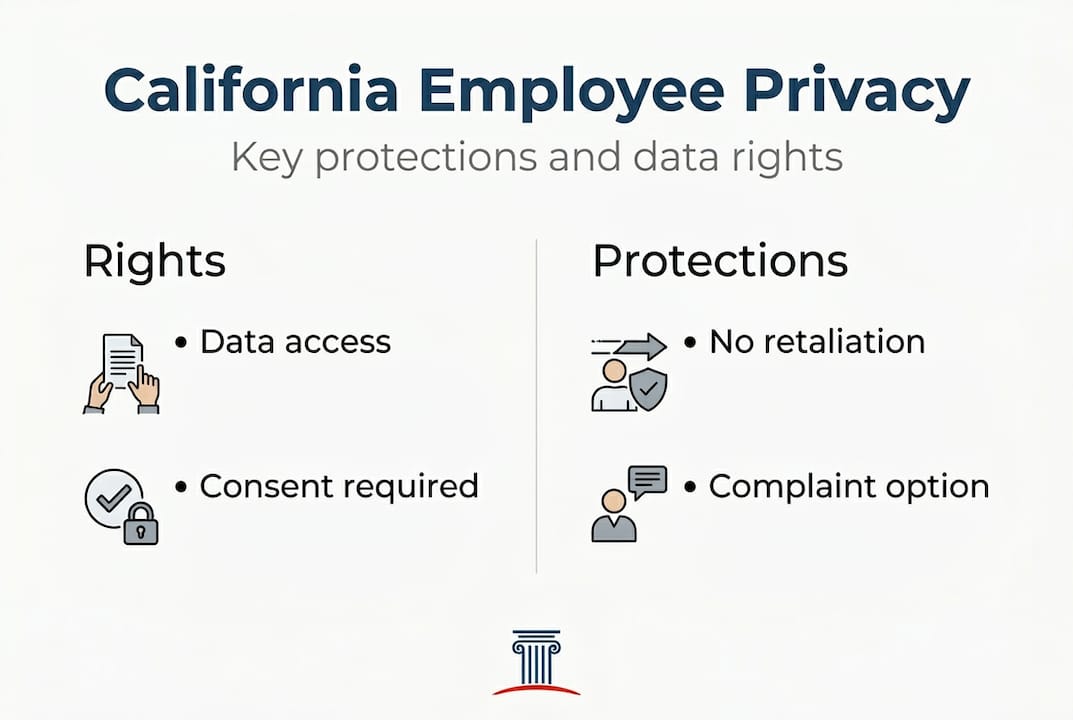
Major California companies operating in Lake Forest are required to disclose their data collection practices, specify what personal information they gather, and confirm that employee data is not sold to outside parties. This applies whether you are a full-time employee, a part-time worker, or even a job applicant in some cases.
Here is a numbered breakdown of your basic CCPA rights as a Lake Forest employee:
- Right to know: You can ask your employer what personal data it has collected about you.
- Right to disclosure: You can request a copy of the categories and specific pieces of information collected.
- Right to non-discrimination: Your employer cannot penalize you for exercising your CCPA rights.
- Right to correct: If your employer holds inaccurate data about you, you can request correction.
- Right to limit use: In some cases, you can limit how sensitive personal information is used.
Beyond CCPA, California Labor Code and common law privacy protections also apply. Courts in California recognize a constitutional right to privacy that extends to private-sector employment. This means monitoring that is overly intrusive, disproportionate to a legitimate business need, or conducted without proper notice can expose employers to legal liability.
“Employees should request CCPA disclosures, consult employment attorneys, and know that retaliation for raising privacy concerns is prohibited under California law.”
One of the most critical protections is the one against retaliation. If you report what you believe to be unlawful monitoring, file a complaint with the California Labor Commissioner, or simply ask your employer for your CCPA disclosures, your employer cannot legally punish you for doing so. Demotions, reduced hours, hostile treatment, or termination tied to these actions may constitute unlawful retaliation. Understanding your retaliation protections before you take any action is a smart first move.
Hidden risks and potential pitfalls: What employees often miss
Legal knowledge is crucial, but so is spotting hidden risks that many overlook. Even when employers follow the letter of the law, monitoring can still harm you in ways that are hard to detect and harder to challenge.
The AI bias problem
AI monitoring tools are only as fair as the data they are trained on. When a system learns to flag certain communication styles, work patterns, or productivity rhythms as “low performance,” it can disadvantage employees whose working style differs from the majority, including people with disabilities, caregivers who manage irregular schedules, or employees whose first language is not English. Legal experts advise that employers should audit tools for algorithmic bias, and lawsuits related to biased AI monitoring are rising nationally. As an employee, you may not even know an AI system influenced a decision about your role.
Common mistakes employees make
Here are the errors that most commonly hurt workers when monitoring-related disputes arise:
- Ignoring the fine print. Many employees sign onboarding paperwork that includes broad consent to monitoring without reading the specifics. Once signed, that consent is real.
- Not requesting disclosures proactively. Waiting until something goes wrong to ask for your CCPA disclosures puts you at a disadvantage. Request them before any conflict arises.
- Failing to document. If you believe monitoring is targeting you unfairly or that you are being retaliated against for raising concerns, you need records. Save written communications. Note dates, times, and what was said in verbal conversations.
- Assuming personal devices are private. If you use a personal phone or laptop on a company network or with a company application installed, some of your data may be accessible to your employer.
- Underestimating the psychological toll. Constant monitoring creates real stress. Studies on surveillance in workplaces consistently link pervasive monitoring to lower morale, reduced job satisfaction, and higher turnover. This is not a minor side effect.
Pro Tip: Keep a personal log, separate from your work devices, of any conversations or incidents related to monitoring. Include dates, names, and what was said. This record can be invaluable if you ever need to consult an attorney or file a complaint.
If you believe your employer has crossed a legal line and then punished you for speaking up, that is a potential whistleblower retaliation issue, and California law provides significant protections in those situations. Do not assume your concerns are too small to matter legally.
How to protect yourself: Practical steps for Lake Forest employees
With risks exposed, let’s turn to practical steps every Lake Forest employee can take. These are not abstract suggestions. They are concrete actions that can make a real difference if a monitoring-related dispute ever comes to a head.
Your step-by-step action plan
- Read your onboarding and employment agreements carefully. If you are still in the process of starting a new job, review all documents related to monitoring and electronic communications before signing. Ask HR to clarify anything you do not understand.
- Submit a CCPA disclosure request. You have the legal right to ask your employer what personal data it has collected about you. Send a written request to HR or the designated privacy officer. Keep a copy of the request and any response you receive.
- Review your employer’s published privacy policy. Most companies subject to CCPA post a privacy notice online or include it in your employee handbook. Read it. Note what types of monitoring are disclosed and whether the policy is vague or specific.
- Document everything, consistently. If you notice unusual scrutiny, sudden changes in performance ratings, or comments from managers that seem tied to your monitored activity, write it down. Include dates, the names of everyone present, and exactly what was said or done.
- Use company resources for company business only. This minimizes the data your employer legitimately collects and helps maintain clearer boundaries between your personal and professional digital life.
- Consult a qualified employment attorney before escalating. If you believe your privacy rights have been violated or that monitoring is being used against you unfairly, speaking with an attorney before you file any formal complaint is wise. An attorney can assess the strength of your position, help you preserve evidence, and advise on timing. CCPA disclosure and retaliation protections are real, but exercising them effectively requires strategy.
- Report violations through proper channels. If an attorney confirms a violation, formal complaints can be filed with the California Labor Commissioner, the California Privacy Protection Agency, or, in certain cases, federal agencies.
Pro Tip: Before you submit any formal complaint or send any written protest to your employer, consult an employment attorney. A single email sent at the wrong time, or worded incorrectly, can complicate your legal position later.
The legal landscape in California gives you meaningful tools. The employees who use them most effectively are those who have done their homework before a problem becomes a crisis. Reaching out to Lake Forest legal support early in the process, even just for an initial consultation, can help you understand where you stand.
Why most privacy concerns are underestimated: Hard truths from local legal experts
Here is a perspective that rarely appears in standard workplace guides: the existence of strong privacy laws does not, by itself, protect you. California has some of the most robust employee privacy statutes in the country, and yet monitoring-related complaints and lawsuits continue to grow year over year. Why?
Because most employees do not act on their rights until harm has already occurred. They notice something feels off but assume there is nothing they can do. They worry that asking questions will mark them as a problem employee. They do not request disclosures because they do not know they can.
The psychological weight of surveillance is also real and underappreciated. Being monitored changes how people work. It can suppress creativity, reduce willingness to ask questions, and create a culture of fear that management may not even recognize they have built. A tool intended to improve productivity can quietly erode the trust that makes a workplace function.
Our view, shaped by working with employees across Orange County, is that most workers consult a lawyer too late. They come in after a termination, after a performance improvement plan has already been filed, after months of documented “poor performance” that was generated by a biased AI tool. At that point, the legal options are narrower.
Local legal insight is most useful before things escalate. Think of it the way you would think of a medical checkup. The best time to understand your rights is when you do not urgently need them.
Get support for your employment privacy concerns
If workplace monitoring is creating stress, affecting your performance reviews, or leading to treatment that feels unfair or retaliatory, you do not have to figure it out alone. Serendib Law Firm works with employees throughout Lake Forest and across Orange County on exactly these issues. Whether you need help understanding your CCPA rights, responding to a biased performance assessment driven by monitoring tools, or addressing clear-cut retaliation resources, our team offers free consultations to help you assess your situation. As a Lake Forest employment lawyer resource, we provide bilingual support in English and Spanish and handle select cases on a contingency basis. Contact us to take that first step.
Frequently asked questions
Are Lake Forest companies allowed to monitor employee computer usage?
Yes, companies in Lake Forest may legally monitor employee computer activity, but California privacy law requires proper disclosure of monitoring practices, and employers cannot sell your data without appropriate notice.
What should I do if monitoring feels invasive or unfair?
Request a copy of your employer’s CCPA disclosures, document your concerns in writing, and consult a qualified employment attorney who can evaluate whether your rights have been violated.
Can an employer retaliate against me for complaining about monitoring?
No. Retaliation is prohibited under California employment law, meaning your employer cannot demote, discipline, or terminate you for raising legitimate privacy concerns.
How has AI changed workplace monitoring in Lake Forest?
AI tools now analyze productivity patterns and flag behavior automatically, but AI monitoring risks such as algorithmic bias mean employees may face unfair assessments without any human ever reviewing the underlying data.