
TL;DR:
- Filing an HR complaint does not automatically prevent retaliation; legal proof and evidence are essential.
- Unlawful retaliation includes demotion, pay cuts, reassignment, or termination connected to protected activities.
- Early legal guidance, thorough documentation, and timely action are critical for successful retaliation claims in Orange County.
Filing an HR complaint takes courage. Many employees assume that once they submit their report, the law automatically wraps a protective shield around them. That assumption is dangerous. Retaliation is still happening to workers across Southern California, and recent Orange County court decisions make it crystal clear that even strong cases can fall apart without the right evidence and legal strategy. If you’ve filed an HR complaint and something feels off about how you’re being treated at work, you need to understand your rights before your situation gets worse.
Table of Contents
- Understanding workplace retaliation after HR complaints
- How to recognize unlawful retaliation in Yorba Linda
- What to do if you’re experiencing retaliation
- Case study: Local outcomes and lessons from Orange County retaliation lawsuits
- The truth about fighting workplace retaliation: What most guides leave out
- Connect with a Yorba Linda employment law expert
- Frequently asked questions
Key Takeaways
| Point | Details |
|---|---|
| State law applies | Retaliation cases in Yorba Linda are governed by California law, not separate city rules. |
| Document everything early | Keeping detailed records of complaints and employer actions is crucial to building your case. |
| Protected activity is key | Your HR complaint must involve a legally protected action for retaliation law to apply. |
| Seek timely legal advice | Quickly consult a local attorney to preserve evidence and meet strict deadlines. |
| Not all negative acts are illegal | Only certain employer behaviors connected to your complaint count as unlawful retaliation. |
Understanding workplace retaliation after HR complaints
Workplace retaliation happens when an employer punishes an employee for engaging in a legally protected activity. Filing an HR complaint about harassment, discrimination, wage violations, or unsafe conditions all qualify as protected activities under California law. When an employer responds to that complaint with punishment rather than a proper investigation, that crosses the line into illegal retaliation.
But here’s where it gets complicated. Not every uncomfortable or unfair action your employer takes after an HR complaint qualifies as illegal retaliation in the eyes of the law. Courts require you to prove a clear connection between your complaint and the negative treatment you experienced. Understanding this distinction is what separates employees who win their cases from those who lose.
Retaliation can show up in many ways after an HR complaint:
- Demotion or reduction in job title or responsibilities
- Pay cuts or denial of scheduled raises
- Increased scrutiny, micromanagement, or false negative performance reviews
- Social isolation by management or pressure on coworkers to avoid you
- Sudden reassignment to undesirable shifts or locations
- Termination, layoff, or constructive dismissal (where working conditions are made so unbearable you’re forced to quit)
- Threats, intimidation, or verbal hostility from supervisors
Yorba Linda workers are protected under California state law, which covers all cities and municipalities in Orange County. There are no local ordinances unique to Yorba Linda that add separate layers of protection or restriction. The California Fair Employment and Housing Act (FEHA) and the California Labor Code are your primary sources of protection, and they carry significant teeth when properly applied. Learning about Orange County retaliation protections helps you understand the full scope of what you’re entitled to under state law.
“Even when an employee suffers real harm, a retaliation case can fail if the legal requirements aren’t precisely met. This is why documentation and legal guidance matter from day one, not after the damage is done.”
The Santa Ana police retaliation lawsuit is a vivid example of what can go wrong. A jury initially awarded $2.9 million to a plaintiff alleging retaliation, but an OC judge later overturned that verdict. The case collapsed because the protected activity element wasn’t firmly established. Real harm was present, but the legal framework wasn’t solid enough to hold. That outcome should put every HR complainant in Southern California on high alert.
How to recognize unlawful retaliation in Yorba Linda
Understanding what retaliation is, the next step is learning how to spot unlawful actions in your own situation. California courts look for three specific elements before they will recognize a retaliation claim as legally valid.
- You engaged in a protected activity. This includes filing an HR complaint, reporting discrimination or harassment, requesting accommodations, reporting wage theft, or participating in a workplace investigation. Your complaint doesn’t have to be proven correct, but it must be made in good faith.
- Your employer took an adverse action against you. The action must be significant enough that it would discourage a reasonable person from making a complaint. Minor annoyances generally don’t qualify. Demotion, termination, pay reduction, hostile reassignment, and denial of promotion clearly do.
- A causal connection exists between the two. Timing is often the most powerful indicator. If your manager suddenly starts giving you poor performance reviews the week after you filed your HR complaint, that timing is a red flag courts take seriously.
The following table breaks down scenarios that cross the legal line versus those that typically don’t:
| Employer action | Protected complaint filed? | Likely retaliation? | Real-world consequence |
|---|---|---|---|
| Demotion two weeks after discrimination report | Yes | Yes | Grounds for FEHA claim |
| Negative review following complaint about harassment | Yes | Likely | Strong documentation needed |
| Undesirable shift change after wage complaint | Yes | Yes | Evidence of motive required |
| Termination six months after complaint, new reason cited | Yes | Possibly | Causation harder to prove |
| Pay freeze applied company-wide | Yes | No | Not retaliation if universal |
| Isolated comment from coworker | Yes | No | Too minor unless repeated |
The overturned Santa Ana police verdict is a hard lesson in how even high-dollar jury awards can evaporate if the protected activity element isn’t clearly established. Orange County prosecutors and defense teams have both learned from that case. Your situation deserves the same rigorous analysis before you assume your complaint automatically qualifies.
Once you recognize possible retaliation, you need to move into action mode fast. Learn the specific steps after facing retaliation to make sure you don’t accidentally undermine your own case.

Pro Tip: Start a written log the moment you notice anything suspicious. Write down dates, times, what was said or done, who was present, and how it connects to your HR complaint. Keep this log somewhere private, ideally outside company servers or email.
What to do if you’re experiencing retaliation
Once you identify potential retaliation, here’s what you can do right away to protect your rights.
-
Preserve every piece of evidence immediately. Save emails, text messages, performance reviews, schedules, and written warnings. Screenshot anything stored digitally. If you receive verbal communication, follow up with an email confirming what was said so there’s a written record.
-
Create a detailed timeline. Write down when you filed the HR complaint, what it covered, who you reported to, and every adverse action that followed. Include exact dates and names. Courts and investigators rely heavily on timelines to establish causation.
-
File a second internal HR complaint if retaliation has started. This creates a documented trail showing that you specifically identified retaliation as an issue and gave your employer the opportunity to correct it. Some employers will respond, which is good. Others won’t, which only strengthens your external claim.
-
Consult a Yorba Linda employment lawyer as soon as possible. Many retaliation victims wait too long, thinking they can handle it internally. The longer you wait, the more evidence you may lose and the closer you get to filing deadlines.
-
File a formal complaint with state or federal agencies if internal resolution fails. The California Civil Rights Department (formerly the DFEH) and the Equal Employment Opportunity Commission (EEOC) both accept retaliation complaints. For most California claims under FEHA, you have three years from the date of the retaliatory act to file with the CRD. Federal deadlines under Title VII are significantly shorter, generally 180 to 300 days.
Key evidence to gather immediately:
- Emails and internal messages referencing your complaint or your performance
- Written performance reviews from before and after the complaint
- Witness contact information (coworkers who observed the retaliation)
- HR documentation of your original complaint and any responses
- Pay stubs, schedules, and assignment records showing changes after your complaint
If the retaliation results in termination, you have additional legal options. Understanding your wrongful termination next steps is critical because termination cases require a slightly different legal approach and additional evidence standards.
Local Orange County law firms, including those familiar with this area’s court landscape, regularly handle retaliation cases across all stages, from internal complaints through trial. Having local counsel who understands Orange County judges and procedures gives you a real strategic advantage.
Pro Tip: Do not delay filing. California has generous deadlines compared to federal law, but those deadlines are still firm. Missing a filing deadline can permanently bar you from recovering compensation, no matter how strong your underlying claim is.
Case study: Local outcomes and lessons from Orange County retaliation lawsuits
Seeing these practical steps in action, let’s examine real-life outcomes from recent Orange County lawsuits. Few cases illustrate the complexity of retaliation claims better than the Santa Ana police retaliation lawsuit that unfolded in Orange County courts.
A jury awarded a plaintiff $2.9 million in damages after finding that retaliatory conduct had occurred. The verdict seemed like a major win. Then an OC judge overturned it entirely. The core problem was that the protected activity element, the foundation of any retaliation claim, was not adequately established under the legal standard. The employer’s conduct may have been problematic, but the legal requirement of a clearly protected complaint in good faith was where the case crumbled.
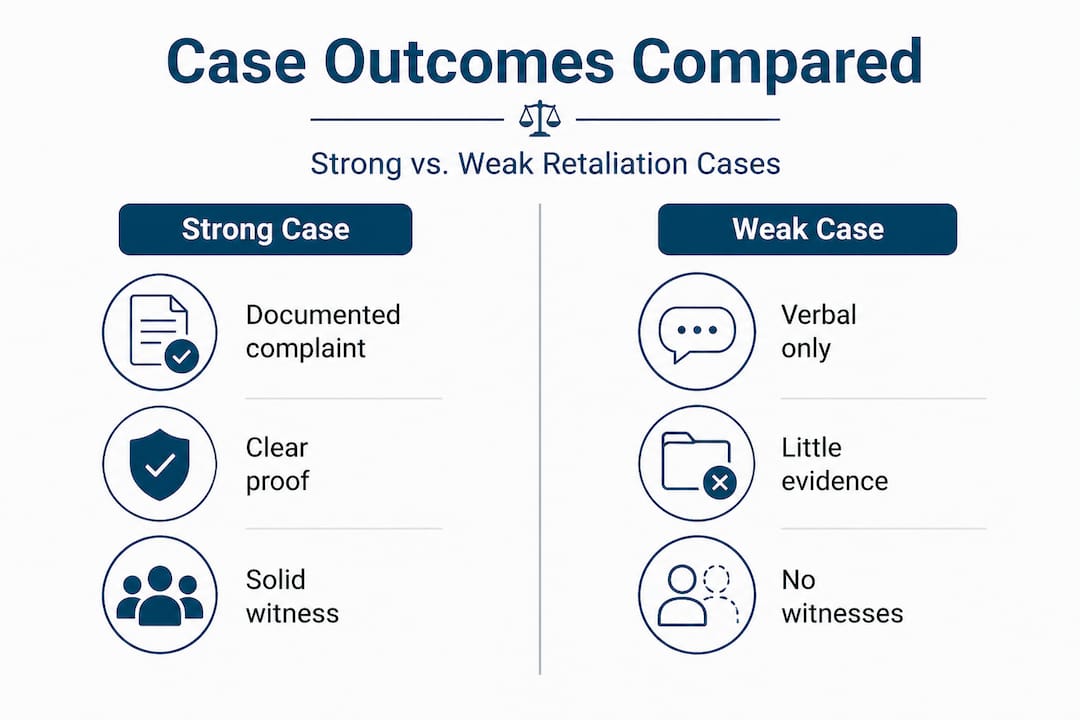
The table below compares key factors across different retaliation case scenarios and what separated wins from losses in Orange County cases:
| Factor | Strong case outcome | Weak case outcome |
|---|---|---|
| Type of complaint | Documented HR complaint, formal and signed | Informal verbal complaint with no paper trail |
| Protected activity clarity | Clear discrimination or harassment report | Vague grievance about working conditions |
| Timing of retaliation | Within days or weeks of complaint | Months later with intervening events |
| Documentation quality | Emails, performance records, witness statements | Memory-based account with no corroboration |
| Legal strategy | Attorney filed early, preserved all evidence | Self-represented, key deadlines missed |
| Outcome | Settlement or jury verdict for plaintiff | Case dismissed or verdict overturned |
The lesson from Orange County court outcomes is this: a sympathetic story is not enough. You need airtight documentation showing that your complaint was protected, that an adverse action followed, and that the employer’s stated reason for that action was a cover for retaliation. Judges scrutinize every element. Defense attorneys will attack each one.
You can explore Orange County court case outcomes related to retaliation to better understand how these cases play out and what factors courts weigh most heavily. Knowing what’s worked for other employees in your county is valuable intelligence before you decide how to proceed.
The truth about fighting workplace retaliation: What most guides leave out
Reflecting on these case takeaways, here’s what you really need to keep in mind that most guides don’t address.
Most articles about workplace retaliation focus on the procedural steps, file your complaint, document the retaliation, contact an attorney. That advice is correct, but it’s incomplete in a way that can actually hurt employees who follow it too literally.
Here is the uncomfortable reality: you can do everything right and still lose your case. The Santa Ana verdict reversal shows exactly that. A jury believed the employee. A judge didn’t find the legal standard met. That gap between feeling wronged and proving it legally is wider than most people realize, and it’s where retaliation cases quietly die.
What most guides skip over is the quality of your protected activity. Many employees assume that any complaint to HR qualifies as a protected act. That’s not always true. Courts look at whether your complaint identified a specific legal violation, such as discrimination, harassment, or wage theft, rather than a general workplace grievance. Complaining that your boss is difficult or that you feel the work environment is unfair may not rise to the level of protected activity under FEHA. This is a detail that can determine whether your entire case stands or collapses.
Our experience working with employees across Orange County shows that the cases with the best outcomes share one common trait: the employee contacted an attorney early, before the situation escalated into termination or before critical evidence disappeared. Waiting until after a major adverse action often means working with incomplete records, faded memories, and expired filing windows.
Connecting with top Orange County employment attorneys early in the process gives you a real evaluation of whether your complaint qualifies as protected activity, what evidence you need, and whether internal resolution or formal agency complaints make more sense for your situation.
Another overlooked truth: most retaliation cases settle before trial. Employers often prefer to avoid the costs and publicity of litigation. That means your goal isn’t always to go to court. It’s to build a case strong enough that settlement becomes the smarter move for your employer. That only happens when your evidence is solid, your legal theory is airtight, and your attorney knows how to apply pressure strategically.
Finally, be realistic about timelines. Retaliation cases can take months or years to resolve. Preparing yourself mentally and financially for that process matters. Your attorney should help you understand what a realistic outcome looks like, not just the best-case scenario.
Connect with a Yorba Linda employment law expert
If you’ve read this far, you already know that handling a retaliation situation alone puts you at a real disadvantage. Local attorneys who handle employment law in Orange County understand the specific courts, judges, and case patterns that shape outcomes here. Whether you’re in Yorba Linda, Lake Forest, or Huntington Beach, working with a Lake Forest employment attorney or a Huntington Beach attorney who knows the Southern California legal landscape can make a measurable difference in your result. Review retaliation case results from our prior clients to see the kinds of outcomes we’ve pursued on behalf of employees in situations like yours. We offer free consultations, and in qualifying cases, we work on contingency so that cost doesn’t stand between you and your rights.
Frequently asked questions
Is there a difference between Yorba Linda and California retaliation laws?
No. Workplace retaliation in Yorba Linda is governed entirely by California state law, and there are no separate local ordinances that apply.
Can I be fired for making an HR complaint in Southern California?
It is illegal for your employer to terminate you in response to a protected HR complaint, but proving that retaliation was the real reason for firing requires solid documentation and legal analysis.
What should I do first if I suspect retaliation?
Document everything in writing immediately, and contact a workplace retaliation attorney quickly since strict filing deadlines apply under both state and federal law.
What are examples of retaliation that courts recognize?
Courts recognize actions like demotion, pay reduction, hostile reassignment, or termination if they’re directly connected to your HR complaint, though a $2.9M verdict was overturned in Santa Ana because the protected activity element wasn’t sufficiently proven, showing how precise the legal requirements are.