
TL;DR:
- In California, employers are generally required to pay final wages immediately upon involuntary separation and within 72 hours for resignations without prior notice. Violations include withholding wages for reasons such as equipment return, which is illegal, and can result in penalties like waiting time damages accruing daily up to 30 days. Workers should gather pay stubs, document discrepancies, and contact local labor offices or attorneys to enforce their wage rights effectively.
You might be surprised to learn that in California, your employer is often legally required to hand you your final paycheck before you even walk out the door on your last day. Yet in Stanton’s hourly workforce, violations happen constantly. Workers leave jobs, get laid off, or are let go without receiving full pay, and many never realize the law gives them powerful tools to fight back. This guide breaks down exactly when your final check is due, what it must include, what happens when employers fall short, and how to take real action.
Table of Contents
- When should you receive your final paycheck?
- What’s considered a final paycheck violation?
- Penalties for late or incomplete final paychecks
- How to take action on final paycheck violations in Stanton
- Edge cases and common pitfalls for Stanton employees
- A candid perspective: What most Stanton workers miss about final paycheck claims
- Get support for your final paycheck or wage claim
- Frequently asked questions
Key Takeaways
| Point | Details |
|---|---|
| Final pay must be prompt | California law requires employers to pay final wages on strict deadlines based on separation type. |
| All earned wages required | Final checks must include all hours worked, PTO/vacation, bonuses, and any other earned income. |
| Penalties add up fast | Delayed or incomplete pay can trigger daily waiting time penalties up to 30 days. |
| Document everything | Accurate records and calculation help you secure full recovery and prove your claim. |
| Legal help is available | Local attorneys and the Labor Commissioner’s Office can support your wage recovery if your employer doesn’t comply. |
When should you receive your final paycheck?
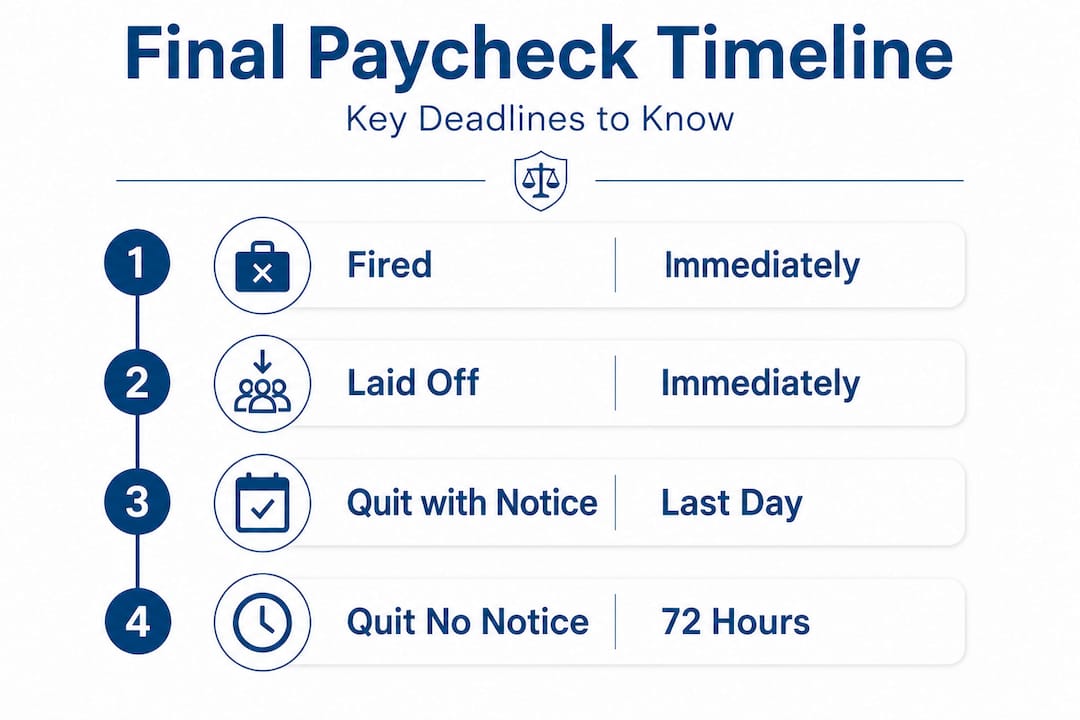
California sets some of the strictest final paycheck deadlines in the country, and they vary based on how your employment ended. Under California Labor Code, employers must pay all wages due immediately upon involuntary termination. If you are fired, laid off, or your position is eliminated, your employer cannot legally wait until the next scheduled payday. Your check is due the moment you separate.
For resignations, the timeline shifts slightly but remains strict. If you give at least 72 hours’ advance notice before quitting, your employer must pay you in full on your last day of work. If you resign without that 72-hour window, your employer has 72 hours from the moment you quit to get your check to you. These rules apply whether you work a traditional retail shift, a warehouse role, or any other hourly position across Stanton and Orange County.
One of the most persistent myths among hourly workers is that an employer can hold your final check hostage until you return a uniform, hand back a key card, or sign exit paperwork. This is completely false. Employers have no legal basis to withhold your earned wages for any of those reasons. If this happens to you, the law treats it as the same kind of violation as simply not paying at all.
| Separation type | Final paycheck deadline |
|---|---|
| Fired, laid off, or involuntary termination | Immediately at time of separation |
| Resigned with 72+ hours’ advance notice | On the last day of work |
| Resigned without 72 hours’ advance notice | Within 72 hours of resignation |
Understanding this timeline puts you ahead of most workers. Many people file Stanton unpaid wage claims weeks or months after the violation simply because they did not know the clock started ticking on day one. If you believe protecting your overtime rights also applies to your situation, these two issues often overlap and can be addressed together.
What’s considered a final paycheck violation?
Understanding the timing is just one part. What goes into the final paycheck is just as vital to your rights, and this is where many employers get it wrong or deliberately cut corners.
Under California Labor Code §201, final pay must include all earned wages, accrued unused vacation or PTO, and any other reasonably calculable compensation owed at the time of separation. That means your employer cannot simply calculate your hourly rate times the hours worked in your final pay period and call it done.
Here is a breakdown of what must appear in a legally complete final paycheck:
- All regular and overtime hours worked through the last day, calculated correctly
- Accrued, unused vacation or PTO (California treats accrued vacation as earned wages, so it cannot be taken away or forfeited)
- Earned bonuses and commissions that can be calculated at the time of separation
- Piece rate pay or shift differentials if applicable to your role
- Meal and rest break premiums owed for missed break violations that occurred during the employment period
| What must be included | What cannot be withheld |
|---|---|
| All regular wages through last day | Wages held for equipment return |
| Accrued unused vacation/PTO | Pay held for unsigned exit forms |
| Earned bonuses, commissions | Pay held for alleged misconduct |
| Overtime, shift differentials | Any wages used as “leverage” |
Pro Tip: Pull together your final pay stub and every pay stub from the last 90 days. Compare hours paid against your schedule. If overtime appears on any week during your employment but suddenly disappears from your final check, that absence is itself a violation worth documenting.
A willful failure to pay in full, meaning your employer knew what was owed and still chose not to pay it, opens the door to penalty claims beyond simply recovering the missing wages.
Penalties for late or incomplete final paychecks
Knowing what belongs in your final paycheck prepares you for the next step. When employers miss the mark, California law does not simply require them to pay what was owed. It piles on significant additional penalties.
Under Labor Code §203, if an employer willfully fails to pay final wages on time, waiting time penalties accrue at the employee’s daily wage for each day the wages remain unpaid, up to a maximum of 30 days. So if your daily rate is $120 and your employer pays you three weeks late, you may be owed an additional $2,520 on top of the underlying wages.
“If an employer willfully fails to pay final wages on time, waiting time penalties accrue at the employee’s daily wage for each day paid late, up to 30 days.” — California Labor Code §203
These penalties are designed to discourage employers from gaming the system by dragging their feet. They add up fast, especially for workers who earn higher hourly rates or work long shifts. Here is how a waiting time penalty scenario plays out in practice:
- Your last day worked is a Monday, and you were terminated without cause.
- Your employer tells you the check will arrive with the next scheduled payroll, two weeks away.
- Your daily wage based on your hourly rate and typical hours is $150.
- Every single day that passes, starting from that Monday, your employer owes you an additional $150 in penalties.
- By day 30, that penalty alone can total $4,500.
You may also be entitled to recover interest on unpaid wages, attorney’s fees, and court costs in certain cases.
A critical point that many workers do not understand: employers cannot lawfully delay your check to force you to return property or sign documents. If your employer says “bring back your badge and then we’ll process your check,” that statement alone may be evidence of a willful violation.
Pro Tip: If your employer gives you any written or verbal reason for withholding or delaying your check, document it immediately. Write down the date, time, who said it, and exactly what they said. This kind of evidence is powerful when you talk to an employment attorney about your options.
How to take action on final paycheck violations in Stanton
Once you understand the penalties and what is owed, here is how you can put your rights into action and get results.
Building a final-pay claim requires collecting all relevant records and calculating precisely what is still unpaid. Without documentation, your claim rests entirely on your word against your employer’s. Documentation is everything.
Step-by-step process for asserting your rights:
- Record the details of your last day. Note your last day worked, whether your separation was voluntary or involuntary, and exactly how it happened.
- Gather all pay stubs. Collect at least the last 90 days of pay stubs, your offer letter, any employment contract, and records of hours worked such as schedules or time clock printouts.
- Calculate what is missing. Add up all unpaid regular wages, overtime, unused PTO, unpaid bonuses, and any missing break premiums. Be specific down to the hour and dollar.
- Document all employer communications. Save any emails, texts, voicemails, or written notices related to your final pay or separation.
- Contact the California Labor Commissioner’s Office. For workers in and around Stanton, the DIR district offices include a Labor Commissioner’s Office that handles wage claims in Orange County. You can file a DLSE (Division of Labor Standards Enforcement) wage claim directly with supporting documents.
- Request a settlement or response. The Labor Commissioner will typically notify your employer and attempt to resolve the issue, or schedule a hearing if disputed.
- Consult an attorney if the claim is complex. If your employer pushes back or if multiple violations are involved, getting qualified legal representation protects your interests and often results in better outcomes.
Documents you should gather:
- All pay stubs from the last 90 to 180 days
- Records of hours worked (schedules, time sheets, shift logs)
- Any written communications about your final pay
- A copy of your employment agreement or offer letter
- Evidence of accrued PTO or vacation time
Claims for unpaid overtime can often be filed alongside a final paycheck claim, allowing you to consolidate violations and present the full picture of what you are owed.
Edge cases and common pitfalls for Stanton employees
No guide is complete without discussing the gray areas. Here is what can complicate final paycheck claims and how to protect yourself.
Waiting time penalties require two things: an actual deadline violation and wages that are genuinely owed. If your employer disputes whether certain pay was earned, for example arguing that a bonus was discretionary and not guaranteed, the penalty clock may be paused or contested until a determination is made. Final-pay timing and classification disputes can directly affect whether waiting time penalties apply, so the facts of your specific situation matter.
Common gray areas include:
- PTO classification: Some employers label time off as “personal days” or “floating holidays” rather than vacation to avoid the California rule that treats accrued vacation as earned wages. Courts often look through this kind of labeling.
- Bonus and commission disputes: If a bonus formula is unclear or a commission dispute arises over whether the work was completed before separation, the employer may argue no wages were due. Document the terms clearly.
- Voluntary versus involuntary separation: A “forced resignation” or a situation where your employer made conditions so unbearable that you had no realistic choice but to quit can be treated as an involuntary termination under a legal theory called constructive dismissal.
- Misclassification as a contractor: If you were misclassified as an independent contractor when you functioned as an employee, California’s final paycheck rules may still apply to you.
- Delayed direct deposit: Final pay must be available, not just submitted for processing. If your employer sends a direct deposit request days after it was due, the violation clock has already started.
Even cases that appear uncertain are worth investigating. We have seen situations involving student worker wage violations and other non-traditional employment that still resulted in valid claims because the underlying facts supported them. When in doubt, gather your documents and speak with someone qualified to evaluate your claim.
A candid perspective: What most Stanton workers miss about final paycheck claims
With the legal landscape mapped out, here is an honest take based on real-world experience with Stanton wage claims.
Most workers who have been shortchanged on a final paycheck do the math, shake their heads, and move on. Maybe they were shorted $87 in overtime. Maybe their PTO payout was off by $200. It feels too small to fight over. Here is the truth: those amounts are not small once you add waiting time penalties, which can multiply the value of a claim dramatically. A $200 shortage from PTO, combined with 20 days of waiting time penalties at $100 per day, becomes a $2,200 claim. The law was designed exactly to stop employers from betting that workers will not bother.
Another pattern we see constantly is workers who have overlapping violations. They were shorted on overtime during their employment, had breaks skipped without premiums, and then received an incomplete final check. Each of these is a separate, compounding claim. Looking at wage violation case studies from similar industries makes clear that workers who document everything from the first day and address violations as a bundle often recover far more than those who only notice issues when they leave.
The single most valuable habit you can build right now, even if you are still employed, is to review every pay stub when you receive it. Note discrepancies. Save the stubs. Keep records of your schedule. If things go wrong at separation, that documentation is the foundation of your entire claim.
Do not assume your claim is too small, too complicated, or too uncertain. Ask.
Get support for your final paycheck or wage claim
If you have read this far and recognize your situation, you do not have to figure out what comes next alone. When your employer refuses to pay what is owed, drags out the process, or disputes valid claims, having an experienced employment attorney in your corner changes the outcome significantly. The Stanton employment attorneys at Serendib Law Firm understand California’s wage laws thoroughly and have experience helping hourly workers recover unpaid wages, PTO, and waiting time penalties. For workers across the broader Orange County area, including those near Lake Forest employment law experts, the firm offers free consultations and handles select wage cases on contingency, meaning you pay nothing unless you recover. Reach out and get a clear picture of what your claim is worth.
Frequently asked questions
How soon should I get my final paycheck if I quit without notice in Stanton?
You must receive your final paycheck within 72 hours of resignation if you did not give at least 72 hours’ advance notice before quitting.
Can my boss hold my last paycheck until I return company equipment?
No. Employers cannot withhold your final paycheck for equipment return or any similar reason, and doing so is a violation of California law.
What should I do if my final paycheck is missing overtime or break premiums?
Calculate what is missing, document each issue, and include all wage violations in your claim, since unpaid overtime claims can be filed alongside a final paycheck complaint.
What kind of penalties can I claim for a late final paycheck?
You may claim waiting time penalties, which accrue each day the final wages remain unpaid, up to 30 days at your daily wage rate.
Where can I get local help for a final paycheck issue in Stanton?
You can contact the nearest Labor Commissioner’s Office district location, which serves workers in the Stanton and Orange County region.
Recommended
- Protect Your Overtime Rights in Stanton Logistics Jobs | Serendib Law Firm
- Unpaid Overtime Claims: Stanton Logistics Workers’ Rights
- Experienced Stanton Employment Law Attorneys
- Meal Break Violations in Stanton Warehouses: Your Legal Rights | Serendib Law Firm
- Understanding Final Paycheck Laws: What You Need To Know