
TL;DR:
- Background check errors due to systemic data delays can falsely impact employment opportunities in Fullerton. California law requires a structured process before employers can rescind offers based on background results, emphasizing the importance of disputing inaccuracies promptly. Proactively reviewing your records and working with legal experts helps protect your rights amid complex government and court reporting issues.
A single background check error can stop a promising job offer in its tracks, and the worst part is that you may have done nothing wrong. For job seekers in Fullerton, the stakes are especially high right now because California job seekers can be affected by background check record errors when public criminal history data is missing or delayed in state systems. These problems do not always trace back to a reporting company making a typo. Some arise from court system overhauls, government data backlogs, and legal corrections that ripple outward into employment decisions without warning. This guide explains how these errors happen, what your rights are under California law, and exactly how to fight back.
Table of Contents
- How background check record errors happen in Fullerton
- The impact of background check errors on hiring and employment offers
- What to do if your background check is wrong: Dispute process and documentation
- Why most background check error advice misses the real risk
- Get help resolving background check and hiring issues in Fullerton
- Frequently asked questions
Key Takeaways
| Point | Details |
|---|---|
| System errors matter | Not all background check issues are clerical; delayed court records can alter your hiring status in Fullerton. |
| Know your rights | California law gives you specific protections and dispute processes if your background check causes employment trouble. |
| Document disputes clearly | Always provide supporting documents and keep records when disputing errors on your report. |
| Local help is key | Fullerton and Orange County have unique legal developments; local employment lawyers offer the best guidance. |
How background check record errors happen in Fullerton
To understand why background check errors catch people off guard, you need to look at where criminal history data comes from and how it travels from a courthouse to a hiring manager’s desk.
Background checks in California typically pull data from multiple sources: the California Department of Justice (DOJ) repository, county court records, and third-party consumer reporting agencies (CRAs). When any one of those pipelines has a gap, delay, or correction event, the information that surfaces on your report may not match reality. And in Los Angeles County, which sits just miles from Fullerton, this is not just a theoretical problem.
A significant backlog issue emerged in LA County where criminal convictions were unreported to the state DOJ for an extended period. When those corrections were eventually processed, thousands of people suddenly had convictions appearing on their records for the first time. Someone who had passed a background check years earlier could fail the same check today, even though nothing in their life changed. The data changed. The system caught up. And the applicant paid the price.
This is not a situation where you can simply ask your employer to “fix the paperwork.” The error lives at the source level, within court reporting systems, DOJ repositories, and data pipelines that feed private CRAs. If you are currently navigating Fullerton employment law challenges tied to a background check, understanding this distinction matters enormously.
Here is a snapshot of common root causes and what triggers them:
| Error Type | Root Cause | Who Experiences It |
|---|---|---|
| Conviction now appearing | Court backlog corrections | Prior applicants who passed before |
| Expunged record still showing | CRA data not updated | Applicants with cleared records |
| Wrong identity match | Common name or SSN data collision | Applicants sharing names or details |
| Sealed record disclosed | State system misclassification | Juvenile record holders |
| Arrest without conviction listed | Incomplete court outcome data | Applicants arrested but not convicted |
“The scope of LA County’s reporting gap means that applicants who felt confident in their record may suddenly find new entries appearing that they never anticipated, through no fault of their own.”
The scale here is important. Thousands of people in Southern California may be in a position where their background check results shift without warning. Employers and job seekers in Fullerton can genuinely be blindsided, which is why knowing your rights and your options before this happens gives you a real advantage.
The impact of background check errors on hiring and employment offers
Background check errors do not just cause inconvenience. They can pull a conditional job offer right out of your hands, sometimes the day before you were supposed to start. Let’s be clear about what that means practically.
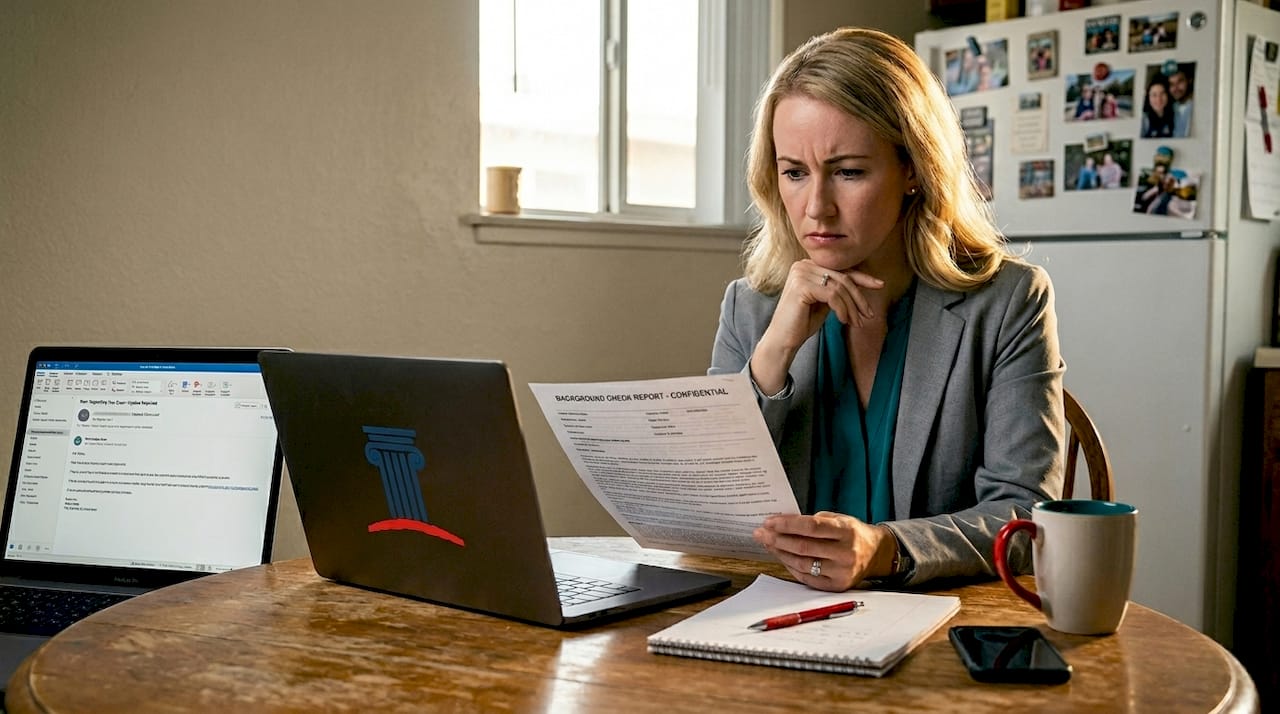
When a hiring manager receives a flagged background check result, many will move to rescind an offer immediately, especially if they are unfamiliar with California’s specific legal obligations. But under California’s Fair Chance framework, employers cannot simply withdraw an offer because a conviction shows up. They are required to go through a structured process before taking any adverse action.
Here is what California law requires before an employer can rescind an offer based on background check results:
- The employer must wait until after a conditional offer before requesting or reviewing criminal history
- Once a potentially disqualifying result appears, the employer must conduct an individualized assessment
- That assessment must consider the nature of the offense, how long ago it occurred, and how it relates to the specific job duties
- The employer must provide written notice of the preliminary decision and the supporting background check
- The applicant gets at least five business days to respond and provide evidence of inaccuracy or rehabilitation
- Only after that response period can the employer make a final decision
This process exists precisely because of situations where data is wrong or incomplete. If an employer skips even one of these steps, that is a potential violation of California law. Understanding your rights after job offer withdrawal can be the difference between losing a job quietly and taking meaningful legal action.
Pro Tip: If an employer verbally tells you they are rescinding your offer because of your background check, ask them to send the preliminary adverse action notice in writing. You are entitled to it under both California law and the federal Fair Credit Reporting Act (FCRA).
Consider the difference between how these situations typically unfold and how they should unfold:
| Scenario | What Often Happens | What the Law Requires |
|---|---|---|
| Conviction shows on check | Offer withdrawn immediately | Written notice plus individualized assessment |
| Applicant disputes the record | Employer ignores it | Must pause adverse action during dispute |
| Old arrest without conviction appears | Treated as disqualifying | Cannot be used to deny employment in California |
| Expunged record appears | Treated like active record | Must be excluded from consideration |
Many employers, even well-intentioned HR departments, are not fully trained on these requirements. If you are dealing with HR background check errors and feel the process was not followed correctly, that is worth examining with legal guidance.
The timing of when an error surfaces in the hiring process matters too. Errors that appear during a background check ordered after an offer carry different legal weight than errors that surface during an informal pre-offer search. Knowing where you are in the process when the error appears tells you which protections apply to you.
What to do if your background check is wrong: Dispute process and documentation
Acting quickly and methodically when you discover a background check error is the single most important thing you can do to protect your job prospects. The good news is that the law gives you real tools to fight back. The challenge is using them correctly.
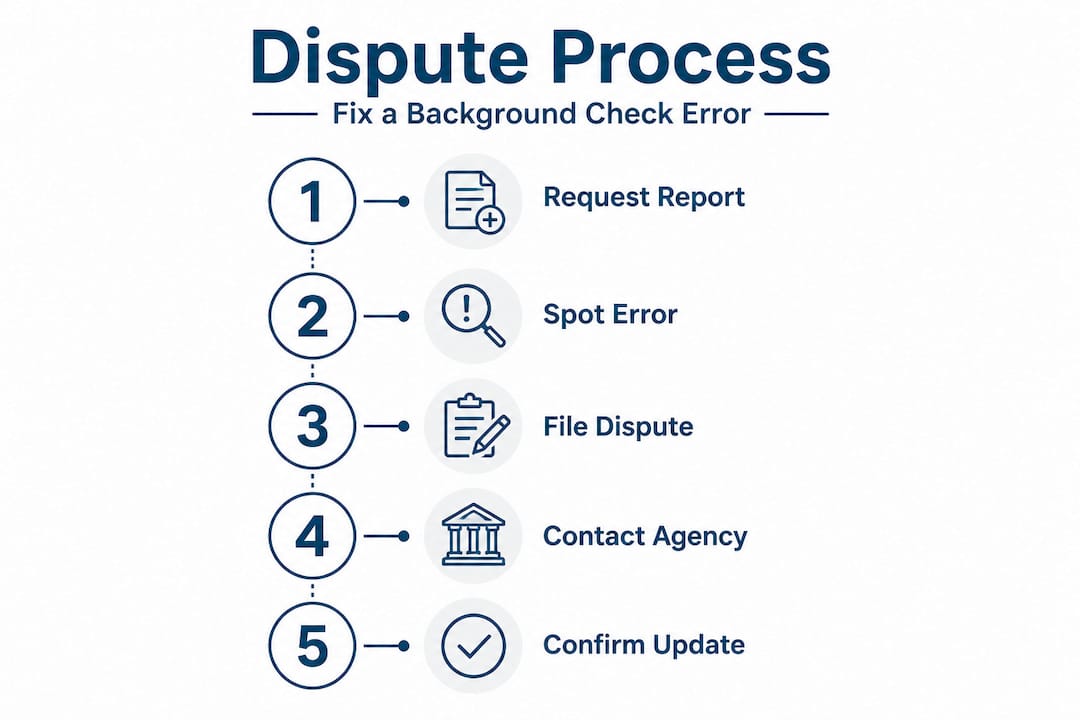
The FCRA dispute process requires that you dispute inaccurate information with the reporting agency and the business that provided the information, and your dispute must be supported and documented. Here is how to do that effectively:
Get a copy of your background check report. You are entitled to a free copy when adverse action is being taken. Review every line item for inaccuracies, including case numbers, dates, disposition status, and jurisdiction.
Identify the specific error type. Is it a conviction that is not yours? An expunged record still showing? An arrest without a final disposition? Each type of error requires slightly different supporting evidence.
File a written dispute with the CRA. Do not call. Write. Send your dispute via certified mail so you have a delivery record. Clearly identify the item in dispute, explain why it is inaccurate, and include copies (never originals) of supporting documentation.
Simultaneously contact the data furnisher. The data furnisher is the court, agency, or government entity that originally reported the information to the CRA. Filing with just the CRA is not enough if the bad data is still live at the source.
Document everything. Keep copies of every letter sent, every receipt, and every response received. Create a timeline. If this ever becomes a legal matter, your documentation is your evidence.
Notify your employer in writing. Once you have filed your dispute, send a brief written notice to your employer or prospective employer explaining that the background check result is being disputed and that you have initiated a formal correction process.
Follow up on the dispute timeline. CRAs must investigate disputes within 30 days under the FCRA. If you submitted additional materials, that window can extend to 45 days. Mark your calendar.
Pro Tip: If your dispute involves a California DOJ record error, you may also need to file a challenge directly with the DOJ through their state record review process. A Fullerton employment attorney can tell you whether you need to pursue both tracks simultaneously.
When errors are tied to systemic court reporting failures like the LA County backlog, the dispute process becomes more complicated. The CRA may verify the record as accurate because the court data still shows the conviction, even if that entry resulted from a delayed reporting fix. In those cases, you need to challenge the underlying court record itself, which is a process that goes well beyond a standard credit bureau dispute form.
Knowing your rights after a background check error puts you in a much stronger position when dealing with employers who may not realize the data they are acting on is wrong or legally questionable.
Why most background check error advice misses the real risk
Here is the uncomfortable truth: most guides on fixing background check errors treat the problem like a simple data entry correction. File a dispute form, wait 30 days, done. That advice works fine when a CRA accidentally typed the wrong middle name. It fails completely when the problem is institutional.
In California right now, some background check errors do not stem from a CRA clerical mistake. They result from systemic data failures or backlog correction events in court record processing. When the LA County reporting gap was addressed and thousands of previously absent convictions entered the DOJ database, every one of those cases represented a real person whose clean record had just become something else overnight. Not because of anything they did. Not because of a typo. Because a court system caught up on its own backlog.
This changes the nature of the problem. When you dispute a record that got into the system through a legitimate court correction, the CRA may verify it as accurate. The court data says the conviction happened. The reporting is technically correct. And yet you were not expecting it. You built your employment history, your references, your applications, around a record that looked different for years.
The real risk that most advice ignores is the time gap problem. Your record can effectively change years after the underlying event, leaving you subject to fresh hiring obstacles during what should be a routine background check. That is a fundamentally different situation from catching an error and correcting it. It requires monitoring your own data proactively, understanding which sources report to which databases, and knowing when a change in your record reflects a legitimate court update versus an outright mistake.
From our perspective working with Fullerton and Orange County job seekers, the people who navigate this successfully are the ones who get ahead of it. They request their own background check reports periodically. They check DOJ records. They do not wait for a rejected offer to discover the problem. And when the issue is complex, they work with legal help for background checks who understand the intersection of court data systems and employment law.
Systemic problems require systemic solutions. A single dispute form is often not enough.
Get help resolving background check and hiring issues in Fullerton
If you are a Fullerton job seeker dealing with an unexpected background check result, a withdrawn job offer, or a dispute that is not going anywhere, you do not have to figure this out alone. Our team at Serendib Law understands both the California-specific legal landscape and the recent court data issues that are affecting applicants throughout Orange County and beyond. We can help you challenge improper hiring denials, navigate the formal dispute process, and hold employers accountable when they skip legally required steps. Whether your issue stems from a CRA error or a deeper government data problem, working with Fullerton employment law attorneys who know this terrain makes a real difference. If you are also searching for support across nearby areas, our Lake Forest employment attorneys serve clients throughout the region. Contact us for a free consultation and take the first step toward protecting your career.
Frequently asked questions
Why was my background check clear before, but now shows a conviction?
A major backlog in LA County court reporting was recently corrected, meaning past convictions that were never submitted to the CA DOJ repository may now appear on your background check for the first time. This is a systemic issue, not a personal error.
Can an employer in Fullerton ask about my criminal history on an initial job application?
No. California’s Fair Chance Act bars covered employers from asking about convictions on initial job applications and requires that any background check be ordered only after a conditional offer has been made.
What should I do if my background check shows a conviction I do not recognize?
You should immediately dispute the error with both the background check company and any credit reporting agency listing the item, and include copies of supporting documents like court records or dismissal paperwork.
How long does it take to fix a background check error?
Corrections typically take between a few days and 45 days, depending on how quickly the reporting agencies investigate and whether the error lives at the CRA level or the original court data source.
Is legal help necessary for background check disputes in Fullerton?
It is especially valuable when the issue traces back to court or government data corrections rather than a simple CRA reporting mistake, since those cases require a more complex challenge that goes beyond a standard dispute form.