

TL;DR:
- California law requires tips to belong solely to the employee who earned them, excluding managers and supervisors from tip pools. Employers can organize tip pools only among direct service staff and must not redirect tips to ineligible parties, with enforcement strengthened through SB 648. Workers should document violations, understand their rights, and seek legal help if tip theft or illegal pooling occurs.
Working in an Anaheim restaurant means navigating a tip system that feels different at every job. One employer runs a strict house pool, another lets servers keep everything, and a third deducts a percentage for back-of-house staff. The confusion is real, and it costs workers money every single shift. What most restaurant employees don’t realize is that California state law, not local custom or manager preference, sets hard rules about how tips must be handled. Understanding those rules puts you in a far stronger position than simply accepting whatever system your employer has in place.
Table of Contents
- Understanding tip pooling: What California law actually says
- Who can and cannot receive pooled tips under the law
- Tip pooling, service charges, and common employer mistakes
- How tip pooling is enforced in Anaheim: Your rights and remedies
- A worker-first perspective: Why clarity matters more than ever
- Get help protecting your tip rights in Anaheim
- Frequently asked questions
Key Takeaways
| Point | Details |
|---|---|
| California law rules | In Anaheim, statewide law—not city law—determines tip pooling legality. |
| Managers must be excluded | Owners or agents with any supervisory authority cannot share tip pools. |
| Service charge confusion | Mandatory service charges are not tips and follow different rules. |
| Strong enforcement | As of 2026, the Labor Commissioner has more power to act on tip theft complaints. |
| Know your remedies | Employees have clear steps for reporting illegal tip pooling and seeking help. |
Understanding tip pooling: What California law actually says
Let’s break down what the law actually requires for tip pooling.
California Labor Code § 351 is the foundation of tip law for every restaurant worker in the state, including those working at establishments on Katella Avenue, Harbor Boulevard, or anywhere else in Anaheim. The statute is direct: tips belong to the employee who earned them, not the employer. When an employer sets up a tip pool, that arrangement must follow strict criteria or it becomes illegal.
California tip pooling is legal only when it is limited to employees who are genuinely part of the service chain, meaning those who directly serve or support customers during the dining experience. Bus staff, food runners, and bartenders who contribute to service are typically eligible. Owners, managers, and supervisory personnel are not.
Anaheim itself has not enacted its own local tip pooling ordinance. This is actually good news for workers because it means a single, well-developed body of state law governs your situation. There’s no patchwork of conflicting rules to sort through. California law preempts local variation, so whatever your employer tells you about “how we do things here,” the state standard still applies.
Know your baseline: California Labor Code § 351 makes tips the exclusive property of the employee who receives them. Any arrangement that redirects those tips to an employer or ineligible party violates this rule outright.
One area where confusion frequently emerges is the overlap between tip pooling and other wage rules. Workers who are also dealing with missed breaks or shortened meal periods should know that California has equally firm protections on those issues. You can review meal and break laws to understand how those protections stack up alongside your tip rights.
The practical takeaway here is simple. Your employer can organize a tip pool. They can set contribution percentages. But they cannot design that pool to benefit themselves or anyone who functions in a managerial or supervisory role. Doing so crosses a legal line.
Who can and cannot receive pooled tips under the law
Now that you know state law applies, let’s see exactly who can be included in a legal tip pool.

The law distinguishes between an “employee” and an “agent.” An agent is someone who acts on behalf of the employer, including managers, supervisors, and in most cases, anyone with authority to hire, fire, or discipline staff. The term “agent” is interpreted broadly by California courts. A shift lead who schedules staff and handles complaints, even without a formal manager title, may qualify as an agent and therefore be ineligible to participate in a tip pool.
Here’s a clear breakdown of who typically falls on each side of that line:
| Position | Eligible for pooled tips? | Reason |
|---|---|---|
| Server / waiter | Yes | Direct service to customers |
| Bartender | Yes | Service role in the chain |
| Busser | Yes | Supports service directly |
| Food runner | Yes | Part of table service delivery |
| Host / hostess | Generally yes, if non-supervisory | Depends on specific duties |
| Dishwasher | Generally no | Not part of direct service |
| Kitchen cook | Generally no | Back-of-house production role |
| Shift supervisor | No | Acts as an agent of employer |
| Restaurant manager | No | Employer’s agent by definition |
| Owner | No | Explicitly excluded by statute |
Tips are the sole property of service employees, and managers or agents must be excluded from tip pools under California law. Violations of this rule are not technical oversights; they are wage theft, plain and simple.
Common illegal practices you should watch for include:
- A general manager receiving a percentage of nightly tip pool distributions
- A head server who also performs supervisory functions being included in the pool
- Tips from a shared pool being funneled back to the restaurant under a “house fee” structure
- Kitchen staff being required to contribute to a pool that then gets distributed to ineligible parties
Pro Tip: If your employer includes anyone in the tip pool who has the power to discipline you, assign your schedule, or approve your time off, that person is almost certainly an “agent” under California law and should not be receiving pooled tips. Document who receives what, and when.
If you’ve experienced pressure or threats for speaking up about tip pool violations, those behaviors may cross into harassment territory. California provides strong harassment law protections that cover the restaurant environment, and you should know those protections exist alongside your tip rights.
Tip pooling, service charges, and common employer mistakes
With eligibility clear, it’s critical to understand how tips differ from service charges, and why this matters.
Many Anaheim restaurants now add a mandatory surcharge of 18% to 22% to every check, often labeled as a “service charge” or “hospitality fee.” Customers frequently assume this goes directly to their server. The legal reality is far more complicated, and employers sometimes use that confusion to their advantage.
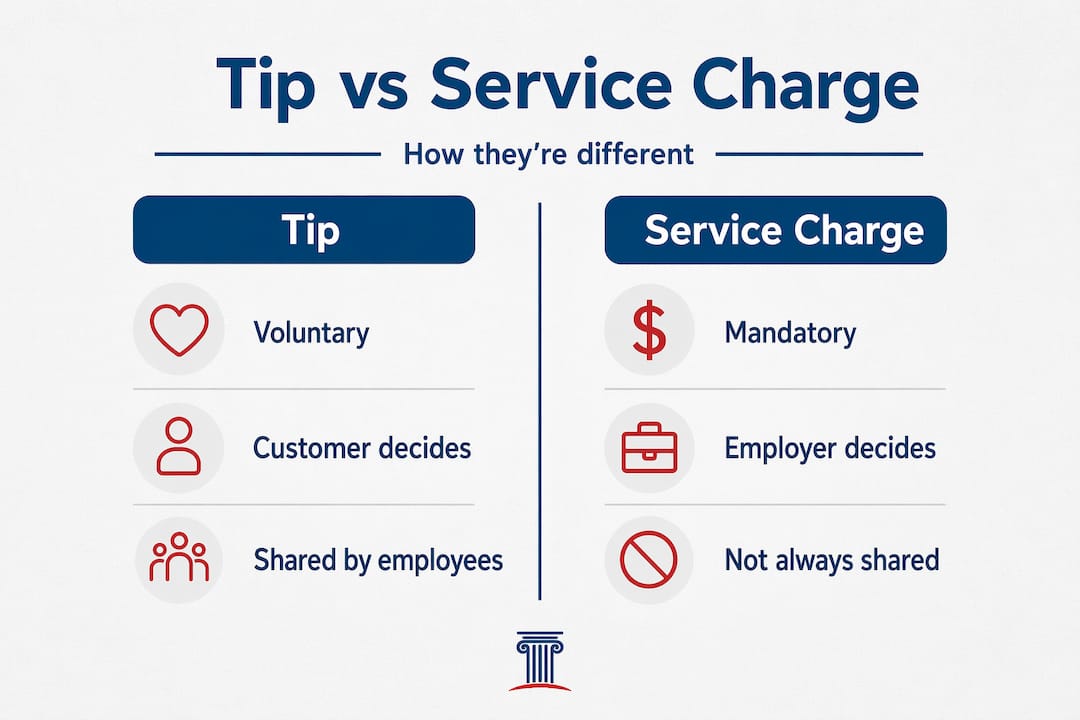
Here is a side-by-side comparison of how tips and service charges differ under California law:
| Factor | Voluntary tip | Mandatory service charge |
|---|---|---|
| Who controls the amount? | Customer | Employer |
| Ownership of funds | Employee (immediate) | Employer until distributed |
| Distribution method | Direct to worker or pooled | At employer’s discretion |
| Tax reporting | Employee reports | Employer reports as revenue |
| Legal implication if withheld | Wage theft under Labor Code | Different liability, breach of contract |
Misclassifying a mandatory service charge as a tip creates liabilities for employers that are distinct from standard tip pooling rules. In some cases, California courts have treated service charges as wages if the employer implied or promised they would go to workers. That creates a whole different category of legal exposure for employers who pocket those fees.
Here’s a step-by-step way to check whether what you’re receiving is a true tip or a misdirected service charge:
- Look at the customer’s receipt. Is the amount printed as a mandatory line item or written in by the customer?
- Ask your employer directly how service charges are distributed and request that answer in writing.
- Compare what customers are paying versus what you actually receive at the end of the night.
- Track this over multiple shifts. Consistent shortfalls are a red flag.
- Review your pay stubs for any deductions labeled as “fees,” “house contributions,” or similar terms.
The most common employer mistakes in this area include labeling mandatory charges as gratuities to avoid distributing them, failing to explain to workers how pooled funds are calculated, deducting “administrative fees” from tip pools without legal basis, and not maintaining records of tip distributions at all.
Pro Tip: California law requires employers to keep accurate wage records, and that includes tip records. If your employer refuses to show you documentation of how pooled tips are calculated and distributed, that refusal itself is a warning sign worth taking seriously.
Workers dealing with related wage issues, including missed overtime tied to long service shifts, can also explore unpaid overtime claims as a connected avenue for recovering what they’re owed.
How tip pooling is enforced in Anaheim: Your rights and remedies
Having covered what’s legal and what’s not, here’s how you can respond if your rights around tip pooling aren’t respected.
California’s enforcement environment has gotten significantly stronger in recent years. Tip theft enforcement was substantially expanded through SB 648, which in 2026 gave the California Labor Commissioner enhanced tools to investigate and penalize tip theft, including the ability to issue citations directly against employers without waiting for employees to file individual civil lawsuits.
This matters enormously for Anaheim restaurant workers. It means that even if you are afraid to put your name on a formal complaint, the Labor Commissioner can act on patterns of violations they identify through audits or reports from multiple workers collectively.
If you believe your tips are being withheld or your tip pool is structured illegally, here’s what to do:
- Document everything immediately. Note dates, shift times, amounts received, and names of anyone who received distributions from the pool.
- Compare your records to customer receipts when possible. Credit card receipts show tip amounts that should match what you receive.
- Talk to coworkers quietly. If this is happening to you, it’s likely happening to others. Multiple complaints carry far more weight.
- File a wage claim with the California Labor Commissioner’s Office. You can do this online, by mail, or in person. There are applicable statutes of limitations that should be evaluated on a case-by-case basis, so acting sooner rather than later protects your ability to recover back wages.
- Consult an employment attorney before signing anything your employer presents. Settlements or arbitration agreements offered by management after you raise concerns deserve careful legal review.
Key protections you already have under California law:
- You cannot be legally fired, demoted, or have your hours cut for reporting tip violations
- Retaliation for filing a wage complaint is itself a separate violation with its own remedies
- You are entitled to back pay for any tips unlawfully withheld, plus potential additional damages
Your protection is real: California law prohibits retaliation against any employee who reports or complains about tip theft or pooling violations. If your employer responds to your inquiry with schedule cuts, write-ups, or termination, that response is actionable.
Workers who face pushback for speaking up can learn more about protection from retaliation under state law. Additionally, restaurant employees involved in collective organizing around wage issues can find relevant information about union activity and retaliation protections that may apply to their specific situation.
A worker-first perspective: Why clarity matters more than ever
Here’s an uncomfortable truth about the Anaheim restaurant industry: “that’s just how we do it here” has never been a legal defense, but it has been an effective way to keep workers quiet for years.
The conventional wisdom that tip practices vary by restaurant and that workers just have to accept whatever system their employer runs is genuinely outdated and increasingly dangerous for employers who rely on it. With SB 648’s enhanced enforcement tools now active, the era of vague, unchallenged tip pool arrangements is ending. Employers who built casual, undocumented systems around informal traditions are now exposed in ways they weren’t five years ago.
What strikes us most in this new enforcement landscape is that the workers who benefit most are not the ones who file the loudest complaints. They’re the ones who simply know the rules. When a server can walk into a pre-shift meeting and ask specifically which positions are included in tonight’s pool and why, that question alone changes the dynamic. Employers who have been cutting corners suddenly face informed staff, and informed staff are far harder to underpay.
There’s also something worth saying about the service charge issue specifically. The practice of advertising a hospitality fee to customers who believe it goes entirely to their server, while the restaurant retains a portion, is not just legally questionable. It erodes trust between staff and management, and between workers and the guests they serve. Transparency here isn’t just a legal requirement. It’s a professional standard.
Our position is direct: if you work in an Anaheim restaurant and you’re not sure whether your tip pool is legal, you probably have good reason to find out. The tools to check are available, the enforcement mechanisms are stronger than they’ve ever been, and employment law expertise is accessible to workers who need guidance. Clarity is always worth pursuing, especially when your paycheck depends on it.
Get help protecting your tip rights in Anaheim
Empowered with new clarity, here’s your next step if you need direct legal support.
If you’re an Anaheim restaurant worker dealing with tip theft, an illegal pool structure, or retaliation for asking questions, you don’t have to figure this out alone. At Serendib Law Firm, we represent employees, not employers, and we understand exactly how tip violations play out in real restaurant settings across Orange County. Whether you’re dealing with a manager taking a cut, a service charge that never makes it to your paycheck, or a sudden schedule change after you raised concerns, our team can help you understand what your situation means legally and what options you have. Explore your rights through our employment law services or reach out directly to speak with our Anaheim employment attorneys. Free consultations are available, and we handle select cases on contingency.
Frequently asked questions
Is tip pooling required in all Anaheim restaurants?
Tip pooling is not required at any Anaheim restaurant, but when an employer chooses to use it, they must follow California law, which limits participation to eligible service chain employees only.
Can my manager or supervisor take a cut of pooled tips?
No. Under California law, managers and agents must be excluded from any tip pool arrangement, regardless of how the employer labels their role or structures the system.
What counts as a tip vs. a service charge?
Tips are voluntary payments made directly by customers at their own discretion, while service charges are mandatory fees set by the employer, and the two carry distinct ownership and liability rules under California law.
If my employer withholds tips from me, what should I do?
You can file a wage claim with the California Labor Commissioner, who has significantly expanded enforcement authority for tip theft complaints under SB 648 as of 2026. Consulting an employment attorney before you act will help you protect your claim.