
TL;DR:
- Employees in California may have legal rights under constructive discharge if workplace conditions become intolerable enough to force resignation. Courts assess whether a reasonable employee would feel compelled to quit, based on patterns of severe harassment or hostile environment tied to protected characteristics. Proper documentation and timely legal consultation are crucial for pursuing claims related to workplace bullying and wrongful termination.
Many employees in Westminster and across Southern California walk away from toxic jobs believing they’ve given up any chance at legal recourse. That instinct is understandable, but it’s often wrong. California law recognizes a legal concept called constructive discharge, which means that quitting under extreme workplace conditions may be treated the same as being fired. If your employer made your job so unbearable that leaving felt like the only option, you may have stronger legal rights than you realize. This guide walks you through how to recognize those conditions, what to document, and how to take action.
Table of Contents
- What is constructive discharge in Westminster?
- Recognizing workplace bullying and intolerable conditions
- Evidence and documentation: What you need
- Your rights and possible next steps in Westminster
- The uncomfortable truth about proving constructive discharge
- How an employment attorney can help you take action
- Frequently asked questions
Key Takeaways
| Point | Details |
|---|---|
| Legal protection exists | Quitting because of severe bullying or harassment can qualify as wrongful termination in California if conditions meet the legal criteria. |
| Severity and duration matter | A single unpleasant incident is usually not enough; persistent or extreme mistreatment is required. |
| Documentation is critical | Thoroughly gathering evidence like emails and witness accounts strengthens your case considerably. |
| Act quickly | Delaying action or not escalating internally may weaken your claim or rights. |
| Legal help is available | Consulting an experienced employment attorney can clarify your rights and best course of action in Westminster. |
What is constructive discharge in Westminster?
Having addressed why many overlook their rights after quitting, let’s clarify exactly what constructive discharge means and when the law is on your side.
Constructive discharge occurs when an employer makes working conditions so intolerable that a reasonable employee would feel forced to resign. California courts treat this resignation as an involuntary termination, which opens the door to the same legal remedies available in a wrongful firing claim. The key word here is “intolerable,” and courts apply a specific standard to measure that.
California uses an objective “reasonable employee” test. This means a judge or jury does not simply ask whether you felt the conditions were unbearable. They ask whether a reasonable person in your same position, facing those same conditions, would also feel compelled to quit. That distinction matters. Personal sensitivity alone will not carry a claim. The conditions themselves must be objectively extreme.
Our Westminster employment attorneys regularly see employees who experienced genuine mistreatment but were unsure whether it met the legal bar. Understanding the threshold early helps you evaluate your situation honestly and protect your options. You can also explore case studies on constructive discharge from similar California situations to get a clearer picture of what courts have accepted as meeting this standard.
What conditions typically rise to the level of constructive discharge in California? Courts have recognized the following as potentially qualifying:
- Repeated, severe harassment based on a protected characteristic such as race, gender, religion, or disability
- Persistent threats of termination or demotion used as intimidation tactics
- Deliberate assignment of impossible or degrading work with no legitimate business reason
- Systematic exclusion from meetings, communications, or opportunities tied to a protected status
- Prolonged exposure to a hostile work environment where management either participated or did nothing to stop it
The law does not protect employees from every unpleasant interaction or difficult manager. The conditions must be more than frustrating. They must be the kind that no reasonable person could be expected to endure and still show up to work.
Recognizing workplace bullying and intolerable conditions
Now that you understand the legal definition, let’s look at real-world behavior and how courts distinguish between actionable bullying and run-of-the-mill work issues.

One of the biggest sources of confusion for employees is the gap between what feels like bullying and what the law actually addresses. Not every difficult situation qualifies. Persistence and severity are the twin pillars California courts rely on. An isolated bad day, a single rude comment, or even one unfair performance review generally will not reach the legal threshold.
Here is a side-by-side comparison of situations that are more likely and less likely to support a constructive discharge claim:
| Scenario | Likely actionable? | Why |
|---|---|---|
| Supervisor repeatedly mocks your accent or religion in front of coworkers | Yes | Ongoing, tied to protected class, creates hostile environment |
| Manager gives harsh feedback on a project | No | Isolated, performance-related, no protected class link |
| Employer reassigns you to night shifts after you file an HR complaint | Likely yes | Retaliatory pattern, timing is significant |
| Co-worker is occasionally rude or dismissive | No | Isolated behavior, not employer-directed |
| HR ignores months of reported sexual harassment by a direct supervisor | Yes | Persistent, severe, employer failed duty to act |
| Annual review contains one unfair rating | No | Isolated incident, no pattern established |
The behaviors most likely to support a legal claim involve a pattern of conduct, often tied to a protected characteristic. Common examples include:
- A manager at a retail company who repeatedly questions an employee’s religious practices and then cuts their hours when they request time off for prayer
- A supervisor at a logistics firm who uses racial slurs and when HR is notified, the behavior continues for months without any real disciplinary action
- An employer who systematically excludes an employee with a disability from team events and promotions, creating professional isolation
For deeper context on how California law addresses these patterns, our resources on workplace harassment and bullying explain the legal standards in more detail. Employees facing harassment tied to their faith may also find our religious discrimination resources specifically helpful for their situation.
Pro Tip: Keep a private, dated journal of every incident. Record exactly what was said, who was present, and how it made performing your job difficult or impossible. Write entries as close to each event as possible, while details are fresh. This habit can make a significant difference if you later pursue a legal claim.
Evidence and documentation: What you need
With clear signs of actionable bullying, being prepared with solid documentation is your biggest advantage.
Courts evaluating constructive discharge claims face a fact-intensive inquiry. Every case turns on its specific details. That means your personal evidence, not just your memory, determines the strength of your position. Many legitimate claims fail not because the mistreatment wasn’t real, but because the paper trail was thin or inconsistent.
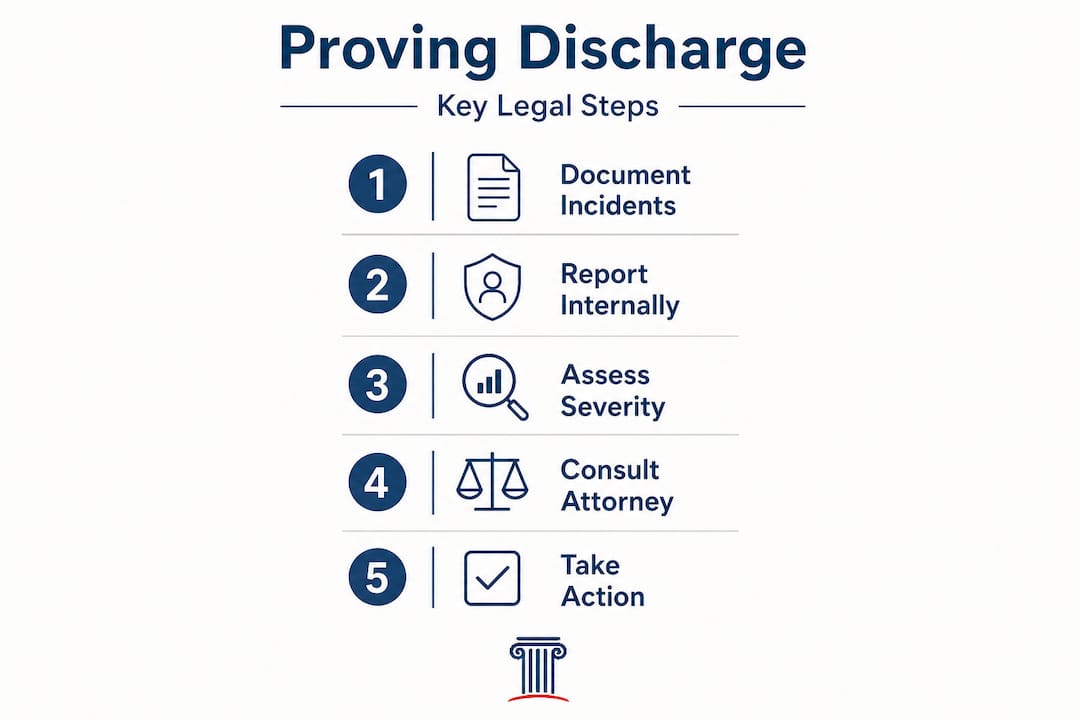
Here is a practical step-by-step approach to building a solid record:
-
Save every relevant email and text message. If your employer communicates threats, demotions, or discriminatory remarks in writing, preserve those immediately. Forward work emails to a personal account or take timestamped screenshots of any platform-based messages. Do not wait until after you resign.
-
Write contemporaneous notes. “Contemporaneous” simply means written at or near the time of the event. If your manager humiliates you in a meeting, write down what was said, when, where, and who heard it. Courts view contemporaneous notes as far more credible than recollections reconstructed months later.
-
Identify and note witnesses. Who else saw or heard the conduct? You don’t need to recruit anyone or coach them on what to say. Simply note names and their relationship to the event. A statement from a co-worker who witnessed repeated harassment carries real weight.
-
Document every HR interaction. If you report bullying to human resources, note the date, who you spoke with, and what their response was. If they follow up in writing, keep those records. If they promised action and nothing happened, that inaction is itself evidence.
-
Request copies of performance reviews and any formal disciplinary records. Sudden negative reviews that appear only after you filed a complaint or reported misconduct can reveal retaliatory intent. Contrast those reviews with prior positive ones to show the timeline clearly.
-
Note any changes to your role, schedule, or responsibilities. If you were demoted, transferred, had your pay cut, or were excluded from projects after raising concerns, document the timeline precisely.
Employees dealing with a hostile work environment often feel pressure to stay silent out of fear of retaliation. Our overview of hostile work environment legal options addresses what protections California law provides against employer retaliation for reporting misconduct.
Pro Tip: Never document anything using company devices or accounts. Use your personal phone, email, and cloud storage. Employers may restrict access to company systems once they are aware of a complaint or potential legal action.
Your rights and possible next steps in Westminster
Once your evidence is ready, it’s time to act. Here’s what to know about your options moving forward in Westminster.
California law gives employees meaningful tools to fight back when a workplace becomes intolerable. A resignation under extreme conditions can be treated as an involuntary termination if the right standards are met, which means you may be entitled to back pay, damages, and other remedies a wrongfully terminated employee would receive.
Here is a practical overview of where to focus your energy:
| Step | What it involves | Why it matters |
|---|---|---|
| Internal reporting | Submitting a written complaint to HR or management | Creates a formal record and may trigger employer obligations |
| Legal consultation | Meeting with an employment attorney about your facts | Clarifies your rights, evaluates your evidence, sets strategy |
| Filing an agency complaint | Filing with the Civil Rights Department or EEOC | Preserves legal options and initiates investigation |
| Pursuing litigation | Filing a civil lawsuit if negotiations fail | Seeks compensation through the court system |
A few additional points every Westminster employee should keep in mind:
- Timing matters. There are applicable statutes of limitations for employment claims that vary depending on the specific claim and circumstances. These should be evaluated on a case-by-case basis with an attorney.
- You do not have to have already resigned to consult an attorney. Many employees consult legal counsel while still employed to understand their options before deciding to leave.
- Your employer cannot legally retaliate against you for reporting workplace harassment or consulting with an attorney about your rights. If they do, that retaliation itself may form the basis of an additional claim.
Our Westminster employment attorneys are familiar with the specific dynamics of the local workforce and can provide guidance tailored to your situation rather than generic advice that may not reflect California’s employment landscape.
Pro Tip: Bring your documentation to the first attorney consultation. Even a rough collection of notes, screenshots, and HR correspondence helps the attorney quickly assess whether your situation is likely to meet the legal standard for constructive discharge.
The uncomfortable truth about proving constructive discharge
Here is something many employees don’t hear until it’s too late: having a real, painful experience of workplace bullying is not the same as having a winning legal claim. This is not cynicism. It is a practical reality that shapes outcomes every day.
The legal bar for constructive discharge is genuinely high. Severity plus duration and continuity are critical. Courts want to see a pattern, not a single incident, no matter how serious that incident felt. Employees who resign after one terrible day, even a legitimately awful one, typically cannot meet the objective “reasonable employee” standard.
The most common reasons valid claims fail:
Waiting too long to document. Employees often endure months of abuse before they think to write anything down. By then, specific dates, words, and witnesses become fuzzy. The employer’s attorney will use that fuzziness to undermine credibility.
Not escalating internally. If you never formally reported the bullying to HR or management, a court may question why. Escalation is not just a professional step. It is often legally necessary to put your employer on notice and give them the opportunity to fix the problem. Failure to give that notice can weaken your claim.
Resigning too quickly. This sounds harsh, but it matters. Resigning the day of a bad incident may not allow enough time to establish the persistence that constructive discharge requires. Consulting an attorney before you resign can help you understand how to protect your legal position while continuing to document the pattern.
Underestimating the employer’s response. Many employees assume the facts will speak for themselves. In reality, employers have legal teams and HR records that will be used to construct an alternative narrative. Your own careful documentation is the counterweight to that advantage.
Reviewing California case studies involving constructive discharge can give you a realistic picture of how courts have evaluated similar situations. Knowledge of past outcomes helps set realistic expectations and informs smarter decisions before and after resignation.
How an employment attorney can help you take action
If you are dealing with persistent workplace bullying in Westminster and believe you have been forced out of your job, the right legal guidance makes a real difference in outcome and peace of mind. An experienced employment attorney can review your documentation, identify which legal theories apply, and advise you on the strongest path forward before you make decisions that affect your claim.
At Serendib Law Firm, we represent employees in Westminster and across Southern California who are facing harassment, bullying, and constructive discharge situations. Our team understands how to evaluate the evidence, challenge employer narratives, and pursue claims aggressively on your behalf. We also work with employees throughout the region, including through our Lake Forest employment law attorneys team. Not sure where to start? Our guide on how to choose an employment lawyer helps you ask the right questions so you find the right fit. Contact us for a free consultation to discuss your specific circumstances.
Frequently asked questions
What types of bullying count as constructive discharge in California?
Repeated and severe harassment, persistent humiliation, demotion, or intentional creation of intolerable conditions may qualify if they are ongoing, egregious, and tied to a protected characteristic or retaliatory motive.
Is one bad incident enough for a constructive discharge claim?
Usually not. Isolated incidents are generally insufficient because California law requires repeated or extremely severe mistreatment that would compel a reasonable person to resign.
What should I do first if I think I was constructively discharged?
Begin gathering documentation immediately and consult with an employment attorney. The threshold is fact-intensive, so a lawyer can assess whether your specific evidence meets the legal standard.
Can I file a claim if my employer did not directly harass me but allowed bullying?
Yes. If your employer knowingly permitted intolerable conditions by ignoring reported bullying, you may still have a valid constructive discharge or hostile work environment claim under California law.