
Most people associate Anaheim with Disneyland, Angel Stadium, and the Honda Center. What gets far less attention is that the city’s massive hospitality, entertainment, and service industries create workplaces where harassment and discrimination are more common than most employees realize. If you work in Anaheim and something has gone wrong at your job — a supervisor crossing lines, a hostile coworker, or a manager retaliating after you spoke up — you have real legal protections. California’s employment laws are among the strongest in the country, and knowing how they apply to your situation is the first step toward protecting yourself.
Table of Contents
- Key takeaways
- Anaheim employees and California harassment law
- What employer training requirements mean for you
- Filing a harassment complaint in Anaheim
- Finding the right legal help in Anaheim
- My honest take on what employees in Anaheim get wrong
- How Serendib law helps Anaheim employees fight back
- FAQ
Key takeaways
| Point | Details |
|---|---|
| California law covers most Anaheim workers | State harassment and discrimination protections apply to employers with 5 or more employees. |
| Training failures can support your claim | If your employer skipped mandatory harassment training, that gap can work in your favor. |
| Documentation starts on day one | Record every incident with dates, witnesses, and details before filing any formal complaint. |
| CRD complaints unlock legal options | Filing with the California Civil Rights Department opens the path to a right-to-sue notice. |
| Deadlines are real and unforgiving | Applicable statutes of limitations vary by case and must be evaluated with an attorney promptly. |
Anaheim employees and California harassment law
Anaheim is one of Orange County’s largest employment hubs. Hotels, theme parks, restaurants, and retail operations employ hundreds of thousands of workers across the city. That scale means workplace conflicts are not rare. They are a daily reality for a significant number of people.
Under California’s Fair Employment and Housing Act (FEHA), workplace harassment is illegal when it targets someone based on a protected characteristic. Sexual harassment covers conduct based on sex, gender identity, gender expression, or sexual orientation, regardless of the gender of the person committing it or the person experiencing it. That is a broader definition than many employees expect.
Protected categories under FEHA include:
- Race, color, and national origin
- Religion
- Sex, gender identity, and sexual orientation
- Age (40 and over)
- Disability, both physical and mental
- Pregnancy and related conditions
- Marital status
- Military or veteran status
Harassment becomes illegal when it is severe or pervasive enough to create a hostile work environment, or when it results in a tangible job consequence like demotion, termination, or a change in duties. A single serious incident can be enough. You do not need a pattern of repeated behavior to have a valid claim.
The California Civil Rights Department (CRD) is the state agency that enforces these protections. It investigates complaints, mediates disputes, and issues right-to-sue notices that allow employees to take their cases to court. Understanding how the CRD fits into your options is critical before you take any formal step.
Pro Tip: If you are unsure whether what you experienced qualifies as harassment under California law, consult an employment attorney before filing anything. Getting the framing right from the start matters.
What employer training requirements mean for you
California law does not leave harassment prevention to employer goodwill. Employers with 5 or more employees must provide sexual harassment prevention training every two years. The minimums are specific: at least 2 hours for supervisory employees and at least 1 hour for non-supervisory employees.

Here is why this matters to you as an employee in Anaheim. If your employer failed to provide that training, it is evidence that they did not take reasonable steps to prevent harassment. That failure can directly support your claim.
Here is what the law requires employers to track:
- The names of all employees who completed training
- The date each training session occurred
- The type of training provided and the format (in-person, online, etc.)
- The name and qualifications of the training provider
- Copies of materials used during the training
- Sign-in sheets or other proof of attendance
Employers must retain these records for at least two years. If your employer cannot produce them, that is a significant problem for their defense and a meaningful advantage for you.
The CRD also provides a free state-approved training course available online in multiple languages. This resource exists for both employees and employers, and it can help you understand exactly what conduct the law considers unacceptable.
One thing many Anaheim workers do not know: you can request copies of your training records from your employer. Do it in writing. If they cannot or will not produce them, missing training documentation becomes a piece of evidence you can use.
Filing a harassment complaint in Anaheim
Knowing your rights is one thing. Acting on them requires a clear plan. Here is how the process works for employees in Anaheim who have experienced workplace harassment or discrimination.
Step one: Document everything. Before you file anything, build your record. Write down every incident with the exact date, time, location, what was said or done, and who witnessed it. Save emails, texts, and any written communications. If you reported the issue internally, keep copies of those reports and any responses.
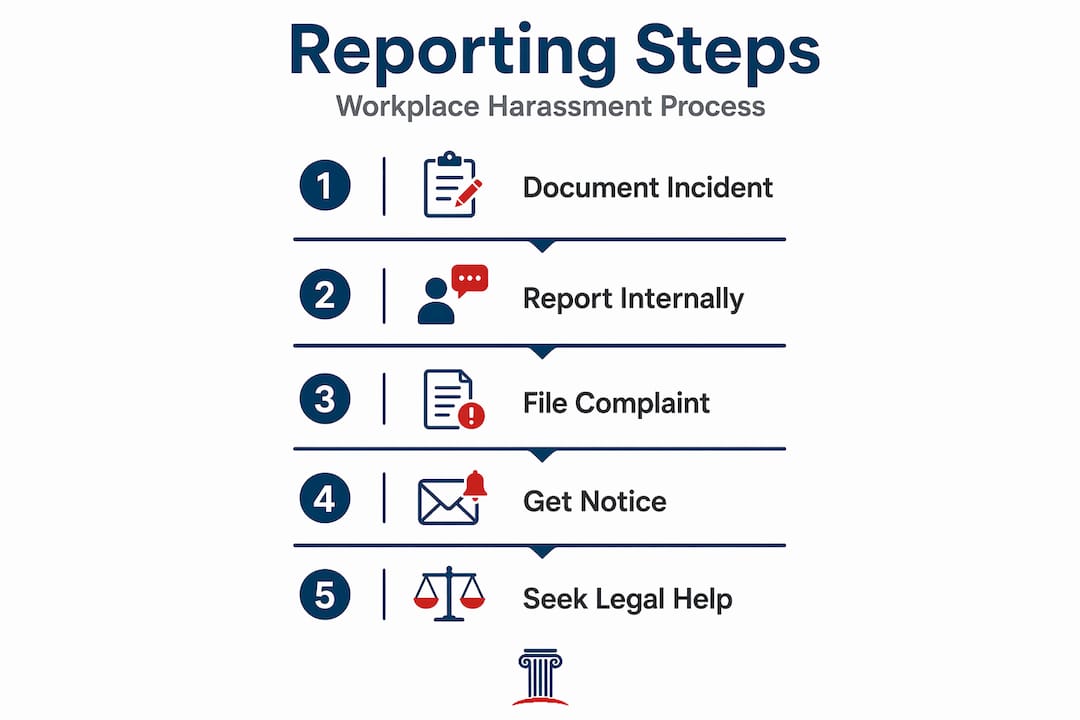
Step two: Report internally if it is safe to do so. Many employees skip this step out of fear. But internal reporting creates a formal record and puts your employer on notice. If they fail to act, that inaction strengthens your case. If reporting internally puts you at risk of retaliation, speak with an attorney first.
Step three: File a complaint with the CRD. The California Civil Rights Department accepts complaints online, by mail, or in person. Once your complaint is verified and processed, the CRD may investigate, attempt mediation, or issue a right-to-sue notice.
Step four: Obtain your right-to-sue notice. The CRD issues right-to-sue notices that allow employees to pursue their claims in civil court. You can request an immediate right-to-sue notice through the CRD’s online portal, and notices often arrive within days of a valid request.
Here is a comparison of your two main options at the complaint stage:
| Option | What it involves | Best when |
|---|---|---|
| CRD investigation | CRD reviews facts, may mediate or pursue action | You want agency support and are open to settlement |
| Immediate right-to-sue | CRD issues notice quickly, you proceed to court | You have an attorney and want to move to litigation |
Missing the applicable deadlines can permanently bar your claim. Statutes of limitations apply to harassment and discrimination cases and vary depending on the facts of your situation. Do not wait to get legal advice.
Pro Tip: Request your right-to-sue notice as soon as you have an attorney lined up. Waiting too long after a triggering event can close the door on your ability to sue.
Finding the right legal help in Anaheim
Anaheim’s workforce is unlike most cities in California. The concentration of large employers in hospitality, entertainment, and tourism creates specific workplace dynamics. Think about the scale of operations at major theme parks, convention centers, and hotel chains. Workers in these environments often face power imbalances, inconsistent management, and limited HR access. Local legal experience matters.
When evaluating an employment attorney in Anaheim, look for:
- A track record specifically in harassment and discrimination cases, not just general employment law
- Familiarity with the hospitality and entertainment industries that dominate Anaheim’s economy
- Willingness to offer a free initial consultation so you can assess the fit without financial risk
- Contingency-based fee arrangements, which mean you pay nothing unless you recover
- Bilingual capability if English is not your primary language
The Anaheim hostile work environment page at Serendib law covers specific scenarios relevant to theme park and hospitality workers, which is a useful reference if your situation involves those industries. If your employer retaliated against you after you reported an issue, Anaheim workplace retaliation lawyers handle exactly those situations.
One practical step many employees overlook: before your first consultation, organize your documentation into a timeline. Attorneys can assess your case far more effectively when the facts are presented clearly and in order.
My honest take on what employees in Anaheim get wrong
I have seen a lot of workplace harassment situations, and the pattern that concerns me most is not the harassment itself. It is the delay. Employees wait weeks or months before taking any formal step, and in that time, evidence disappears, witnesses move on, and deadlines quietly close.
The second biggest mistake I see is assuming that because nothing was put in writing, there is no case. That is not how California law works. Verbal harassment, witnessed incidents, and patterns of behavior all carry legal weight. What matters is how well you can reconstruct the record.
What I have learned from working with employees in Anaheim specifically is that the city’s hospitality economy creates a culture where workers often feel replaceable and afraid to speak up. That fear is understandable. It is also exactly what some employers count on. The law exists precisely to counter that power imbalance, but it only works if you use it.
My advice is straightforward: start documenting the moment something feels wrong, even before you are certain it crosses a legal line. Consult an attorney early. And do not assume the situation will resolve itself. In my experience, it rarely does without intervention.
How Serendib law helps Anaheim employees fight back
If you are dealing with workplace harassment, discrimination, or retaliation in Anaheim, Serendib law provides experienced legal representation built around your needs as an employee. The firm’s Anaheim employment law attorneys handle cases involving sexual harassment, hostile work environments, wrongful termination, and retaliation. Free consultations are available, and the firm works on a contingency basis in qualifying cases. The team is bilingual in English and Spanish, which matters in Anaheim’s diverse workforce. You can also review the firm’s California employment claims guide to understand what type of claim fits your situation before you call.
FAQ
What counts as workplace harassment under California law?
Harassment is illegal under California’s FEHA when it targets a protected characteristic and is severe or pervasive enough to create a hostile work environment. Sexual harassment includes conduct based on sex, gender identity, or sexual orientation regardless of the genders involved.
How do I get a right-to-sue notice in California?
You file a complaint with the California Civil Rights Department, or request an immediate right-to-sue notice through their online portal. Notices typically arrive within days of a valid request and allow you to pursue your claim in civil court.
Can I request my employer’s harassment training records?
Yes. California law requires employers to retain training records for at least two years, including attendance sheets and training materials. If your employer cannot produce them, that gap can support your legal claim.
What if I was retaliated against for reporting harassment?
Retaliation after reporting harassment is itself illegal under California law. Document every change in your working conditions after you reported, and consult an Anaheim retaliation attorney as soon as possible.
How long do I have to file a harassment claim in Anaheim?
Statutes of limitations apply to harassment and discrimination claims, and the applicable window depends on the specific facts of your case. Consult an employment attorney promptly to avoid losing your right to pursue a claim.