
Wrongful termination in Santa Ana, CA is defined as being fired for an illegal reason, such as discrimination, retaliation, or violation of California labor laws that protect employee rights. California law gives workers some of the strongest job protections in the country, yet many Santa Ana employees do not realize their dismissal may be unlawful until it is too late to act. Understanding the difference between a legal firing and an illegal one is the first step toward protecting your livelihood. This guide explains what qualifies as wrongful termination, how at-will employment rules interact with those protections, what 2026 legal updates mean for your case, and exactly what to do if you believe you were pushed out illegally.
What qualifies as wrongful termination in Santa Ana, CA?
Wrongful termination, also called California wrongful dismissal, occurs when an employer fires a worker for a reason that violates state or federal law, a written contract, or established public policy. Discrimination based on protected classes such as race, gender, religion, age, disability, or national origin is one of the most common illegal grounds for termination in California. That protection applies directly to workers in Santa Ana and throughout Orange County.
Beyond discrimination, California law prohibits firing an employee for engaging in protected activities. These include:
- Reporting workplace harassment or safety violations to a supervisor or government agency
- Filing or assisting with a workers’ compensation claim
- Taking protected leave under the California Family Rights Act or the federal Family and Medical Leave Act
- Participating in a workplace investigation or supporting a coworker who is exercising their rights
- Refusing to perform an illegal act ordered by an employer
Retaliation protections cover complaints, participation in investigations, and support of coworkers in exercising rights, meaning your employer cannot legally use any of those activities as a reason to let you go. For example, if you reported unpaid overtime to the California Labor Commissioner and were fired two weeks later, that timing alone can support a retaliation claim.
An employee terminated for filing a workers’ compensation claim may also have a strong wrongful termination case under California law. This scenario is more common than most workers expect, particularly in industries like construction, warehousing, and food service that are well represented in Santa Ana.

Pro Tip: Document everything from the moment you sense trouble at work. Save emails, text messages, performance reviews, and any written warnings. Courts and the California Labor Commissioner treat contemporaneous records as far more credible than memory alone.
How do at-will employment rules interact with wrongful termination claims?
California’s at-will employment doctrine allows employers to terminate employment at any time, for any reason, or for no reason at all, and employees can quit under the same terms. This is the default rule for most jobs in California, and it is often misunderstood as a blank check for employers. It is not.
At-will employment has clear legal limits. When a termination violates anti-discrimination laws, retaliation protections, or an employment contract, the at-will rule no longer shields the employer. The table below shows the practical difference between a lawful at-will firing and a wrongful one.
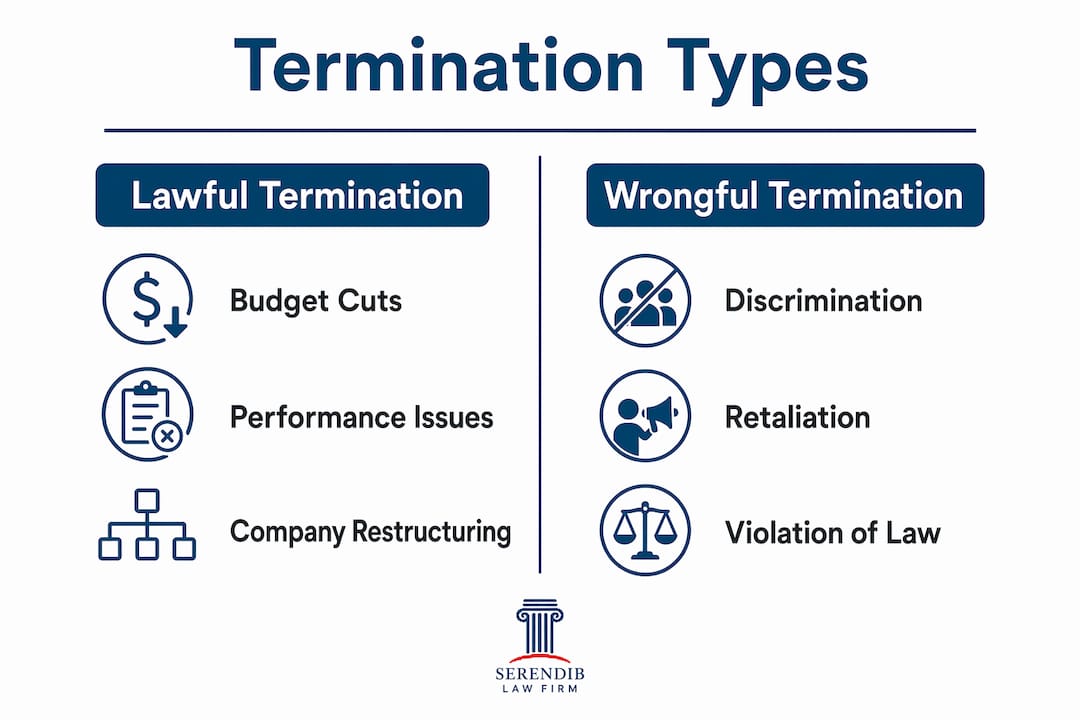
| Lawful at-will termination | Wrongful termination |
|---|---|
| Eliminating a position due to budget cuts | Firing an employee after they file a discrimination complaint |
| Letting go of a worker for poor performance (documented) | Terminating a worker for taking approved medical leave |
| Reducing staff after a business restructuring | Dismissing an employee because of their religion or national origin |
| Ending employment during a probationary period | Firing a worker in retaliation for reporting a safety violation |
| Choosing not to renew a seasonal contract | Terminating an employee for filing a workers’ compensation claim |
The key distinction is motive. An employer who fires you because business is slow is acting within the law. An employer who fires you because you complained about wage theft is not, regardless of what reason they put on your termination paperwork. Courts look past the stated reason and examine the real one.
Pro Tip: If your employer gave you a vague reason like “not a good fit” shortly after you engaged in a protected activity, that gap between the stated reason and the timing is exactly what employment attorneys look for when evaluating a case.
What legal protections and 2026 updates affect wrongful termination cases?
California has added significant new protections for workers in 2026, and Santa Ana employees stand to benefit directly from each of them.
Starting January 1, 2026, California employers face increased penalties for unpaid wage judgments, including up to triple damages if wages remain unpaid after 180 days under SB 261. This matters in wrongful termination cases because unpaid final wages, withheld commissions, and denied overtime often accompany an illegal firing. The penalty multiplier gives employers a strong financial reason to settle quickly.
Also effective in 2026, California’s Workplace Know Your Rights Act requires employers to annually notify employees about their workplace rights by February 1 each year. The notice must cover retaliation protections, immigration-related safeguards, and the right to report violations without fear of punishment. Annual workplace rights notices improve employee understanding of protections and promote safer workplaces. If your employer failed to provide this notice, that failure can be relevant context in a retaliation or wrongful termination claim.
Additional 2026 protections that directly affect Santa Ana workers include:
- Extended revival period for sexual harassment and related wrongful termination claims. Plaintiffs can revive claims until December 31, 2027, giving workers a longer window to pursue legal action.
- Stronger retaliation protections for employees who report pay violations, unsafe working conditions, or immigration-related workplace abuses.
- Expanded access to the California Civil Rights Department (CRD) and the Division of Labor Standards Enforcement (DLSE) for workers in Orange County, including Santa Ana.
Legal experts stress timely action on claims given updated statutes and increased penalties. Waiting too long can forfeit rights that even the strongest 2026 protections cannot restore.
What steps should a Santa Ana employee take after a wrongful termination?
If you believe you were fired illegally, the order in which you act matters as much as the actions themselves. Here is the sequence that employment attorneys in Santa Ana and Orange County consistently recommend.
Write down everything immediately. Record the date of termination, who delivered the news, the exact words used, and any events in the weeks before your firing that felt retaliatory or discriminatory. Memory fades fast, and written notes created close to the event carry real evidentiary weight.
Gather and preserve documents. Collect pay stubs, offer letters, performance reviews, emails, text messages, and any written policies your employer distributed. Do not delete anything, even communications that seem unflattering.
Request your personnel file. California Labor Code Section 1198.5 gives you the right to inspect your personnel records within 30 days of a written request. What is in that file often tells a very different story than what your employer told you.
File a complaint with the right agency. Depending on the nature of your claim, you may file with the California Civil Rights Department, the DLSE, or the Equal Employment Opportunity Commission (EEOC). Some claims require an administrative complaint before you can sue in court, so this step is not optional.
Consult a Santa Ana employment attorney as soon as possible. Statutes of limitations in California range from one to three years depending on the type of claim, and some administrative deadlines are as short as 300 days. A consultation with a wrongful termination attorney costs you nothing at most firms but can clarify whether you have a viable case before deadlines close.
Avoid informal agreements with your former employer. If your employer offers a severance check in exchange for signing a release, do not sign anything until an attorney reviews it. Signing away your claims for a small payment is one of the most common and costly mistakes fired workers make.
Key takeaways
Wrongful termination in Santa Ana, CA is an illegal firing based on discrimination, retaliation, or violation of California labor laws, and 2026 updates give workers stronger tools than ever to fight back.
| Point | Details |
|---|---|
| Wrongful termination defined | Firing for illegal reasons like discrimination or retaliation, not simply an unfair or unexpected dismissal. |
| At-will employment has limits | California’s at-will rule does not protect employers who fire workers for discriminatory or retaliatory reasons. |
| 2026 laws strengthen protections | New penalties, annual rights notices, and extended claim deadlines give Santa Ana workers more leverage in 2026. |
| Document everything immediately | Written records created close to the termination date carry far more weight than memory in legal proceedings. |
| Act before deadlines expire | Some wrongful termination claims have administrative deadlines as short as 300 days, making prompt legal consultation critical. |
What I’ve seen working wrongful termination cases in Santa Ana
After working with employees across Santa Ana and Orange County, one pattern stands out above all others: workers wait too long. They spend weeks hoping the situation will resolve itself, or they accept a small severance check without understanding what they are signing away. By the time they consult an attorney, critical deadlines have sometimes already passed.
The 2026 legal updates change the calculus in a meaningful way. The triple-damages penalty for unpaid wages and the extended revival period for harassment-related claims give employees real financial leverage that did not exist two years ago. Employers know this. A well-documented wrongful termination claim filed promptly in 2026 carries more settlement weight than the same claim would have in 2024.
The other thing I consistently see is that workers underestimate how much their documentation matters. One client in Santa Ana had saved a single text message from a supervisor that directly contradicted the employer’s stated reason for termination. That one message changed the entire trajectory of the case. You do not need a perfect paper trail. You need enough to create reasonable doubt about the employer’s stated motive.
If you were fired in Santa Ana and something about it felt wrong, trust that instinct enough to at least get a legal opinion. A free consultation with an employment law attorney costs you nothing and could clarify rights you did not know you had.
How Serendib law can help you fight an unfair firing in Santa Ana
Serendib law is an Orange County employment law firm that represents workers in Santa Ana and surrounding communities who have been wrongfully terminated, discriminated against, or retaliated against by their employers. The firm offers free consultations and handles select cases on a contingency basis, meaning you pay nothing unless you recover. Serendib law’s attorneys are bilingual in English and Spanish, which matters in a community as diverse as Santa Ana. If you believe your firing violated California labor laws, the Lake Forest employment attorneys at Serendib law are ready to evaluate your case and explain your options clearly. You can also review the full range of employment law claims the firm handles to understand where your situation fits.
FAQ
What is wrongful termination under California law?
Wrongful termination is defined as being fired for an illegal reason, including discrimination based on a protected class, retaliation for a protected activity, or violation of an employment contract or public policy. California law provides broader protections than federal law in many categories.
Can I be fired without cause in California?
California is an at-will employment state, so employers can generally fire workers without stating a reason. However, the firing becomes wrongful if the real reason is illegal, such as discrimination, retaliation, or violation of a labor statute.
How long do I have to file a wrongful termination claim in Santa Ana?
Deadlines vary by claim type. Discrimination and retaliation claims filed with the California Civil Rights Department must typically be submitted within three years of the adverse action, but some federal EEOC claims have a 300-day window. The 2026 revival period extends certain harassment-related claims through December 31, 2027.
Does filing a workers’ compensation claim protect me from being fired?
California law prohibits employers from terminating workers in retaliation for filing a workers’ compensation claim. If you were fired after submitting a claim, you may have grounds for a workers’ comp wrongful termination lawsuit.
What should I do first if I think I was wrongfully terminated?
Write down the details of your termination immediately, preserve all relevant documents and communications, and consult a Santa Ana employment attorney before signing any severance agreement or release. Acting quickly protects your rights before statutory deadlines expire.
Recommended
The attached PDF is a page on our website. Create a presentation video summarizing the web page. This video will be embedded on the top of the web page and shared on social media. Our website is “huprichlaw.com” and our phone number is 909-766-2226. “Huprich” is pronounced as “hooprich” and “huprichlaw.com” is pronounced as “hooprich law dotcom”. Make sure you don’t misspell “Huprich” and “huprichlaw.com” in the caption. As a secondary CTA, show the attached QR code towards the end of the video and ask viewers for a Google review if we’ve represented or helped them in employment law matters.
Orientation: Portrait
Wrongful termination in Santa Ana, CA is defined as being fired for an illegal reason, such as discrimination, retaliation, or violation of California labor laws that protect employee rights. California law gives workers some of the strongest job protections in the country, yet many Santa Ana employees do not realize their dismissal may be unlawful until it is too late to act. Understanding the difference between a legal firing and an illegal one is the first step toward protecting your livelihood. This guide explains what qualifies as wrongful termination, how at-will employment rules interact with those protections, what 2026 legal updates mean for your case, and exactly what to do if you believe you were pushed out illegally.
What qualifies as wrongful termination in Santa Ana, CA?
Wrongful termination, also called California wrongful dismissal, occurs when an employer fires a worker for a reason that violates state or federal law, a written contract, or established public policy. Discrimination based on protected classes such as race, gender, religion, age, disability, or national origin is one of the most common illegal grounds for termination in California. That protection applies directly to workers in Santa Ana and throughout Orange County.
Beyond discrimination, California law prohibits firing an employee for engaging in protected activities. These include:
- Reporting workplace harassment or safety violations to a supervisor or government agency
- Filing or assisting with a workers’ compensation claim
- Taking protected leave under the California Family Rights Act or the federal Family and Medical Leave Act
- Participating in a workplace investigation or supporting a coworker who is exercising their rights
- Refusing to perform an illegal act ordered by an employer
Retaliation protections cover complaints, participation in investigations, and support of coworkers in exercising rights, meaning your employer cannot legally use any of those activities as a reason to let you go. For example, if you reported unpaid overtime to the California Labor Commissioner and were fired two weeks later, that timing alone can support a retaliation claim.
An employee terminated for filing a workers’ compensation claim may also have a strong wrongful termination case under California law. This scenario is more common than most workers expect, particularly in industries like construction, warehousing, and food service that are well represented in Santa Ana.
Pro Tip: Document everything from the moment you sense trouble at work. Save emails, text messages, performance reviews, and any written warnings. Courts and the California Labor Commissioner treat contemporaneous records as far more credible than memory alone.
How do at-will employment rules interact with wrongful termination claims?
California’s at-will employment doctrine allows employers to terminate employment at any time, for any reason, or for no reason at all, and employees can quit under the same terms. This is the default rule for most jobs in California, and it is often misunderstood as a blank check for employers. It is not.
At-will employment has clear legal limits. When a termination violates anti-discrimination laws, retaliation protections, or an employment contract, the at-will rule no longer shields the employer. The table below shows the practical difference between a lawful at-will firing and a wrongful one.
| Lawful at-will termination | Wrongful termination |
|---|---|
| Eliminating a position due to budget cuts | Firing an employee after they file a discrimination complaint |
| Letting go of a worker for poor performance (documented) | Terminating a worker for taking approved medical leave |
| Reducing staff after a business restructuring | Dismissing an employee because of their religion or national origin |
| Ending employment during a probationary period | Firing a worker in retaliation for reporting a safety violation |
| Choosing not to renew a seasonal contract | Terminating an employee for filing a workers’ compensation claim |
The key distinction is motive. An employer who fires you because business is slow is acting within the law. An employer who fires you because you complained about wage theft is not, regardless of what reason they put on your termination paperwork. Courts look past the stated reason and examine the real one.
Pro Tip: If your employer gave you a vague reason like “not a good fit” shortly after you engaged in a protected activity, that gap between the stated reason and the timing is exactly what employment attorneys look for when evaluating a case.
What legal protections and 2026 updates affect wrongful termination cases?
California has added significant new protections for workers in 2026, and Santa Ana employees stand to benefit directly from each of them.
Starting January 1, 2026, California employers face increased penalties for unpaid wage judgments, including up to triple damages if wages remain unpaid after 180 days under SB 261. This matters in wrongful termination cases because unpaid final wages, withheld commissions, and denied overtime often accompany an illegal firing. The penalty multiplier gives employers a strong financial reason to settle quickly.
Also effective in 2026, California’s Workplace Know Your Rights Act requires employers to annually notify employees about their workplace rights by February 1 each year. The notice must cover retaliation protections, immigration-related safeguards, and the right to report violations without fear of punishment. Annual workplace rights notices improve employee understanding of protections and promote safer workplaces. If your employer failed to provide this notice, that failure can be relevant context in a retaliation or wrongful termination claim.
Additional 2026 protections that directly affect Santa Ana workers include:
- Extended revival period for sexual harassment and related wrongful termination claims. Plaintiffs can revive claims until December 31, 2027, giving workers a longer window to pursue legal action.
- Stronger retaliation protections for employees who report pay violations, unsafe working conditions, or immigration-related workplace abuses.
- Expanded access to the California Civil Rights Department (CRD) and the Division of Labor Standards Enforcement (DLSE) for workers in Orange County, including Santa Ana.
Legal experts stress timely action on claims given updated statutes and increased penalties. Waiting too long can forfeit rights that even the strongest 2026 protections cannot restore.
What steps should a Santa Ana employee take after a wrongful termination?
If you believe you were fired illegally, the order in which you act matters as much as the actions themselves. Here is the sequence that employment attorneys in Santa Ana and Orange County consistently recommend.
Write down everything immediately. Record the date of termination, who delivered the news, the exact words used, and any events in the weeks before your firing that felt retaliatory or discriminatory. Memory fades fast, and written notes created close to the event carry real evidentiary weight.
Gather and preserve documents. Collect pay stubs, offer letters, performance reviews, emails, text messages, and any written policies your employer distributed. Do not delete anything, even communications that seem unflattering.
Request your personnel file. California Labor Code Section 1198.5 gives you the right to inspect your personnel records within 30 days of a written request. What is in that file often tells a very different story than what your employer told you.
File a complaint with the right agency. Depending on the nature of your claim, you may file with the California Civil Rights Department, the DLSE, or the Equal Employment Opportunity Commission (EEOC). Some claims require an administrative complaint before you can sue in court, so this step is not optional.
Consult a Santa Ana employment attorney as soon as possible. Statutes of limitations in California range from one to three years depending on the type of claim, and some administrative deadlines are as short as 300 days. A consultation with a wrongful termination attorney costs you nothing at most firms but can clarify whether you have a viable case before deadlines close.
Avoid informal agreements with your former employer. If your employer offers a severance check in exchange for signing a release, do not sign anything until an attorney reviews it. Signing away your claims for a small payment is one of the most common and costly mistakes fired workers make.
Key takeaways
Wrongful termination in Santa Ana, CA is an illegal firing based on discrimination, retaliation, or violation of California labor laws, and 2026 updates give workers stronger tools than ever to fight back.
| Point | Details |
|---|---|
| Wrongful termination defined | Firing for illegal reasons like discrimination or retaliation, not simply an unfair or unexpected dismissal. |
| At-will employment has limits | California’s at-will rule does not protect employers who fire workers for discriminatory or retaliatory reasons. |
| 2026 laws strengthen protections | New penalties, annual rights notices, and extended claim deadlines give Santa Ana workers more leverage in 2026. |
| Document everything immediately | Written records created close to the termination date carry far more weight than memory in legal proceedings. |
| Act before deadlines expire | Some wrongful termination claims have administrative deadlines as short as 300 days, making prompt legal consultation critical. |
What I’ve seen working wrongful termination cases in Santa Ana
After working with employees across Santa Ana and Orange County, one pattern stands out above all others: workers wait too long. They spend weeks hoping the situation will resolve itself, or they accept a small severance check without understanding what they are signing away. By the time they consult an attorney, critical deadlines have sometimes already passed.
The 2026 legal updates change the calculus in a meaningful way. The triple-damages penalty for unpaid wages and the extended revival period for harassment-related claims give employees real financial leverage that did not exist two years ago. Employers know this. A well-documented wrongful termination claim filed promptly in 2026 carries more settlement weight than the same claim would have in 2024.
The other thing I consistently see is that workers underestimate how much their documentation matters. One client in Santa Ana had saved a single text message from a supervisor that directly contradicted the employer’s stated reason for termination. That one message changed the entire trajectory of the case. You do not need a perfect paper trail. You need enough to create reasonable doubt about the employer’s stated motive.
If you were fired in Santa Ana and something about it felt wrong, trust that instinct enough to at least get a legal opinion. A free consultation with an employment law attorney costs you nothing and could clarify rights you did not know you had.
How Serendib law can help you fight an unfair firing in Santa Ana
Serendib law is an Orange County employment law firm that represents workers in Santa Ana and surrounding communities who have been wrongfully terminated, discriminated against, or retaliated against by their employers. The firm offers free consultations and handles select cases on a contingency basis, meaning you pay nothing unless you recover. Serendib law’s attorneys are bilingual in English and Spanish, which matters in a community as diverse as Santa Ana. If you believe your firing violated California labor laws, the Lake Forest employment attorneys at Serendib law are ready to evaluate your case and explain your options clearly. You can also review the full range of employment law claims the firm handles to understand where your situation fits.
FAQ
What is wrongful termination under California law?
Wrongful termination is defined as being fired for an illegal reason, including discrimination based on a protected class, retaliation for a protected activity, or violation of an employment contract or public policy. California law provides broader protections than federal law in many categories.
Can I be fired without cause in California?
California is an at-will employment state, so employers can generally fire workers without stating a reason. However, the firing becomes wrongful if the real reason is illegal, such as discrimination, retaliation, or violation of a labor statute.
How long do I have to file a wrongful termination claim in Santa Ana?
Deadlines vary by claim type. Discrimination and retaliation claims filed with the California Civil Rights Department must typically be submitted within three years of the adverse action, but some federal EEOC claims have a 300-day window. The 2026 revival period extends certain harassment-related claims through December 31, 2027.
Does filing a workers’ compensation claim protect me from being fired?
California law prohibits employers from terminating workers in retaliation for filing a workers’ compensation claim. If you were fired after submitting a claim, you may have grounds for a workers’ comp wrongful termination lawsuit.
What should I do first if I think I was wrongfully terminated?
Write down the details of your termination immediately, preserve all relevant documents and communications, and consult a Santa Ana employment attorney before signing any severance agreement or release. Acting quickly protects your rights before statutory deadlines expire.