
Losing your job is stressful enough. Losing it illegally is something else entirely. If you work in Irvine, Anaheim, Huntington Beach, or anywhere else in Southern California, you need to understand what is wrongful termination before you assume your firing was either your fault or simply unfair. These are not the same thing legally, and that distinction matters enormously. This guide breaks down exactly what wrongful termination means under California law, what grounds qualify, what steps you should take right now, and what remedies exist for employees whose rights have been violated.
Table of Contents
- Key Takeaways
- What wrongful termination means under California law
- Common grounds and real examples of wrongful termination
- Steps to take after suspecting wrongful termination
- Legal protections and remedies available in Orange County
- My take on what employees in Orange County get wrong
- How Serendib Law Firm can help you fight back
- FAQ
Key Takeaways
| Point | Details |
|---|---|
| Not every unfair firing is illegal | Wrongful termination requires a violation of law, contract, or public policy, not just poor management. |
| California law offers broader protections | FEHA and state statutes protect workers beyond federal law, especially for smaller employers. |
| Documentation is your first defense | Record every detail of your termination meeting immediately, including names, words, and documents. |
| Most claims resolve before trial | Skilled legal counsel typically pursues settlements that maximize compensation without courtroom litigation. |
| Act without delay | Statute of limitations apply to wrongful termination claims and must be evaluated case by case. |
What wrongful termination means under California law
Wrongful termination is a legal claim that arises when an employer fires you in violation of a statute, a contract, or public policy. That definition matters because it rules out a large category of firings people commonly assume are illegal. A boss who fires you because he simply does not like you, a manager who lets you go after a personality clash, or a company that eliminates your position for vague business reasons may be acting unfairly. Unless those actions cross a specific legal line, they do not constitute wrongful termination.
California operates under at-will employment, meaning employers can generally terminate workers for any reason or no reason at all. But at-will employment does not grant immunity from discrimination laws, retaliation prohibitions, or contractual obligations. That is where the law carves out real protections for you.
California’s Fair Employment and Housing Act (FEHA) is one of the most powerful employee protection statutes in the country. FEHA applies to employers with 5 or more employees, which is broader than federal law thresholds. That means a significant number of smaller Orange County businesses are covered under FEHA, protecting workers who might not have federal recourse.
Common illegal reasons for termination under California law include:
- Discrimination based on race, gender, age, disability, national origin, religion, sexual orientation, or pregnancy
- Retaliation for reporting illegal activity, filing a workers’ compensation claim, or complaining about harassment
- Breach of an employment contract, whether written, oral, or implied through company policy
- Violation of public policy, such as firing someone for serving on jury duty or taking protected medical leave
Pro Tip: If your employer gave you a reason for your termination, write it down word for word. The stated reason versus the actual reason is often at the center of a wrongful discharge claim.
Many employees mistakenly believe every unfair firing is wrongful termination. The reality is that only terminations violating a law, contract, or recognized public policy qualify. Knowing this distinction helps you evaluate your situation clearly rather than emotionally.
Common grounds and real examples of wrongful termination
Southern California workplaces in cities like Fullerton, Costa Mesa, and Huntington Beach see wrongful termination claims across several consistent categories. Understanding where claims typically arise helps you identify whether your situation fits.
Discrimination-based termination is one of the most frequently cited grounds. This includes being fired because of your age if you are over 40, being let go after a pregnancy announcement, or losing your job after disclosing a disability. Employers rarely announce discriminatory intent outright. The pattern typically emerges through timing, selective enforcement of company policies, or replacement by a significantly younger or different demographic employee.

Retaliation claims arise when you are fired shortly after doing something legally protected. That could mean reporting sexual harassment to HR, filing a complaint with a government agency, or cooperating with a workplace investigation. Employees who file workers’ compensation claims and are then terminated often have strong retaliation claims. The connection between the protected activity and the termination is what courts and investigators focus on.
Here is a side-by-side look at terminations that are unfair versus those that are potentially unlawful:
| Situation | Unfair but legal? | Potentially wrongful termination? |
|---|---|---|
| Fired after a personality conflict with your manager | Yes | No, unless discrimination is evident |
| Fired two weeks after reporting harassment to HR | Unlikely | Yes, strong retaliation claim |
| Laid off without explanation during company restructuring | Possibly | Only if targeting protected class |
| Fired the day after filing a workers’ compensation claim | No | Yes, retaliation likely applies |
| Terminated for refusing to commit an illegal act | No | Yes, public policy violation |
Breach of contract claims arise when a company handbook, written agreement, or consistent oral promises lead you to reasonably expect job security. If your employer committed to progressive discipline before termination and skipped that process entirely, that gap may support a claim.
Constructive discharge is a less understood but equally valid ground. It occurs when your employer makes working conditions so intolerable that a reasonable person would feel compelled to quit. This could be a sudden demotion to a humiliating role, elimination of your duties, or persistent harassment after you complain. Legally, a resignation under those circumstances can be treated the same as a termination.
Steps to take after suspecting wrongful termination
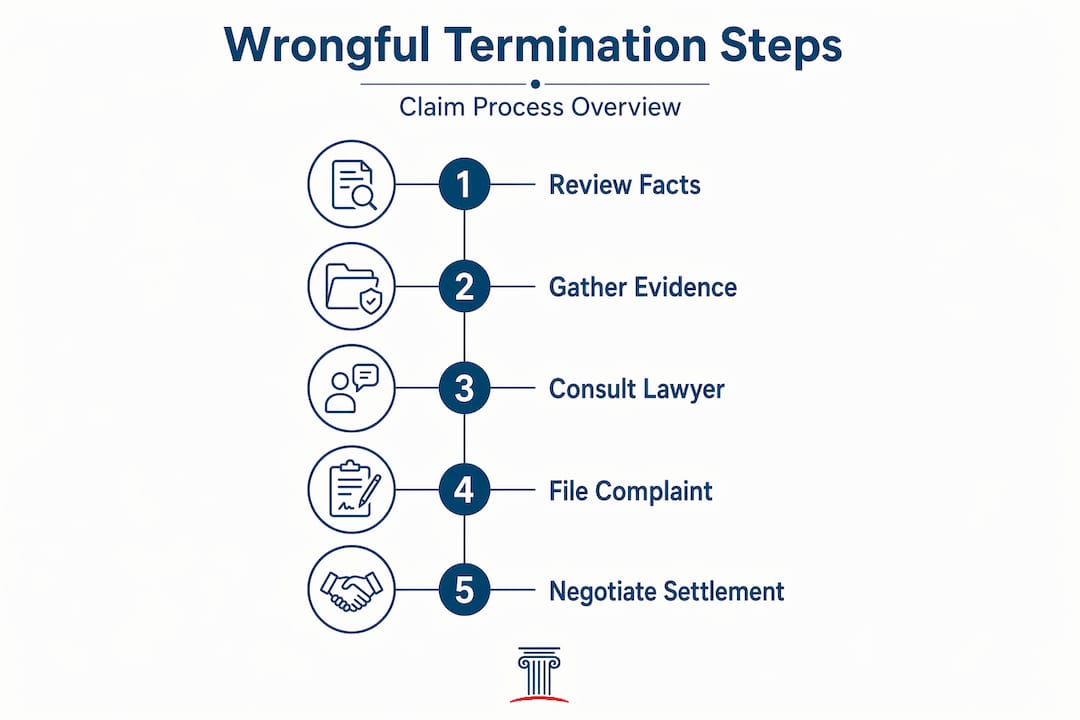
If you believe you were fired unlawfully, the hours and days immediately following your termination are critical. Here is what to do.
Write down everything immediately. Record the date and time of your termination meeting, the names of everyone present, every word your employer said about the reason for your firing, and any documents you received or were asked to sign. Contemporaneous written records are often essential evidence in legal proceedings and carry significant weight because they were created at the moment of the event.
Preserve all communications. Save emails, text messages, performance reviews, disciplinary notices, and any correspondence that relates to your employment or termination. Do not delete anything. If you had access to a work email or system, note that you likely lose access quickly and should retain copies of anything you already have lawfully.
Avoid signing documents under pressure. Employers sometimes present severance agreements requiring you to waive legal claims in exchange for a payout. Do not sign anything until you have reviewed it with an attorney. Once you sign, you may give up significant rights.
File with the right agency if discrimination is involved. For federal discrimination claims, the EEOC process is mandatory before you can file a lawsuit in federal court. For state claims under FEHA, you file with the California Civil Rights Department. Your attorney can help you determine which path applies.
Consult an employment attorney. This is not a step to delay. Statute of limitations apply to wrongful termination claims and must be evaluated on a case by case basis with a qualified attorney. Missing a filing deadline can permanently bar your claim, regardless of how strong it is.
Pro Tip: Do not discuss your termination on social media. Anything you post publicly can be used against you during litigation or settlement negotiations.
Employees in Anaheim and Tustin often make the mistake of waiting too long because they are unsure whether what happened to them was truly illegal. If you are unsure, talking to an attorney for a free consultation costs you nothing and clarifies everything.
Legal protections and remedies available in Orange County
California provides some of the strongest employee protections in the country. Local legal guidance is essential because state law frequently goes further than federal statutes in both coverage and remedies.
If your wrongful termination claim succeeds, the remedies available to you can include:
- Back pay for wages you would have earned from the date of termination through the resolution of your claim
- Front pay or reinstatement to your former position if reinstatement is feasible and appropriate
- Compensatory damages for emotional distress and other harm caused by the unlawful termination
- Punitive damages in cases involving particularly egregious or malicious employer conduct
- Attorney fees and court costs, which California law often allows prevailing employees to recover
Most wrongful termination claims settle before reaching trial. That means skilled negotiation often delivers faster resolution and meaningful compensation without the uncertainty of a jury verdict. An experienced employment attorney understands how to maximize settlement value by building a strong factual record early, which is why documentation from day one matters so much.
Employees working with larger employers, including companies across Newport Beach, Lake Forest, and Westminster, often have additional leverage in settlement because of the reputational and financial costs those companies face in litigation.
My take on what employees in Orange County get wrong
I have worked with employees across Orange County who came to me weeks or months after a termination, angry but uncertain. What I have seen consistently is that the biggest obstacle is not the strength of the legal claim. It is the gap in documentation.
In my experience, most employees who have a valid wrongful termination claim do not realize it immediately. They spend the first week second-guessing themselves, wondering if they deserved it or if it was just bad luck. That window of self-doubt is exactly when the most important evidence either gets preserved or lost forever.
What I tell every employee I speak with: the emotional response is understandable, but the practical response needs to happen in parallel. Write it down. Save everything. Then call someone who knows employment law. Wrongful termination claims involving retaliation after HR complaints, in my observation, are some of the most underreported. Employees in cities like Santa Ana and Fullerton often do not connect the timing of a complaint with the timing of a termination weeks later, and that connection is exactly what builds a case.
California law is genuinely on your side in ways that most employees have never had explained to them. You deserve to understand those rights before you decide what to do next.
How Serendib Law Firm can help you fight back
If you believe you were wrongfully terminated, Serendib Law Firm is ready to listen. The firm serves employees across Orange County, with experience handling termination claims in Huntington Beach, Newport Beach, La Habra, Irvine, and communities throughout Southern California. Serendib Law Firm’s employment law attorneys work on contingency in qualifying cases, meaning you do not pay unless you recover. Free consultations are available, giving you the chance to understand your rights before committing to anything.
Whether your situation involves discrimination, retaliation, a breach of contract, or constructive discharge, the legal team at Serendib Law Firm has the background to evaluate your claim and advocate for the outcome you deserve. The firm also offers bilingual services in English and Spanish, making legal support accessible to a broader community across Southern California. Reach out to the experienced Orange County attorneys at Serendib Law Firm today for a free case evaluation.
FAQ
What is wrongful termination in California?
Wrongful termination occurs when an employer fires an employee in violation of a state or federal statute, an employment contract, or established public policy. Not every unfair firing qualifies; the termination must cross a specific legal line.
Does at-will employment prevent a wrongful termination claim?
No. California is an at-will state, but that does not protect employers who fire workers for illegal reasons such as discrimination, retaliation, or breach of contract. At-will employment has clear legal limits.
What counts as wrongful termination due to retaliation?
Retaliation claims arise when you are fired for engaging in a legally protected activity, such as reporting harassment, filing a workers’ compensation claim, or complaining about wage theft. The closer the timing between the protected act and the termination, the stronger the signal.
What is constructive discharge?
Constructive discharge occurs when an employer creates working conditions so intolerable that a reasonable employee would feel forced to quit. Courts can treat this resignation as a wrongful termination.
What should I do first if I think I was wrongfully terminated?
Write down every detail of your termination meeting immediately, preserve all communications, avoid signing severance agreements without legal review, and consult an employment attorney as soon as possible to protect your rights before any filing deadlines pass.