
A slip and fall accident is defined as an injury event where a person slips, trips, or falls on someone else’s property due to an unsafe condition the property owner or responsible party failed to correct. Under California law, this falls under premises liability, the legal doctrine that holds property owners and others in control of a space accountable for maintaining safe conditions. If you were injured in Huntington Beach, knowing who may be liable for your slip and fall accident is the first step toward recovering compensation for your medical bills, lost wages, and pain.
Who is responsible for slip and fall accidents in Huntington Beach?
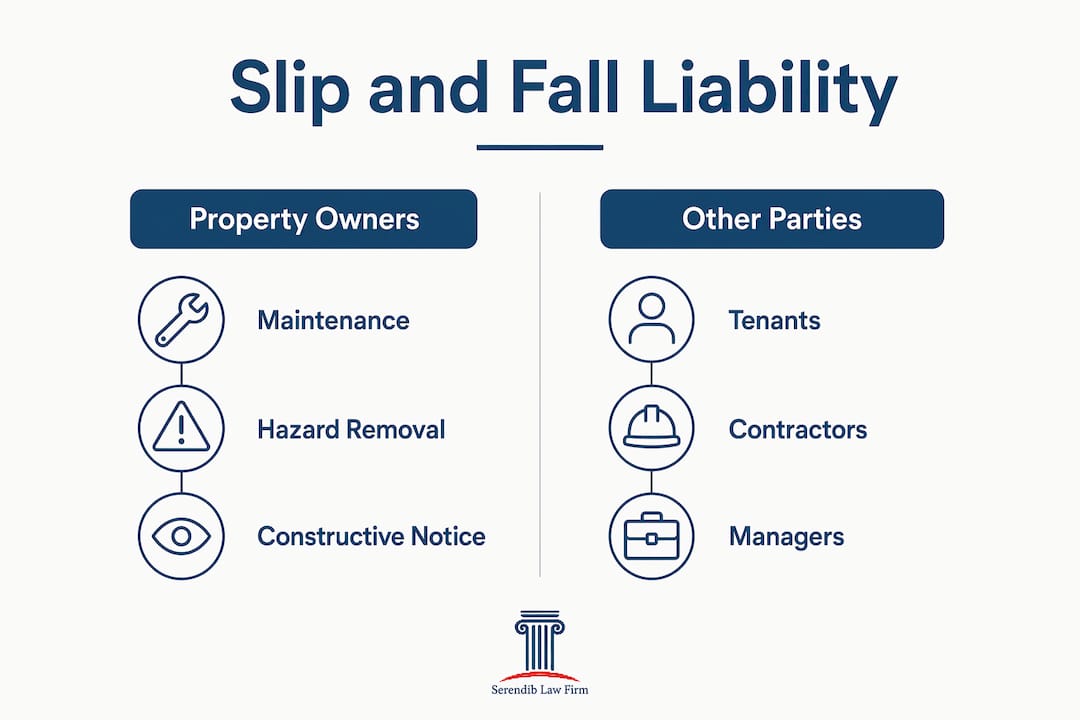
Liability in Huntington Beach slip and fall cases rarely falls on just one party. Multiple parties can be held responsible depending on who controlled the property and who had a duty to fix the hazard.
The most common liable parties include:
- Property owners. Residential and commercial owners in Huntington Beach must keep their premises reasonably safe for visitors. A landlord who ignores a broken staircase or a cracked parking lot is a textbook example of owner negligence.
- Commercial tenants and retailers. Lease agreements define maintenance duties, and a restaurant or retail store that fails to clean up a spill or mark a wet floor can be held liable inside its leased space.
- Property management companies. If a management company holds a contract to maintain safety and ignores hazards like broken handrails or unaddressed water leaks, courts hold them directly liable.
- Janitorial and maintenance contractors. A third-party cleaning crew that mops a floor without placing warning signs, or a contractor who leaves debris in a walkway, can share liability.
- Government entities. Falls on public sidewalks, beaches, or city-owned parking structures in Huntington Beach may involve a claim against the City of Huntington Beach, though government claims carry specific procedural requirements.
Huntington Beach properties including residential complexes, surf shops, restaurants, and mixed-use developments along Pacific Coast Highway all carry specific safety duties under California code. That variety of property types means the liable party in your case may not be obvious at first.
Pro Tip: Always identify every party that had control over the area where you fell, not just the property owner. A janitorial contractor or a commercial tenant may carry separate insurance and share liability.
How does California’s comparative negligence law affect your claim?
California uses a pure comparative negligence system. This means you can recover compensation even if you were partly at fault for your own fall.
What this looks like in practice: In a $100,000 case, a plaintiff found 60% at fault can still recover $40,000. Your compensation is reduced by your percentage of fault, not eliminated.
That rule is more generous than most states. Many states bar recovery entirely if you are more than 50% at fault. California’s approach encourages injured people to file claims rather than assume they have no case because they were partially careless.
For Huntington Beach claimants, this matters in real situations. Say you were walking through a grocery store parking lot while looking at your phone and stepped into an unmarked pothole. A court might assign you 20% of the fault. You would still recover 80% of your total damages. California’s comparative fault system balances fairness by allowing recovery even when the injured party shares some blame.
The practical takeaway is this: do not assume your case is weak because you were not paying perfect attention. The property owner’s failure to fix a known hazard still carries legal weight.
What evidence do you need to prove liability?
Proving a Huntington Beach premises liability claim requires showing that the responsible party knew about the hazard and failed to fix it. California law recognizes two types of knowledge: actual notice and constructive notice.
Actual notice means the property owner or manager was directly told about the hazard. Constructive notice means the hazard existed long enough that a reasonable owner would have discovered it through routine inspection. Constructive knowledge is often easier to establish than people expect, especially when maintenance logs show no inspections were done.
The strongest slip and fall cases are built on the following evidence:
- Photographs and video. Take photos of the exact hazard immediately after the fall. Capture wet floors, uneven pavement, missing handrails, or poor lighting. Security camera footage from the property can also be critical.
- Witness statements. Get names and contact information from anyone who saw the fall or who knew about the hazard before the accident.
- Incident reports. Report the accident to the property owner or manager before you leave. Ask for a copy of the written report. This creates an official record.
- Medical records. Seek medical attention the same day, even if your injuries seem minor. Medical records link your injuries directly to the fall.
- Maintenance and inspection logs. Photos of spills and maintenance logs showing a lack of inspections are among the most persuasive pieces of evidence in these cases.
- Lease agreements and contracts. These documents reveal which party was contractually responsible for maintaining the area where you fell.
Local Huntington Beach ordinances and California building codes can also support your claim. If a stairwell lacked required lighting or a ramp did not meet ADA standards, that code violation is direct evidence of negligence.
Pro Tip: Do not post anything about your accident on social media. Defense attorneys routinely search Instagram, Facebook, and TikTok for posts that contradict injury claims.
What steps should you take after a slip and fall in Huntington Beach?
The actions you take in the hours and days after a fall directly affect the strength of your injury claim. Most people make at least one critical mistake during this window.
- Get medical care immediately. Injuries like traumatic brain injuries, spinal damage, and torn ligaments are common slip and fall injuries that may not feel severe right away. A same-day medical visit creates the documentation your case depends on.
- Document everything at the scene. Photograph the hazard, your injuries, and the surrounding area. Note the time, date, and weather conditions.
- Report the accident officially. Notify the property owner, store manager, or building supervisor before leaving. Request a written incident report.
- Preserve your clothing and footwear. The shoes you wore can be relevant evidence. Do not wash or discard them.
- Avoid giving recorded statements to insurance companies. Insurers often contact injured people quickly and ask for recorded statements. These statements can be used to minimize your claim. Speak with an attorney first.
- Contact a personal injury attorney promptly. California law sets applicable statutes of limitations on personal injury claims that must be evaluated on a case-by-case basis. Waiting too long can bar your claim entirely.
The most common mistake injured people make is assuming the property owner’s insurance company will treat them fairly. Insurance adjusters work to minimize payouts, not to protect your interests. An attorney who handles slip and fall claims in Huntington Beach understands how to counter those tactics and build a case that reflects your full damages.
Key Takeaways
Liability in Huntington Beach slip and fall cases depends on proving that a responsible party knew about a hazard and failed to fix it, and California’s pure comparative negligence rule means partial fault does not end your right to recover.
| Point | Details |
|---|---|
| Multiple parties may be liable | Property owners, tenants, managers, and contractors can all share responsibility for a fall. |
| Comparative negligence protects you | California allows recovery even if you were partly at fault; your award is reduced, not eliminated. |
| Evidence is built at the scene | Photos, witness names, incident reports, and medical records form the foundation of a strong claim. |
| Constructive notice is provable | A hazard that existed long enough establishes that the owner should have known and acted. |
| Act quickly on your claim | Statutes of limitations apply and vary by case; delay can forfeit your right to compensation. |
What I’ve learned from Huntington Beach slip and fall cases
The biggest mistake I see injured people make is underestimating how many parties may share liability. They focus entirely on the property owner and miss the management company, the cleaning contractor, or the commercial tenant who was actually responsible for that specific area.
The second mistake is waiting. Evidence disappears fast. Spills get cleaned up. Security footage gets overwritten. Witnesses move on. The clients who come to me within days of an accident almost always have stronger cases than those who wait weeks.
California’s comparative fault rule is genuinely on your side. I have seen clients walk away from cases they were convinced they could not win because they thought being distracted made them fully responsible. It does not. The property owner’s failure to fix a known hazard carries independent legal weight regardless of what you were doing at the moment of the fall.
If you were hurt at a Huntington Beach shopping center, a beachfront hotel, a restaurant on Main Street, or even a city-owned facility, you likely have more legal options than you realize. The key is moving quickly and working with someone who knows how to investigate all the responsible parties, not just the most obvious one.
Serendiblaw’s support for Huntington Beach injury victims
Serendiblaw represents injured people in Huntington Beach and across Orange County in premises liability and personal injury cases. The firm investigates all potentially liable parties, from property owners to management companies and contractors, to build the strongest possible claim on your behalf. Serendiblaw offers free consultations and handles qualifying personal injury cases on a contingency basis, meaning you pay nothing unless you recover. The team is bilingual in English and Spanish. If you were hurt in a slip and fall, contact a California personal injury lawyer at Serendiblaw to review your case at no cost.
FAQ
Who can be liable for a slip and fall in Huntington Beach?
Property owners, commercial tenants, property management companies, janitorial contractors, and in some cases the City of Huntington Beach can all be liable depending on who controlled the area and had a duty to fix the hazard.
Does being partly at fault cancel my slip and fall claim in California?
No. California’s pure comparative negligence rule allows you to recover compensation even if you were partially at fault. Your award is reduced by your percentage of fault, not eliminated entirely.
What is constructive notice in a slip and fall case?
Constructive notice means a hazard existed long enough that a reasonable property owner should have discovered and fixed it through routine inspection, even without being directly told about it.
How soon should I contact an attorney after a fall in Huntington Beach?
Contact an attorney as soon as possible. Evidence like security footage and witness availability fades quickly, and California’s statutes of limitations on personal injury claims must be evaluated on a case-by-case basis to avoid losing your right to sue.
What are the most common injuries in slip and fall accidents?
Slip and fall accidents commonly cause traumatic brain injuries, spinal injuries, broken bones, and torn ligaments. Many of these injuries do not show full symptoms immediately, which is why same-day medical care is critical.