
Speeding, distracted driving, DUI, left-turn failures, and red-light violations cause the majority of car accidents in Costa Mesa, and the injuries that follow range from whiplash and concussions to spinal fractures and internal trauma. If you were hurt in a crash here, your three most important steps right now are: report the collision and get a police report, seek same-day medical care to document your injuries, and consult a Costa Mesa personal-injury attorney before giving any recorded statement to an insurance adjuster. California follows pure comparative negligence, meaning your recovery is reduced by your share of fault but never fully eliminated. Proposition 213 (Civil Code §3333.4) bars uninsured or DUI drivers from recovering non-economic damages. California’s minimum liability limits are set by law and require specific minimum coverage amounts per person, per accident, and for property damage, and many serious injuries exceed those limits entirely.
Immediate actions to take right now:
- Call 911 and request a police report, even for minor crashes
- Get medical care the same day, whether or not you feel seriously hurt
- Photograph the scene, vehicle damage, and any visible injuries before leaving
- Exchange insurance and contact information with all involved drivers
- Notify your own insurer promptly, but do not give a recorded statement to the at-fault carrier without legal counsel
Pro Tip: Take timestamped photos at the scene and back them up to cloud storage immediately. Same-day medical records are among the strongest pieces of evidence linking your injuries to the crash.
Serendib Law Firm represents injured drivers and passengers throughout Costa Mesa and Orange County, offering free consultations and contingency-fee representation so you pay nothing unless we recover for you.
Table of Contents
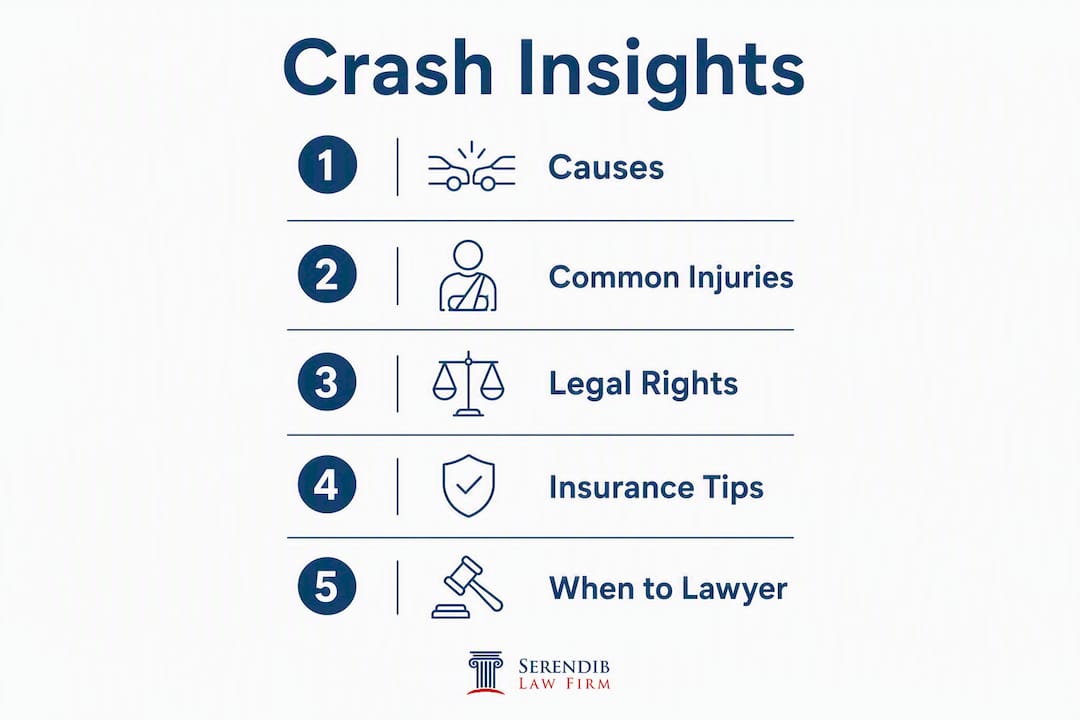
- What causes most car accidents in Costa Mesa?
- Common crash types in Costa Mesa and what they mean for your case
- What injuries should you watch for after a Costa Mesa crash?
- Immediate steps after a crash in Costa Mesa
- What are your legal rights in California after a Costa Mesa crash?
- What compensation can injured Costa Mesa drivers seek?
- How should you handle insurance companies after a Costa Mesa crash?
- Do you have a case? When should you hire a Costa Mesa car-accident attorney?
- What does the claim process look like from crash to resolution?
- How Serendib Law Firm helps injured Costa Mesa drivers and passengers
- How do accident types relate to urban driving in Costa Mesa?
- Detailed checklist: what to do immediately after a crash
- How to handle other drivers at the scene
- How to document and track medical treatments and expenses
- Long-term injury symptoms and when to seek further evaluation
- California statutes of limitations: what injured victims need to know
- How to choose the right car-accident lawyer in Costa Mesa
- Key Takeaways
- What I see in Costa Mesa crash cases that most people miss
- Injured in Costa Mesa? Serendib Law Firm is ready to help
- Sources and further reading
What causes most car accidents in Costa Mesa?
Costa Mesa sits at the intersection of commuter corridors, retail traffic, and freeway on-ramps, and that combination produces a predictable set of crash causes. Speeding, distracted driving, DUI, failure to yield, and red-light violations account for the overwhelming majority of collisions on local roads like Harbor Boulevard, Bristol Street, and the 405 and 55 freeway interchanges.

Speeding compresses reaction time and multiplies crash force. On Costa Mesa’s shorter signal cycles and dense surface streets, a driver traveling even 10 mph over the limit can turn a manageable situation into a serious collision. Under California’s pure comparative negligence framework, a speeding driver’s fault percentage will typically be high, which directly increases the injured victim’s recovery.
Distracted driving and texting remain a leading cause of rear-end and intersection crashes. California Vehicle Code §23123.5 prohibits handheld phone use while driving, yet enforcement data consistently shows violations persisting. When a driver’s phone records show active texting at the time of impact, that evidence can be decisive in establishing liability.
Driving under the influence produces some of the most catastrophic crashes in Orange County. A DUI driver who injures you faces both criminal charges and civil liability, and the facts surrounding the impairment can support a claim for punitive damages beyond standard compensation.
Failure to yield and left-turn collisions are especially common at busy Costa Mesa intersections like Newport Boulevard and 19th Street. A driver turning left across oncoming traffic bears a strong presumption of fault under California law, though the specific facts of each crash always matter.
Red-light and stop-sign violations frequently produce T-bone collisions at speed. Signal timing records, intersection cameras, and witness accounts are critical evidence in these cases.
Road rage and reckless driving create unpredictable hazards on the 405 and surface streets alike. Aggressive lane changes, tailgating, and deliberate braking all generate liability, and documented road-rage conduct can support punitive-damage claims.
Most personal-injury cases settle before trial, but the strength of your settlement depends heavily on how clearly fault is established from the start. Each of these causes leaves a distinct evidentiary trail, and identifying it early is what protects your claim’s value.
Common crash types in Costa Mesa and what they mean for your case
The type of collision you were in shapes both the injuries you are likely to have and the fault questions an insurer or jury will examine.
- Rear-end collisions are the most frequent crash type in urban driving. The striking driver bears a strong presumption of fault, though insurers will probe whether the lead driver stopped suddenly or had broken brake lights. Typical injuries: whiplash, cervical strain, and concussion.
- T-bone (side-impact) collisions occur most often at intersections when one driver runs a red light or fails to yield. Side structures offer less protection than front or rear crumple zones, making traumatic brain injury, rib fractures, pelvic injuries, and femur fractures common outcomes.
- Head-on collisions are statistically the most deadly crash type. They tend to happen on divided roads when a driver crosses the center line due to impairment, distraction, or fatigue. Fault is usually clear, but injuries are severe and often require long-term care.
- Sideswipe collisions happen during lane changes on the 405, the 55, and surface streets with multiple lanes. Fault turns on which driver failed to check mirrors or signal. Injuries vary widely depending on speed and whether the sideswipe forces a secondary collision.
- Rollovers are less common but produce disproportionately serious injuries. They typically involve SUVs or trucks, high speed, and either a sharp maneuver or a collision that tips the vehicle. Roof crush injuries and ejection injuries are the primary concerns.
Evidence that matters most by crash type: For rear-enders, dashcam footage and skid-mark measurements. For T-bone crashes, signal-timing records and intersection camera footage. For head-on collisions, toxicology results and cell phone records. For sideswipe crashes, lane-change witness accounts and vehicle black-box data. Collecting this evidence promptly, before it is lost or overwritten, is one of the most concrete ways an attorney adds value early in a case.
What injuries should you watch for after a Costa Mesa crash?
The most common injuries in Costa Mesa car accidents are whiplash, concussion and traumatic brain injury (TBI), spinal injuries, soft-tissue strains, fractures, and internal injuries. What makes many of these dangerous is that symptoms often appear hours or days after the crash, not at the scene.
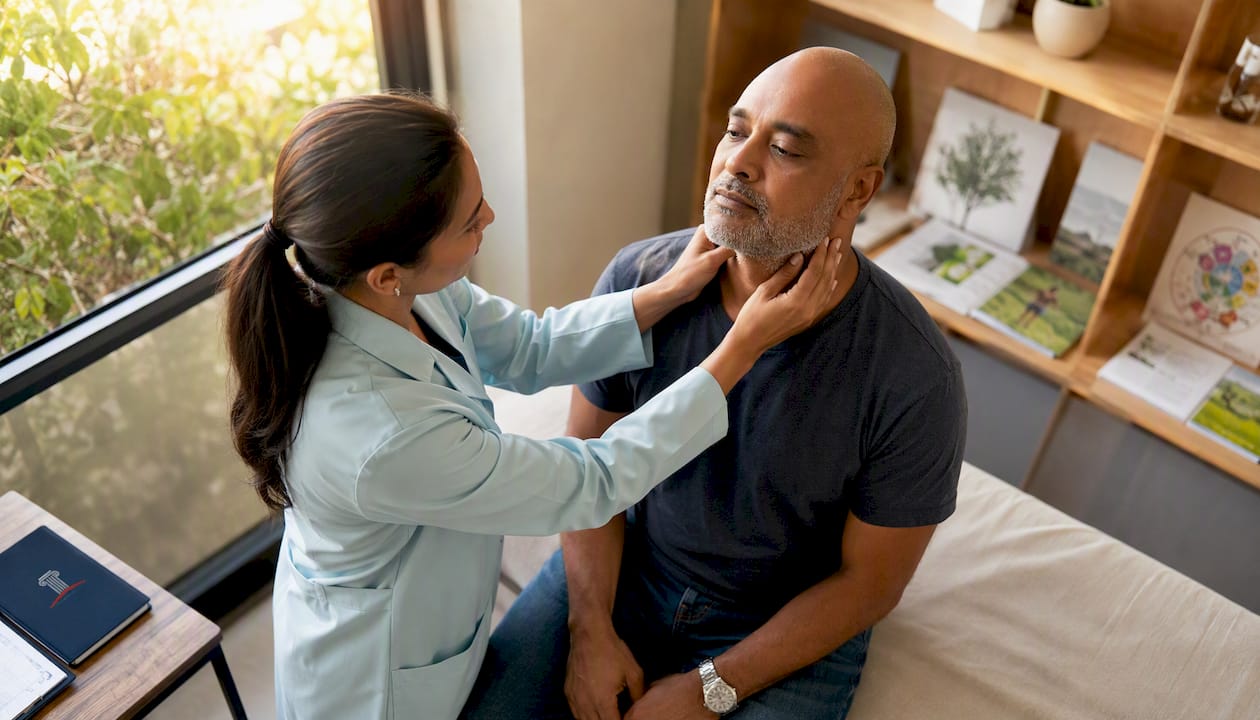
Whiplash results from the rapid back-and-forth snapping of the neck during impact. Neck stiffness and pain may not peak until 24–72 hours after the collision. Insurers routinely challenge whiplash claims when there is no same-day medical record, which is exactly why immediate evaluation matters.
Concussion and TBI can follow any crash with significant head movement, even without a direct blow. Symptoms include headache, confusion, memory gaps, light sensitivity, and mood changes. Mild TBI is frequently underdiagnosed at the scene, and untreated concussions can produce lasting cognitive effects.
Spinal injuries range from herniated discs to fractures and, in the most serious cases, partial or complete paralysis. Back and neck pain that worsens over days after a crash warrants imaging, not a wait-and-see approach.
Soft-tissue injuries to muscles, tendons, and ligaments are painful and functionally limiting, yet they do not always show on standard X-rays. MRI is often necessary to document them for insurance purposes.
Fractures to the wrist, clavicle, ribs, and lower extremities are common in side-impact and head-on crashes. Rib fractures in particular can mask internal injuries.
Internal injuries to the spleen, liver, or kidneys may produce only mild abdominal discomfort initially. Left untreated, they become life-threatening. Any abdominal pain after a crash warrants emergency evaluation.
Red-flag symptoms requiring urgent care:
- Worsening headache or sudden severe headache
- Loss of consciousness or confusion after the crash
- Numbness, tingling, or weakness in the arms or legs
- Abdominal pain or swelling
- Difficulty breathing or chest pain
- Vision changes or unequal pupils
Pro Tip: Keep a written log of every medical visit, prescription, imaging study, and referral from the day of the crash forward. A consistent, documented treatment timeline is one of the strongest tools for countering an insurer’s argument that your injuries were pre-existing or unrelated to the collision.
If you need guidance on medical documentation or local referral resources, the Costa Mesa personal-injury team at Serendib Law Firm can help you build that record from day one.
Immediate steps after a crash in Costa Mesa
Your two priorities after any collision are personal safety and medical documentation. Everything else, including dealing with insurance, follows from those two.
- Move to safety if possible — California law generally requires drivers to move vehicles out of traffic when a crash occurs on a roadway and it is safe to do so. Turn on hazard lights immediately.
- Call 911. Request police and emergency medical services. A police report is one of the most important documents in any injury claim, and California courts recognize it as foundational evidence for establishing fault and linking injuries to the crash.
Pro Tip: Your phone’s camera automatically timestamps photos. Take a photo of the intersection sign or street name in your first shot to establish location, then photograph the scene systematically. Upload everything to Google Photos or iCloud before you leave the area.
What are your legal rights in California after a Costa Mesa crash?
California is an at-fault state with no no-fault or personal-injury-protection (PIP) system, meaning the driver who caused the crash is responsible for the resulting damages. Two California-specific rules shape almost every Costa Mesa injury claim.
Pure comparative negligence means your recovery is reduced by your own percentage of fault, but you can still recover even if you were partly responsible. If a jury finds you 20% at fault and awards $100,000, you receive $80,000. This rule, adopted in California, protects injured victims from being shut out of recovery simply because they share some blame.
Proposition 213 (Civil Code §3333.4) creates a significant exception: if you were driving without insurance or under the influence at the time of the crash, you cannot recover non-economic damages such as pain and suffering, even if the other driver was primarily at fault. This rule applies to the injured person’s own conduct, not the at-fault driver’s.
Uninsured/underinsured motorist (UM/UIM) coverage is your safety net when the at-fault driver has no insurance or insufficient coverage. Under California Insurance Code §11580.2, insurers must offer UM/UIM coverage matching your liability limits unless you reject it in writing. Check your declarations page and any rejection forms you may have signed. If the at-fault driver carries only the 30/60/15 minimum limits and your medical bills exceed $30,000, your own UM/UIM policy may be the primary source of full recovery.
Key legal questions to ask yourself:
- Was the other driver uninsured or underinsured? Check your own UM/UIM coverage immediately.
- Did a government vehicle or road defect contribute to the crash? Government claims carry different notice requirements.
- Were multiple vehicles or a commercial truck involved? Each additional party adds insurance layers and potential defendants.
- Were you working at the time of the crash? A workers’ compensation claim may run alongside your personal-injury claim.
What compensation can injured Costa Mesa drivers seek?
California law allows injured crash victims to pursue three categories of damages: economic, non-economic, and, in limited circumstances, punitive.
Economic damages are the measurable financial losses the crash caused:
- Emergency room and hospital bills
- Ongoing medical treatment, physical therapy, and specialist care
- Future medical expenses for long-term or permanent injuries
- Lost wages from missed work during recovery
- Loss of future earning capacity if the injury affects your career
- Vehicle repair or replacement costs
- Out-of-pocket expenses like prescription medications and medical equipment
Non-economic damages compensate for losses that do not come with a receipt: pain and suffering, emotional distress, loss of enjoyment of life, and loss of consortium for a spouse or partner. California imposes no statutory cap on non-economic damages in standard car-accident cases, though the facts of each case determine what a jury or settlement negotiation will support.
Punitive damages are reserved for conduct that goes beyond ordinary negligence, such as a DUI driver who had multiple prior convictions, or a driver who deliberately used their vehicle as a weapon. They are relatively rare and require clear and convincing evidence of malice, oppression, or fraud under California Civil Code §3294.
Documenting economic losses for your claim:
- Save every medical bill, explanation of benefits, and insurance statement
- Keep a mileage log for every medical appointment
- Preserve pay stubs and employer letters documenting missed work
- Photograph property damage before repairs begin and retain repair estimates and invoices
- Track prescription costs and any out-of-pocket medical expenses with receipts
How should you handle insurance companies after a Costa Mesa crash?
Be cooperative with your own insurer and cautious with everyone else’s. That one-sentence rule prevents most of the mistakes that reduce claim value.
Common insurer tactics to recognize:
- Quick lowball settlement offers made before you know the full extent of your injuries. Accepting early locks you into a release that waives future claims.
- Recorded statement requests from the at-fault carrier. Adjusters are trained to ask open-ended questions that elicit admissions of fault or minimization of injuries. You are not required to give one.
- Treatment-gap arguments. If you miss appointments or delay follow-up care, the adjuster will argue your injuries were not serious or were caused by something other than the crash.
- Comparative-fault pressure. Adjusters may suggest you were partly responsible to reduce the payout, sometimes citing factors like your speed or lane position.
- Surveillance and social media monitoring. Insurers have been known to photograph claimants and review social media posts looking for activity inconsistent with claimed injuries.
When an adjuster calls for the first time, a safe response sounds like this: “I was involved in a crash on [date] at [location]. I am still receiving medical treatment and am not in a position to discuss the details of the accident or my injuries at this time. Please direct further questions to my attorney.” That response is factual, non-adversarial, and preserves your position.
Pro Tip: Never speculate about your injuries in any conversation with an insurer. “I think I’m okay” or “It’s probably just a sore neck” can be used against you even if you later discover a herniated disc. Stick to facts you know: the crash happened, you sought medical care, and you are still being evaluated.
Do you have a case? When should you hire a Costa Mesa car-accident attorney?
Hire an attorney when injuries are serious, liability is disputed, multiple parties are involved, or the at-fault driver is uninsured or underinsured. Those four situations are where legal representation most directly protects your recovery.
Red flags that justify consulting an attorney immediately:
- Injuries requiring hospitalization, surgery, or long-term rehabilitation
- Lost wages or a permanent impact on your ability to work
- Disputed fault, especially when the other driver’s insurer blames you
- Multiple vehicles or multiple insurance carriers involved
- A commercial truck, rideshare vehicle (Uber, Lyft), or government vehicle involved
- An at-fault driver who was uninsured, underinsured, or fled the scene
- A crash caused by a road defect, signal malfunction, or dangerous intersection design
Contingency-fee representation means you pay no attorney fees upfront. Serendib Law Firm is paid a percentage of the settlement or verdict only if we recover for you. Beyond attorney fees, most personal-injury cases also involve case expenses, such as costs for medical record retrieval, expert witnesses, court filing fees, and deposition transcripts. A reputable attorney will explain these costs clearly and typically requires your approval before incurring significant expenses. Those costs are usually reimbursed from the recovery at the end of the case.
Serendib Law Firm’s Orange County personal-injury practice brings local knowledge of Costa Mesa’s traffic patterns, common crash corridors, and the insurers who operate in this market. The firm also offers bilingual services in English and Spanish, which matters when navigating complex insurance negotiations or court proceedings.
What does the claim process look like from crash to resolution?
Most Costa Mesa car-accident claims follow a predictable sequence, though the timeline varies significantly based on injury severity and whether liability is disputed.
- Crash and immediate medical care (Day 1–7). Seek treatment, preserve evidence, and notify your insurer. This phase sets the foundation for everything that follows.
- Ongoing medical treatment and documentation (Weeks 1–several months). Continue all prescribed treatment. Your attorney will begin gathering police reports, medical records, witness statements, and any available camera footage.
- Maximum medical improvement (MMI). Your attorney will typically wait until you reach MMI, the point at which your condition has stabilized, before sending a demand letter. Settling before MMI risks undervaluing future care costs.
- Demand letter and negotiation (1–3 months after MMI). Your attorney sends a detailed demand package to the at-fault carrier. Negotiations follow. The vast majority of personal-injury cases settle at this stage without going to court.
- Filing a lawsuit (if negotiations fail). A lawsuit is a last resort, not a first step. Filing opens the formal discovery process: written questions (interrogatories), document requests, and depositions. Many cases settle during or after discovery.
- Mediation. Most California courts require or strongly encourage mediation before trial. A neutral mediator facilitates settlement discussions. A large percentage of cases resolve here.
- Trial. Only a small fraction of cases reach a jury. Trial is expensive and time-consuming, but sometimes necessary to achieve a fair result.
Patience and consistent medical documentation improve both the value and the credibility of your claim. An insurer is far more likely to offer a fair settlement when your medical records tell a clear, uninterrupted story from the day of the crash to the day you reached maximum recovery.
How Serendib Law Firm helps injured Costa Mesa drivers and passengers
Serendib Law Firm represents injured victims in Costa Mesa and throughout Orange County, offering free consultations and contingency-fee representation with no upfront costs.
What we do for our clients:
- Investigate the crash: gather police reports, camera footage, black-box data, and witness statements
- Preserve time-sensitive evidence before it is lost or overwritten
- Arrange medical referrals so treatment gaps do not undermine your claim
- Handle all communications with insurance adjusters on your behalf
- Analyze your UM/UIM coverage and advise on all available insurance sources
- Build and submit a comprehensive demand package documenting economic and non-economic losses
- File suit and litigate aggressively when insurers refuse to negotiate fairly
- Provide bilingual representation in English and Spanish throughout the process
If you were injured in a Costa Mesa crash and are unsure whether you have a claim, the best time to call is now, before evidence disappears and before you say something to an adjuster that limits your options. Schedule a free consultation online or by phone. There are no upfront fees, and we only get paid when you do.
How do accident types relate to urban driving in Costa Mesa?
Costa Mesa’s street grid, with its mix of commercial corridors, residential cut-throughs, and freeway access points, produces a specific distribution of crash types that differs from rural or highway-only driving.
Rear-end collisions dominate in stop-and-go commuter traffic on Harbor Boulevard, Bristol Street, and the 405 on-ramps. A driver following too closely at 35 mph has almost no stopping distance when the vehicle ahead brakes for a signal. These crashes are frequent, often underestimated in severity, and almost always place fault on the following driver.
T-bone collisions cluster at uncontrolled or poorly timed intersections. Costa Mesa’s grid includes intersections where signal timing does not always match traffic volume, and drivers who misjudge a yellow light create side-impact crashes at closing speeds that can exceed 60 mph combined.
Head-on collisions are less common in urban Costa Mesa but occur on divided arterials when a driver drifts across the center line, often due to impairment or distraction. The 55 freeway and its surface-street approaches see these crashes at higher speeds.
Sideswipe collisions are a daily occurrence on multi-lane roads like Newport Boulevard and the 405. Lane changes without adequate mirror checks, combined with blind spots in larger SUVs and pickup trucks like the Ford F-150 or Chevrolet Silverado, produce these crashes regularly.
Rollovers in urban Costa Mesa typically involve a sideswipe or T-bone that destabilizes a taller vehicle, or a driver overcorrecting at speed. They are more common near freeway on-ramps and off-ramps where speed differentials are highest.
Understanding which crash type you were in helps your attorney identify the right evidence to pursue and the fault presumptions most likely to apply.
Detailed checklist: what to do immediately after a crash
Personal safety comes first. Everything else, including evidence collection, is secondary to getting yourself and others out of immediate danger.
- Move vehicles out of traffic if it is safe to do so — California law generally requires this when the crash is minor and vehicles are operable. Turn on hazard lights before moving.
If a DUI driver caused your crash and is arrested at the scene, you may need information about the criminal process as it intersects with your civil claim. Local resources like Costa Mesa bail bonds services can provide context on what happens after an arrest, though your civil claim proceeds independently of any criminal case.
How to handle other drivers at the scene
The moments immediately after a crash are high-stress, and what you say to the other driver can affect your claim as much as what you say to an insurer.
Exchange information, not opinions. You need the other driver’s name, license number, insurance carrier and policy number, vehicle make, model, and plate. You do not need to discuss who was at fault, how fast anyone was going, or what either driver was doing before the crash.
Stay calm and factual. If the other driver is agitated or aggressive, disengage and wait for police. Do not argue about fault at the scene. Anything said in anger or frustration can be repeated to an adjuster or in a deposition.
Never admit fault, even partially. Statements like “I didn’t see you” or “I was distracted for a second” are admissions that insurers will use to assign comparative fault and reduce your recovery. California’s comparative-negligence rules mean even a small fault allocation costs you money.
Do not sign anything at the scene. Some drivers or their passengers may ask you to sign a statement or agree not to involve insurance. Decline politely and wait for the police report.
Photograph the other driver’s license and insurance card rather than copying the information by hand. This eliminates transcription errors and creates a timestamped record.
If the other driver flees, note the vehicle description, direction of travel, and any partial plate information immediately. Report it to 911 and to your own insurer. A hit-and-run claim typically proceeds through your own UM coverage.
How to document and track medical treatments and expenses
Thorough medical documentation is not just good health practice. It is the foundation of your financial recovery. California courts and insurers alike rely on contemporaneous medical records to establish both the existence of injuries and their connection to the crash.
Start a dedicated folder or digital file on the day of the crash. Every document related to your injuries and treatment goes in it: emergency room discharge papers, imaging reports, prescription receipts, physical therapy notes, and specialist referral letters.
Track every appointment. Create a simple log with the date, provider name, type of visit, and what was discussed or prescribed. This log becomes a timeline your attorney can use to counter any insurer argument about treatment gaps.
Save all bills and explanation-of-benefits statements. Do not discard any medical billing document, even if your health insurer paid it. The full billed amount, not just your out-of-pocket cost, is typically recoverable in a personal-injury claim.
Document out-of-pocket costs. Keep receipts for prescription medications, over-the-counter pain relief, medical equipment like braces or crutches, and transportation to appointments. A mileage log for every medical trip adds up meaningfully over a long recovery.
Photograph your injuries over time. Bruising, swelling, and scarring change day by day. A weekly photo series documents the progression and severity of visible injuries in a way that words alone cannot.
Communicate honestly with your providers. Tell every treating physician about all symptoms, even ones that seem minor or unrelated. Undisclosed symptoms that emerge later can look like fabrication to an insurer if they do not appear in early records.
Long-term injury symptoms and when to seek further evaluation
Some of the most serious injuries from a car crash do not announce themselves immediately. Delayed-onset symptoms are a recognized medical reality, and they are also a legal issue: if you wait too long to seek care, insurers will argue the injury was not caused by the crash.
Chronic neck and back pain that persists or worsens beyond two weeks after a crash may indicate a herniated disc or nerve impingement rather than simple muscle strain. An MRI, not just an X-ray, is necessary to evaluate these conditions accurately.
Persistent headaches following a crash can signal post-concussion syndrome, which may last months or years. Neurological evaluation is warranted when headaches do not resolve within a few weeks.
Cognitive and emotional changes including difficulty concentrating, memory problems, irritability, anxiety, or depression after a crash are recognized symptoms of mild TBI and post-traumatic stress. These conditions are compensable injuries, but they require documented psychiatric or neuropsychological evaluation.
Radiating pain, numbness, or tingling in the arms or legs suggests nerve involvement and warrants prompt evaluation by an orthopedic specialist or neurologist.
Abdominal pain or tenderness that develops in the days after a crash should be evaluated urgently. Delayed splenic or hepatic injuries can become life-threatening.
Fatigue and sleep disruption that persist beyond normal post-crash stress may indicate an underlying injury or psychological condition that benefits from treatment and documentation.
The general principle: if a symptom appears or worsens in the weeks following a crash, connect it to your treating physician and document it. Waiting to see if it resolves on its own creates the treatment gap that insurers use to challenge your claim.
California statutes of limitations: what injured victims need to know
California law sets time limits on when you can file a personal-injury lawsuit, and missing those limits typically means losing your right to sue entirely. The general rule under Code of Civil Procedure §335.1 is a two-year period from the date of the crash for bodily-injury claims, but that general rule comes with important exceptions.
Government vehicle involvement triggers a separate claims process with a shorter notice deadline. Claims against a city, county, or state agency require filing a government tort claim before any lawsuit, and the notice period is significantly shorter than two years.
Minors generally have their limitations period tolled until they reach adulthood, though the specific rules depend on the circumstances.
Discovery of delayed injuries can sometimes extend the period when an injury was not reasonably discoverable at the time of the crash, but this exception is narrow and fact-specific.
Wrongful-death claims brought by surviving family members have their own limitations period that runs from the date of death, not the date of the crash.
Because these rules are complex and the consequences of missing a deadline are severe, the applicable statute of limitations in your case should be evaluated on a case-by-case basis with a qualified attorney. Do not assume the general two-year rule applies to your specific situation without legal advice.
How to choose the right car-accident lawyer in Costa Mesa
Not every personal-injury attorney is equally equipped to handle a Costa Mesa car-accident case, and the questions you ask during a consultation will tell you more than any website biography.
Questions worth asking:
- How many car-accident cases have you handled in Orange County, and what percentage involved disputed liability?
- Will you personally handle my case, or will it be assigned to a paralegal or junior associate?
- How do you communicate with clients, and how often can I expect updates?
- What case expenses might I be asked to approve, and how are they handled at the end of the case?
- Have you handled cases involving the same type of crash or injury I experienced?
Red flags to watch for:
- An attorney who guarantees a specific settlement amount before reviewing your records
- A firm that cannot tell you who will actually work on your file
- Pressure to sign a retainer agreement at the first meeting without time to review it
- Vague answers about case expenses or how costs are deducted from your recovery
- No clear communication plan or dedicated point of contact
Understanding costs beyond the contingency fee: Contingency fees cover attorney time, but personal-injury cases also generate case expenses: medical record retrieval, expert witness fees, court filing fees, deposition costs, and accident reconstruction if needed. These are typically advanced by the firm and reimbursed from the recovery. A transparent attorney will give you a written explanation of how expenses are handled before you sign anything.
Serendib Law Firm handles car-accident cases on a contingency basis and provides a clear explanation of all costs during the free initial consultation. The firm’s local Orange County experience and bilingual staff make it a practical choice for Costa Mesa residents navigating a complex claim.
Key Takeaways
Car accidents in Costa Mesa most often stem from speeding, distracted driving, and DUI, and the injuries that follow frequently include whiplash, concussion, and spinal damage that may not appear until days after the crash.
| Point | Details |
|---|---|
| Document immediately | Take timestamped photos at the scene and seek same-day medical care to link injuries to the crash. |
| Know California’s fault rules | Pure comparative negligence reduces your recovery by your fault percentage but never eliminates it entirely. |
| Check your UM/UIM coverage | California’s 30/60/15 minimums often fall short of serious-injury costs; your own policy may be your primary recovery source. |
| Statute of limitations | The applicable filing deadline must be evaluated case-by-case with an attorney; do not assume the general rule applies to your situation. |
| Serendib Law Firm | Represents injured Costa Mesa and Orange County victims with free consultations, contingency-fee representation, and bilingual services. |
What I see in Costa Mesa crash cases that most people miss
The cases that concern me most are not the catastrophic ones where liability is obvious and injuries are severe. Those cases, as difficult as they are for the people involved, tend to resolve with the seriousness they deserve. The cases that quietly go wrong are the ones where an injured person felt “mostly okay” at the scene, gave a recorded statement to the at-fault carrier within 48 hours, and then discovered two weeks later that they had a herniated disc at C5-C6.
Costa Mesa’s traffic patterns create a specific kind of crash that I see repeatedly: a moderate-speed rear-end collision on Harbor Boulevard or near the 405 interchange, a driver who walks away from the scene, declines an ambulance, and tells the adjuster on the phone the next morning that they are “a little sore but fine.” That statement, made in good faith, becomes the insurer’s primary argument for limiting the claim to a few hundred dollars in chiropractic visits.
What I want every injured Costa Mesa resident to understand is this: the gap between “I feel okay right now” and “I have a serious injury” is often measured in days, not minutes. Whiplash, concussion, and disc injuries have a delayed onset that is medically well-documented. The legal system accounts for this, but only if you have the medical records to prove it. Same-day care, consistent follow-up, and honest communication with your doctors are not just good health practices. They are the foundation of a claim that holds up.
The bilingual services we offer at Serendib Law Firm matter here too. A significant portion of Costa Mesa’s community is most comfortable discussing medical symptoms and legal options in Spanish, and the nuances of a delayed-injury claim are exactly the kind of thing that gets lost in translation. We have those conversations in the language that works best for each client, and we find that it changes what people tell us, and what we can do for them.
If you were in a crash in Costa Mesa and you are not sure whether you need an attorney, the answer is almost always: call and find out. A free consultation costs you nothing and may protect a claim you did not know you had.
Injured in Costa Mesa? Serendib Law Firm is ready to help
If you or someone you care about was hurt in a Costa Mesa car accident, Serendib Law Firm offers a free, no-obligation consultation to evaluate your claim and explain your options. We represent injured victims throughout Costa Mesa and Orange County on a contingency-fee basis, meaning you pay no attorney fees unless we recover compensation for you.
Our team handles every aspect of your claim: investigating the crash, preserving evidence, communicating with insurers, arranging medical referrals, and filing suit when necessary. We provide bilingual services in English and Spanish, and we bring direct local knowledge of Costa Mesa’s roads, intersections, and the insurers operating in this market.
To get started, contact us online or call our office directly. The sooner you reach out after a crash, the more options we have to protect your claim and your recovery.
Sources and further reading
- Civil Code §3333.4 — Proposition 213 (California Legislature): The primary statutory text barring non-economic damage recovery for uninsured or DUI drivers in California.
- Personal injury cases — California Courts Self Help Guide: Plain-language overview of how personal-injury claims work in California courts, including the role of police reports and medical records.
- California Car Accident Laws: Fault, Insurance, and Your Claim — Recording Law: Covers pure comparative negligence, the 30/60/15 minimum limits, UM/UIM requirements, and the general statute of limitations framework.
- Common Car Accident Injuries and Treatment Options — Alexander Orthopaedics: Medical overview of whiplash and other common crash injuries, including delayed-onset symptoms.
- Serendib Law Firm — Costa Mesa Personal Injury Practice: Local practice page with information on Serendib’s experience handling car-accident injury claims in Costa Mesa and Orange County.
- Damages — Cornell Law School Legal Information Institute: Reference overview of economic, non-economic, and punitive damages under U.S. law.
This article provides general legal information about car accidents in Costa Mesa and California law. It is not legal advice, and it does not create an attorney-client relationship. Laws and procedures change; confirm current rules and deadlines with a qualified California personal-injury attorney before making any legal decisions.