
If your employer in Santa Ana owes you pay, you can file a wage claim with the California Labor Commissioner’s Office (DLSE) or contact Serendib Law Firm for a free consultation to start recovering what you are owed. The process moves from filing to a settlement conference to a formal hearing if needed, and it protects every worker in Orange County regardless of immigration status.
What you need to know right now:
- File immediately. Submit a DLSE wage claim online, by email, by mail, or in person, or call Serendib Law Firm for a free case evaluation.
- All workers are protected. California wage law covers every employee, regardless of immigration status or documentation.
- You can recover more than back pay. Recoverable amounts include unpaid wages, overtime premiums, meal and rest break penalties, waiting time penalties, wage statement penalties under Labor Code §226, interest, and attorneys’ fees in appropriate cases.
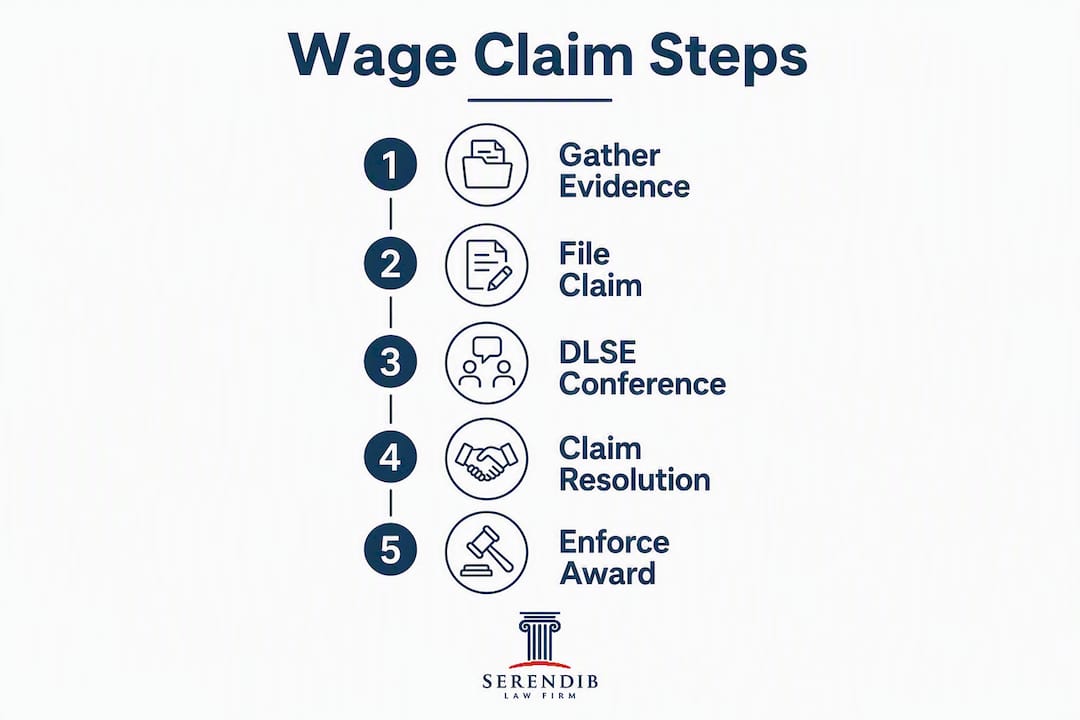
- Typical timeline: File claim → DLSE investigation → settlement conference → hearing (if unresolved) → Order, Decision, or Award (ODA) → possible appeal.
Ready to act? Contact Serendib Law Firm for a free consultation. Bilingual English/Spanish service is available to the Santa Ana and Orange County community.
Table of Contents
- What wage violations are most common for Santa Ana employees?
- What can you actually recover from a wage claim?
- How do you file a wage claim in Santa Ana, step by step?
- What evidence should you gather before filing?
- Are you protected from retaliation for filing a wage claim?
- How Serendib Law Firm helps Santa Ana employees recover unpaid wages
- Key Takeaways
- What most employees get wrong when filing a wage claim
- Serendib Law Firm: local representation for Santa Ana wage claims
- Authoritative sources and official DLSE resources
What wage violations are most common for Santa Ana employees?
Wage and hour violations in California are more widespread than most workers realize, and recognizing your situation is the first step toward recovery. Below are the violations that most frequently trigger DLSE claims in Orange County.
- Unpaid overtime. California Labor Code §510 requires 1.5x your regular rate for hours over eight in a day or 40 in a week, and 2x for hours over 12 in a day. Red flag: your paystub shows a flat daily rate with no overtime line, even on days you worked ten or more hours.
- Missed meal and rest breaks. California law mandates a 30-minute unpaid meal period for shifts over five hours and a paid 10-minute rest for every four hours worked. Under Labor Code §226.7, a missed break triggers one additional hour of pay at your regular rate per violation. Red flag: your schedule shows back-to-back shifts with no break recorded.
- Minimum wage violations. California’s minimum wage applies to all hours worked. Red flag: your effective hourly rate, when you divide total pay by total hours, falls below the state or local minimum.
- Unpaid commissions or bonuses. Earned commissions and promised bonuses are wages under California law. Red flag: a commission statement shows amounts earned but your final paycheck does not include them.
- Employee misclassification. Employers sometimes label workers as independent contractors to avoid overtime and benefit obligations. Red flag: you set your own hours in name only, use the company’s tools, and work exclusively for one employer.
- Improper deductions. Employers generally cannot deduct business costs from your wages. Red flag: your paystub shows deductions for uniforms, equipment, or cash shortages.
These protections apply to workers at large employers like Amazon fulfillment centers, restaurant chains, construction contractors, and retail operations throughout Santa Ana and Orange County, as well as to workers at small local businesses.
What can you actually recover from a wage claim?
The remedies available through a DLSE claim are broader than most employees expect. Here is a clear breakdown:
| Remedy | What It Covers | Statutory Reference |
|---|---|---|
| Unpaid regular wages | All hours worked at your agreed or minimum rate | — |
| Overtime premium | 1.5x or 2x rate for qualifying overtime hours | CA Labor Code §510 |
| Meal/rest break premium | One additional hour of pay per missed break per day | Labor Code §226.7 / DLSE guidance |
| Waiting time penalties | Penalties apply when final pay is delayed beyond the legally authorized period. | — |
| Wage statement penalties | Statutory penalties can apply for inaccurate or incomplete pay stubs under California law. | CA Labor Code §226 |
| Interest | Accrues on unpaid wages from the date owed | — |
| Attorneys’ fees | Recoverable in successful wage claims | — |

A practical example: Suppose you worked ten-hour days, five days a week, for six months at a Santa Ana warehouse, and your employer paid you straight time for all hours. Under §510, you were owed 1.5x pay for two hours each day. Add in two missed meal breaks per week at one hour of premium pay each, and the unpaid amounts accumulate quickly, before waiting time penalties or wage statement penalties are even calculated.
Beyond the DLSE administrative process, some situations warrant a civil lawsuit or a claim under the Private Attorneys General Act (PAGA), which allows employees to recover civil penalties on behalf of themselves and other affected workers. PAGA claims are particularly relevant when a violation is systematic across a workforce. An experienced Santa Ana employment attorney can assess whether a DLSE claim, a civil suit, or a PAGA action best fits your situation.
If an employer refuses to pay an ODA after a hearing, the DLSE can convert the award into a court judgment for collection purposes, or you can pursue collection independently.
How do you file a wage claim in Santa Ana, step by step?
The DLSE filing process is accessible and does not require an attorney to start, though legal guidance significantly strengthens your position.
- Submit your claim — You can file online through the DLSE portal, by email, by mail, or in person. For Santa Ana employees, claims are routed through the DLSE’s Santa Ana district office. You can locate the correct office by entering your workplace city or zip code on the DLSE office locator page at dir.ca.gov.
- Hearing (if unresolved). If the conference does not produce a settlement, the DLSE schedules a formal wage hearing. Both parties testify under oath, proceedings are recorded, and the hearing officer issues an ODA.
- Appeal. Either party may appeal the ODA to civil court for a de novo hearing. If you cannot afford counsel on appeal, the DLSE may represent you at its discretion.
Pro Tip: When filing by email, include “Wage Claim Submission” and your full name in the subject line. Once your claim number is assigned, reference it in every follow-up communication to avoid processing delays.
What evidence should you gather before filing?
Strong documentation is what separates a resolved claim from a prolonged dispute. The DLSE relies heavily on organized evidence at both the conference and hearing stages.

| Evidence Type | Specific Examples |
|---|---|
| Paystubs / wage statements | Show employer name, pay period, hours listed, deductions, and gross/net pay |
| Time records | Employer-issued timesheets, punch records, or app-based clock-in logs |
| Work schedules | Posted schedules, text confirmations of shift times, manager emails |
| Personal hours log | A daily written or digital log you maintained showing actual start/end times |
| Text and email records | Messages confirming hours worked, missed breaks, or unpaid commissions |
| Commission statements | Any written record of earned commissions or bonus calculations |
| Bank deposit records | Confirm amounts actually received versus amounts owed |
| Witness information | Names and contact details of coworkers or supervisors who observed violations |
Preserve electronic evidence by taking screenshots and backing them up outside of any employer-controlled system. If your employer’s records are missing or incomplete, reconstruct your hours using a written timeline: note each workday, your approximate start and end times, and any breaks you did or did not receive. Courts and hearing officers give weight to consistent, contemporaneous personal records.
If you cannot locate your employer’s full legal name or address, alternative identifiers like paystub mailing addresses, product labels, or vehicle license plate numbers visible at the worksite can help trace the responsible entity via a California warrant search.
Pro Tip: Bring copies, not originals, of all documents to any DLSE conference or hearing unless originals are specifically requested. Attach each document to the corresponding entry in your written timeline so the hearing officer can follow your account without confusion.
Are you protected from retaliation for filing a wage claim?
Yes, and the protection is explicit under California law. Filing a wage claim, threatening to file one, or even discussing your wages with coworkers are all protected activities. Retaliation in any form is illegal.
Retaliation includes:
- Termination or constructive dismissal shortly after you file or threaten to file
- Demotion or reduction in hours or pay
- Hostile treatment, increased scrutiny, or unwarranted discipline
- Threats related to immigration status or other personal circumstances
If you experience retaliation, take these steps immediately:
- Document everything in writing with dates, times, and the names of anyone present.
- Preserve all communications, including texts, emails, and voicemails, from supervisors or HR.
- File a discrimination/retaliation complaint with the DLSE in addition to your wage claim.
- Consult a local employment attorney as soon as possible, because applicable statutes of limitations vary by claim type and should be evaluated on a case-by-case basis.
Civil litigation may also be available for retaliation claims, and remedies can include reinstatement, back pay, and damages beyond what the DLSE administrative process provides. Serendib Law Firm handles workplace retaliation claims in Orange County and can assess your situation in a free consultation.
How Serendib Law Firm helps Santa Ana employees recover unpaid wages
Serendib Law Firm serves employees throughout Santa Ana and Orange County with a direct, evidence-focused approach to wage and hour claims. The firm’s practice includes:
- Free initial consultation to assess your claim and explain your options
- Contingency-fee representation in appropriate cases, meaning no upfront legal fees
- Bilingual English/Spanish service for the diverse Santa Ana and Orange County workforce
- Local experience with DLSE conferences and hearings routed through the Orange County district
The firm prepares clients for every stage of the DLSE process: organizing evidence, drafting a clear timeline, preparing testimony for the settlement conference, and, when necessary, representing clients through formal hearings and appeals. When a case involves systematic violations affecting multiple workers, Serendib Law Firm evaluates whether a PAGA claim or civil lawsuit would produce a stronger recovery than the administrative route alone.
For wage and hour claims in Orange County, having an attorney who knows the local DLSE office procedures and the specific industries that dominate Santa Ana’s economy makes a measurable difference in outcomes.
Key Takeaways
Santa Ana employees can recover unpaid wages, overtime, and penalties through the DLSE administrative process, and every worker is protected regardless of immigration status.
| Point | Details |
|---|---|
| File a DLSE claim promptly | Submit DLSE Form 1 online, by email, by mail, or in person at the Santa Ana district office. |
| Know what you can recover | Unpaid wages, overtime premiums, meal/rest break penalties, waiting time penalties, and attorneys’ fees are all available remedies. |
| Build your evidence file | Gather paystubs, time records, schedules, texts, and witness contact information before filing. |
| Retaliation is illegal | Document any adverse action immediately and file a separate retaliation complaint with the DLSE. |
| Serendib Law Firm | Offers free consultations, contingency-fee options, and bilingual service for Santa Ana and Orange County wage claims. |
What most employees get wrong when filing a wage claim
The single most common and costly mistake workers make is waiting too long to start documenting their situation. By the time someone contacts our office, months of evidence have already been lost: deleted texts, discarded paystubs, and faded memories of specific dates. Applicable statutes of limitations exist for every wage claim type, and while we evaluate those timelines individually for each client, the practical reality is that the sooner you start building your record, the stronger your position at every stage.
The second mistake is underestimating the settlement conference. Workers sometimes arrive without a written timeline, without copies of their documents, and without a clear sense of the total amount owed. The hearing officer at a DLSE conference is not there to build your case for you. A well-organized binder with a chronological timeline, attached paystubs, and a calculated damages summary tells a far more persuasive story than verbal testimony alone.
Pro Tip: Before your conference, write out a one-page timeline: date, hours worked, breaks taken or missed, and pay received. Attach the corresponding paystub or schedule to each entry. This single document often resolves disputes at the conference stage without a formal hearing.
If you are unsure where to start, the Santa Ana employment attorneys at Serendib Law Firm can walk you through the evidence-gathering process in a free consultation.
Serendib Law Firm: local representation for Santa Ana wage claims
Wage theft is not a minor payroll error. When an employer in Santa Ana withholds overtime, skips meal break premiums, or misclassifies workers to avoid paying what the law requires, the financial impact on employees and their families is real and significant. Serendib Law Firm represents Santa Ana and Orange County employees in exactly these situations, with no upfront fees in cases that qualify for contingency representation.
The firm offers a free consultation to review your situation, explain what you can recover, and outline the most effective path forward, whether that is a DLSE claim, a PAGA action, or a civil lawsuit. Bilingual English/Spanish service means the entire process is accessible regardless of your preferred language. To speak with a California employment lawyer about your wage claim, contact Serendib Law Firm today through the online form or by phone. Your consultation is free, and the conversation could be the first step toward recovering what your employer owes you.
Authoritative sources and official DLSE resources
| Resource | What It Provides |
|---|---|
| How to File a Wage Claim (DLSE) | Filing options, required forms, and step-by-step instructions |
| DLSE Wage Hearing Procedures | Hearing process, ODA, and what to expect at a formal hearing |
| California Labor Code §510 | Statutory overtime thresholds and definitions |
| DLSE Rest and Meal Periods Guidance | Break requirements and one-hour penalty pay rule |
| DLSE Overtime FAQ | Employer record obligations, retaliation protections, and enforcement |
| DLSE After a Hearing | Appeal rights and ODA collection procedures |
| DLSE Policies and Procedures | Overview of the full wage claim process from filing through appeal |
| DLSE Initial Report or Claim Form | The official DLSE Form 1 to initiate a wage claim |
To reach the DLSE Santa Ana district office directly, visit dir.ca.gov and use the office locator tool with your workplace zip code. When visiting in person, bring printed copies of your completed DLSE Form 1 and all supporting documents. The office can confirm receipt, answer procedural questions, and direct your claim to the correct deputy labor commissioner.
This article provides general legal information about California wage and hour law and is not a substitute for advice from a licensed attorney about your specific situation. Consult a qualified employment lawyer or the DLSE directly to confirm current rules and applicable deadlines for your claim.