
Yes. If you qualify for FMLA or CFRA leave, your Villa Park employer must restore you to the same job or an equivalent one, with the same pay, benefits, and terms, once your leave ends. That obligation comes from two overlapping laws: the federal Family and Medical Leave Act, enforced by the U.S. Department of Labor’s Wage and Hour Division, and California’s own law, the California Family Rights Act (CFRA). Serendib Law Firm works with employees throughout Orange County, including Villa Park, who run into trouble when employers ignore these protections.
Whether restoration applies to your situation depends on a handful of thresholds:
- Employer size: CFRA covers employers with 5 or more employees; FMLA requires 50 or more employees within 75 miles.
- Tenure and hours: you generally need 12 months of employment and 1,250 hours worked in the prior year.
- Ongoing employer duties: your group health benefits must continue during leave, and your employer must meet notice and designation deadlines.
- Filing deadlines: applicable statutes of limitations vary by claim type and should be evaluated case by case with an attorney.
Key Takeaways
Employers covered by FMLA or CFRA must restore eligible employees to the same or an equivalent job after protected leave, subject to narrow, fact-specific exceptions.
| Point | Details |
|---|---|
| Check both laws | CFRA covers employers with 5+ employees; FMLA requires 50+ within 75 miles, so smaller Villa Park employers may still owe CFRA protection. |
| Confirm your eligibility | You generally need 12 months of employment and 1,250 hours worked in the prior year to qualify. |
| Document the timeline | Save leave requests, employer notices, job descriptions, and any changes announced during or right after your leave. |
| Know the narrow exceptions | Legitimate layoffs and the key-employee exception can excuse reinstatement, but employers must prove the exception genuinely applies. |
| Get a free legal review | Serendib Law Firm offers bilingual, no-cost consultations for Villa Park employees whose jobs weren’t properly restored after leave. |
Authoritative Quick Links for Villa Park Employees
- U.S. DOL FMLA overview
- California EDD FMLA/CFRA FAQs
- California Civil Rights Department leave guide
- California-focused FMLA guide
Save every employer notice you receive, and bring these sources along if you seek legal advice.
Table of Contents
- FMLA Leave Eligibility Villa Park: Federal vs. California Rules
- How Long Can You Take Leave, and Can It Be Intermittent?
- Does a Layoff During Leave Cancel Your Reinstatement Rights?
- Are “Key Employees” Treated Differently Under FMLA?
- What Happens if Your Employer Won’t Restore Your Job?
- When Can an Employer Legally Refuse to Reinstate You?
- How Serendib Law Firm Supports Villa Park Employees
- Why Working With Serendib Law Firm Makes Sense Here
- Frequently Asked Questions
- Sources
FMLA Leave Eligibility Villa Park: Federal vs. California Rules
Villa Park employees often assume FMLA is the only law that matters. It isn’t, and for many local workers, CFRA offers broader protection. FMLA applies only to employers with 50 or more employees within a 75-mile radius, which excludes a lot of small businesses along Santiago Boulevard or in nearby retail centers. CFRA kicks in at just five employees, so a worker at a small medical office or family-owned shop in Villa Park may have no federal protection but full state protection.
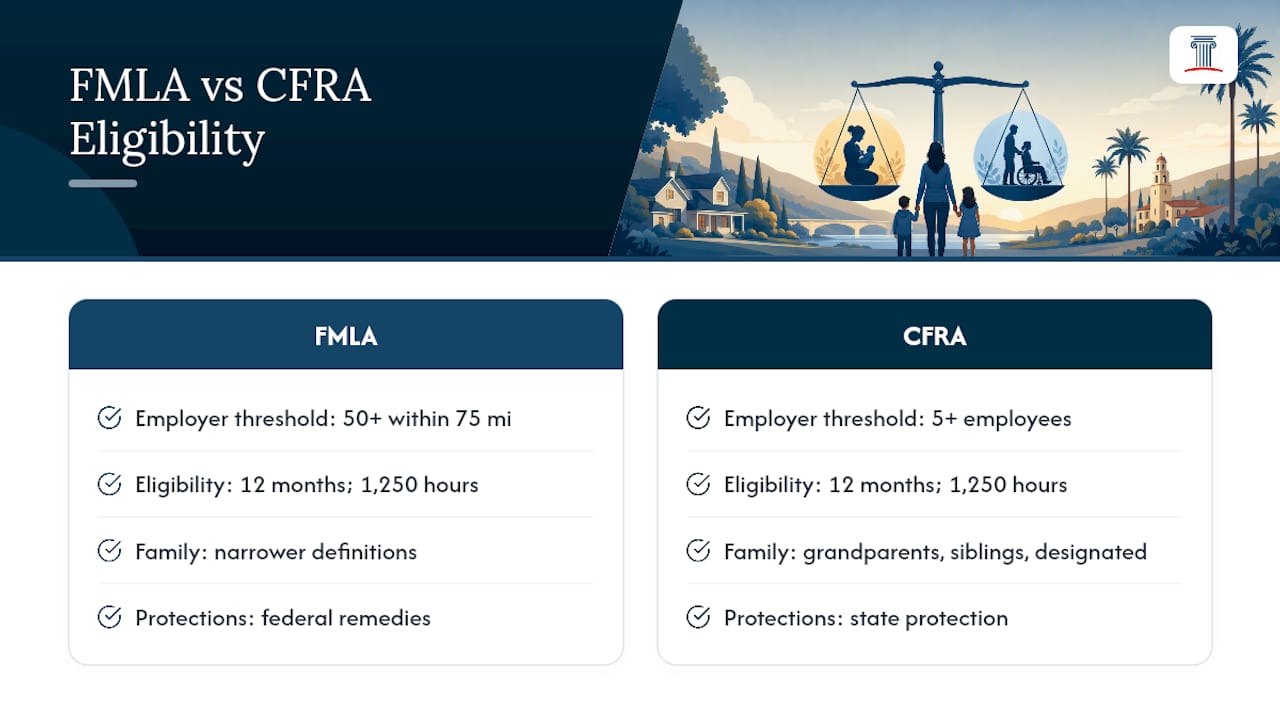
The two laws overlap heavily on eligibility, both generally requiring 12 months of employment and 1,250 hours worked in the prior year, but they diverge on family coverage. CFRA recognizes a broader set of family relationships than FMLA, including grandparents, siblings, and designated persons in many cases, while FMLA’s definitions are narrower.
When both laws apply to your situation, you’re entitled to whichever standard protects you more. That means a Villa Park employee covered by both FMLA and CFRA doesn’t have to pick one. If CFRA gives more generous family coverage and FMLA guarantees federal remedies, you get the benefit of both. This is where a lot of employees, and frankly some employers, get confused, and where a call to an employment attorney can clarify things quickly. If your employer operates near the Fullerton border or has locations across Orange County, our related guide on CFRA leave in Fullerton covers similar overlap questions.
How Long Can You Take Leave, and Can It Be Intermittent?
Both FMLA and CFRA provide up to 12 workweeks of job-protected leave in a 12-month period. That leave is unpaid under both statutes. California’s wage-replacement programs, State Disability Insurance and Paid Family Leave, can provide income during that time but don’t provide job protection on their own. Job protection comes strictly from FMLA or CFRA, so don’t assume that receiving SDI or PFL payments automatically means your position is secured.
Leave doesn’t have to be taken in one continuous block. Intermittent leave lets you take time off in separate periods, a few hours here, a few days there, when medically necessary, such as for chemotherapy appointments or recurring flare-ups of a chronic condition. Reduced-schedule leave lets you work fewer hours per week for a period rather than stopping entirely. Both options require medical certification supporting the need for a non-continuous schedule.
For Villa Park employees managing a parent’s care or a child’s ongoing treatment, intermittent leave is often more practical than a single 12-week absence. Your employer can require certification and, in some circumstances, recertification, and you generally have 15 calendar days to provide the documentation once requested. Keep copies of everything you submit. If a dispute arises later over whether your intermittent schedule was properly honored, your own paper trail often matters more than your employer’s.
Does a Layoff During Leave Cancel Your Reinstatement Rights?
This is one of the most misunderstood parts of FMLA and CFRA, and it catches Villa Park employees off guard regularly. Job restoration is not absolute. If your employer would have eliminated your position anyway, due to a genuine layoff, a company-wide reorganization, or a location closure, taking leave doesn’t insulate you from that outcome. The law protects you from losing your job because you took leave, not from business changes that would have happened regardless.

That distinction is where most disputes live. An employer claiming a “reorganization” while your leave was pending needs to show the change was genuine and would have occurred whether or not you took leave. If your position was eliminated but a similar role opened up elsewhere in the company, or if a replacement was hired doing essentially your old job under a new title, that’s a red flag worth investigating.
Document everything before, during, and after your leave: your job description, performance reviews, any internal communications about restructuring, and the timeline of when you requested leave versus when the layoff was announced. If your employer eliminated your role while you were out and can’t clearly explain why that decision was unrelated to your leave, you may have grounds for a restoration claim. Timing alone isn’t proof, but a layoff announced right after you request leave, especially if you were performing well beforehand, deserves a closer look from someone who handles these cases regularly.
Are “Key Employees” Treated Differently Under FMLA?
If restoring a key employee would cause “substantial and grievous economic injury” to the employer’s operations, the employer may deny reinstatement.
This exception is applied narrowly, and it’s one employers sometimes stretch further than the law allows. To use it lawfully, your employer generally must notify you at the time you request leave (or as soon as the key-employee status becomes clear) that you may be denied restoration, explain the reasons, and give you a chance to return to work before making a final decision. An employer who never raised the key-employee issue until after your leave began, or who can’t articulate the specific economic harm your return would cause, is on shaky ground.
CFRA does not include an identical key-employee carve-out in the same form, which is another reason the interplay between the two laws matters for higher-earning Villa Park professionals. If you’re a manager, director, or highly compensated specialist and your employer suddenly invokes a “key employee” exception after you announce leave, that timing itself is worth examining. This exception exists to prevent genuine operational damage to a business, not to give employers an easy way around inconvenient reinstatement obligations. If you believe it’s being misapplied to you, that’s a conversation to have with an attorney before you accept your employer’s explanation at face value.
What Happens if Your Employer Won’t Restore Your Job?
You have two main paths for enforcement: the federal Department of Labor’s Wage and Hour Division, which investigates FMLA violations, and the California Labor Commissioner’s Office, which handles state wage and leave violations alongside the California Civil Rights Department. Each agency has its own intake process, typically starting with a written complaint describing your leave dates, your job before and after, and how your employer failed to restore you.
Retaliation is treated as a separate, serious violation. Adverse actions like disciplinary write-ups for FMLA-protected absences, denied promotions tied to your leave use, or sudden negative performance reviews right after you return are actionable on their own, even apart from a restoration failure. Agencies weigh the timeline closely: an employer who never criticized your work before leave and suddenly finds problems after you return has a credibility issue to overcome.
Before filing anywhere, gather your records: your leave request and any written responses, your job description before and after, pay stubs showing any changes in compensation, and names of coworkers who might have witnessed relevant events. Applicable statutes of limitations vary depending on which claim and which agency you’re pursuing, so this isn’t something to sit on while you decide what to do. An employment attorney can evaluate your specific timeline and tell you which venue, agency complaint or private lawsuit, fits your situation better. Our page on Villa Park workplace retaliation covers how these claims typically unfold.
When Can an Employer Legally Refuse to Reinstate You?
Beyond the key-employee exception, a few other circumstances can lawfully excuse an employer from restoring your job. If your position genuinely would have been eliminated regardless of your leave, through a legitimate layoff, department closure, or loss of a specific contract or funding source, the employer may not be required to reinstate you into a job that no longer exists. The employer bears the burden of showing the elimination was unrelated to your leave.
Another narrow scenario involves employees who wouldn’t have been able to perform the essential functions of their job anyway, independent of the leave, though this overlaps with disability accommodation law and needs separate analysis. Fraudulent certification, if an employee never actually qualified for leave or misrepresented the reason for it, can also void protections, though employers rarely have strong evidence for this and often use it as a pretext.
These exceptions are narrow by design, and employers carry the burden of proving them. Vague explanations like “we decided to restructure” or “the position changed” without documentation rarely hold up under scrutiny. If your employer cites one of these exceptions after you request or return from leave, ask for the specifics in writing. A legitimate business reason should be easy for a legitimate employer to explain clearly. When it isn’t, that gap is often where a valid claim begins.
How Serendib Law Firm Supports Villa Park Employees
We’ve represented Orange County employees, including workers throughout Villa Park, who returned from protected leave to find their schedule changed, their route to work relocated beyond a reasonable commute, or a bonus they’d already earned quietly withheld. Our team works in English and Spanish, so language is never a barrier to understanding your rights.

We see the same patterns repeatedly: attendance points added for FMLA-protected absences, promotions given to someone else while an employee was out, or a “reorganization” that happens to eliminate exactly one position. If any of that sounds familiar, a free consultation with our office costs you nothing and commits you to nothing.
Why Working With Serendib Law Firm Makes Sense Here
Filing a complaint with a government agency means navigating forms, deadlines, and a process built for volume, not for your specific situation. Serendib Law Firm gives Villa Park employees something an agency complaint alone doesn’t: a dedicated advocate who reviews your documentation, identifies whether your employer violated FMLA, CFRA, or both, and builds your case around the specific facts of your job and your leave.
We take employment cases on a contingency basis in select circumstances, meaning you’re not paying hourly fees while your restoration claim is unresolved. Our attorneys work in both English and Spanish, and initial consultations cost nothing. If your employer changed your schedule, relocated your position, or denied a bonus after your leave, or if you’re staring down a “key employee” exception that doesn’t add up, reach out to Serendib Law Firm’s employment law attorneys to have your situation reviewed before you accept your employer’s version of events.
Frequently Asked Questions
Does my Villa Park employer have to give me my exact old job back?
Not necessarily. FMLA and CFRA both require restoration to the same position or an equivalent one, meaning substantially similar pay, benefits, duties, and status. Your desk or job title can change; your core compensation and responsibilities generally shouldn’t.
What if my employer is too small for FMLA?
Check CFRA. It covers employers with five or more employees, far fewer than the 50-employee, 75-mile threshold FMLA requires. Many Villa Park workers who fall outside FMLA are still protected under California law.
Can my employer lay me off while I’m on leave?
Only if the layoff would have happened regardless of your leave, for reasons unrelated to your time off. The employer must prove the elimination was independent of your leave, not simply assert it.
What counts as a “key employee,” and does it apply to me?
The exception applies narrowly and requires your employer to notify you and prove that restoring you would cause substantial economic harm to the business.
Where do I file a complaint if my job wasn’t restored?
You can file with the U.S. Department of Labor’s Wage and Hour Division for FMLA violations or with the California Labor Commissioner’s Office and California Civil Rights Department for CFRA violations. An attorney can help you decide which path, or a private lawsuit, fits your situation, since applicable statutes of limitations vary by claim.
This article is general information, not a substitute for advice from a qualified lawyer. Consult a qualified legal professional about your own circumstances before acting on anything here.
Sources
- Family and Medical Leave Act (FMLA) | U.S. Department of Labor
- Family and Medical Leave Act (FMLA) and California Family Rights Act (CFRA) FAQs | EDD
- Family Care Medical Leave | California Civil Rights Department (CRD)