
If you slipped on a wet floor, cracked sidewalk, or poorly lit stairway in Costa Mesa and someone else’s negligence caused it, you likely have a viable claim, provided the property owner knew or should have known about the hazard. The catch is time: California gives you a limited time to sue, with a shorter deadline for claims against government entities than for private property. Preserve evidence now and talk to a lawyer before those clocks run out.
TL;DR:
- Evidence like photographs, video footage, and inspection logs must be gathered promptly within days of the fall, as much of it disappears quickly.
- For falls on private property, filing a claim within two years is essential, while government property claims must be submitted within six months.
- Establishing notice through circumstantial evidence requires documentation of regular inspections and maintenance logs that can be scrutinized by courts.
- Fault can reduce compensation in California’s comparative negligence system, so it is crucial to minimize assumed fault with strong evidence.
- Consulting a bilingual lawyer quickly increases chances of preserving critical evidence and meeting legal deadlines, especially for city-owned property where the window is as short as six months.
Table of Contents
- How a Costa Mesa Slip and Fall Injury Claim Works
- What Evidence Proves Notice, Causation, and Damages?
- How Long Do You Have to File a Slip and Fall Claim?
- What Compensation Can You Recover After a Fall?
- What to Do Immediately After a Slip and Fall in Costa Mesa
- How Serendib Law Firm Handles Your Costa Mesa Claim
- How to Choose the Right Slip and Fall Attorney
- An Editorial Take on What Wins These Cases
- Talk to a Costa Mesa Slip and Fall Lawyer Today
- Sources
How a Costa Mesa Slip and Fall Injury Claim Works
Winning a slip and fall accident claim in Costa Mesa comes down to four legal elements, and missing any essential element can sink an otherwise strong case. California premises liability law traces back to Civil Code section 1714(a), which imposes a general duty of reasonable care on property owners and operators. The landmark case Rowland v. Christian reshaped this duty decades ago by rejecting rigid visitor categories (invitee, licensee, trespasser) in favor of a foreseeability standard. Put simply, owners must act reasonably toward anyone whose presence on their property is foreseeable, not just paying customers.
To succeed on a premises liability claim, you must prove:
- Duty: the property owner or occupier owed you a duty of reasonable care.
- Hazardous condition: a dangerous condition existed on the property.
- Notice: the owner knew, or reasonably should have known, about the hazard.
- Causation: the hazard directly caused your fall and your injuries.
Notice is where most Costa Mesa slip and fall lawsuits stall. Actual notice means someone reported the spill or reported the broken tile before you fell. Constructive notice is trickier. It asks whether the hazard existed long enough that a reasonable inspection routine would have caught it. This is where Ortega v. Kmart becomes essential. That case established that a plaintiff can prove constructive notice through circumstantial evidence, including a lack of inspection logs or an unreasonably long gap between cleaning checks.
CACI No. 1000, California’s standard jury instruction, lays out these exact elements for jurors, and it summarizes the essential factual elements a plaintiff must prove in any premises liability trial. Attorneys build their entire case strategy around satisfying this instruction, which is why the evidence you gather in the first 48 hours often decides whether notice can be proven at all.
What Evidence Proves Notice, Causation, and Damages?
Winning the notice element usually comes down to paperwork the property owner would rather you never see. Building a strong slip and fall lawsuit means gathering specific evidence types quickly, before surveillance footage gets overwritten and witnesses forget details.
- Photos and video of the hazard. Capture the wet floor, torn carpet, or uneven pavement immediately, including wide shots showing lighting and any (missing) warning signs.
- Surveillance footage. Many Costa Mesa retailers and shopping centers record continuously but only retain footage for a limited window, sometimes as short as seventy-two hours.
- Maintenance and inspection logs. These records either support or destroy an owner’s claim that they inspected regularly, and courts weigh evidence of regular inspections heavily when assessing constructive notice under the Ortega framework.
- Incident reports. Ask the manager or property staff to complete one on the spot and request a copy before you leave.
- Witness statements and contact information. Memories fade fast, so get names and phone numbers while people are still on scene.
- Medical records and bills. These connect your injury directly to the fall and establish the causation element.
- Preserved clothing and footwear. Insurers sometimes argue the wrong shoes caused the fall, so don’t wash or discard what you were wearing.
Pro Tip: Never give a recorded statement to the property owner’s insurance adjuster. Insurers routinely use early, unrehearsed statements to argue you were distracted or wearing inappropriate shoes, and those recordings follow you into settlement negotiations.
Insurance adjusters are trained to find inconsistencies in your account, and early conversations often work against injured claimants who haven’t yet spoken with counsel. Get medical care documented first, then let a lawyer handle every conversation with the insurance company after that.
How Long Do You Have to File a Slip and Fall Claim?
California’s clock on slip and fall lawsuits starts ticking the moment you fall, and missing the deadline ends your case regardless of how strong your evidence is.
- Two years for private property. Under California Code of Civil Procedure section 335.1, you generally have two years from the date of injury to file a lawsuit against a private property owner, business, or landlord.
- Six months for government property. If you fell on a public sidewalk, in a Costa Mesa city park, or inside a government building, Government Code section 911.2 requires you to submit a formal written claim to the responsible public entity within six months of the incident, not two years.
- Late-claim relief is narrow. You can sometimes apply for permission to file late under Government Code section 911.4, but that application must generally happen within one year, and approval is far from guaranteed.
The practical reality: if your fall happened on city-owned property near a Costa Mesa park or municipal building, treat the six-month window as your real deadline, not the two-year figure most people assume applies. Evidence like surveillance footage and inspection logs also tends to disappear long before either deadline arrives, which is the bigger reason to move fast.
What Compensation Can You Recover After a Fall?
Costa Mesa slip and fall victims can pursue two broad categories of damages, and understanding both helps you recognize when an insurance offer falls short.
Economic damages cover quantifiable financial losses:
- Emergency room and hospital bills
- Physical therapy and ongoing medical treatment
- Lost wages from missed work
- Future medical care for lasting injuries
- Reduced earning capacity if you can’t return to your prior job
Non-economic damages compensate for harder-to-quantify harm:
- Physical pain and suffering
- Emotional distress
- Loss of enjoyment of life
- Impact on relationships and daily activities
Unlike medical malpractice cases, California places no statutory cap on non-economic damages in an ordinary premises liability claim, meaning a jury can award pain and suffering compensation proportional to the actual harm you suffered.
Fault, however, can shrink your recovery. California follows pure comparative negligence, which means your compensation gets reduced by whatever percentage of fault a jury assigns to you, even if that’s just 10%. Insurance companies know this rule well and often argue you were texting, wearing flip-flops, or ignoring a posted warning sign specifically to knock down your payout. A skilled personal injury attorney anticipates these tactics and gathers evidence that keeps your fault percentage as low as the facts allow.
What to Do Immediately After a Slip and Fall in Costa Mesa
The first 24 hours after a fall shape everything that follows, from your medical recovery to your legal leverage.
- Get medical attention right away, even if the injury seems minor. Adrenaline masks pain, and a same-day medical record directly links your injury to the fall.
- Photograph everything at the scene, including the hazard, the surrounding area, and any warning signs (or their absence).
- Identify and speak with witnesses, and get their names and phone numbers before they leave.
- Request a written incident report from the property manager or business owner, and ask for your own copy.
- Preserve your clothing and shoes exactly as worn, without washing or altering them.
- Keep every medical bill and record, since public-health fall data underscores how quickly injuries can escalate without prompt treatment and documentation.
- Avoid recorded statements to any insurance adjuster until you’ve spoken with a lawyer.
- Contact a Costa Mesa personal injury lawyer promptly, ideally within days, not weeks.
Every one of these steps get harder the longer you wait, and some, like surveillance footage, become impossible to recover after a short window closes.
How Serendib Law Firm Handles Your Costa Mesa Claim
We start every slip and fall case with a free consultation where we walk through what happened, review your medical treatment so far, and identify what evidence still needs to be secured. From there, our investigation moves quickly, because we know how much of the strongest proof disappears within days.
Our process typically includes:
- Sending preservation letters to retrieve surveillance footage before it’s overwritten
- Subpoenaing maintenance and inspection records to establish constructive notice under the Ortega framework
- Interviewing witnesses while their memory of the scene is still fresh
- Consulting with medical and safety experts when causation or the standard of care is disputed
- Negotiating directly with insurance adjusters so you never have to give a recorded statement yourself
We represent Costa Mesa personal injury clients on a contingency fee basis, meaning you owe us nothing unless we recover compensation for you. Our attorneys also provide full bilingual support in English and Spanish, so language is never a barrier to understanding your rights or your case’s progress.
Pro Tip: Bring your incident report and any photos to your first consultation, even if you think they’re incomplete. What looks like a minor detail to you is often exactly what an attorney needs to establish notice.
How to Choose the Right Slip and Fall Attorney
Not every personal injury lawyer handles premises liability the same way, and the wrong fit can cost you both time and money. During your free consultation, evaluate the attorney on a few concrete factors.
- Trial experience. Ask how many premises liability cases they’ve taken to trial versus settled, since insurers negotiate harder with attorneys who won’t hesitate to litigate.
- Track record with slip and fall cases specifically. General personal injury experience doesn’t always translate to strong notice arguments under the Ortega framework.
- Communication style. Ask who your direct point of contact will be and how quickly they typically respond.
- Fee transparency. Confirm the contingency percentage and whether any costs come out of your pocket if the case doesn’t settle.
Ask directly: “What’s your realistic timeline for a case like mine?” and “What’s a fair compensation range given my injuries and evidence?” Be wary of any attorney who guarantees a specific dollar amount before reviewing your medical records. That’s a red flag, not a promise.
An Editorial Take on What Wins These Cases
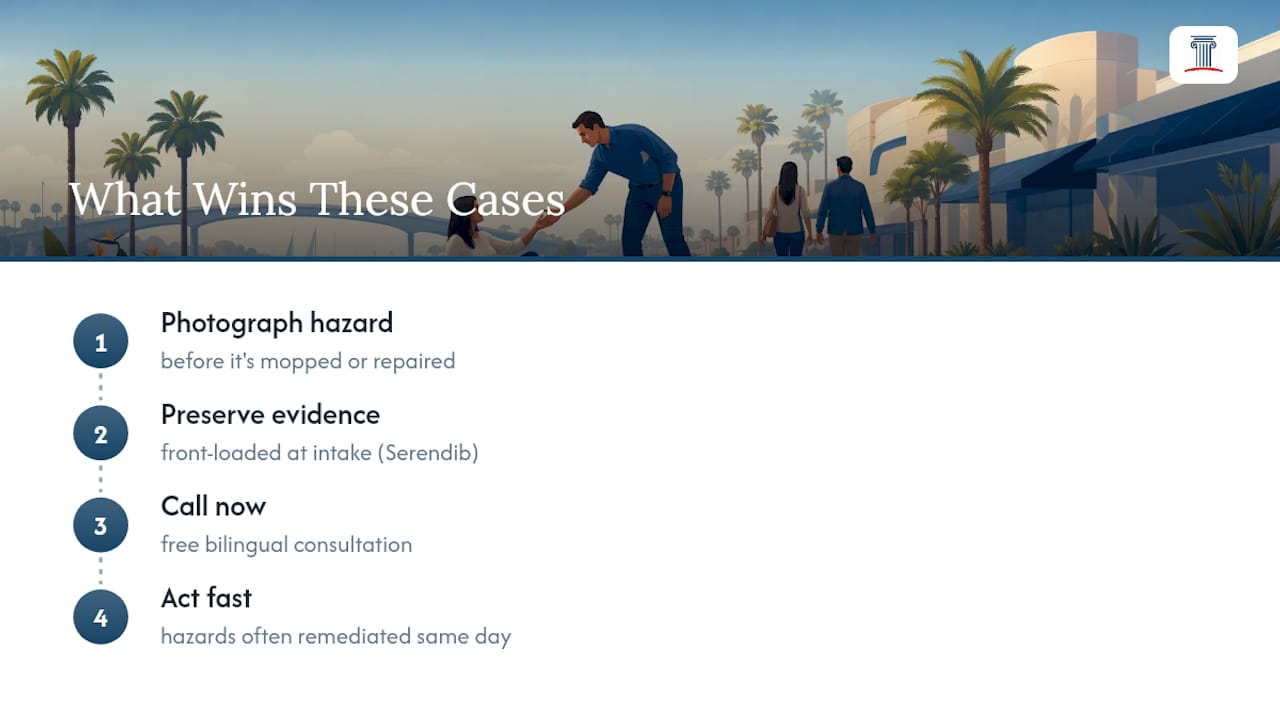
The gap between a strong slip and fall claim and a weak one almost never comes down to how badly someone got hurt. It comes down to whether anyone thought to photograph the hazard before it got mopped up or repaired. I’ve seen the pattern repeat across dozens of premises liability disputes: the client with the most severe injury sometimes has the weakest case simply because the evidence of notice evaporated in the first hour.
Costa Mesa’s mix of retail centers, restaurants, and public walkways means hazards get remediated fast, often within the same day. That speed works against injured people who assume they have weeks to sort out documentation. Serendib Law Firm’s bilingual attorneys built our intake process around this exact problem, front-loading evidence preservation before we even discuss settlement value. If you’re weighing whether to call, use the free consultation now. The hazard that hurt you probably won’t exist tomorrow.
— Maya Serkova
Talk to a Costa Mesa Slip and Fall Lawyer Today
Serendib Law Firm gives Costa Mesa residents something most insurance-backed defense teams count on you not having: a bilingual legal team that moves on evidence preservation the same week you call, not after your two-year deadline is already ticking down. Schedule a free consultation through our contact page and bring what you have, photos of the hazard, medical records, witness names, and any incident report you received. If your fall happened on a Costa Mesa sidewalk or government-owned property, remember your written claim deadline is six months, not two years, so don’t sit on this. We work on contingency, so there’s no upfront cost to find out where your case stands. Call or submit the form today to lock in your evidence before it disappears.
Sources
- Deadlines to sue someone | California Courts | Self Help Guide
- California Slip and Fall Laws: Proving Premises Liability | Recording Law
- CACI No. 1000. Premises Liability – Essential Factual Elements :: California Civil Jury Instructions (CACI)
- CDC falls data and research
Each source anchors a specific legal deadline, evidentiary standard, or medical practice referenced throughout this guide, so you can verify the rules governing your own Costa Mesa claim directly at the source.
This article is general information, not a substitute for advice from a qualified lawyer. Consult a qualified legal professional about your own circumstances before acting on anything here.