
California law, through the Fair Employment and Housing Act, protects Santa Ana employees from workplace discrimination and harassment based on a wide range of characteristics. If something at work feels wrong, your immediate priorities are simple: preserve your evidence and submit a CRD intake within the three-year filing window, then talk to a California employment lawyer before you make any major decisions about your job.
TL;DR:
- Discrimination claims must be filed within three years of the last incident, and evidence preservation is crucial within this limited window.
- Record-keeping of incidents, communications, and internal complaints significantly strengthens your case and should be done promptly and carefully.
- Filing a formal complaint with the CRD requires evidence and documentation, which are best gathered as soon as suspicions arise.
- Remedies for successful claims include back pay, emotional distress damages, and workplace policy changes, with legal support often recoverable from the employer.
- Waiting to seek legal advice risks losing key witnesses and evidence, as workplace turnover and time can undermine your case.
Table of Contents
- What California Law Protects for Santa Ana Workers
- How to Spot Discrimination or Harassment at Work
- What to Do Right Now to Protect Your Claim
- Filing a Complaint With the California Civil Rights Department
- Remedies Available Under California Employment Law
- Local Protections and Resources for Santa Ana Employees
- Retaliation Protections if You Report Discrimination
- Employer Obligations to Prevent Discrimination
- Mediation and Alternative Dispute Resolution Options
- Federal Protections That Work Alongside California Law
- Why Santa Ana Employees Should Not Wait to Get Advice
- Talk to a Santa Ana Employment Lawyer About Your Situation
- Where to File and Verify Your Rights
- Sources
What California Law Protects for Santa Ana Workers
FEHA gives Santa Ana employees far broader protection than most people realize. The statute prohibits discrimination based on race, sex, pregnancy, disability, age 40 and older, gender identity, sexual orientation, religion, national origin, marital status, and medical or genetic information, among other categories laid out in Government Code §12940. The statute also spells out exceptions for bona fide occupational qualifications, which matters if your employer claims a job requirement justified excluding you.
Coverage extends further than most workers assume:
- Applicants, employees, unpaid interns, and volunteers all fall under FEHA’s protections.
- Independent contractors are covered too, not just W-2 employees.
- Harassment protections apply no matter how small the employer is, including businesses with fewer than five people on staff, according to the California Civil Rights Department.
- Some obligations, like mandatory sexual harassment training and pregnancy disability leave, only kick in once an employer reaches five or more employees.
- Your immigration status has no bearing on your right to file. The CRD does not ask about citizenship when evaluating a complaint.
If you work in a warehouse near the rail yards, a call center in a Santa Ana office park, or a small family-owned restaurant, these protections follow you regardless of the size of the operation you work for.
How to Spot Discrimination or Harassment at Work
Discrimination rarely announces itself. It shows up as a promotion that mysteriously goes to someone less qualified, a schedule change that only affects employees over 40, or a manager who “jokes” about your accent in front of coworkers. Sometimes it is a single, severe incident. Other times it builds slowly into what the law calls a hostile work environment, where repeated comments or conduct tied to a protected trait make it difficult to do your job.
Watch for these patterns:
- Hiring, firing, or promotion decisions that consistently disadvantage people with a shared protected characteristic.
- Comments, jokes, or slurs tied to race, sex, religion, disability, or another protected category.
- Unwelcome sexual comments, touching, or pressure connected to job benefits.
- Refusal to provide reasonable accommodation for a disability or a pregnancy-related condition.
- Sudden negative performance reviews that appear right after you disclosed a pregnancy, disability, or complaint.
Start collecting evidence the moment you suspect something is off: save emails and texts, write down witness names, keep copies of performance reviews, and request a copy of your employer’s anti-discrimination policy.
Pro Tip: Keep a simple, dated log on your personal phone or a notebook at home, not on a work device. Note who said what, when, and who else was in the room. That log becomes one of the most persuasive pieces of evidence if your case moves forward.

What to Do Right Now to Protect Your Claim
Once you suspect discrimination, the next few weeks matter more than most people expect. Evidence disappears, memories fade, and employers sometimes move quickly to reshape the narrative once they sense a complaint is coming.
- Write everything down. Record dates, times, exact quotes, and witnesses for every incident while your memory is fresh.
- Save your communications. Screenshot texts, forward emails to a personal account, and keep any written policies you were given at hiring or since.
- Report internally, in writing. Send your complaint to HR or a manager by email rather than only in person, and ask for written confirmation that they received it.
- Preserve your devices and accounts. Do not delete anything, even messages that seem embarrassing or unrelated. Request a copy of your personnel and payroll file if your employer allows it.
- Hold off on resigning. Quitting can weaken certain claims and complicate your damages. Get legal advice before you walk away from the job, unless your physical safety is genuinely at risk.
- Prioritize safety first. If you are in danger, remove yourself from the situation and document what happened afterward. No claim is worth your physical safety.
These steps cost you almost nothing, and they are the difference between a claim with real teeth and one that depends entirely on your memory months later.
Filing a Complaint With the California Civil Rights Department
The CRD is the state agency that handles FEHA complaints, and understanding its process removes a lot of the anxiety around filing. You submit an intake form online, by email, or by mail, describing what happened, when, and which protected characteristics were involved. The form also asks about accommodations you may need during the process, including interpreter services.
Deadline to know: You have three years from the last discriminatory act to submit your CRD intake for an employment case, according to the CRD’s complaint process page. Miss that window and you generally lose the right to pursue the claim through this channel.
A few things to keep in mind before you file:
- The CRD conducts an intake interview after you submit the form, which can lead to mediation, a full investigation, or enforcement action if the agency finds reasonable cause.
- You can request an immediate Right-to-Sue notice at the time of filing if you would rather go straight to court instead of waiting on the CRD’s investigation.
- Requesting an immediate Right-to-Sue is a real tradeoff. It gets you into court faster but gives up the CRD’s investigative leverage, which sometimes resolves a case without litigation at all.
- Gather personnel records, pay stubs, performance reviews, and copies of your internal complaint before your intake interview so you are not scrambling for documents later.
Remedies Available Under California Employment Law
If your claim succeeds, whether through CRD enforcement or a court judgment, California law allows for a broad set of remedies designed to make you whole and change the employer’s conduct going forward.
Monetary relief can include:
- Back pay for wages lost because of the discrimination
- Front pay if reinstatement is not practical
- Emotional distress damages
- Punitive damages in cases involving malice or reckless conduct
- Attorney’s fees and costs
Non-monetary relief can include:
- Reinstatement to your former position
- Promotion you were wrongly denied
- Changes to company policy
- Mandatory training for supervisors or staff
- Reasonable accommodations going forward
The CRD outlines these remedies directly, and the availability of attorney’s fees matters more than it might seem. It means qualifying cases can often be pursued without a large up-front cost to you, since a lawyer’s fees may be recovered from the employer if you win.
Local Protections and Resources for Santa Ana Employees
Santa Ana does not maintain a separate municipal fair employment ordinance the way a handful of larger California cities do, so your primary protections come from state law under FEHA and, where applicable, federal statutes. That said, the city’s demographics shape how discrimination claims actually play out here. Santa Ana has one of the highest concentrations of Spanish-speaking workers in Orange County, and national-origin and language-based discrimination complaints are common enough that the CRD’s intake process explicitly accommodates non-English speakers, including interpreter services during the intake interview.
Local context also affects where you go for help. Santa Ana sits within Orange County’s broader network of legal aid organizations and worker centers, several of which specialize in wage and discrimination issues among manufacturing, hospitality, and service-industry employees, sectors that dominate much of the local economy. If your workplace is a warehouse, restaurant, or retail operation along Bristol Street or in the Santa Ana industrial corridor, you are far from alone in facing these issues, and local employment attorneys handle a steady volume of similar cases.
Because Santa Ana lacks its own discrimination ordinance, do not assume city government offers a separate complaint pathway. Your claim runs through the CRD’s state process regardless of which Orange County city you work in, which actually simplifies things: one set of rules, one filing deadline, and one agency to contact no matter where in Santa Ana your employer is located.
Retaliation Protections if You Report Discrimination
Reporting discrimination should not cost you your job, but retaliation is one of the most common employer responses when a complaint gets filed. FEHA treats retaliation as its own, independently actionable violation, separate from the underlying discrimination claim itself.
Retaliation can look like a sudden demotion, a schedule cut, a poor performance review that appears out of nowhere, exclusion from meetings you used to attend, or outright termination shortly after you raise a concern. The timing is often the biggest clue. If discipline follows closely on the heels of a complaint you filed, that timing itself becomes evidence.
If you experience retaliation after reporting discrimination or harassment, document it the same way you documented the original incident: dates, specifics, who was involved, and how it differed from how you were treated before you spoke up. Mention the retaliation explicitly when you file your CRD intake, since it strengthens your overall case and stands as its own violation even if the underlying discrimination claim faces challenges.
One detail catches many employees off guard: retaliation protections apply even if the CRD ultimately determines the original discrimination did not rise to a legal violation. You do not need to win the underlying claim for a retaliation claim to succeed, as long as you had a reasonable, good-faith belief that you were reporting something unlawful. That distinction protects employees who speak up in good faith, even when the facts turn out to be more complicated than they first appeared.
Employer Obligations to Prevent Discrimination
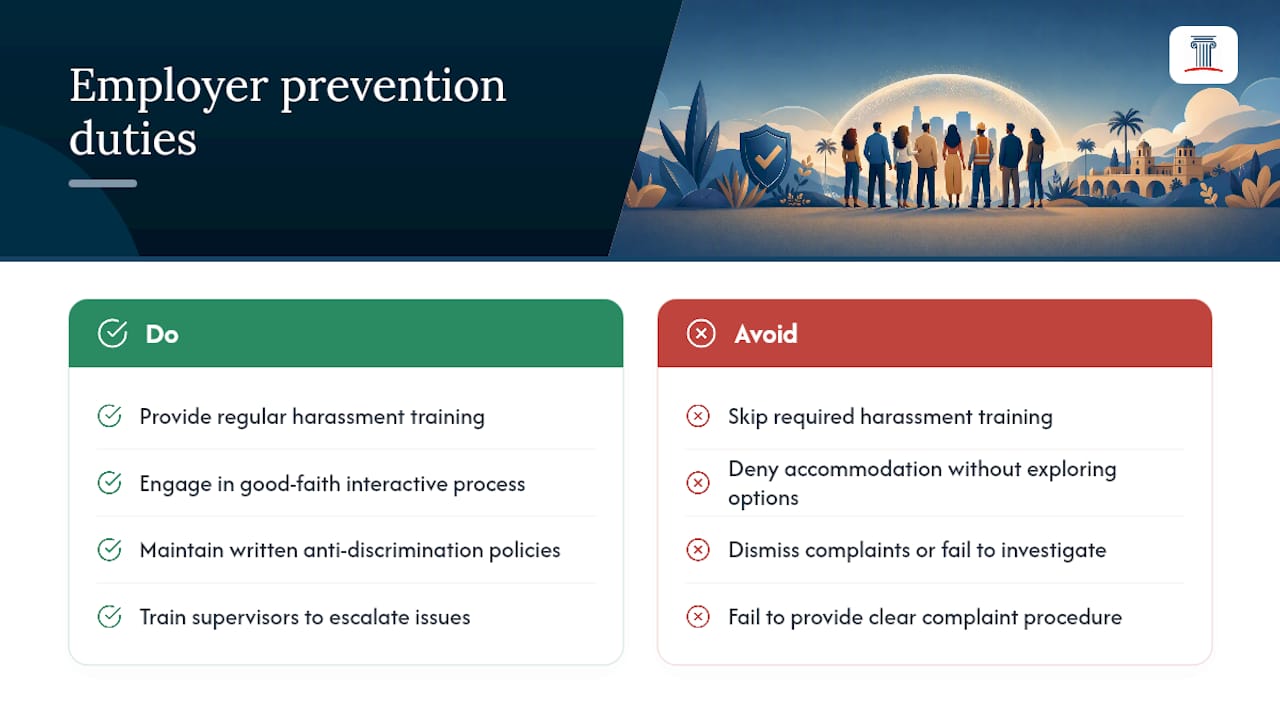
California places real obligations on employers, not just employees seeking protection. Employers with five or more employees must provide sexual harassment prevention training on a regular basis, and the CRD accepts complaints specifically about employers who skip this requirement entirely.
Beyond training, employers must engage in a good-faith, interactive process with employees who request reasonable accommodations, whether for a disability, a pregnancy-related condition, or a religious practice. That process is not optional and it is not a one-time conversation. An employer that denies an accommodation without genuinely exploring alternatives is exposing itself to liability, even if it never intended to discriminate.
Employers also carry an affirmative duty to prevent discrimination and harassment before it happens, not just respond after a complaint lands on someone’s desk. That includes maintaining written policies, providing a clear complaint procedure, and training supervisors to recognize and escalate issues rather than dismiss them.
For employees, this matters practically. If your employer never provided the required training, never posted an anti-harassment policy, or brushed off your accommodation request without a real conversation, those failures are not just bad management. They are potential evidence that strengthens a discrimination or failure to accommodate claim. Keep a copy of whatever policy documents you were given at hiring, or note if you were never given any at all. That gap alone tells a story about how seriously your employer took its legal obligations.
Mediation and Alternative Dispute Resolution Options
Not every discrimination claim needs to end in a courtroom. The CRD’s process often includes an option for mediation before a full investigation moves forward, giving both sides a chance to resolve the dispute through a negotiated agreement rather than years of litigation.
Mediation works because it is faster, less expensive, and less public than a lawsuit. A neutral mediator facilitates a conversation between you and your employer, often resulting in a settlement that includes some combination of back pay, policy changes, or a negotiated separation, without either side having to prove their entire case in court. For many Santa Ana employees juggling a job search and financial pressure, that speed matters as much as the outcome itself.
That said, mediation is not always the right move. If your employer refuses to negotiate in good faith, or if the case involves particularly severe conduct, pushing forward with a CRD investigation or litigation may produce a better result than a quick settlement that undervalues your claim. This is exactly the kind of decision where having a California Employment Lawyer review your specific facts before you agree to anything makes a real difference. Settlements are typically final, and once you sign, you generally cannot go back and ask for more later if new information surfaces.
Federal Protections That Work Alongside California Law
FEHA does not exist in isolation. Several federal laws provide overlapping protection, and in some cases, federal law covers situations California’s statute does not reach as directly.
Title VII of the Civil Rights Act of 1964 prohibits discrimination based on race, color, religion, sex, and national origin for employers with 15 or more employees. The Americans with Disabilities Act provides parallel protection to FEHA’s disability provisions, and the Age Discrimination in Employment Act protects workers 40 and older at the federal level, mirroring FEHA’s age protections but with its own separate filing agency, the Equal Employment Opportunity Commission.
For most Santa Ana employees, FEHA remains the stronger option because California’s law generally covers smaller employers and provides broader remedies than federal statutes allow. But federal claims matter when your employer falls outside FEHA’s employee-count thresholds for certain protections, or when you want to preserve every possible legal avenue. The CRD and EEOC have a work-sharing agreement, so filing with one agency often protects your rights under both frameworks without requiring two separate complaints. An attorney can tell you quickly whether your situation benefits from pursuing both tracks or whether focusing on FEHA alone gives you the strongest position.
Why Santa Ana Employees Should Not Wait to Get Advice
The biggest mistake I see is not a lack of evidence. It is delay. Employees sit on a discrimination claim for months, hoping the situation resolves itself or fearing that reporting will make things worse, and by the time they reach out, key witnesses have moved on or documents have been deleted in the normal course of business.
FEHA’s three-year filing window sounds generous, and technically it is compared to many other states. But the practical reality inside a workplace moves much faster than that deadline suggests. Managers get replaced, companies restructure, and coworkers who witnessed the harassment or discrimination often leave the company within a year or two. Every month you wait to consult a California Employment Lawyer, you are losing access to the evidence that actually wins these cases.
I also think the conventional advice to “wait and see if it gets better” undersells how much documentation matters in the early stages. A claim built on contemporaneous notes and preserved emails looks entirely different to a CRD investigator than one built on memory alone, reconstructed a year after the fact. Santa Ana’s employees, many of them working in industries with tight-knit crews and high turnover, are especially vulnerable to losing that evidentiary window. Acting early is not about being aggressive. It is about protecting a claim before the facts scatter.
— Maya Serkova
Talk to a Santa Ana Employment Lawyer About Your Situation
If you are weighing whether to file a CRD complaint on your own or hand the process to someone who does this every day, that decision alone can shape your outcome. Serendib Law Firm offers a free consultation to Santa Ana employees, walking through your specific facts, your CRD intake, and whether requesting an immediate Right-to-Sue makes sense for your case rather than waiting on the agency’s timeline.
Our team provides bilingual support in English and Spanish, handles evidence preservation and intake preparation directly, and takes qualifying employment claims on contingency, so cost is not a barrier to finding out where you stand. Whether your case involves workplace discrimination or harassment, our Santa Ana employment attorneys can review your documentation and outline your options before the three-year window narrows. Contact us today to schedule your free consultation and find out what your claim is actually worth.
Where to File and Verify Your Rights
Start with the CRD’s own complaint process page for filing instructions and deadlines, then download the official intake form to prepare your submission. For the underlying legal standards, Government Code §12940 lays out exactly what FEHA prohibits. These are primary government sources, not secondhand summaries, so they reflect the current rules directly. For more on local procedures, see this Santa Ana workplace disputes guide.
This article is general information, not a substitute for advice from a qualified lawyer. Consult a qualified legal professional about your own circumstances before acting on anything here.
Sources
- Complaint process | California Civil Rights Department (CRD)
- Government Code §12940 — Unlawful employment practices (FEHA)