

Villa Park employees who report illegal conduct at work are protected under California Labor Code §1102.5, which bars employers from firing, demoting, or otherwise punishing workers for internal or external whistleblowing. If your employer retaliates, you may recover reinstatement, back pay, attorney fees, and civil penalties up to several thousand dollars per violation. The first move: preserve every document and email now, then call an employment lawyer before deadlines close.
TL;DR:
- Retaliation protections under Labor Code §1102.5 apply when an employer responds within 90 days of a report, shifting the burden to prove legitimacy if adverse actions occur within that window.
- Protected whistleblowing includes internal or external reports of suspected law violations, refusing to participate in illegal acts, and assisting investigations, even if the belief is mistaken.
- Establishing retaliation demands proof of protected activity, an adverse employment action, and a causal link; timely follow-up emails and documentation are critical evidence.
- Retaliation claims must be filed within one year through the DLSE or within up to three years if pursued via civil court or civil rights agencies, depending on the basis of the claim.
- Successful recoveries can include reinstatement, back pay, attorney fees, and penalties up to $10,000 per violation, with evidence strength and timing influencing outcome severity.
Table of Contents
- Which California Laws Protect Whistleblower Retaliation Villa Park CA Employee Rights
- What Counts as Protected Whistleblowing Activity?
- How Do You Prove Retaliation Actually Happened?
- Where and When Should You File a Retaliation Claim?
- What Remedies Can You Actually Recover?
- Building Your Evidence File: Steps to Take Right Now
- Special Protections for Public Employees Under Government Code §8547.2
- Does Villa Park or Orange County Add Any Local Protections?
- When Retaliation Overlaps With Discrimination: Working With the CRD
- What Happens If Your Retaliation Claim Gets Denied?
- How Employers Fight Back and How You Counter It
- A Villa Park Employment Lawyer’s Perspective
- Get Help From Serendib Law Firm After Retaliation
- Sources
Which California Laws Protect Whistleblower Retaliation Villa Park CA Employee Rights
Two statutes do most of the heavy lifting for a Villa Park employee facing payback for speaking up. Labor Code §1102.5 is the workhorse: it protects you for reporting suspected legal violations internally to a supervisor, externally to a government agency, or by refusing to participate in an activity you reasonably believe is illegal. The statute’s text covers disclosures made to a person with authority over you, not just outside regulators, which surprises a lot of employees who assume they had to go to a government hotline for protection to kick in.
Built into §1102.5 is a 90-day rebuttable presumption: if your employer takes adverse action against you within 90 days of your protected report, the law presumes retaliation, and the burden shifts to the employer to prove it had a legitimate, independent reason, according to DLSE’s whistleblower notice.
When retaliation overlaps with discrimination or harassment, for example your whistleblowing report and your protected-class status are both in play, California’s Civil Rights Department (CRD) may also have jurisdiction. Practical filing targets include:
- DLSE (Labor Commissioner’s Office): handles most Labor Code §1102.5 retaliation complaints
- CRD: handles retaliation tied to discrimination or harassment claims under FEHA
- California Attorney General’s whistleblower resources: background and referral information for reporting misconduct
- Civil court: a direct lawsuit is possible for many §1102.5 claims without exhausting an agency process first
Choosing the right venue early matters. Filing in the wrong place can cost you months you don’t have.
What Counts as Protected Whistleblowing Activity?
Not every complaint at work qualifies as legally protected whistleblowing, but the standard is broader than most employees assume. California protects you when you act on a reasonable, good-faith belief that a law was violated, even if you turn out to be wrong about the legal technicalities.
- Internal reports to a supervisor, HR, or company compliance line about suspected wage theft, safety violations, or fraud.
- External reports to a government agency such as Cal/OSHA, the Labor Commissioner, or a licensing board.
- Refusing to participate in an act you reasonably believe is illegal, such as falsifying safety logs or destroying records under investigation.
- Testifying or assisting in someone else’s investigation or proceeding related to a suspected violation.
California also protects employees who are only perceived as whistleblowers, even if they never actually reported anything, and in some circumstances protects family members of a whistleblower from retaliatory backlash. If your employer assumed you were the one who called Cal/OSHA and punished you for it, that assumption alone can trigger protection.
How Do You Prove Retaliation Actually Happened?
Every retaliation claim rests on three elements: you engaged in protected activity, your employer took an adverse employment action against you, and there’s a causal connection between the two. Miss any one, and the claim falls apart.
Adverse actions go beyond outright firing. Courts and agencies recognize:
- Termination or forced resignation
- Demotion or unwanted transfer
- Sudden schedule cuts or reduced hours
- Exclusion from meetings, projects, or communications you were previously part of
- A sharp, unexplained drop in performance reviews right after your report
Causation is usually the hardest element to nail down, and it’s where cases are won or lost. The 90-day presumption helps if the adverse action happened quickly, but the California Supreme Court’s decision in Lawson v. PPG lowered the bar further. Under Lawson, your protected activity only needs to be a contributing factor in the adverse action, not the sole or even primary reason. That single change has made it substantially harder for employers to argue “we would have fired them anyway.”
Strong evidence of causation includes a clear timeline connecting your report to the punishment, contemporaneous emails or texts, performance records showing no prior issues, and witness statements corroborating your account, per guidance on proving retaliation claims.
Pro Tip: Send a follow-up email after any verbal report to your supervisor, something as simple as “Confirming we discussed the safety issue I raised today.” That single email can become the anchor date for your entire timeline later.
Where and When Should You File a Retaliation Claim?
Deadlines in retaliation cases are unforgiving, and they vary by agency. Missing one by even a few days can end a valid claim before it starts.
- DLSE (Labor Commissioner): most retaliation complaints under §1102.5 must be filed within one year of the retaliatory act, though a few narrow categories, like certain childcare licensing claims, carry a shorter 90-day window.
- CRD: when retaliation intersects with discrimination or harassment, some claims allow up to three years to file.
- Civil lawsuit: many §1102.5 claims can go straight to court without first exhausting an administrative process, which can be faster if your case is strong and well documented.
Each route has trade-offs. DLSE complaints are free and don’t require a lawyer, but investigations move slowly. CRD can issue a “right to sue” letter that lets you move to court. A direct civil suit gives you more control over strategy and potentially larger damages, but it demands stronger upfront documentation.
One detail that matters for immigrant workers in Villa Park: DLSE accepts complaints without a Social Security number and will not report your immigration status to any other agency. That should remove a real barrier for workers who’ve stayed silent out of fear.
What Remedies Can You Actually Recover?
Winning a retaliation claim can restore both your job and your finances, though the size of any recovery depends heavily on your documentation and the length of time you were out of work.
Available remedies typically include:
- Reinstatement to your former position
- Back pay covering wages lost from the date of retaliation forward
- Front pay in some cases, when reinstatement isn’t practical
- Attorney fees, since a 2021 amendment to §1102.5 lets courts award reasonable fees to employees who win
- Civil penalties up to $10,000 per violation, paid by the employer under §1102.5’s enforcement provisions
- Emotional-distress damages, where the facts support them
The size of a recovery usually tracks three things: how long you were out of work, how strong your contemporaneous evidence is, and how much emotional or reputational harm you can document. A worker fired the same week they reported wage theft, with emails to prove it, is in a far stronger position than one relying only on memory months later.
Building Your Evidence File: Steps to Take Right Now
What you do in the days right after retaliation often decides the case more than anything a lawyer does later. Move fast.
- Save everything immediately. Screenshot texts, forward work emails to a personal account, and download Slack or Teams messages before access is cut off.
- Keep your pay stubs and schedules. Sudden hour cuts are easier to prove with a paper trail showing your hours before and after your report.
- Build a dated timeline. Write down the date you reported misconduct, who you told, and every adverse action that followed.
- Memorialize verbal reports in writing. A short follow-up email turns a conversation into evidence.
- Identify witnesses now, while memories are fresh and before coworkers become reluctant to get involved.
- Don’t sign anything from HR or legal, including a severance release, without an employment attorney reviewing it first.
- Document emotional distress with dated notes and, where appropriate, medical or counseling records if the retaliation affected your health.
Pro Tip: Keep your evidence in a personal email account or cloud folder, never only on a work laptop. Employers routinely lock accounts the same day they terminate someone.
Special Protections for Public Employees Under Government Code §8547.2
If you work for a city, county, or state agency, your protections come from a different statute. California Government Code §8547.2 governs whistleblower protections for public employees and defines “improper governmental activity” broadly, covering violations of federal, state, or local law, as well as economic waste, fraud, and abuse of authority by government officials.
Public-sector whistleblowers report through a different channel than private employees. Rather than going straight to DLSE, many public employees report to their agency’s internal whistleblower hotline, an Inspector General, or the State Auditor’s office, depending on the level of government involved. The reporting mechanism differs, but the underlying protection concept, no retaliation for good-faith disclosure, tracks closely with §1102.5’s private-sector framework.
If you work for a Villa Park public agency, a school district, or a county department, don’t assume §1102.5 alone covers you. Government Code §8547.2 often applies in parallel, and the procedural requirements, including which office you report misconduct to first, can differ meaningfully from private-employer rules. Getting the wrong statute or the wrong agency at the filing stage is one of the most common, and most avoidable, mistakes public employees make. An employment lawyer familiar with both frameworks can identify which one, or both, applies to your specific job classification before you file anything.
Does Villa Park or Orange County Add Any Local Protections?
Villa Park itself doesn’t have a separate municipal whistleblower ordinance layered on top of state law, and neither do most surrounding Orange County cities. What changes locally isn’t the statute, it’s the practical path to enforcing it.
Villa Park employees file retaliation complaints with the same statewide DLSE and CRD offices that serve the rest of California, and the nearest regional Labor Commissioner and CRD intake offices serving Orange County residents handle claims from across the county, not just one city. That means your rights under §1102.5 and Government Code §8547.2 are identical whether you work in Villa Park, Orange, or Santa Ana.
Where local matters is practical: knowing which Orange County courthouse would hear a civil suit, understanding regional employer patterns (Villa Park’s small-business and professional-office employers behave differently in litigation than large county agencies), and having representation that’s actually shown up in the relevant county courts before. A Villa Park workplace retaliation lawyer who regularly handles cases across nearby cities, including Orange and Costa Mesa, tends to know how local employers and their counsel typically approach settlement versus litigation, which shapes strategy from day one.
When Retaliation Overlaps With Discrimination: Working With the CRD
If your whistleblower retaliation is tangled up with discrimination or harassment, say your employer retaliated against you for reporting misconduct and your complaints also touched on age, disability, or another protected characteristic, the California Civil Rights Department becomes a critical second track.
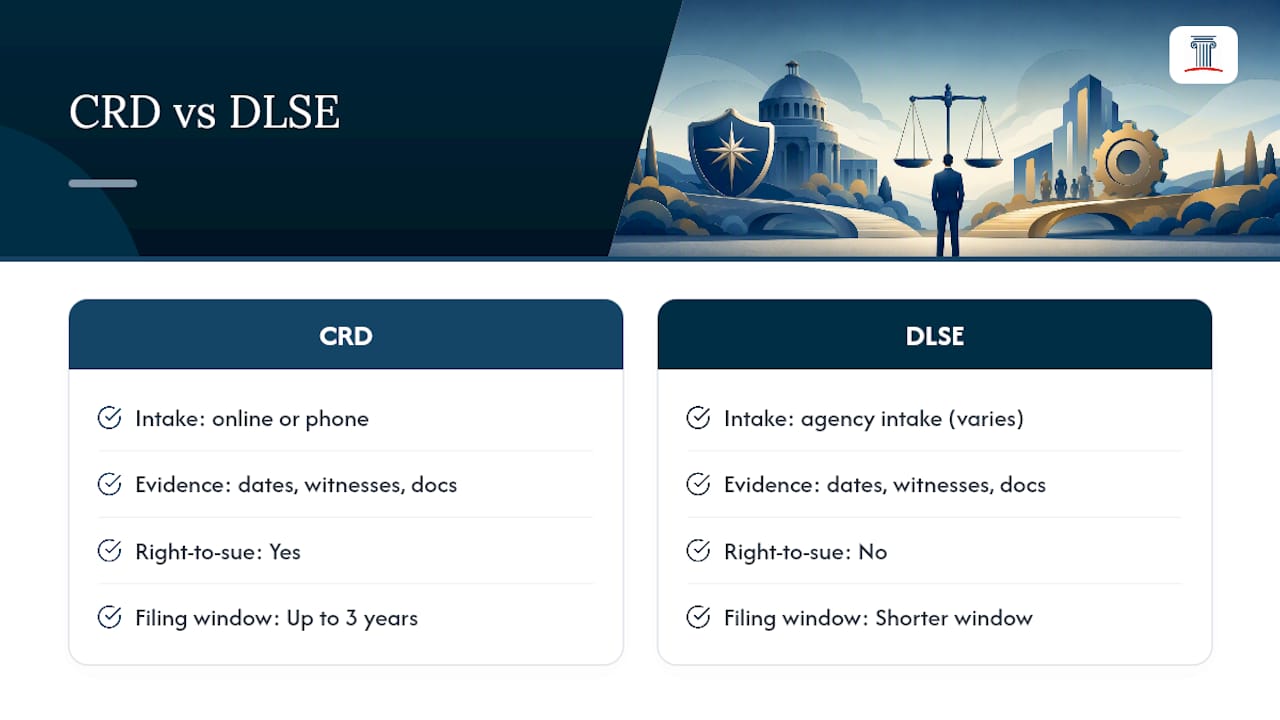
Filing with CRD starts with an intake interview, either online or by phone, where you describe the protected activity, the adverse action, and how the two connect. CRD staff will ask for the same core evidence a court would want: dates, witnesses, and documentation. The CRD retaliation factsheet walks through what qualifies and how the agency evaluates claims.
One advantage CRD offers that DLSE doesn’t: a right-to-sue letter. Once CRD issues one, either after investigating or upon your request, you can take the case directly to civil court, often with a longer window to file, up to three years for many discrimination-related retaliation claims. That flexibility matters if your case needs more time to develop stronger evidence before litigation.
Bring everything from your evidence timeline to the CRD intake, including any comparator information showing how similarly situated coworkers who didn’t report misconduct were treated differently. That comparison is often what separates a straightforward retaliation claim from one that also proves discriminatory intent.
What Happens If Your Retaliation Claim Gets Denied?
A denial isn’t the end of the road, but the appeals path depends on which agency issued it. If DLSE closes your retaliation complaint without finding a violation, you generally retain the right to pursue the same claim through a direct civil lawsuit, since many §1102.5 claims don’t require you to exhaust the administrative process first.
If CRD closes your case without pursuing it further, the agency typically issues a right-to-sue letter on request, which lets you file in civil court within the statutory window rather than treating the denial as final. That’s a meaningful safety net: an agency declining to litigate your case doesn’t mean your case lacks merit, it often just reflects limited agency resources.
For claims that do go through formal agency adjudication, there may be a right to request reconsideration or appeal within the agency itself before heading to court, depending on which office handled the initial decision. The specific procedural rules and deadlines for that internal appeal vary by agency, which is exactly the kind of detail worth confirming with an attorney immediately after a denial, since the clock on any follow-up civil filing is often still running even while you weigh your options.
The biggest mistake employees make after a denial is treating it as the final word and letting filing deadlines lapse while they decide what to do next.
How Employers Fight Back and How You Counter It
Employers rarely admit to retaliating. Instead, they build a defense around timing and performance, and understanding their playbook helps you prepare.
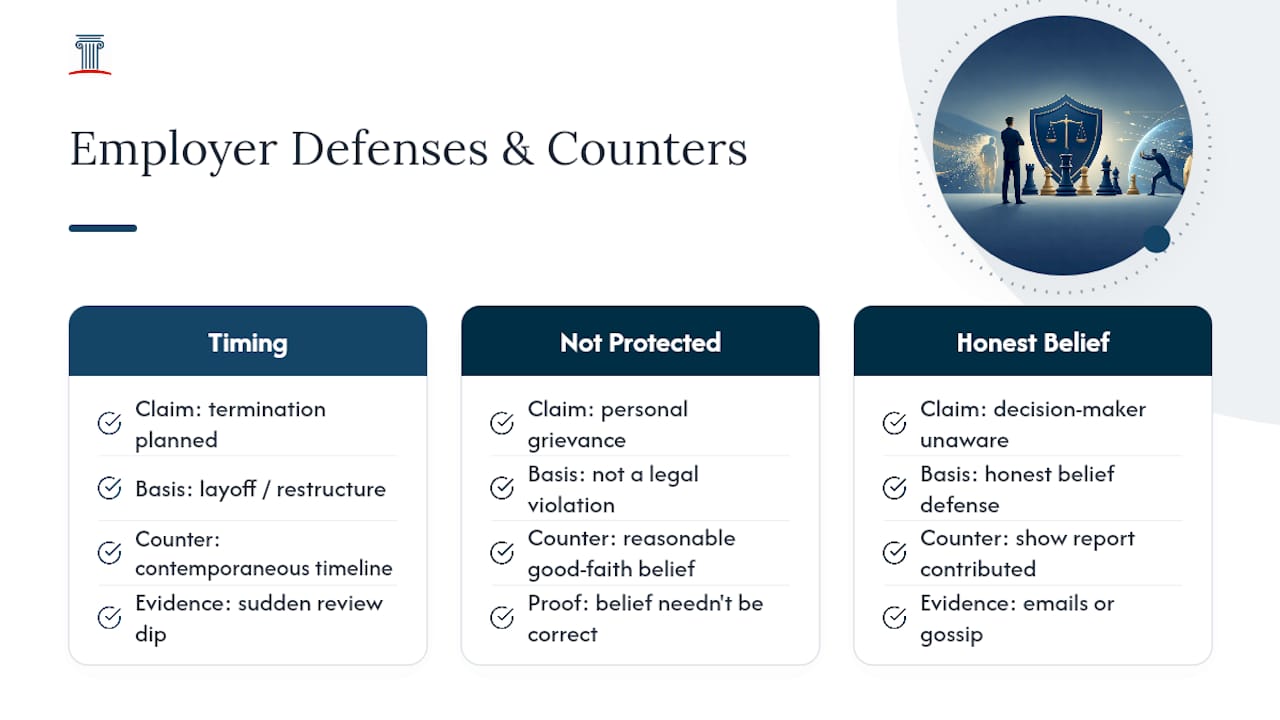
The most common defense is the legitimate business reason: the employer claims the termination or demotion was already planned, tied to a layoff, restructuring, or documented performance problem that predates your report. This is exactly why a contemporaneous timeline matters so much. If your performance reviews were positive right up until your report and then suddenly turned negative, that pattern undercuts the employer’s story.
A second common defense argues you weren’t engaged in protected activity at all, that your complaint was about a personal grievance rather than a suspected legal violation. This is where the “reasonable good-faith belief” standard protects you: you don’t need to prove an actual violation occurred, only that you reasonably believed one did.
Employers also lean on the honest belief defense, arguing decision makers genuinely didn’t know about your protected activity when they acted. Under the Lawson standard, you counter this by showing your report was a contributing factor, not necessarily the only one, which is a considerably lower bar than older law required. Evidence that decision makers knew about your report, even informally through office gossip or a shared email chain, can defeat this defense outright.
A Villa Park Employment Lawyer’s Perspective
Most employees wait too long to document what happened, and by the time they call a lawyer, the timeline has gone soft in their memory. We’ve seen how a single dated email, sent the same week as a retaliatory schedule change, can turn a shaky case into one an employer’s counsel wants to settle quickly rather than litigate. Villa Park and the surrounding Orange County communities have a mix of small professional offices and larger county employers, and both respond very differently once they see an employee has kept precise records.
— Maya Serkova
Get Help From Serendib Law Firm After Retaliation
If your employer retaliated after you reported misconduct or refused to break the law, don’t let the clock run out while you decide what to do. Contact Serendib Law Firm for a free consultation and find out exactly where your case stands.
This article is general information, not a substitute for advice from a qualified lawyer. Consult a qualified legal professional about your own circumstances before acting on anything here.
Sources
- California Labor Code – LAB § 1102.5 | FindLaw
- How to file a retaliation complaint | DLSE
- Retaliation factsheet | California Civil Rights Department
- Proving retaliation | EmploymentLawAid
- Labor Code § 1102.5 – Shouse Law