
Whistleblower retaliation is defined as any adverse employment action an employer takes against an employee for reporting legal violations or refusing to participate in unlawful conduct. In Costa Mesa, CA, this protection is grounded in California Labor Code Section 1102.5, one of the strongest whistleblower protection laws in the country. The law covers employees at every company, regardless of size, and enforcement runs through state agencies including the Division of Labor Standards Enforcement (DLSE). If your employer has punished you for speaking up, California law gives you real remedies, including reinstatement, back pay, and civil penalties.
What actions constitute whistleblower retaliation in Costa Mesa workplaces?
Retaliation is not always a pink slip. Adverse employment actions cover a wide range of employer conduct, and many employees in Costa Mesa do not recognize subtler forms until the pattern becomes clear.
Common retaliatory actions include:
- Termination or constructive dismissal — firing you outright or making conditions so unbearable you feel forced to quit
- Demotion or title reduction — stripping responsibilities or moving you to a lower role after you reported a violation
- Poor performance reviews — suddenly receiving negative evaluations with no prior history of performance issues
- Reduced hours or pay cuts — cutting your schedule or compensation shortly after a report
- Harassment or hostile treatment — being excluded from meetings, publicly humiliated, or subjected to a hostile work environment
- Threats and intimidation — verbal warnings that your job is at risk if you continue raising concerns
- Reassignment to undesirable duties — being moved to a less favorable shift, location, or role
Retaliation also covers situations where an employer punishes you for refusing illegal conduct, not just for making a formal report. Costa Mesa has a mix of retail, healthcare, hospitality, and tech sector employers, and retaliation patterns appear across all of them. A restaurant worker who reports wage theft, a clinic employee who flags patient safety violations, or a warehouse worker who refuses to falsify records all qualify for protection.
Pro Tip: Keep a private written log of every incident, including dates, times, names, and exact words used. This record becomes your most important evidence if you file a claim.

Which California laws protect whistleblowers in Costa Mesa?
California Labor Code Section 1102.5 is the primary statute protecting employees who report violations to government agencies, supervisors, or authorized personnel. The law prohibits retaliation against any employee who discloses information about a legal violation, regardless of whether the disclosure leads to a formal investigation.
California Labor Code Section 98.6 adds another layer of protection. It specifically covers employees who file complaints, testify in proceedings, or exercise rights under the Labor Code. Under Section 98.6, civil penalties reach up to $10,000 per violation, per employee. That figure applies on top of other remedies, making it a meaningful deterrent for employers who retaliate.
| Legal Protection | What It Covers | Key Remedy |
|---|---|---|
| Labor Code § 1102.5 | Reporting violations to government or supervisors | Reinstatement, back pay, damages |
| Labor Code § 98.6 | Filing complaints or exercising Labor Code rights | Civil penalties up to $10,000 per violation |
| Rebuttable presumption rule | Adverse action within 90 days of protected activity | Shifts burden of proof to employer |
| Employer size exemption | None. All employers are covered | Full statutory remedies apply |
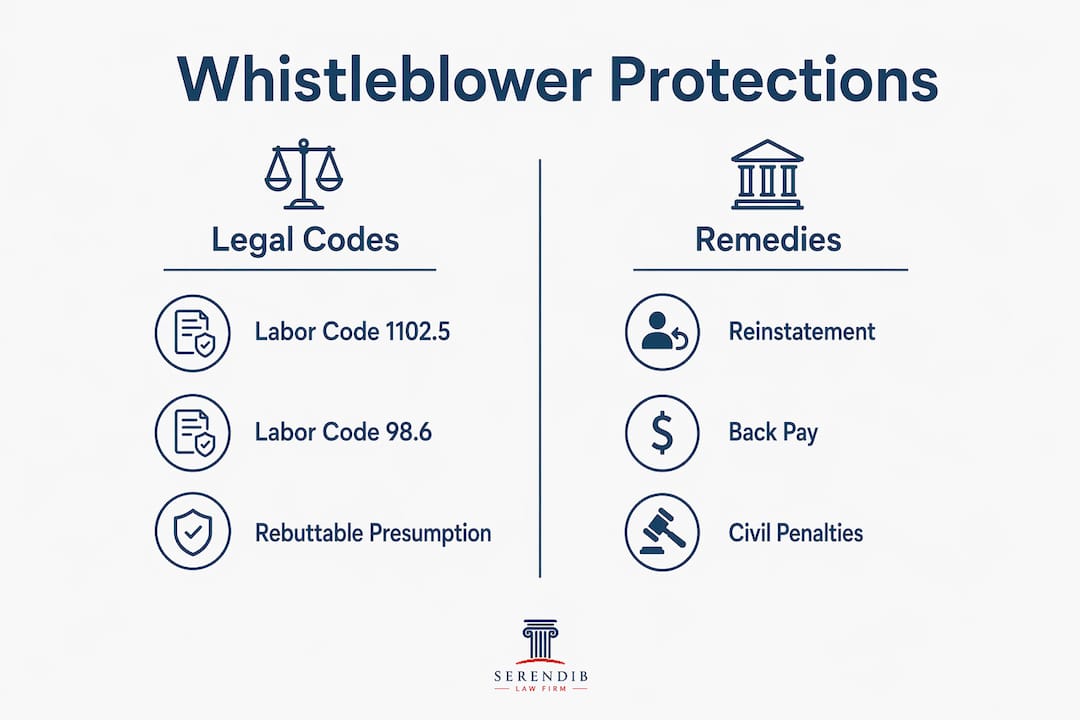
The rebuttable presumption rule is one of the most powerful tools in a retaliation claim. If your employer takes adverse action against you within 90 days of your protected activity, the law presumes the action was retaliatory. Your employer must then prove a legitimate, non-retaliatory reason. That shift in burden significantly strengthens your position.
Remedies available to Costa Mesa employees include reinstatement to your former position, recovery of lost wages, compensation for emotional distress, and civil penalties. Courts can also award attorney fees in successful cases, which means you may be able to pursue a claim without paying legal costs out of pocket.
Pro Tip: The 90-day presumption window is a legal clock your employer cannot ignore. If your situation falls within that window, document the timeline carefully before you do anything else.
How to file a whistleblower retaliation complaint in Costa Mesa
Filing with the correct agency is the single most important procedural decision you will make. Filing with the wrong agency often results in dismissal of your complaint, potentially cutting off your right to recover entirely. California routes retaliation claims through different agencies depending on the nature of the underlying violation.
The two primary agencies are:
- Division of Labor Standards Enforcement (DLSE): Handles retaliation claims tied to wage disputes, safety complaints, and general Labor Code violations. The DLSE enforces California labor laws and investigates complaints through a structured intake and interview process.
- Civil Rights Department (CRD): Handles retaliation claims connected to discrimination or harassment based on protected characteristics such as race, gender, disability, or national origin.
Once you file with the correct agency, the process generally follows these steps:
- Submit your complaint — Provide a written account of the retaliation, including dates, the protected activity you engaged in, and the adverse actions that followed.
- Intake interview — An investigator reviews your complaint and may schedule an interview to gather additional facts.
- Employer notification — The agency notifies your employer and requests a response.
- Investigation phase — Investigators review documents, interview witnesses, and assess whether probable cause exists.
- Resolution or referral — The agency may mediate a settlement, issue a finding, or refer the matter for further legal action.
Applicable statutes of limitations govern how long you have to file. These deadlines vary based on the type of claim and the agency involved, and they should be evaluated on a case-by-case basis with an attorney. Missing a deadline can permanently bar your claim, regardless of its merit.
Employees retain rights throughout the investigation. Your employer cannot retaliate against you for filing a complaint, and you have the right to present evidence and respond to employer claims.
What practical steps can Costa Mesa employees take after facing retaliation?
Acting quickly and carefully after retaliation begins gives you the strongest possible foundation for a claim. The steps you take in the first days and weeks often determine the outcome of your case.
- Document everything immediately. Write down every retaliatory act with specific dates, times, locations, and the names of anyone present. Save emails, texts, performance reviews, and any written communications that show a change in how you were treated after your report.
- Preserve your own copies. Do not rely on your employer’s systems. Save documentation to a personal device or account before access is restricted.
- Review your employer’s retaliation policy. Many companies have internal reporting procedures. Following them creates a paper trail that shows you acted in good faith.
- Avoid discussing your case broadly. Confidentiality protects you. Limit conversations about your situation to trusted advisors and your attorney.
- Seek legal advice before filing. An attorney can identify which agency applies to your claim, evaluate the strength of your evidence, and prevent procedural errors that could sink your case.
- Do not resign without legal counsel. Quitting may affect your ability to claim certain remedies. If conditions are intolerable, an attorney can advise whether constructive dismissal applies to your situation.
Employers cannot prohibit employees from discussing wages or helping coworkers exercise their rights. Both activities are protected whistleblowing conduct under California law. If your employer has punished you for either, that conduct qualifies as retaliation.
Pro Tip: Consult a California whistleblower attorney before you file anything. The agency you choose and the claims you assert at the outset are difficult to change later. Getting it right the first time matters.
Key Takeaways
California whistleblower retaliation law gives Costa Mesa employees concrete legal remedies, but those remedies depend entirely on filing with the right agency, within the applicable deadline, with solid documentation in hand.
| Point | Details |
|---|---|
| Retaliation takes many forms | Termination, demotion, harassment, and pay cuts all qualify as unlawful retaliation under California law. |
| Two key statutes apply | Labor Code §§ 1102.5 and 98.6 protect all California employees, regardless of employer size. |
| 90-day presumption rule | Adverse action within 90 days of protected activity creates a legal presumption of retaliation against the employer. |
| Agency selection is critical | Filing with the wrong agency can result in dismissal and loss of your right to recover. |
| Document and act early | Written records and early legal counsel are the two factors most likely to determine your outcome. |
Why I think most employees wait too long to act
Retaliation cases in Costa Mesa follow a pattern I have seen repeat itself. An employee reports something, the employer’s behavior shifts, and the employee spends weeks or months hoping things will normalize. They do not. By the time the employee seeks legal advice, critical deadlines have passed, evidence has been deleted, and the employer has built a paper trail of pretextual performance issues.
The law in California is genuinely strong. The 90-day rebuttable presumption, the civil penalties under Section 98.6, and the broad scope of Labor Code Section 1102.5 give employees real leverage. But that leverage disappears if you wait. I have seen employees with airtight facts lose their claims entirely because they filed with the wrong agency or missed a statute of limitations they did not know existed.
The other thing most articles do not say plainly: your employer’s HR department works for the company, not for you. Internal complaints are useful for creating a record, but they are not a substitute for legal advice. If you work in Costa Mesa’s healthcare sector, retail industry, or any other field and you have reported a violation, the next call you make should be to an attorney, not to HR. Employees who understand their rights under California whistleblower law consistently achieve better outcomes than those who navigate the process alone.
— Maya Serkova
Serendib Law Firm is ready to help Costa Mesa employees
Serendib Law Firm represents employees in Costa Mesa and across Orange County who face retaliation after reporting workplace violations. The firm handles cases under California Labor Code Sections 1102.5 and 98.6, including claims involving termination, demotion, harassment, and wage-related retaliation. Consultations are confidential and free of charge. If you believe your employer has punished you for speaking up, contact Serendib Law Firm to have your situation evaluated by an attorney who focuses exclusively on employee rights. The firm also offers bilingual services in English and Spanish, making legal support accessible to more workers throughout the Costa Mesa community.
FAQ
What is whistleblower retaliation under California law?
Whistleblower retaliation is any adverse employment action an employer takes against an employee for reporting legal violations or refusing to engage in unlawful conduct. California Labor Code Section 1102.5 prohibits this conduct and covers employees at all companies regardless of size.
How long do I have to file a retaliation complaint in Costa Mesa?
Statutes of limitations apply to retaliation claims in California, but the exact deadline depends on the type of claim and the agency involved. An attorney should evaluate your specific situation before you file to avoid missing a critical deadline.
What remedies can I recover in a whistleblower retaliation case?
California law provides reinstatement, back pay, emotional distress damages, and civil penalties up to $10,000 per violation under Labor Code Section 98.6. Attorney fees may also be recoverable in successful cases.
Which agency handles whistleblower retaliation complaints in California?
The DLSE handles wage and safety-related retaliation claims, while the Civil Rights Department handles retaliation tied to discrimination or harassment. Filing with the wrong agency can result in dismissal of your complaint.
Does the 90-day rule help my retaliation case?
If your employer takes adverse action within 90 days of your protected activity, California law presumes the action was retaliatory. Your employer must then prove a legitimate reason for the action, which shifts the legal burden in your favor.
Recommended
- Whistleblower Retaliation in Newport Beach, CA: Are You Protected? | Serendib Law Firm
- Whistleblower Retaliation Rights In Yorba Linda Accounting | Serendib Law Firm
- Whistleblower Protections in Santa Ana After Corruption Cases | Serendib Law Firm
- Whistleblower protections for government employees 2026 | Serendib Law Firm