
If you were fired in Yorba Linda after complaining about discrimination, taking protected leave, reporting safety violations, or asserting a contract right, you may have a valid wrongful termination claim under California law. Act now: preserve every email, text, and pay stub, write down names and dates while your memory is fresh, do not sign any severance release, and talk to an employment lawyer before you say anything else to HR. California’s Fair Employment and Housing Act (FEHA) and related statutes protect most Yorba Linda workers, but strict deadlines apply.
TL;DR:
- Claimants must preserve all relevant evidence, including emails, pay stubs, and witness contact information, before talking to HR or signing severance releases.
- Discrimination, retaliation, public policy violations, and breach of contract are the main wrongful termination categories, each requiring specific evidence.
- FEHA protects most workers at companies with five or more employees, but harassment protections can extend even to smaller employers, while federal laws cover those over 40 or with disabilities.
- Filing a claim requires initial steps with California’s Civil Rights Department or the EEOC, with strict deadlines for discovery and civil litigation.
- Damages can include back pay, future earnings, emotional distress, and punitive damages, with employment attorneys often working on contingency to maximize access.
Table of Contents
- What Wrongful Termination Means Under California Law
- What Are the Illegal Reasons Employers Fire Workers?
- Who Is Protected: FEHA Coverage and Employer Size Rules
- How Do You File a Wrongful Termination Claim in California?
- Evidence Checklist: What to Preserve Before You Talk to a Lawyer
- What Damages Can You Recover in a Wrongful Termination Case?
- What to Expect: Timeline, Settlement, and Legal Fees
- How Serendib Law Firm Supports Yorba Linda Employees
- Talk to a California Employment Lawyer About Your Case
- Sources
What Wrongful Termination Means Under California Law
California is an at-will employment state, which means an employer can generally fire you for any reason, or no reason at all, without warning. That single fact confuses a lot of Yorba Linda workers into thinking they have no recourse. They do, in the right circumstances.
At-will hits a wall the moment an employer’s real motive is illegal. FindLaw’s overview of California wrongful termination law confirms the exceptions: firing someone because of a protected characteristic, in retaliation for protected activity, in violation of public policy, or in breach of an employment contract. Courts call the public policy category a Tameny claim, named after the case that first recognized it, and it covers situations like getting fired for refusing to commit an illegal act your boss demanded.
An employer handing you an “at-will” clause in your offer letter does not grant permission to fire you for an unlawful reason. That clause governs the lack of a notice requirement, not the legality of the motive behind the decision. California Government Code § 12940 spells out the prohibited motives in detail, from race and age to disability and retaliation for opposing unlawful practices, and the statute itself is worth reading if you want the exact legal language your attorney will eventually cite.
What Are the Illegal Reasons Employers Fire Workers?
Most wrongful termination claims in Yorba Linda fall into one of four buckets. Recognizing which one fits your situation shapes everything that follows, from which agency you file with to how much your case might be worth.
- Discrimination: firing tied to age (40 and older), race, national origin, sex, pregnancy, disability, religion, or sexual orientation, such as a Yorba Linda warehouse worker let go weeks after disclosing a pregnancy while younger colleagues with worse attendance records kept their jobs.
- Retaliation: termination following a complaint about wage theft, a workers’ compensation filing, a request for disability accommodation, or taking California Family Rights Act leave.
- Public policy violations: getting fired for refusing to falsify safety records, reporting environmental violations, or declining to break a law your employer wanted broken.
- Breach of contract: violating the terms of a written or implied employment agreement, or breaching the covenant of good faith and fair dealing that California courts read into most employment relationships.
Retaliation claims are especially common in Orange County, where mid-size employers sometimes fire the employee who filed the complaint faster than they investigate the complaint itself. If that pattern sounds familiar, our detailed breakdown of retaliation after an HR complaint in Yorba Linda walks through how those cases typically unfold.
Who Is Protected: FEHA Coverage and Employer Size Rules
FEHA applies to employers with five or more employees, and it protects against discrimination and retaliation across a long list of characteristics, including race, age, disability, gender, and pregnancy, according to the California Civil Rights Department. If you work for a small Yorba Linda business with fewer than five employees, FEHA’s discrimination protections technically may not reach you, but harassment protections under the same law can still apply regardless of headcount.
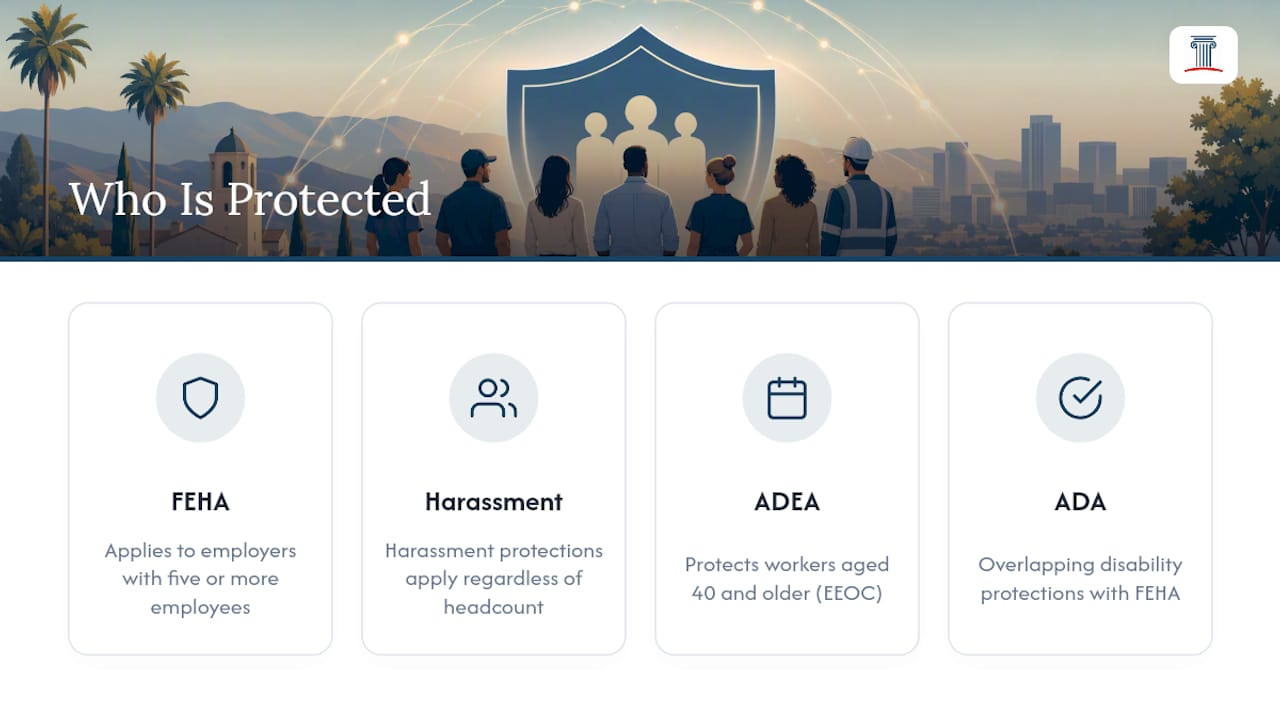
Federal law fills some of the remaining gaps. The Age Discrimination in Employment Act, enforced by the EEOC, protects workers 40 and older, and the Americans with Disabilities Act offers overlapping disability protections. When state and federal law both apply to your situation, you generally get the benefit of whichever offers stronger protection or a better remedy, and FEHA often does exactly that. Its remedies frequently include compensatory and punitive damages without some of the caps that limit certain federal claims, which is one reason California employees often fare better filing under state law when both routes are open.
How Do You File a Wrongful Termination Claim in California?
Before you can sue for most discrimination or retaliation claims, you typically need to file with an administrative agency first. This step, called administrative exhaustion, is not optional for many claim types, though public policy and breach of contract claims can often go straight to court, per Nolo’s explanation of California wrongful termination claims.
- Decide where to file. California’s Civil Rights Department (formerly DFEH) and the federal EEOC both accept discrimination and retaliation complaints, and cross-filing agreements mean a complaint filed with one agency often gets automatically filed with the other.
- Gather your intake documents. Bring your termination letter, a written timeline, and any evidence showing the protected activity or characteristic that triggered the firing.
- Choose between investigation and an immediate right-to-sue. The CRD can investigate your claim, or you can request an immediate right-to-sue letter, which skips the investigation and lets you head to court faster. Attorneys often recommend the immediate route when the evidence is already strong and litigation leverage matters more than agency findings.
- Track your deadlines closely. Administrative deadlines and civil statutes of limitations run on separate clocks, and missing either one can end a valid claim before it starts.
- Move to litigation once you exhaust or waive agency review. Once you have a right-to-sue letter, you can file a civil complaint in California superior court.
The CRD’s employment FAQ walks through remedies and exhaustion requirements in more detail, and it is a genuinely useful resource if you want to read the agency’s own language before your consult.
Evidence Checklist: What to Preserve Before You Talk to a Lawyer
The single biggest mistake Yorba Linda employees make after a suspicious firing is waiting weeks to organize their records, by which point memory fades and access to workplace systems disappears. Start collecting the moment you suspect something is wrong.
- A written timeline: dates, locations, who said what, and who witnessed it, built while your memory is sharp.
- Employment paperwork: your offer letter, performance reviews, prior write-ups, and any disciplinary notices.
- Electronic communications: emails, text messages, Slack threads, and HR correspondence, especially anything referencing your complaint or the reason given for termination.
- Payroll and benefits records: pay stubs, commission statements, and any severance or separation offer you received.
- Names and contact information for coworkers who witnessed the relevant events or who faced similar treatment.
The State Bar of California’s own guidance on selecting an attorney recommends bringing a clear timeline and supporting documents to your first meeting, and that advice lines up with what practitioners see every day: organized clients get faster, more accurate case assessments.
Pro Tip: Back up every document to a personal cloud account or external drive the same day you preserve it. Employer-owned email and HR systems can lock you out within hours of separation, and a screenshot on your phone is far better than a memory of a document you can no longer access.

What Damages Can You Recover in a Wrongful Termination Case?
Damages in a successful wrongful termination case usually fall into a few categories: back pay for wages lost since termination, front pay for anticipated future losses, and in some cases reinstatement to your former position along with restored benefits. The CRD’s remedies guidance confirms that FEHA claims can also include emotional distress damages and, when the employer’s conduct was especially egregious, punitive damages.
Attorney’s fees often shift to the losing employer in successful FEHA cases, which changes the math significantly for employees who could not otherwise afford representation. FEHA’s remedies tend to run broader than some federal counterparts, since federal law caps certain damages in ways that California’s own statute does not.
Actual recoveries vary enormously depending on your income level, how long you were unemployed afterward, the strength of your documentation, and the size and conduct of the employer. A well-documented case against a mid-size Orange County employer looks very different on paper than a thin claim against a company with few resources and weaker evidence against it.
What to Expect: Timeline, Settlement, and Legal Fees
Agency investigations can take months, and civil litigation often runs a year or longer once a case heads to court, according to the practical procedural guidance published by the California Department of Industrial Relations. Most wrongful termination cases settle before trial, largely because litigation is expensive and unpredictable for both sides, and a negotiated resolution gives everyone certainty a jury verdict cannot guarantee.
Employment attorneys frequently work on contingency in wrongful termination cases, meaning you pay nothing upfront and the fee comes out of any recovery. Free consultations are common industry-wide and let you get an honest read on your case before committing to anything.
One practical warning: stay off social media about your termination while your case is active. Employers and their attorneys regularly search for posts that undercut emotional distress claims or contradict your own timeline.
How Serendib Law Firm Supports Yorba Linda Employees
We built our employment practice around the reality that Orange County workers need honest answers fast, not a runaround. Legal services often include free consultations and contingency-fee representation in select matters so cost never blocks you from finding out where you stand.
Some legal teams work in English and Spanish to reflect the community served throughout Orange County. During an initial consult, we review your documentation, assess the strength of your discrimination, retaliation, or contract claim, and lay out realistic next steps. Bring your timeline, employment paperwork, and any communications you preserved, and visit our contact page to get started.
— Maya Serkova
Talk to a California Employment Lawyer About Your Case
Clients seeking legal support in Yorba Linda and Orange County can find representation familiar with local employers, regional agency intake patterns, and effective case documentation.
Many employment law practices emphasize accessibility through free consultations with no obligation, contingency-fee representation in select matters, and bilingual support in English and Spanish to serve Orange County’s diverse workforce. If your situation involves the retaliation, discrimination, or contract issues covered above, our Yorba Linda employment law attorneys can review your documents and tell you plainly whether you have a claim worth pursuing. Reach out through our California employment lawyer consultation page and bring your timeline, your records, and your questions.
This article is general information, not a substitute for advice from a qualified lawyer. Consult a qualified legal professional about your own circumstances before acting on anything here.
Sources
- Employment — California Civil Rights Department (CRD)
- California Government Code § 12940
- California wrongful termination claims — FindLaw
- Do I Have a Wrongful Termination Claim in California? — Nolo
- Termination of Employment (DLSE/DIR guidance)