
What are the key signs you may have a wrongful termination claim in La Habra?
If you were fired in La Habra and something about it felt wrong, California law may give you grounds to act. Wrongful termination occurs when an employer fires an employee for a reason prohibited under state or federal law, and California’s Fair Employment and Housing Act (FEHA) provides some of the strongest employee protections in the country. The signs below are the ones attorneys look for first.
Key indicators your termination may be illegal:
- You were fired shortly after filing a complaint, requesting medical leave, or reporting workplace misconduct
- Your employer gave a reason that contradicts a previously clean performance record
- The stated reason for your termination shifted or changed over time
- You belong to a protected class (race, age over 40, disability, sex, religion, national origin, and others) and were treated differently from colleagues outside that class
- You were terminated after filing a workers’ compensation claim or cooperating with a workplace investigation
- Your employer skipped the progressive discipline process that applied to other employees
- You were pressured to sign a severance agreement quickly, without time to review it
Any one of these circumstances can signal a legally actionable claim. When several appear together, the case for wrongful termination becomes considerably stronger.

Common legal grounds for wrongful termination under California law
California recognizes several distinct legal theories that support wrongful termination claims, and La Habra employees are protected under all of them.

FEHA discrimination and retaliation
Government Code § 12940 prohibits termination motivated by a protected characteristic: race, color, national origin, religion, sex, gender identity, sexual orientation, age over 40, disability, medical condition, marital status, military or veteran status, and reproductive health decisions. Any employer with five or more employees falls under FEHA’s reach. Retaliation claims arise when an employer fires someone for opposing discrimination, filing a complaint, or participating in a workplace investigation.
Whistleblower protections
Labor Code § 1102.5 protects employees who report violations of state or federal law to a supervisor or government agency. Termination following such a disclosure constitutes whistleblower retaliation, and California courts treat it seriously.
Family and medical leave retaliation
The California Family Rights Act (CFRA) prohibits termination for taking or requesting protected medical or family leave. If you were fired after requesting FMLA or CFRA leave, or shortly after returning from it, that timing alone can support a retaliation claim.
Public policy violations (Tameny claims)
A Tameny claim arises when an employer fires someone for exercising a statutory right, such as filing a workers’ compensation claim, serving on jury duty, or refusing to participate in illegal activity. These are tort claims, which means they can support emotional distress and punitive damages in addition to lost wages.
Implied contract claims
California recognizes implied employment contracts even without a signed agreement. If your employee handbook listed specific grounds for termination, or a manager told you that your job was secure as long as you followed company policy, your employer may have created an enforceable promise they cannot simply ignore.
Pro Tip: If you were fired after taking protected leave or filing a workers’ compensation claim, review our resource on wrongful termination after workers’ comp to understand how those specific protections apply to your situation.
Subtle signs your termination may have been illegal in La Habra
Not every illegal firing comes with an obvious paper trail. Some of the most compelling wrongful termination cases in California are built on patterns that, individually, might seem unremarkable.
Watch for these less obvious red flags:
- Sudden performance criticism after protected activity. If your reviews were consistently positive until you filed a complaint or requested leave, and negative write-ups appeared only afterward, that sequence is a recognized indicator of pretext.
- Shifting explanations. Inconsistent or changing reasons for your termination undermine your employer’s credibility and signal that the stated reason may not be the real one.
- Exclusion before termination. Being left out of meetings, removed from projects, or reassigned to less desirable duties shortly before your firing can indicate a manufactured path to termination.
- Comparator treatment. Colleagues outside your protected class who committed similar or worse infractions kept their jobs while you were let go.
- No prior discipline. Your employer bypassed the progressive discipline process that applied to others, going straight to termination without warnings or a performance improvement plan.
- Timing. A termination that follows a protected event by days or weeks carries significant legal weight. Temporal proximity is one of the most powerful circumstantial indicators California courts consider.
- Constructive termination. If your employer made working conditions so intolerable that you felt forced to resign, that can qualify as wrongful termination under California law.
Pro Tip: Write down everything you remember about the circumstances of your termination as soon as possible, including dates, names, and exact words used. Memory fades quickly, and contemporaneous notes carry real evidentiary weight.
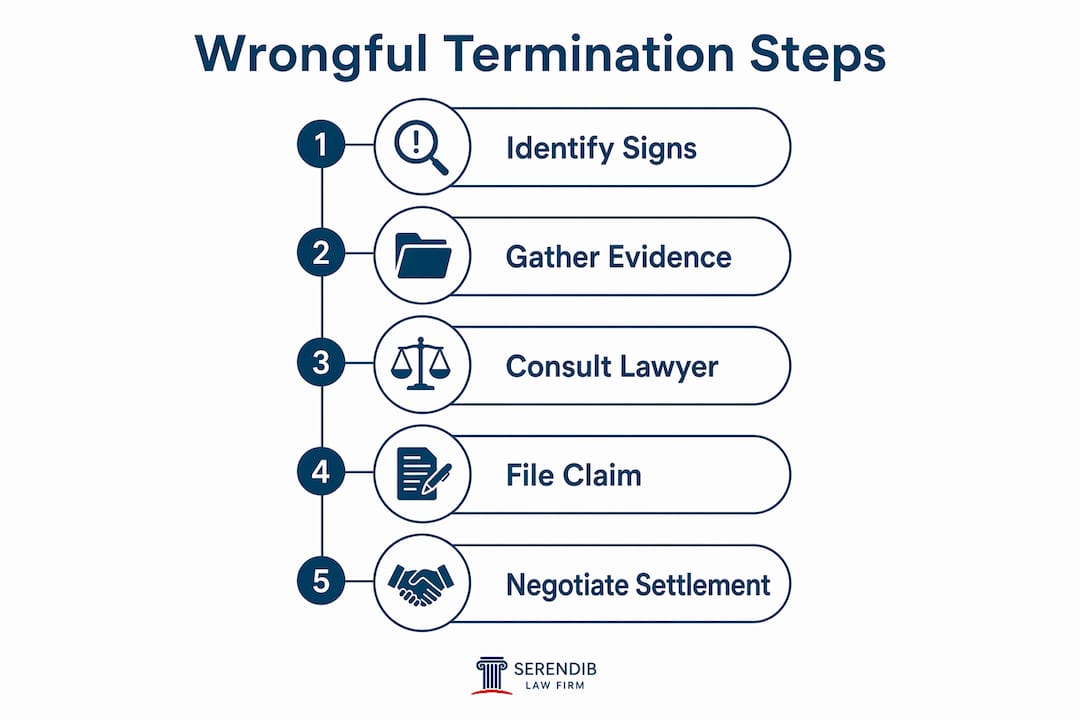
Steps to take if you suspect wrongful termination in La Habra
Acting quickly and deliberately after a termination protects your rights and builds the foundation of your case.
Immediate actions:
- Preserve every document you have access to, including offer letters, performance reviews, emails, text messages, and your termination letter
- Request your personnel file in writing under Labor Code § 1198.5, which gives you the right to obtain it from your employer
- Write a detailed account of the events leading to your termination while they are fresh, noting dates, witnesses, and specific statements made by supervisors or HR
Before you sign anything:
- Do not sign a severance agreement without legal review. Most severance agreements include a broad release of all claims, including your wrongful termination claims. Once signed, that release is typically enforceable and permanent.
- If you are over 40, federal law gives you at least 21 days to review a severance offer and 7 days to revoke it after signing.
Next steps:
- Contact an experienced La Habra employment attorney for a free consultation to assess your claim’s strength before making any decisions.
- Identify all potential legal theories that apply to your situation, since some claims carry different filing deadlines than others.
- Avoid discussing your termination on social media or with former colleagues who may be called as witnesses.
- Continue documenting your job search efforts, since California law requires you to make reasonable efforts to find comparable work after termination.
Pro Tip: Many employment attorneys, including those at Serendib Law Firm, work on a contingency basis, meaning you pay nothing upfront and attorney fees come only from what you recover.
How experienced California employment lawyers evaluate wrongful termination claims
When attorneys at Serendib Law Firm review a wrongful termination case, they look at the full picture, not just whether a protected characteristic was involved.
The single most powerful factor is timing. California’s SB 497, effective January 1, 2024, establishes a rebuttable presumption of retaliation when termination occurs within 90 days of protected activity under Labor Code § 1102.5. That presumption shifts the burden to the employer, who must rebut it with clear and convincing evidence. For La Habra employees fired shortly after a complaint or disclosure, this law is a significant advantage.
Documentary evidence drives settlement value. Performance reviews, emails, and HR records that contradict the stated termination reason are among the highest-value evidence categories attorneys rely on. Comparator evidence, showing how similarly situated employees outside your protected class were treated, is equally powerful.
At-will employment is the defense employers raise most often, but it does not protect illegal firings. An employer can terminate an at-will employee for any lawful reason. The word “lawful” is where wrongful termination claims live. When an employer’s stated reason is contradicted by the employee’s prior record, or when negative documentation appears only after protected activity, courts recognize that as pretext.
Pro Tip: Bring every piece of documentation you have to your first attorney consultation, even items that seem minor. A single email referencing your age, disability, or complaint can shift the entire evaluation of your case.
What are the time limits for filing a wrongful termination claim in California?
California wrongful termination claims carry applicable statutes of limitations that vary depending on the legal theory involved, and these deadlines should be evaluated on a case-by-case basis with an attorney. Under FEHA, following AB 9 (2019), employees generally have a period to file a complaint with the California Civil Rights Department (CRD) before pursuing a civil lawsuit. Federal Title VII claims carry a shorter window. Tameny public policy claims and implied contract claims filed directly in superior court operate under different timeframes. Workers’ compensation retaliation claims under Labor Code § 132a have their own separate deadline.
The key point is that multiple theories can arise from the same termination, and the shortest applicable deadline governs your most urgent decision. Filing with the CRD is a mandatory administrative step before you can sue under FEHA, and missing that step can bar your claim entirely. Contact a California employment lawyer as soon as you suspect your termination was unlawful, before any deadline passes.
What damages and remedies can you recover in a wrongful termination case?
California offers broader recovery than most states. Under FEHA, there is no statutory cap on compensatory or punitive damages, which means a strong case can produce substantial results. If you win a wrongful termination claim, you may recover:
- Back pay: Wages lost from your termination date through settlement or trial
- Front pay: Future wages you will lose if comparable work is not available
- Lost benefits: Health insurance, retirement contributions, bonuses, and stock options
- Emotional distress damages: Compensation for anxiety, depression, and humiliation, which are uncapped under FEHA and strengthened by contemporaneous mental health treatment records
- Punitive damages: Available in FEHA and Tameny claims where the employer acted with malice, oppression, or fraud
- Attorney’s fees and costs: Under Government Code § 12965, a prevailing FEHA plaintiff recovers attorney’s fees from the employer as a matter of right
Typical wrongful termination settlements in California often fall between approximately $150,000 and $450,000, depending on claim strength, evidence, and case complexity, with higher settlements seen in cases of sustained discrimination, senior-level compensation, or punitive damages exposure. Claimants represented by legal counsel receive compensation in approximately 64% of cases, compared to 30% for those without counsel.
What defenses do employers commonly raise in wrongful termination cases?
Understanding the defenses your employer is likely to use helps you prepare a stronger case.
At-will employment. This is the most common defense. California is an at-will employment state, meaning employers can terminate for any lawful reason. An employer who presents a credible, documented, non-retaliatory reason for the termination shifts the burden back to the employee to show that reason is pretextual.
Legitimate business reason. Employers often point to documented performance issues, restructuring, or budget cuts. The strength of this defense depends entirely on whether that documentation existed before your protected activity or appeared only afterward.
Failure to mitigate. California law requires terminated employees to make reasonable efforts to find comparable work. If you did not actively job search, your employer may argue your damages should be reduced.
Signed severance release. A severance agreement that includes a release of claims can bar your lawsuit entirely. However, releases signed under duress, without adequate consideration, or that violate public policy may be unenforceable, which is why legal review before signing is critical.
Employer size. FEHA applies to employers with five or more employees. Smaller employers may fall outside certain protections, though other state and federal laws may still apply.
California wrongful termination examples that reflect La Habra workplace realities
While we do not cite specific case numbers, the patterns that produce successful wrongful termination claims in California appear regularly in workplaces across La Habra and the broader Orange County area.
A warehouse worker in a distribution facility files an internal complaint about unsafe conditions. Two weeks later, she receives her first negative performance review in three years, followed by termination the following month. The timing and the sudden appearance of documentation after her complaint are classic indicators of retaliation under Labor Code § 1102.5.
A retail manager in his mid-fifties is passed over for promotion in favor of a significantly younger, less experienced colleague. Shortly after raising the issue with HR, he is placed on a performance improvement plan for the first time in his career and terminated within 60 days. Age discrimination combined with retaliation for the HR complaint gives him two independent legal theories under FEHA.
A healthcare worker at a local clinic requests CFRA leave to care for a seriously ill parent. Upon returning, she finds her position has been “restructured” and she is offered a lower-paying role. When she declines, she is terminated. That sequence describes both CFRA retaliation and potentially constructive termination.
These patterns are not hypothetical. They reflect the types of employment discrimination claims that California courts have consistently recognized as actionable, and they occur in La Habra workplaces across industries.
Why documentation and evidence gathering can make or break your claim
The outcome of a wrongful termination case often turns on what you preserved in the days immediately after your firing. Employees who preserve communications and personnel files early in the process consistently produce stronger claims and better settlement outcomes than those who wait.
Gather every document you can access before losing entry to employer systems: offer letters, performance reviews, disciplinary records, emails referencing your protected characteristic or complaint, and any written communications about your termination. Your termination letter matters, but so do the messages that preceded it.
Oral conversations are also evidence. Write down every relevant discussion you can recall, noting the date, location, who was present, and the exact words used. If a supervisor made a comment about your age, disability, or medical condition, even in passing, that detail belongs in your notes.
Medical records documenting emotional distress, created contemporaneously during the period of wrongful conduct, carry significantly more weight than testimony assembled later. If you sought therapy or medical treatment after your termination, preserve those records. Under FEHA, emotional distress damages are uncapped and can materially increase your total recovery.
The foundation you build in the first 30 days shapes everything that follows. We encourage every La Habra employee who suspects an unlawful termination to treat evidence preservation as the first and most urgent priority, and to consult with an attorney before that window closes.
Key Takeaways
California law gives La Habra employees some of the strongest wrongful termination protections in the country, and acting quickly with solid documentation is the single most important factor in building a successful claim.
| Point | Details |
|---|---|
| FEHA covers broad protected classes | Race, age over 40, disability, sex, religion, and more are protected under Government Code § 12940. |
| Timing is powerful evidence | SB 497 creates a rebuttable presumption of retaliation when termination occurs within 90 days of protected activity. |
| Damages are uncapped under FEHA | California allows unlimited emotional distress and punitive damages, unlike most other states. |
| Representation improves outcomes | Claimants with legal counsel receive compensation in approximately 64% of cases, compared to 30% for those without an attorney. |
| Never sign severance without review | A signed release is typically permanent and waives your right to pursue wrongful termination claims. |
Recommended
- What Is Wrongful Termination? A California Guide | Serendib Law Firm
- Wrongful Termination After HR Reports in Orange County | Serendib Law Firm
- Wrongful Termination After Workers’ Comp Claims: Huntington Beach Impact | Serendib Law Firm
- Employment Discrimination in La Habra, CA: Know Your Legal Options | Serendib Law Firm