

If you were hurt in a car accident in Garden Grove, you can pursue compensation for your medical bills, lost income, and pain and suffering, but California law gives you a limited window to act. The time limit to act begins on the day of the crash, and early medical care and documentation can strengthen the value of your later claim. A California Personal Injury Lawyer can review your case at no cost and explain your options before that window closes.
TL;DR:
- Claims for severe or ongoing injuries, disputed fault, or complex future treatment typically require legal representation to maximize settlement potential.
- Providing thorough documentation, including medical records, witness statements, and property evidence, is essential for building a strong claim, especially within the two-year deadline.
- Early medical care, continuous treatment, and detailed symptom logs are crucial to support damages and counter insurer tactics aimed at reducing claim value.
- Settlement offers are driven by documented medical costs, projected future expenses, and pain and suffering, with proper proof necessary to prevent undervaluation.
- Most cases benefit from legal guidance when facing delays, disputed liability, or the need to navigate multiple insurance policies or potential trial proceedings.
Table of Contents
- Types of damages you can claim after a Garden Grove car crash
- How a car-accident injury claim proceeds in California statute of limitations and fault rules
- Practical steps after a Garden Grove crash that preserve your claim
- How claims are valued: factors that drive settlement amounts in Garden Grove cases
- When to hire a Garden Grove personal injury lawyer and what fees look like
- Serendib Law Firm’s Garden Grove experience and client resources
- Typical costs and fees beyond attorney fees
- Common challenges and delays in California car accident claims
- Insurance claim procedures specific to Garden Grove and California
- How pre-existing conditions affect your compensation eligibility
- Mediation, arbitration, and trial options if settlement talks fail
- Realistic expectations and common settlement pitfalls
- How to get a free Garden Grove car accident consultation
- Sources
- FAQ
Types of damages you can claim after a Garden Grove car crash
California law recognizes several categories of compensation after a car crash, and understanding each one helps you know what you are entitled to pursue. Economic damages cover the financial losses you can document with paper: medical bills, wage statements, and repair or diminished value estimates for your vehicle. Non-economic damages compensate for the ways an injury changes your daily life, including pain, emotional distress, and loss of enjoyment of activities you used to take for granted. These are harder to put a number on, but insurers and courts still assign them real value based on the severity and duration of your injuries.
A smaller category, special damages, covers losses tied to your specific circumstances, such as a car’s diminished resale value after a collision even when repairs are complete. In the rare case a crash proves fatal, surviving family members may have a separate wrongful death claim.
Building a strong claim in any of these categories comes down to records:
- Medical documentation: bills, treatment notes, imaging, and physician statements on prognosis.
- Wage proof: pay stubs, tax records, or a letter from your employer confirming missed work and reduced hours.
- Property records: repair estimates, mechanic invoices, and diminished value appraisals.
- Daily-impact evidence: a symptom journal noting pain levels, missed events, and activities you can no longer do comfortably.
The more complete your paper trail, the less room an insurance adjuster has to argue your losses are smaller than they actually are.
How a car-accident injury claim proceeds in California statute of limitations and fault rules
Most Garden Grove car accident claims follow a predictable sequence, even though the details vary case by case.
- Report and document the crash, including a police report and photos of the scene.
- Get medical care immediately, even if injuries seem minor at first.
- Notify the insurers involved, both yours and the at-fault driver’s.
- Send a demand letter once your treatment stabilizes, outlining your damages and requested compensation.
- Negotiate with the insurer, who will typically counter with a lower offer.
- Settle or file a lawsuit if negotiations stall or the offer does not reflect your losses.
California gives injured people two years from the date of the crash to file a personal injury lawsuit, and missing that deadline generally forfeits your right to sue altogether. Acting quickly matters not just for the deadline itself but because evidence, like skid marks and witness memories, fades fast.
California also follows a pure comparative negligence rule, meaning you can recover damages even if you were partly at fault for the crash. Your compensation is simply reduced by your percentage of fault. If a jury finds you 20% responsible for a collision and your total damages are $100,000, you would recover $80,000. This rule protects Garden Grove drivers from being shut out of compensation entirely over a minor shared responsibility.
Insurers, including your own underinsured or uninsured motorist coverage, and medical payments coverage, play a central role throughout this process. Once fault is disputed or an insurer delays or lowballs an offer, it is generally time for an attorney to take over those conversations.
Practical steps after a Garden Grove crash that preserve your claim
What you do in the hours and days after a crash can determine whether your claim succeeds or stalls. Start with safety and medical care, then move quickly to documentation before evidence disappears.
- Seek medical attention immediately, even for injuries that seem minor, and follow through on every recommended follow-up visit.
- Photograph the scene, including vehicle damage, road conditions, skid marks, and any visible injuries, before anything is moved or repaired.
- Collect witness contact information on the spot, since witnesses are often impossible to track down later.
- Request a copy of the police report, which crash investigators use to document the same kind of scene evidence, like skid marks and vehicle contacts, that the Crash Investigation Sampling System relies on for crash analysis.
- Keep a symptom log tracking pain levels, missed workdays, and physical restrictions as they evolve.
Once an insurance adjuster calls, be careful. Adjusters are trained to get recorded statements early, before you know the full extent of your injuries, and to use casual phrasing against you later. Avoid signing any release or accepting a settlement offer until you understand the full scope of your medical needs. Many claimants have learned the hard way that early mistakes, like admitting fault informally or downplaying pain to sound tough, can quietly erode a claim’s value.
Pro Tip: Never give a recorded statement to the at-fault driver’s insurer without talking to an attorney first, since anything you say can be used to reduce or deny your claim later.
How claims are valued: factors that drive settlement amounts in Garden Grove cases
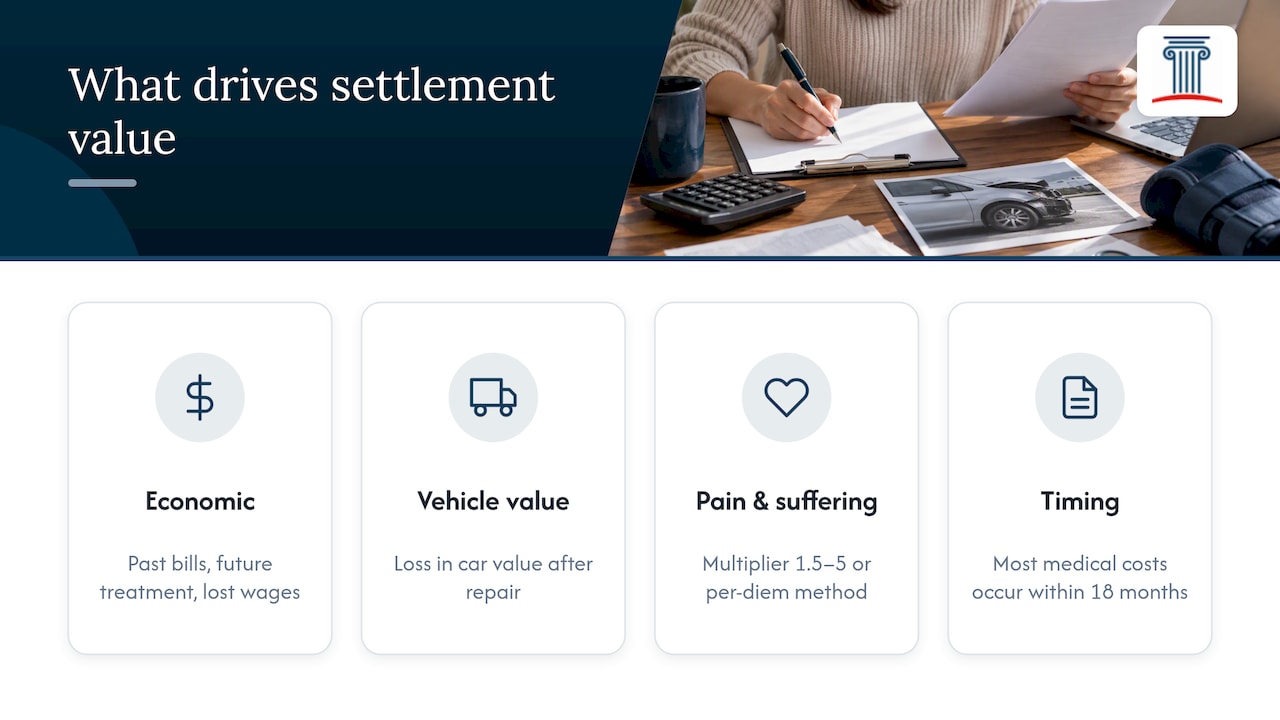
Settlement value comes down to a handful of concrete inputs, and understanding them helps you recognize whether an offer is fair. Insurers and attorneys start with your past medical bills, then factor in projected future treatment, lost wages and diminished earning capacity, and any permanent impairment. Vehicle diminished value, the difference between what your car was worth before and after the crash even post-repair, gets added on top.
Pain and suffering, the non-economic piece, is typically calculated using one of two methods. The multiplier method takes your economic damages and multiplies them by a number, usually between 1.5 and 5, based on injury severity and how consistently you received treatment. The per-diem method instead assigns a daily dollar value to your suffering and multiplies it by your recovery period. Either way, gaps in treatment or inconsistent medical visits give insurers an excuse to argue your pain was not as severe as claimed.
The timing of medical costs matters more than most people realize. A CDC analysis of nonfatal motor vehicle injuries found that most lifetime medical costs for crash-related emergency visits and hospitalizations are incurred within the first 18 months after the crash, which is exactly why early, continuous treatment does more than help your recovery. It also builds the financial record your claim depends on.
Insurers commonly try to depress valuation by disputing whether an injury was crash-related, arguing you failed to mitigate damages by skipping appointments, or offering a quick settlement before your treatment is complete. Solid documentation, consistent care, and a clear paper trail counter every one of these tactics.
When to hire a Garden Grove personal injury lawyer and what fees look like
Not every fender bender needs a lawyer, but certain situations call for one clearly. If your injuries are serious, involve long-term or permanent effects, or fault is disputed, professional representation changes the outcome. Complex medical futures, meaning you may need ongoing treatment years down the road, also require the kind of expert input an attorney can bring to the table.
Most personal injury attorneys work on contingency, which means you pay no upfront fees and the attorney is only paid a percentage of what you recover. This arrangement lets injured people pursue full compensation without worrying about hourly billing while they are already dealing with medical costs and lost income.
A lawyer’s real value shows up in the work you cannot easily do yourself: investigating the crash, coordinating with medical experts on prognosis and future care costs, and preparing your case for litigation if the insurer refuses to negotiate fairly. That preparation alone often pushes settlement offers higher, since insurers respond differently when they know a case is trial-ready.
Bring these items to a free consultation:
- Police report and any citations issued.
- Medical records and bills from every provider you have seen.
- Photos of the scene, your injuries, and vehicle damage.
- Insurance correspondence, including any offers already made.
Serendib Law Firm’s Garden Grove experience and client resources
Some law firms represent injured people throughout Orange County, including Garden Grove, in personal injury claims arising from car accidents. Often, personal injury practices operate on contingency in select cases, so clients are not paying legal fees out of pocket while they focus on recovery. Bilingual staff fluent in English and Spanish can help make the process accessible for a broader range of families navigating an already stressful situation.
For readers who want more detail on how the firm approaches these cases locally, the Experienced Garden Grove Personal Injury Lawyers page walks through the firm’s approach to crash claims in the area, and the premises liability evidence checklist offers a practical model for the kind of documentation that strengthens any injury claim, crash-related or otherwise. This article was written by Maya Serkova. A free consultation is available for anyone who wants to understand their options before deciding how to proceed.
Typical costs and fees beyond attorney fees
Attorney fees are not the only cost involved in pursuing a car accident claim, and it helps to know what else might come out of a settlement. Court filing fees apply if your case proceeds to a lawsuit, and these vary by county courthouse. Expert witness fees, for accident reconstructionists or medical specialists who testify on future care needs, can add up in more serious cases, though these costs are typically advanced by the attorney and reimbursed from the settlement.
Medical record retrieval fees, deposition costs, and mediation or arbitration fees may also apply depending on how far your case progresses. Under a contingency arrangement, most of these case costs are fronted by the law firm and deducted from your settlement only if you win or settle, which means you are not paying out of pocket while your case is pending. It is worth asking any attorney you consult with to explain exactly which costs come out of your recovery and in what order, since fee structures vary between firms.
Common challenges and delays in California car accident claims
Claims stall for predictable reasons, and knowing them ahead of time helps you avoid unnecessary delays. Disputed liability is one of the most common holdups, especially in intersection crashes or multi-vehicle pileups where each driver blames someone else. Insurers may also delay simply because a slow response pressures injured claimants into accepting a lower offer out of financial necessity.
Incomplete medical treatment creates another common snag: if you stop seeing doctors before your recovery is documented as complete, the insurer will argue your damages are smaller than claimed. Missing or inconsistent records, gaps in your symptom log, or a lapse in follow-up care all give an adjuster room to negotiate down. Coordination between multiple insurance policies, such as your own uninsured motorist coverage layered on top of the at-fault driver’s policy, can also slow things down administratively.
The best way to overcome these delays is consistency: keep every medical appointment, respond promptly to insurer requests, and put demands and important conversations in writing. When an insurer’s delay crosses into bad faith, meaning it appears designed to pressure you rather than fairly evaluate your claim, that is generally the point where legal representation becomes worth the investment.
Insurance claim procedures specific to Garden Grove and California
California is an at-fault insurance state, which means the driver responsible for the crash, and their insurer, is generally responsible for covering the other party’s damages. After a Garden Grove crash, you will typically file a claim directly with the at-fault driver’s insurer, though you may also need to notify your own insurer, especially if uninsured or underinsured motorist coverage applies.
California law requires insurers to acknowledge a claim within a set period and to conduct a reasonably prompt investigation, though the state does not guarantee a specific settlement timeline. If your own insurer is unresponsive or acting in bad faith, the California Department of Insurance can be a resource for filing a complaint, though this process runs separately from your personal injury claim itself.
Garden Grove claimants should also expect the adjuster to request a copy of the police report and any medical records tied to the crash before making an offer. Because Orange County courts and local insurance adjusters handle a high volume of car accident claims, having your documentation organized before you file speeds up the review process considerably.
How pre-existing conditions affect your compensation eligibility
Having a pre-existing condition does not disqualify you from compensation, but it does change how your claim gets evaluated. California law allows recovery for the aggravation of a pre-existing injury, meaning if the crash worsened a condition you already had, like a prior back injury or old whiplash, you can still recover damages for that worsening.
The challenge is proof. Insurers will scrutinize your medical history closely and may argue that your current pain stems entirely from the old condition rather than the crash. This is where a clear medical record showing your baseline condition before the accident, compared to your symptoms and limitations after, becomes essential. A treating physician’s opinion connecting the crash to your worsened condition carries significant weight in these disputes.
If you have a relevant medical history, be upfront about it with both your doctor and your attorney early on. Trying to hide a pre-existing condition rarely works and can damage your credibility if the insurer discovers it independently, which they often do through medical record requests.
Mediation, arbitration, and trial options if settlement talks fail
Most car accident claims settle before ever reaching a courtroom, but it helps to understand what happens if negotiations break down. Mediation involves a neutral third party who facilitates discussion between you and the insurer, aiming to reach a voluntary settlement without either side being bound by the outcome. It is often faster and less expensive than litigation, and many California courts encourage or require it before trial.
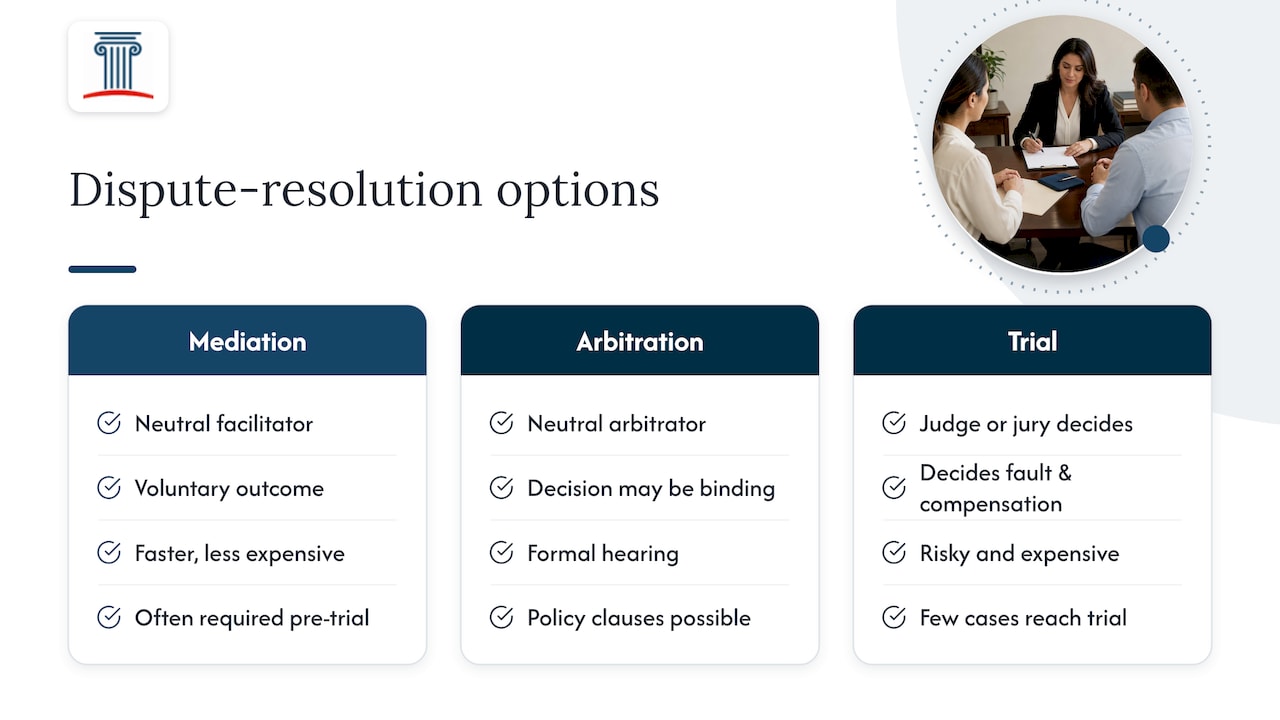
Arbitration is more formal: both sides present their case to an arbitrator, who issues a decision that may be binding or non-binding depending on the agreement in place. Some auto policies include arbitration clauses for uninsured motorist disputes specifically, which can affect how that piece of your claim gets resolved.
If mediation and arbitration do not resolve the dispute, or if the case involves significant disputed liability or damages, the claim proceeds to trial. A jury or judge then decides both fault and the amount of compensation owed. Very few personal injury cases actually reach trial, since most parties prefer the certainty of a negotiated settlement over the risk and expense of litigation, but preparing a case as though it will go to trial is often what pushes an insurer to offer a fair number sooner.
Realistic expectations and common settlement pitfalls
Early documentation and continuity of care are the two things that consistently separate strong claims from weak ones. Claimants who accept a quick, low offer before their treatment is complete often leave real money on the table, and those who delay medical care to “wait and see” hand insurers an easy argument that their injuries were not serious. Bilingual support matters too, since a language barrier should never be the reason someone accepts less than their claim is worth.
— Maya Serkova
How to get a free Garden Grove car accident consultation
If you were injured in a Garden Grove car accident, some law firms offer case reviews on a contingency basis, so there is no upfront cost while you focus on recovery. It is advisable to bring your police report, medical records, insurance correspondence, and any photos from the scene to a consultation. Bilingual staff may be available for clients who prefer to discuss their case in Spanish, and urgent matters can often be addressed quickly once you make contact.
Contact a California Personal Injury Lawyer today to find out what your claim may be worth before the statute of limitations closes your window to act.
Sources
Figures cited above come from NHTSA’s crash data systems and CDC’s motor vehicle injury cost analysis, along with CDC VitalSigns crash injury data.
This article is general information, not a substitute for advice from a qualified lawyer. Consult a qualified legal professional about your own circumstances before acting on anything here.
- Crash Investigation Sampling System | NHTSA
- Vital Signs: Health Burden and Medical Costs of Nonfatal Injuries to Motor Vehicle Occupants — United States, 2012
FAQ
What is the average personal injury settlement in California?
There is no single average settlement figure, since amounts depend heavily on injury severity, medical costs, and fault percentage in each case. A CDC cost analysis of nonfatal crash injuries shows medical costs alone vary widely by injury type, which is one reason settlement values differ so much case to case.
How much compensation will I get for a car accident?
Compensation depends on your documented medical bills, lost wages, vehicle damage, and the severity of your pain and suffering, all reduced by any percentage of fault assigned to you under California’s comparative negligence rule. A free consultation with an attorney can give you a realistic estimate based on your specific records and injuries.
Is $50,000 a good settlement for a car accident?
Whether a specific settlement amount is fair depends entirely on the severity of your injuries, your medical costs, and your lost income, since a moderate injury with modest bills may settle well above typical costs while a catastrophic injury may be worth far more. There is no fixed benchmark, which is why comparing an offer against your actual documented damages matters more than comparing it to a general number.
How is pain and suffering calculated in a settlement?
Pain and suffering is typically calculated using the multiplier method, applying a factor based on injury severity to your economic damages, or the per-diem method, assigning a daily value multiplied by your recovery period. Consistent medical treatment and documentation generally support a higher multiplier because they demonstrate the injury’s real impact on your life.
Do I need a lawyer for a minor car accident claim in Garden Grove?
Minor claims with clear fault and modest injuries can sometimes be resolved without an attorney, but disputed fault, ongoing symptoms, or a lowball insurer offer are strong reasons to consult one. Most personal injury attorneys, including those working on contingency, offer a free consultation so you can find out where your case stands before deciding.