

California Labor Code §1102.5 protects employees who report legal violations, and if your employer punished you for speaking up, you may have a claim for reinstatement, back pay, and attorney fees. Your first move matters: document everything now and speak with a California employment lawyer in Newport Beach before you respond to your employer or sign anything.
TL;DR:
- Retaliation can include subtle acts like schedule cuts, transfer to less desirable roles, or increased scrutiny, which courts assess based on timing and pattern.
- Building strong evidence, such as preserving emails, notes, witness information, and taking screenshots, is critical right after the retaliatory act occurs.
- Filing deadlines vary by agency and law, making early consultation with a lawyer essential to avoid losing your legal rights due to missed windows.
- Continued employment during an investigation is common and legal, but documentation and performance consistency are key to strengthening your case if retaliation escalates.
- Choosing the correct legal route based on your report type impacts remedies and deadlines, with California law providing remedies such as reinstatement, back pay, and attorney fees.
Table of Contents
- California and federal whistleblower laws that protect you
- How retaliation commonly appears in Newport Beach workplaces
- How to document and report retaliation (practical steps)
- Agencies, legal options, and remedies in California
- Immediate checklist and timeline expectations after retaliation
- Key takeaways for Newport Beach employees
- Definition and examples of whistleblower protection specific to Newport Beach or Orange County
- Statute of limitations and deadlines for filing whistleblower retaliation claims in California
- Potential impacts on employment status and how to handle continued employment while pursuing a claim
- Author/firm perspective on defending whistleblowers in Newport Beach
- How Serendib Law Firm can help: contact options and next steps
- Sources
- FAQ
California and federal whistleblower laws that protect you
California Labor Code §1102.5 makes it illegal for an employer to retaliate against you for disclosing information you reasonably believe shows a violation of state or federal law, whether you report it internally to a supervisor or externally to a government agency. The protection applies whether you are still employed or have already been let go, and it covers reports made in good faith even if the violation turns out not to be provable.
Section 1102.6 governs how these cases play out once they reach court. You, as the employee, must first show that your protected activity was a contributing factor in the adverse action against you. That is a lower bar than proving it was the only reason. Once you clear that hurdle, the burden shifts to your employer, who must prove by clear and convincing evidence that it would have taken the same action for legitimate, independent reasons anyway. The Lampkin v. County of Los Angeles decision from 2025 shows how this plays out in practice: a plaintiff can successfully prove protected whistleblowing activity and still walk away without money damages if the employer convinces the court it would have made the same decision regardless.
Federal law can also apply depending on what you reported. OSHA enforces whistleblower protections tied to workplace safety complaints, and the False Claims Act covers reports of fraud against government programs, sometimes allowing qui tam suits where you share in any recovery. Which law applies changes your filing deadline and the relief available, so identifying the right statute early shapes your entire strategy.
How retaliation commonly appears in Newport Beach workplaces
Retaliation rarely announces itself. Some acts are unmistakable, while others unfold slowly enough that employees second-guess whether anything wrong happened at all.
- Termination or demotion immediately or shortly after you report a violation.
- Reduced hours or pay without a business justification tied to performance.
- Sudden negative performance reviews after a history of positive ones.
- Exclusion from meetings or projects you previously handled.
- Increased scrutiny or write-ups for conduct that was tolerated before.
The EEOC’s guidance on retaliation explains that the legal test is not whether the employer’s conduct caused you to lose pay or your job outright. It asks whether the action might deter a reasonable person from reporting misconduct in the first place. That standard reaches subtler behavior, including social isolation, a sudden cold shoulder from a manager who once mentored you, or being quietly reassigned to less visible work. Courts applying this framework look closely at timing and pattern: an unexplained shift in how a manager treats you right after you raise a concern often carries more weight than the employer’s stated reason for the change.
How to document and report retaliation (practical steps)
Evidence built while events are fresh holds up far better than memory reconstructed months later.
- Save every relevant communication including emails, texts, and Slack or Teams messages, and back them up outside your work account.
- Write contemporaneous notes after each meeting or incident, noting the date, who was present, and exactly what was said.
- Identify witnesses by name and note what each one observed or could confirm.
- Preserve your personnel file and pay records, requesting copies before any dispute becomes formal.
- Photograph or screenshot schedule changes, performance reviews, or written warnings before they can be edited or deleted.
Pro Tip: Never delete anything from a work device once you suspect retaliation, even messages that seem to hurt your case; altered or missing records can undermine your credibility later.
Reporting internally to HR or a compliance line can create a paper trail and sometimes resolves the problem quickly, but it also alerts your employer that you are watching closely, which can accelerate retaliation if the culture is hostile. Filing with an outside agency skips that risk and starts a formal clock, though it can take longer to reach a resolution. Many employees do both: an internal report to preserve the argument that the employer had notice, followed by an agency filing once it is clear the internal process will not fix the problem.
Agencies, legal options, and remedies in California
Where you file depends on what kind of violation you reported and what outcome you want.
- California’s Labor Commissioner (DLSE) handles Labor Code §1102.5 retaliation complaints and wage-related claims.
- The EEOC covers retaliation connected to discrimination or harassment complaints under federal law.
- OSHA takes whistleblower complaints tied to workplace safety violations, with its own short filing window.
- False Claims Act qui tam suits apply when the underlying report involves fraud against government funds, and these are filed in federal court rather than with an agency, often allowing you to recover a share of any government recovery.
Remedies vary by route but commonly include reinstatement to your former position, back pay for wages lost during the retaliation, and injunctive relief ordering the employer to stop the retaliatory conduct. California law also allows recovery of attorney fees in successful 1102.5 cases, which matters because it can make pursuing a claim financially viable even when the direct damages are modest. As Usa notes, choosing the correct administrative process from the start affects both your deadline and what you can ultimately recover.
Immediate checklist and timeline expectations after retaliation
Speed matters more than most employees realize, because some agency filing windows are measured in months, not years.
- Document the retaliatory act the same day it happens, while details are accurate in your memory.
- Request your personnel file and any relevant records from your employer in writing.
- Follow up in writing after verbal warnings or meetings, summarizing what was said and asking for confirmation.
- Back up anything on a work device to a personal account before access is restricted.
- Consult a California employment lawyer promptly, since exact filing deadlines depend on which agency or statute applies to your situation.
Administrative filing windows differ by agency and by the nature of the claim, and missing one can permanently bar an otherwise strong case. Rather than relying on a generic deadline, treat every situation as time-sensitive until a lawyer confirms which window applies to your facts. Early legal advice also shapes strategy in ways that are easy to miss on your own: a lawyer may advise you to request specific documents before your employer can alter them, or to frame an internal complaint in a way that strengthens a later legal filing rather than weakening it.
Key takeaways for Newport Beach employees
California law protects you when you report a legal violation in good faith, and successful claims can result in reinstatement, back pay, and attorney fees. The strength of your case often comes down to what you preserved early: emails, notes, witness names, and a clear timeline. Deadlines vary by agency, so treat every day as one that counts. The most reliable next step is a conversation with a California employment lawyer who can walk through your specific facts and filing options.
Definition and examples of whistleblower protection specific to Newport Beach or Orange County
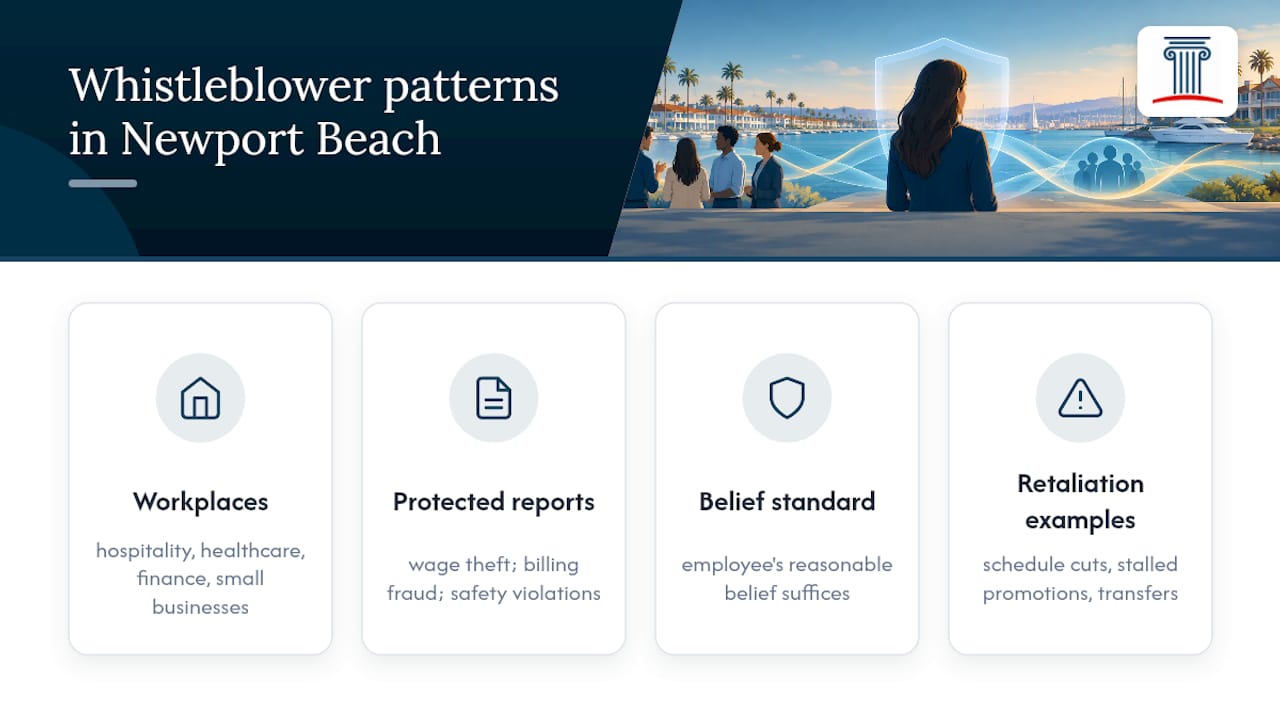
Whistleblower protection in Newport Beach works under the same California statutes that apply statewide, since Labor Code §1102.5 does not carve out different rules by city. What changes locally is the kind of workplace where these disputes tend to arise: hospitality and tourism employers along the coast, healthcare practices, financial services firms headquartered in the area, and the small and mid-size businesses common throughout Orange County.
A hotel employee who reports wage theft to a manager, a healthcare worker who flags a billing practice that looks like insurance fraud, or a retail employee who reports safety violations to a supervisor are all engaged in protected activity under California law, regardless of whether the report goes up the chain internally or out to a state agency. What counts is that the employee reasonably believed the conduct violated the law, not that a court later agrees the violation actually occurred.
Orange County employers, like employers anywhere in the state, sometimes respond to these reports with subtle retaliation rather than outright termination, since an abrupt firing invites more obvious scrutiny. A schedule quietly cut, a promotion that stalls without explanation, or a transfer to a less desirable location can all qualify, and local employees facing this kind of pressure have the same statutory protections as anyone else in California.
Statute of limitations and deadlines for filing whistleblower retaliation claims in California
Deadlines for whistleblower retaliation claims depend heavily on which law and which agency apply to your situation, and getting this wrong can permanently close off an otherwise valid claim. A Labor Code §1102.5 retaliation complaint filed with California’s Labor Commissioner operates on a different timeline than a discrimination-related retaliation charge filed with the EEOC, and OSHA whistleblower complaints tied to safety violations often carry a much shorter window than either of those.
Because the correct deadline depends on the specific statute involved and the exact date the retaliatory act occurred, there is no single number that applies to every case, and treating one deadline as universal is a common and costly mistake. The safest approach is to assume the clock is already running and to get a lawyer’s confirmation of your specific deadline as soon as possible after the retaliatory act, rather than waiting to see how the situation develops. Waiting even a few weeks to “see what happens” has cost employees the ability to file at all in cases where the applicable window turned out to be shorter than expected.
Potential impacts on employment status and how to handle continued employment while pursuing a claim
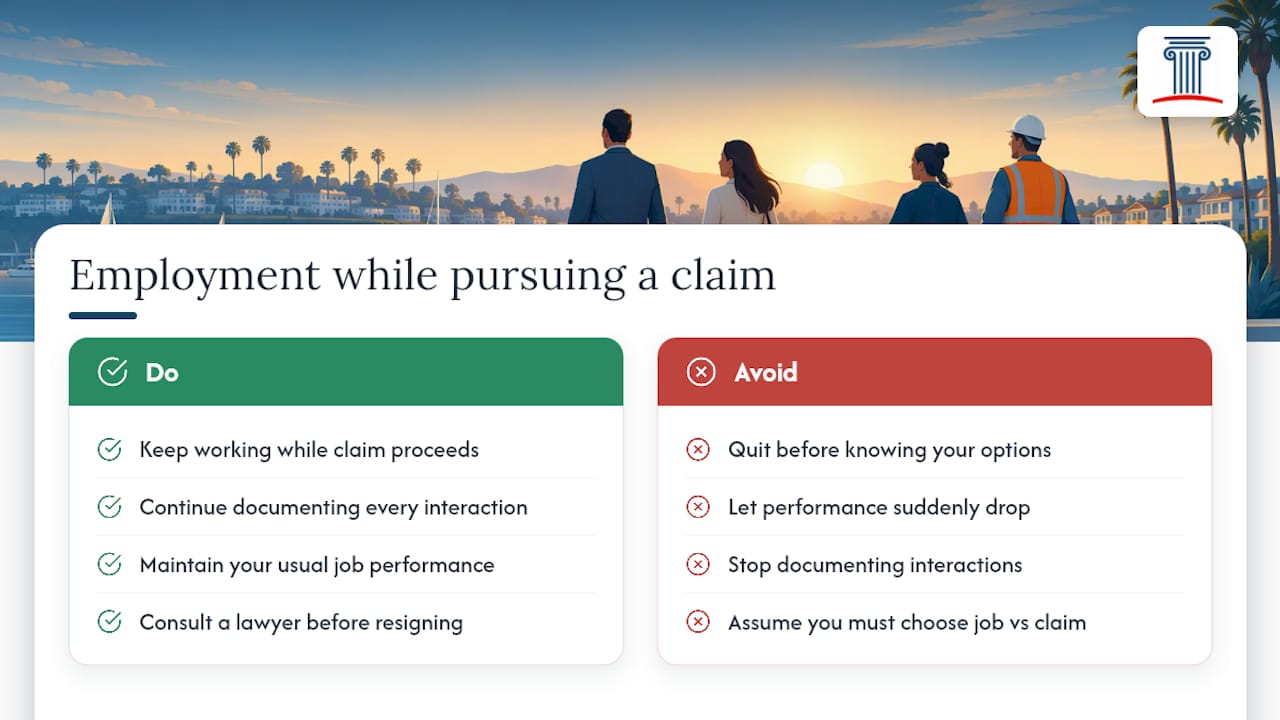
Filing a complaint does not automatically end your job, and many employees continue working for the same employer while a retaliation claim moves forward. That arrangement can be uncomfortable, but quitting before you understand your legal options can also weaken a case, particularly if your claim depends on showing a pattern of retaliation that continues over time.
If you remain employed, keep documenting every interaction the same way you did before filing, since retaliation sometimes escalates once an employer learns a complaint has been made. Continue performing your job to the same standard you always have, since a sudden dip in performance can be used against you regardless of the reason. If working conditions become unsafe or unbearable, a constructive discharge claim may be available, but that legal theory has a high bar and should be discussed with a lawyer before you resign rather than after.
Employees sometimes assume they must choose between keeping their job and pursuing a claim. In most cases, that is a false choice, and a lawyer can advise on how to protect both your position and your legal rights at the same time.
Author/firm perspective on defending whistleblowers in Newport Beach
Retaliation cases are won or lost on details most employees do not think to save: a screenshot taken before a schedule was changed, a note written the same afternoon a manager’s tone shifted. That is where our attention goes first, before a single form gets filed. Some law firms offer free consultations and bilingual support in English and Spanish, and may handle qualifying employment matters on contingency where appropriate, because the cost of getting legal advice should never be the reason someone stays silent about misconduct. If you are weighing whether what happened to you counts as retaliation, that question deserves a direct answer from someone who has looked closely at the facts.
— Maya Serkova
How Serendib Law Firm can help: contact options and next steps
If you are dealing with retaliation in Newport Beach right now, you do not have to sort out the statutes and deadlines on your own. Our Employment Law team handles retaliation, wrongful termination, and whistleblower claims for employees across Orange County, with free consultations and bilingual service in English and Spanish so language is never a barrier to getting help.
Before your consultation, gather what you have: relevant emails and texts, a written timeline of what happened and when, the names of any witnesses, and copies of your personnel file if you already have them. Reach our California employment lawyer team by phone or through our contact page to talk through what happened and what your options look like from here.
This article is general information, not a substitute for advice from a qualified lawyer. Consult a qualified legal professional about your own circumstances before acting on anything here.
Sources
- Retaliation – Making it Personal | U.S. Equal Employment Opportunity Commission
- Usa
- Lampkin v. County of Los Angeles, Court of Appeal (2025) — Justia
FAQ
What is the typical whistleblower retaliation settlement amount in California?
There is no fixed or typical settlement figure for whistleblower retaliation cases in California, since outcomes depend heavily on lost wages, the strength of the evidence, and whether the employer can prove a same-decision defense under Section 1102.6. Remedies can include back pay, reinstatement, and attorney fees, but the value of any individual case turns entirely on its own facts.
How does an employee prove whistleblower retaliation?
Under California’s burden-shifting framework, you first show that your protected report was a contributing factor in the adverse action taken against you. Your employer can then avoid liability for damages by proving with clear and convincing evidence that it would have taken the same action anyway, a defense discussed in the Lampkin decision.
Can I sue my employer for retaliation in California?
Yes, California Labor Code §1102.5 allows employees to pursue legal action against an employer who retaliates against them for reporting a suspected legal violation in good faith. The right agency or court route depends on the type of violation reported, which is why confirming your options with an employment lawyer early matters.
How much is a retaliation claim worth in California?
The value of a retaliation claim depends on factors like lost wages, emotional distress, and whether reinstatement is available, and there is no standard amount that applies across cases. An employer’s ability to prove it would have made the same decision regardless of the protected activity, as described in the Lampkin ruling, can also significantly affect what a plaintiff ultimately recovers.