
If you work in Lake Forest and your paycheck is short, your overtime is missing, or your breaks keep getting skipped, you have two realistic paths to recover what you are owed: a wage claim with the Labor Commissioner’s Office (DLSE) or a lawsuit in civil court. With California’s minimum wage rising to $16.90 per hour on January 1, 2026, start by pulling your pay stubs and time records, then file or call Serendib Law for a free consult.
TL;DR:
- Missed meal or rest breaks can earn one extra hour of pay at your regular rate for each workday with a violation.
- Deadlines vary by claim: unpaid wages usually have three years, written contract claims four years, and appeals of DLSE awards just 10 days.
- Filing a DLSE wage claim costs nothing, requires no attorney, and does not require employees to disclose their immigration status.
- Build your case with pay stubs, time records, schedules, messages, and a dated personal log, especially when employer records are missing.
- When coworkers share a violation, ask counsel whether a workplace investigation or group action may work better than individual DLSE claims.
Table of Contents
- Common wage-and-hour violations Lake Forest employees face
- How to file a wage claim with the Labor Commissioner (DLSE): step-by-step
- Evidence to gather: the checklist to support a Lake Forest wage claim
- Timelines and deadlines: statutes of limitation for wage and retaliation claims
- What to expect at a settlement conference and hearing: outcomes and enforcement
- Retaliation protections: how to document and where to file if your employer retaliates
- How Serendib Law supports Lake Forest employees with wage-and-hour claims
- Overview of employee rights under California and federal wage and hour laws specific to Lake Forest, CA
- Common employer defenses in wage and hour claims and how employees can respond
- Detailed explanation of the process timeline from claim filing through resolution
- Information on potential legal fees, costs, and attorney contingency arrangements for wage and hour claims
- How wage and hour claims interact with other employment law claims such as wrongful termination or discrimination
- Firm perspective: common local patterns and a quick 30-90 day action checklist
- Contact Serendib Law: free consult, what to bring, next steps
- FAQ
- Sources
Common wage-and-hour violations Lake Forest employees face
Wage violations show up in predictable patterns, and recognizing yours is the first step toward a claim. Final paycheck disputes are among the most frequent: California Labor Code sections 200 through 203 require employers to pay all wages owed immediately upon termination or within 72 hours of a resignation without notice, and missing that deadline can trigger waiting-time penalties.
Overtime miscalculation is another common problem, especially where employers misapply daily versus weekly overtime rules or fail to count bonuses toward the regular rate used for overtime math. Commission-based employees face their own headaches: a plan that promises a percentage of sales but defines “earned” vaguely often shortchanges workers who leave mid-cycle or hit quotas the employer disputes.
Meal and rest break violations carry a specific remedy: under Labor Code section 226.7 and the applicable Industrial Welfare Commission wage orders, an employer who fails to provide a compliant meal or rest period owes one additional hour of pay at the employee’s regular rate for each workday a violation occurs. Misclassifying a worker as an independent contractor strips that person of overtime, minimum wage, and break protections altogether, even when the actual job duties look like regular employment.
- Unpaid final wages or late payment after termination or resignation.
- Overtime calculated incorrectly or not paid at all.
- Commissions or bonuses withheld or miscalculated under a vague plan.
- Missed meal or rest breaks without the required premium pay.
- Independent contractor misclassification that eliminates wage protections.
California’s statewide minimum wage rises to $16.90 per hour on January 1, 2026, and employers in cities with a higher local ordinance must pay whichever rate benefits the employee more.
How to file a wage claim with the Labor Commissioner (DLSE): step-by-step
Filing a wage claim does not require an attorney, though having one organize your evidence tends to speed things along. The Labor Commissioner’s Office accepts claims online, by mail, or in person at a local DLSE office, and the agency does not require you to disclose immigration status to file.
- Complete the initial wage claim form with accurate dates, amounts owed, and a clear description of each violation, since inaccuracies can slow down or derail processing.
- Submit your claim through your preferred channel and wait for assignment to a Deputy Labor Commissioner, who reviews the file and may request additional documentation.
- Attend a settlement conference, where the Deputy tries to broker a resolution between you and your employer before any formal hearing.
- If settlement fails, proceed to a hearing where both sides testify under oath and the Deputy issues a written Order, Decision, or Award (ODA).
Language access and scheduling accommodations are available throughout the process, so claimants who are not fluent in English can request interpretation services at any stage. If your situation involves multiple coworkers facing the same violation, a DLSE claim may not be the most efficient route. The Bureau of Field Enforcement can investigate workplace-wide violations, and claims affecting many employees may also raise questions worth discussing with counsel about a Private Attorneys General Act (PAGA) action or a class action.
Pro Tip: File your claim as soon as you confirm the violation; a Deputy Labor Commissioner can only act on the dates and amounts you document, so earlier filing means fresher, more complete records.
Evidence to gather: the checklist to support a Lake Forest wage claim
The strength of a wage claim rests almost entirely on documentation, so start collecting before you file. Pay stubs, bank deposit records, time sheets, work schedules, job descriptions, and any written commission or bonus plan form the backbone of most cases. Texts, emails, or notes from a supervisor that reference hours worked, promised pay, or missed breaks can corroborate your account when official records are incomplete or missing.
If your employer never kept accurate time records, you can reconstruct your hours through a chronological log built from calendar entries, rideshare receipts, parking records, or coworker observations. Witnesses who can confirm your schedule or working conditions matter too, and the DLSE can issue subpoenas to compel testimony or records at a hearing.
- Pay stubs, bank statements, and any written pay or commission agreements.
- Time sheets, schedules, and job descriptions showing your actual duties.
- Texts, emails, or messages referencing hours, breaks, or pay promises.
- A personal log reconstructing hours if employer records are missing or incomplete.
Pro Tip: Keep a running, dated log in a notebook or phone app the moment you suspect a pay problem; contemporaneous records carry far more weight at a hearing than a reconstruction built months later.
Timelines and deadlines: statutes of limitation for wage and retaliation claims
Deadlines vary by claim type, so confirm yours early. Unpaid wages and missed meal or rest period premiums generally fall under a three-year statute of limitations, per DLSE guidance and Code of Civil Procedure section 338. Contract-based wage claims can extend further: two years for an oral agreement, four years for a written one.
- Unpaid wages and break premiums: generally three years from the violation.
- Written contract wage disputes: up to four years; oral agreements: two years.
- Retaliation complaints: filing windows range from one to three years depending on the forum, so check which agency applies to your situation.
- Appeals of a DLSE Order, Decision, or Award: must be filed within 10 days of service.
What to expect at a settlement conference and hearing: outcomes and enforcement
The settlement conference is informal and designed to resolve your claim without a full hearing, giving both sides a chance to negotiate under the Deputy’s guidance. If no agreement is reached, the case proceeds to a hearing, where DLSE procedures require sworn testimony from both parties and a recorded record of the proceedings.
- Bring three complete sets of every document: one for the hearing officer, one for your employer, and one for yourself, since only evidence introduced at the hearing counts toward the decision.
- Expect the hearing officer to issue a written ODA after reviewing testimony and evidence, which can take several weeks.
- If your employer does not pay or appeal the ODA, it converts into a court judgment, and the DLSE’s Judgment Enforcement Unit can assist in collecting it.
- If your employer appeals, the case moves to Superior Court, where the DLSE’s post-hearing guidance notes that low-income claimants can request attorney assistance using specific agency forms.
Retaliation protections: how to document and where to file if your employer retaliates
Retaliation for raising a wage complaint can take many forms: termination, cut hours, a sudden stream of negative performance reviews, or an unwanted reassignment shortly after you spoke up. California law protects employees who report wage violations, and you can file a retaliation complaint with the California Civil Rights Department within the applicable filing window, which can run up to three years depending on the claim.
- Document retaliation separately from your wage claim, noting dates, witnesses, and specific actions taken against you.
- Retaliation complaints can be filed alongside a wage claim or pursued independently, depending on your situation.
- Save written communications, especially anything that references your wage complaint before adverse action occurred.
If harassment or hostile conduct accompanies the retaliation, workplace prevention resources like harassment-prevention training can help you and coworkers recognize and document patterns before they escalate.
How Serendib Law supports Lake Forest employees with wage-and-hour claims
We help workers organize scattered pay records into a coherent claim, file with the DLSE, and represent clients through settlement conferences and hearings. Legal support is available for judgment enforcement when an employer refuses to pay an ODA, and assistance is provided in English and Spanish to help ensure language is not a barrier.
- Review your pay stubs, timeline of events, and any written communications during a free consult.
- Organize evidence and file your DLSE wage claim or civil complaint accurately and on time.
- Represent you at settlement conferences and hearings, and pursue enforcement if an employer refuses to pay.
- Identify related claims, such as retaliation, that may strengthen your overall case.
Our Lake Forest employment law attorneys focus on exactly these situations, and our broader California employee rights overview covers related protections worth understanding.
Maya Serkova
Overview of employee rights under California and federal wage and hour laws specific to Lake Forest, CA
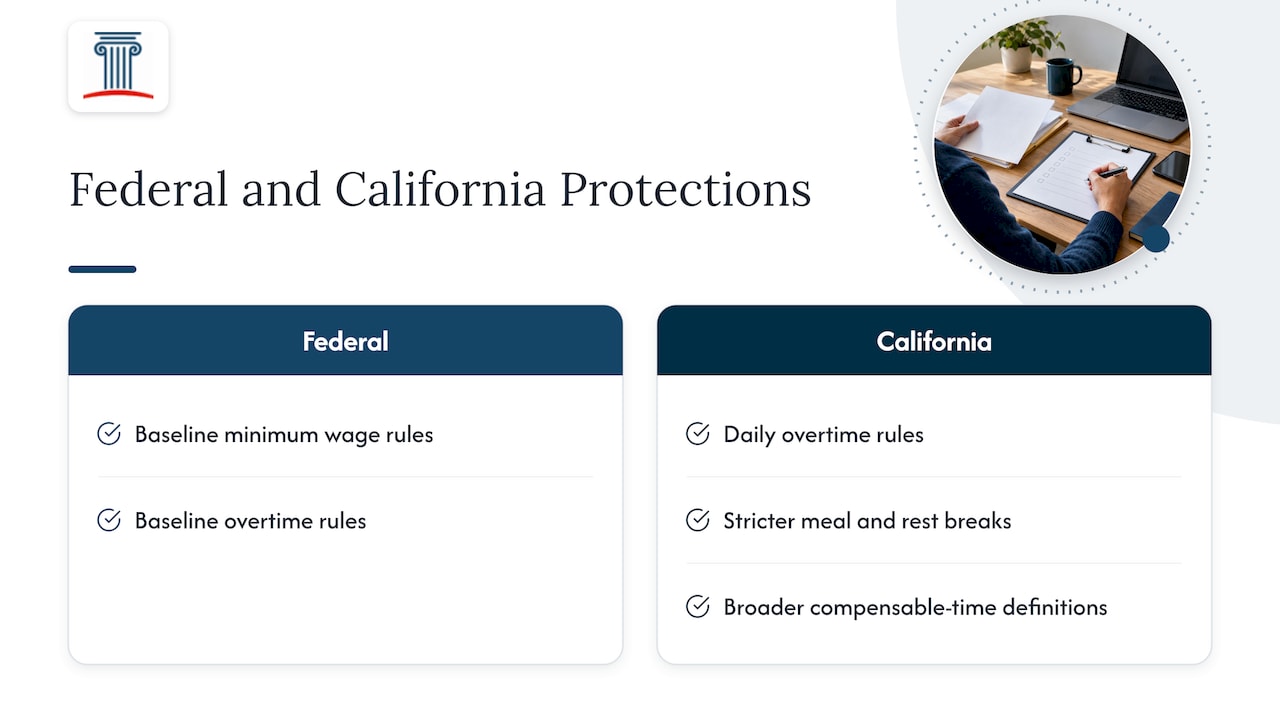
Lake Forest employees are protected by a layered system of federal and state wage law, and state protections almost always set a higher floor than federal ones. The federal Fair Labor Standards Act establishes baseline minimum wage and overtime rules, but California’s Labor Code and the IWC wage orders go further, covering daily overtime, stricter meal and rest break requirements, and broader definitions of what counts as compensable time.
Because Lake Forest sits in Orange County without its own separate minimum wage ordinance, the statewide rate of $16.90 per hour effective January 1, 2026 applies to most employees working there, though some employees working across multiple cities during a pay period may be subject to a different local rate for hours worked in that jurisdiction. The MW-2026 wage order updates also revise meal and lodging credit rules and require employers to post the current wage order where employees can see it.
Retail, hospitality, and small professional offices make up a large share of Lake Forest’s local employment base, and these industries commonly see the exact violations covered above: missed breaks during busy shifts, off-the-clock work before opening or after closing, and misclassified “assistant manager” roles that function as hourly positions. Understanding that state law protects you regardless of your immigration status, and regardless of whether you signed an arbitration agreement for some types of claims, helps clarify that nearly every worker in Lake Forest has standing to pursue unpaid wages.
Common employer defenses in wage and hour claims and how employees can respond
Employers facing a wage claim tend to raise a handful of recurring defenses, and knowing them in advance helps you prepare a stronger response. A common one is disputing the hours claimed, arguing that your records are inaccurate or that you clocked out and kept working voluntarily. Responding well means presenting your own contemporaneous log, text messages, or witness statements that corroborate the hours you are claiming.
Another frequent defense is misclassification justification, where an employer argues your role genuinely qualifies as exempt from overtime, for instance under an executive or administrative exemption. The actual test turns on your real job duties, not your title, so documenting what you actually did day to day, versus what your job description says, often undercuts this defense.
Employers also sometimes argue that a wage claim is time-barred, which makes confirming your applicable statute of limitations early in the process important. Finally, some employers claim a payroll error was isolated and already corrected, hoping to minimize the dispute. If you received a late or partial correction, keep records of when the correction happened and whether it fully resolved the shortfall, since partial fixes do not eliminate liability for the period before the correction.
Detailed explanation of the process timeline from claim filing through resolution
A DLSE wage claim typically moves through several distinct phases, though exact timing varies by caseload and complexity. After you submit your claim, the DLSE assigns it to a Deputy Labor Commissioner who reviews the file, which can take several weeks depending on regional office volume.
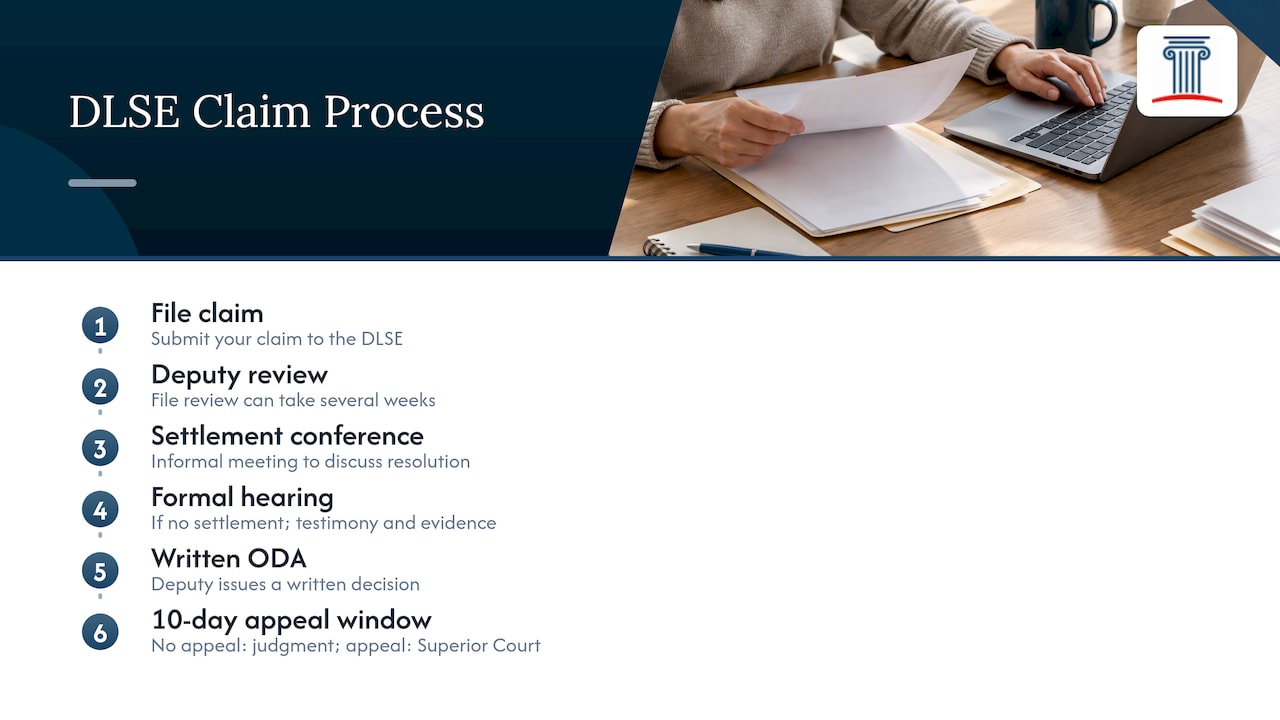
The Deputy then schedules a settlement conference, an informal meeting where both sides discuss the dispute and often reach a resolution without further proceedings. If no settlement occurs, the case moves to a formal hearing, where both parties testify under oath and present documentary evidence.
Following the hearing, the Deputy issues a written ODA, which can take additional weeks to finalize. Once the ODA is issued, your employer has 10 days to appeal to Superior Court. If no appeal is filed and the employer does not pay voluntarily, the ODA can be entered as a judgment, and the DLSE’s enforcement resources describe how the agency’s Judgment Enforcement Unit can assist with collection. If an employer does appeal, the matter proceeds through Superior Court litigation, which follows its own separate timeline and procedural rules distinct from the DLSE’s administrative process. Throughout every phase, maintaining organized records and responding promptly to any DLSE requests keeps your case moving without unnecessary delay.
Information on potential legal fees, costs, and attorney contingency arrangements for wage and hour claims
Cost concerns stop many Lake Forest employees from pursuing wage claims they would otherwise win, but the fee structures available for these cases are designed to reduce that barrier. Filing a wage claim directly with the DLSE costs nothing, and the agency does not charge employees to use its settlement conference or hearing process.
When employees choose to work with an attorney, many wage and hour cases are handled on a contingency basis, meaning the attorney’s fee comes from a percentage of the amount recovered rather than upfront hourly billing. This arrangement lets employees pursue a claim without paying out of pocket while the case is pending, and it aligns the attorney’s incentive with maximizing your recovery.
We offer a free consultation to evaluate your situation before any commitment, and our Employment Law services include contingency-based representation in select wage and hour matters. Beyond attorney fees, some cases may involve minor costs such as filing fees in Superior Court if an employer appeals an ODA, though many of these costs can potentially be recovered as part of a successful judgment, depending on the specifics of your case.
How wage and hour claims interact with other employment law claims such as wrongful termination or discrimination
Wage violations rarely exist in isolation, and the same facts that support an unpaid wage claim frequently overlap with other employment law issues. An employee who is terminated shortly after complaining about unpaid overtime may have both a wage claim and a retaliation or wrongful termination claim arising from the same timeline of events.
Similarly, workers who face discrimination or harassment sometimes discover that their pay was also manipulated, for instance through reduced hours assigned disproportionately to one protected group, or commission structures applied unevenly. In these situations, pursuing the wage claim alongside a discrimination or harassment claim can paint a more complete picture of the employer’s conduct and strengthen both cases.
Disability-related wage issues also intersect with accommodation law: an employee denied a reasonable schedule accommodation, then penalized for using unpaid time instead of an available paid benefit, may have both a wage and a disability accommodation claim. Because these claims can run on different statutes of limitation and before different agencies, identifying every applicable claim early prevents you from missing a filing deadline on one while pursuing another. Our broader employment law practice regularly handles cases where wage issues, retaliation, and discrimination overlap in exactly this way.
Firm perspective: common local patterns and a quick 30-90 day action checklist
Lake Forest’s retail, hospitality, and small-business sectors see recurring recordkeeping gaps that favor employers until workers push back. Within 30 days: save every pay stub, start a daily time log, and request missing pay in writing. Escalate to a DLSE filing, or call counsel, once your employer ignores that written request.
— Maya Serkova
Contact Serendib Law: free consult, what to bring, next steps
If you are ready to move forward, we offer a free consultation to review your wage and hour situation and outline realistic options, including contingency-based representation for qualifying cases. Our Employment Law team handles everything from initial DLSE filings to hearings and judgment enforcement, and we also represent clients in Personal Injury, Business Litigation, Immigration Law, and Disability and Workers’ Compensation matters when your situation calls for it.
Before your first call, gather:
- Recent pay stubs and any bank records showing deposits.
- A written timeline of dates, hours worked, and specific pay problems.
- Copies of texts, emails, or messages referencing your pay or schedule.
- Names of coworkers who witnessed the violations.
Reach us through our Contact Us page or by phone, and our first conversation will focus on understanding your timeline, your documents, and the fastest path to recovering what you are owed.
This article is general information, not a substitute for advice from a qualified lawyer. Consult a qualified legal professional about your own circumstances before acting on anything here.
FAQ
What is the 7 minute rule in California?
Time-rounding practices under California guidance allow employers to round time punches to the nearest tenth of an hour as long as the rounding is neutral and does not consistently shortchange employees. If your employer routinely rounds down in its favor, that pattern can support a wage claim.
What is the most commonly litigated wage and hour violation?
Meal and rest break violations, along with overtime miscalculation, are among the most frequently raised issues in California wage disputes. Both carry clear statutory remedies, including the one-hour premium under Labor Code section 226.7 for missed breaks.
Is it worth pursuing a wage claim against your employer?
For many employees, filing a DLSE wage claim costs nothing and can recover unpaid wages, penalties, and break premiums without the expense of a lawsuit. Whether litigation makes sense beyond that depends on the amount owed, available evidence, and whether contingency-based representation is available for your case.
How long does an employer have to correct a payroll mistake in California?
California law does not set one universal grace period for every payroll error, but prompt correction reduces the risk of waiting-time penalties, particularly for final paycheck violations under Labor Code sections 200 through 203. Employees should document when an error was corrected and whether the correction fully covered the shortfall for the affected period.