
If your Fullerton employer shorted your paycheck, skipped overtime, or denied your breaks, you can generally file a wage claim with the California Labor Commissioner, and the process starts with DLSE Form 1. The claim types that qualify most often involve unpaid wages, missed meal or rest breaks, unpaid overtime, unpaid final wages, unpaid commissions, or unlawful deductions. Act fast: depending on the violation, you have up to several years to file depending on the violation type, so gather your pay stubs and employer information now.
TL;DR:
- Most wage claims in Fullerton involve unpaid wages, missed meal or rest breaks, unpaid overtime, or unlawful deductions, with deadlines ranging from 1 to 4 years depending on violation type.
- Filing requires matching the employer’s exact legal name, gathering pay records, and submitting DLSE Form 1 along with supporting documents such as pay stubs and time logs.
- Evidence like pay stubs, schedules, bounced checks, and eyewitness notes significantly strengthen your claim, especially if employer records are incomplete or missing.
- After filing, a deputy reviews the case and may hold a settlement conference, a formal hearing, or dismiss the claim; written decisions are usually issued within 15 days of a hearing.
- Employers cannot legally retaliate within 90 days of your wage claim by firing or punishing you, and retaliation claims can be filed with evidence of adverse actions shortly after your protected activity.
Table of Contents
- Wage and Hour Claims Fullerton CA Employee Rights: Where You Stand
- How Do You File a Wage Claim With the DLSE?
- How Long Do You Have to File a Wage Claim in California?
- What Documents Prove Your Wage Claim?
- What Happens After You File a DLSE Claim?
- What Are the Most Common Wage Violations and Remedies?
- Can Your Employer Retaliate Against You for Filing?
- When Does a Wage Claim Need an Employment Attorney?
- Your First 30 Days: A Practical Checklist
- Get Help Filing Your Fullerton Wage Claim
- Sources
- FAQ
Wage and Hour Claims Fullerton CA Employee Rights: Where You Stand
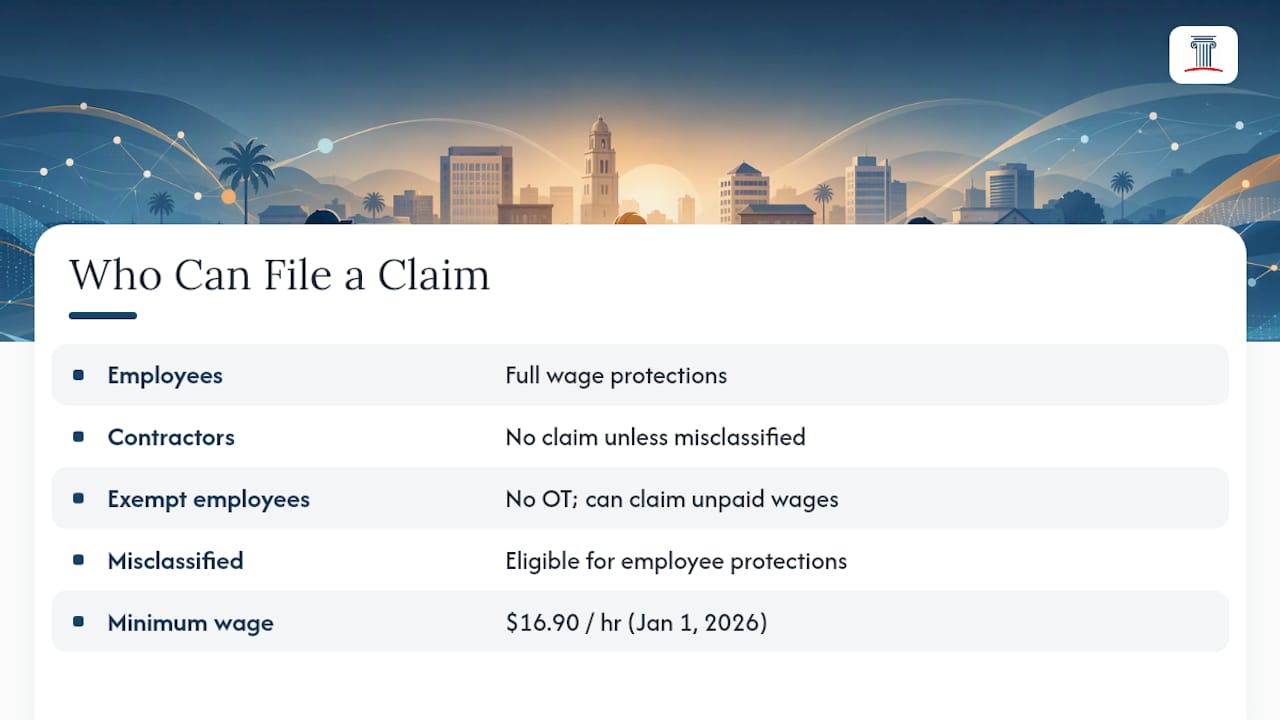
California gives workers stronger wage protections than most states, and Fullerton employees fall under the same statewide rules enforced by the Division of Labor Standards Enforcement (DLSE), often called the Labor Commissioner’s Office. As of January 1, 2026, the statewide minimum wage sits at $16.90 per hour, and any Fullerton employer paying less, or failing to pay earned overtime, meal premiums, or final wages on time, is exposed to a wage claim.
Employees have this right. Independent contractors generally do not, unless they were misclassified. Exempt employees, meaning certain salaried workers who meet specific duties tests, cannot claim overtime but can still pursue unpaid wages, unreimbursed expenses, or final pay violations. If your employer called you a contractor but controlled your schedule, supervised your work, and required you to use company equipment, you may actually qualify as a misclassified employee entitled to full wage protections.
The legal term for what you are pursuing is a “wage and hour claim,” a category covering minimum wage violations, unpaid overtime, missed breaks, and improper deductions. Some Fullerton workers search for “wage theft,” which describes the same underlying conduct: an employer failing to pay what state law requires.
How Do You File a Wage Claim With the DLSE?
Filing a claim is more paperwork than mystery, and getting the sequence right saves weeks of back and forth with the Labor Commissioner’s office.
- Identify your employer’s exact legal name and address. Check pay stubs, employee handbooks, or scheduling software. The name on your claim must match the entity that actually employed you, not just the store brand on the sign.
- Gather the basics. Dates of employment, your regular hourly rate, and a clear estimate of the wages you believe you are owed.
- Complete DLSE Form 1 (the Initial Report or Claim). This is the core document every wage claim needs.
- Add supplemental forms if they apply. DLSE’s Form 1 packet includes Form 55 for employees with irregular hours, Form 155 for unpaid commission disputes, and a Vacation Pay Schedule for accrued vacation claims.
- Submit your claim. You can file through the DLSE’s online and in-person filing options, by email, by mail, or in person at the nearest DLSE office. Always send copies, never your only originals.
Attach whatever documentation you have: pay stubs, personal time records, bounced paychecks, and any Labor Code §2810.5 wage notice your employer issued at hire. If a collective bargaining agreement covers your job, include that too.
- Pay stubs covering the disputed period
- Personal notes, calendars, or time logs
- Copies of bounced or short paychecks
- Your §2810.5 new-hire wage notice, if you have one
Pro Tip: If your employer never gave you accurate time records, use Form 55 to submit your best honest estimate of hours worked, and jot down how you calculated it. DLSE deputies are used to reconstructing hours from incomplete records, and a reasonable, well-explained estimate carries real weight.
How Long Do You Have to File a Wage Claim in California?
Deadlines depend entirely on what kind of violation you’re claiming, and missing one can end your case before it starts.
- 4 years: claims based on a written employment contract
- 3 years: unpaid minimum wage, overtime, meal and rest break violations, and unreimbursed business expenses
- 2 years: wages promised orally rather than in writing
- 1 year: bounced paycheck penalties and denial of access to personnel records
Deadline Snapshot: DLSE guidance confirms filing windows range from one to four years depending on the violation, which means a three-year-old overtime dispute may still be viable while a two-year-old bounced-check claim already expired.
There’s a separate wrinkle worth understanding: waiting-time penalties under Labor Code §203 keep accruing daily after you leave a job with unpaid final wages, up to 30 days’ worth of pay. Filing a DLSE claim does not stop that clock; only filing a lawsuit does. A Fullerton restaurant worker who waits eighteen months to report a missing final paycheck may have technically preserved the underlying wage claim, but lost months of penalty accrual they could have locked in sooner.
What Documents Prove Your Wage Claim?
Strong evidence turns a shaky claim into a credible one, and DLSE deputies weigh documentation heavily during both the initial review and any later hearing.
- Pay stubs and direct deposit records for every disputed pay period
- Personal time logs, calendars, or phone notes tracking hours worked
- Text messages or emails confirming schedules, shift changes, or promised pay rates
- Screenshots of scheduling apps showing assigned shifts
- Bounced or returned paychecks
- Your Labor Code §2810.5 wage notice and any collective bargaining agreement
- Receipts for unreimbursed work expenses under Labor Code §2802
If your employer kept sloppy or missing records, don’t assume you’re out of luck. DLSE’s own Form 1 instructions allow employees to submit their best estimates, and both DLSE and courts can draw reasonable inferences from your testimony when the employer failed to keep required records.
Pro Tip: Build a simple, labeled folder before you file: a one-page timeline of events, your wage computation worksheet, two full sets of copies of every document, and contact information for any coworkers who witnessed your hours or the dispute. Hearing officers respond well to organization, not just volume.
What Happens After You File a DLSE Claim?
Once your claim lands at the local DLSE office, a deputy labor commissioner reviews it and decides one of three paths: schedule a conference, refer the case directly to a hearing, or dismiss it.
- Conference. An informal, not-under-oath meeting where a deputy tries to help both sides settle. Bring your documents, but expect a conversational tone rather than a courtroom one.
- Hearing. A formal proceeding where both parties testify under oath and present evidence. DLSE’s hearing rules give each side the chance to call witnesses and challenge the other’s evidence.
- Order, Decision, or Award (ODA). The hearing officer typically issues a written ODA within 15 days of the hearing, stating how much, if anything, you’re owed.
If your employer skips the hearing entirely, the officer can rule based solely on your evidence and testimony. Either side can appeal the ODA to civil court within the appeal window listed in your decision, and if your employer still refuses to pay after losing, the ODA converts into an enforceable court judgment.
Before any hearing:
- Bring original documents plus two full sets of copies
- Request DLSE subpoenas at least 15 business days ahead if you need employer records or a reluctant witness
- Arrange for a Spanish or other language interpreter in advance if you need one
What Are the Most Common Wage Violations and Remedies?
Unpaid overtime is one of the most frequently litigated wage violations in California, largely because overtime math trips up employers who misclassify workers or miscalculate the “regular rate” used for time-and-a-half. Common claim types include:
- Unpaid regular wages (Labor Code §200 et seq.)
- Unpaid overtime (Labor Code §510)
- Missed meal and rest break premiums (Labor Code §226.7)
- Unpaid accrued vacation (Labor Code §227.3)
- Unreimbursed business expenses (Labor Code §2802)
DLSE guidance confirms that missed meal or rest breaks generally cost the employer one additional hour of pay per violation, per day, which adds up fast for workers who routinely skip lunch.
Remedies can include back pay, meal and rest premiums, waiting-time penalties of up to the maximum allowed by law, interest on unpaid amounts, and in some cases attorney’s fees. Classification matters here too. The Labor Commissioner applies the ABC test for independent contractor status, and a written “contractor agreement” does not override that test if your actual working conditions look like employment.
Can Your Employer Retaliate Against You for Filing?
No. Labor Code §98.6 makes it illegal for a Fullerton employer to fire, demote, cut hours, or otherwise punish you for filing a wage claim or cooperating with a DLSE investigation. If adverse action happens within 90 days of your protected activity, the law creates a rebuttable presumption that it was retaliatory, shifting the burden onto your employer to prove otherwise.
You can file a retaliation complaint using the RCI-1 form with the Labor Commissioner, and available remedies include reinstatement, back pay, and civil penalties.
- Write down every adverse action with dates and details
- Save texts, emails, and schedule changes that suggest a retaliatory motive
- Talk to an employment attorney promptly if you’re demoted, cut, or fired after speaking up
Pro Tip: Retaliation cases often hinge on timing. If something bad happens to your job status shortly after you file a claim or complain internally, write down the date immediately, because that 90-day window can make or break the legal presumption in your favor.
When Does a Wage Claim Need an Employment Attorney?
Most straightforward, single-paycheck disputes move fine through the DLSE process without a lawyer. Complexity is where that changes. Misclassification disputes, claims involving multiple employees or potential class issues, cases where an employer appeals an ODA to civil court, or any situation involving retaliation typically benefit from experienced counsel who can evaluate damages accurately and handle procedural deadlines you might miss on your own.
Legal firms in Orange County often represent employees in wage-and-hour disputes, may offer free consultations, and sometimes provide bilingual support to ensure language is not a barrier to understanding rights. If you worked in Orange, CA and faced similar wage issues, or you’re a Fullerton employee wondering about your broader workplace rights, those local resources walk through examples close to home. Student workers at CSUF facing shift or pay disputes can also find practical guidance built for campus employment situations.
Your First 30 Days: A Practical Checklist
Start today, not after your next paycheck. Write down every hour you work, request your pay records in writing if your employer hasn’t provided them, and save every text or email touching your schedule or pay. Within the first week or two, complete and submit DLSE Form 1, adding Form 55 if your hours were irregular. Expect a conference notice within roughly 30 days of filing. If your situation involves possible misclassification, retaliation, or amounts large enough that an appeal seems likely, call Serendib Law Firm before you file rather than after a dispute gets complicated.
Get Help Filing Your Fullerton Wage Claim
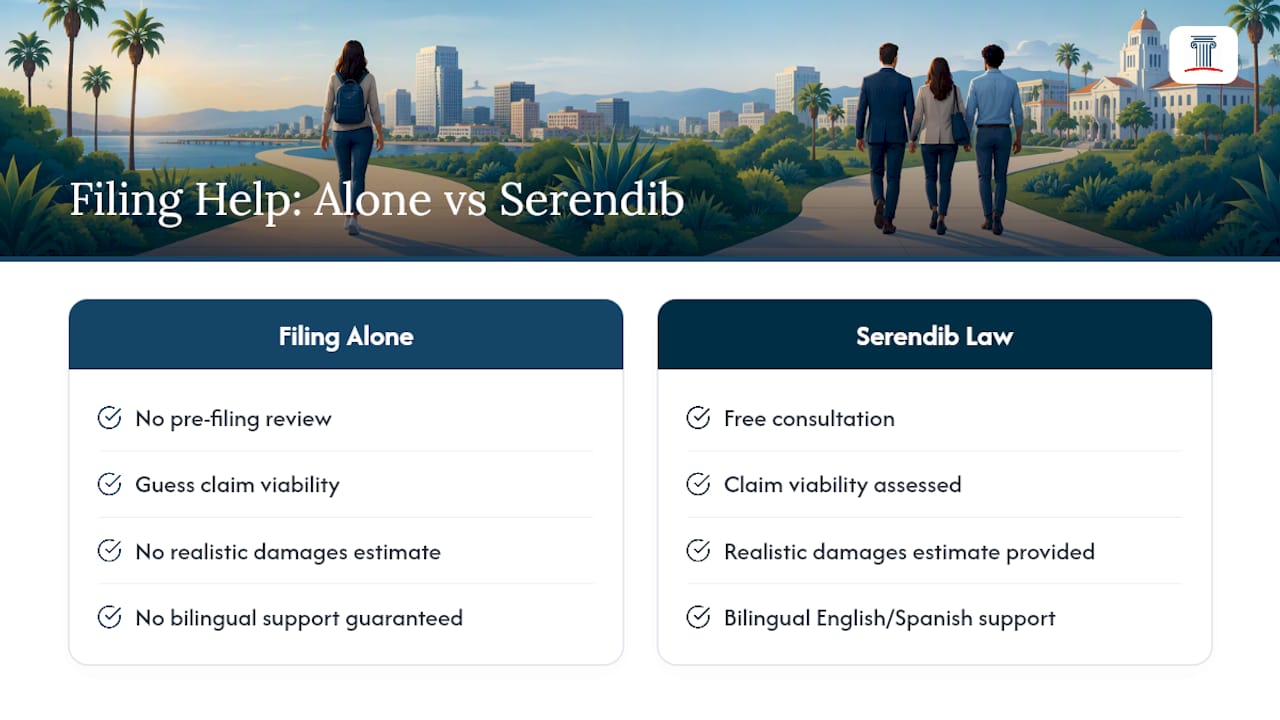
Filing a DLSE claim on your own is possible, but knowing whether your case is worth $800 or $18,000, and whether your employer is likely to appeal, is a different question entirely. Serendib Law Firm is the alternative to guessing your way through the DLSE process alone: Fullerton employees get a free consultation covering claim viability, your specific statute-of-limitations window, a realistic damages estimate, and whether contingency representation makes sense for your situation.
A consult with our employment law team walks through your pay records, timeline, and employer conduct before you ever submit paperwork, so you file once and file correctly. Bilingual support in English and Spanish means your case gets handled clearly, not lost in translation. If your situation also touches on injury, business disputes, or immigration status, our firm handles those matters too. Reach out through our contact page to schedule your free consultation and find out exactly where your Fullerton wage claim stands.
This article is general information, not a substitute for advice from a qualified lawyer. Consult a qualified legal professional about your own circumstances before acting on anything here.
Sources
- How to File a Wage Claim (DLSE)
- Instructions for Filing a Wage Claim (DLSE Form packet)
- Policies and Procedures for Wage Claim Processing (DLSE)
- What Happens After Hearing (DLSE)
FAQ
What Is the 7 Minute Rule in California?
The rule about rounding time punches allows employers to round to the nearest quarter hour, but only if the rounding is neutral over time and doesn’t consistently shortchange employees. If your Fullerton employer’s rounding practice systematically reduces your pay, that itself can support a wage claim.
Can I Sue My Employer for Stress and Anxiety in California?
You generally cannot sue solely for workplace stress unless it stems from an unlawful act like discrimination, harassment, or retaliation, which may support emotional distress damages in a broader employment claim. A straightforward unpaid wage dispute is handled through the DLSE process rather than a stress-based lawsuit.
What Is the Most Commonly Litigated Wage and Hour Violation?
Unpaid overtime is among the most frequently disputed violations, largely because calculating the correct overtime rate gets complicated when bonuses, commissions, or multiple pay rates are involved. Meal and rest break violations run a close second, especially in retail and food service jobs common around Fullerton.
What Happens When You File a Wage Claim in California?
After you file DLSE Form 1, a deputy labor commissioner reviews your claim and refers it to a conference, a formal hearing, or dismissal. If a hearing occurs, the officer typically issues a written decision within 15 days, and that decision can become an enforceable court judgment if your employer doesn’t pay.
Does Serendib Law Firm Charge for a Wage Claim Consultation?
Serendib Law Firm offers free consultations for Fullerton employees exploring a wage-and-hour claim, and contingency-fee representation is available in select employment matters. Current details on services and fee structures are available through the firm’s employment law page.