

A cyclist killed and two others seriously hurt on Pacific Coast Highway. That’s the reality Huntington Beach has faced in recent local crash reports, and it defines what injured riders need to do next: get medical care documented immediately, preserve every piece of evidence before it disappears, and contact a personal injury attorney before California’s filing clocks run out. Local personal injury attorneys work these cases locally, and timing decisions made in the first days often shape the outcome months later.
TL;DR:
- Immediate medical evaluation and documentation are crucial to preserve evidence and support your injury claim, especially for serious head, spinal, or internal injuries.
- Evidence such as police reports, scene photos, witness contact info, and medical bills must be collected quickly because they fade or get repaired over time.
- You have two years to file a personal injury lawsuit in California, but claims against public entities must be filed within six months through a formal claim process.
- Insurance coverage typically includes at-fault driver’s liability, uninsured motorist, and health insurance, but gathering strong evidence reduces the impact of shared fault.
- Contacting a lawyer promptly after severe crashes or hit-and-run incidents improves your chances to preserve evidence, navigate deadlines, and maximize recovery.
Table of Contents
- What Recent Bicycle Accidents in Huntington Beach Tell Us
- What Injuries Do Cyclists Typically Suffer, and Why Does Documentation Matter?
- What Legal Rights Do Injured Cyclists Have in California?
- What Steps Preserve Evidence After a Crash?
- How Much Time Do You Have to File a Claim in California?
- When Should You Contact a Personal Injury Lawyer?
- How Can Cyclists Reduce Their Risk on Huntington Beach Roads?
- What Bicycle Laws and Ordinances Apply in Huntington Beach?
- What Compensation Do Bicycle Injury Cases Typically Involve?
- How Do You Document Injuries and Damages for a Claim?
- What Insurance Coverage Applies to a Bicycle Accident Claim?
- A Local Attorney’s View on Huntington Beach Bicycle Cases
- Get Help After a Bicycle Accident in Huntington Beach
- Sources
- FAQ
What Recent Bicycle Accidents in Huntington Beach Tell Us
Local coverage of Huntington Beach crashes follows a pattern that matters to anyone filing an injury claim. In one case that drew widespread attention, prosecutors alleged a driver struck cyclists riding in a bike lane on Pacific Coast Highway near Newland, killed one rider, and kept driving roughly half a mile before stopping. Two surviving cyclists suffered spinal fractures and broken ribs. Separately, KTLA reported a fatal PCH collision involving a 70-year-old cyclist, underscoring that this isn’t an isolated event on that corridor.
A few contributing patterns show up again and again in these reports:
- Vehicles drifting into or crossing bike lanes, particularly along PCH
- Early-morning crashes when visibility is lower and traffic patterns shift
- Multi-cyclist incidents where a single driver error injures more than one rider
- Drivers fleeing the scene, triggering hit-and-run investigations alongside the civil claim
The outcomes described in these reports are severe. Fatalities, spinal fractures, and hospitalizations aren’t rare exceptions. They’re the baseline injuries local police and news outlets have documented on Huntington Beach roads.
What Injuries Do Cyclists Typically Suffer, and Why Does Documentation Matter?
Cyclists have almost no protection when a vehicle makes contact, so injuries tend to be serious even in crashes that look minor from the outside. The most common injuries reported in Huntington Beach cases include:
- Head trauma and concussion, sometimes with delayed symptoms
- Spinal fractures, which can require surgery and months of rehabilitation
- Broken ribs and limb fractures
- Internal injuries that don’t always show symptoms right away
Getting evaluated at an emergency room or urgent care immediately, even if you feel “okay,” does two things at once. It catches injuries that haven’t fully presented, and it creates a medical record with a timestamp close to the crash. Insurance adjusters and defense attorneys routinely challenge claims where treatment was delayed, arguing the injury came from something else.
Keep every piece of paper the crash generates: medical bills, prescription receipts, physical therapy schedules, and a log of workdays missed. That record becomes the backbone of your damages claim later.
What Legal Rights Do Injured Cyclists Have in California?
An injured cyclist generally has a negligence claim against the at-fault driver, built on the same legal theory as any car accident case: the driver owed a duty of care, breached it, and caused measurable harm. When a crash proves fatal, surviving family members can bring a separate wrongful-death claim, which follows different rules for who can sue and what damages apply.
Damages in these cases usually fall into two buckets:
- Economic damages: medical expenses, lost wages, future earning capacity, and property damage to the bicycle
- Non-economic damages: pain and suffering, loss of enjoyment of life, and in wrongful-death cases, loss of companionship and funeral or burial costs
California follows a pure comparative negligence rule, established by Li v. Yellow Cab Co., which means you can still recover damages even if you share some fault for the crash. Your award simply gets reduced by your percentage of responsibility. A cyclist found 30% at fault for, say, riding without lights at night would see their recovery cut by 30%, not eliminated. Insurance companies lean hard on comparative fault arguments to shrink payouts, which is exactly why the evidence you gather in the first days after a crash carries so much weight later.
What Steps Preserve Evidence After a Crash?
Evidence disappears fast. Skid marks fade, witnesses forget details, and vehicle damage gets repaired. If you’re able to act at the scene or shortly after, these steps protect your claim:
- Call 911 and request police response, even for crashes that seem minor at first.
- Photograph the scene from multiple angles: your injuries, the vehicle, skid marks, road conditions, and any bike lane signage.
- Collect names and contact information from witnesses before they leave.
- Request the police report and keep the report number. Insurers and attorneys will ask for it repeatedly.
- File a DMV SR-1 report within 10 days if the crash caused injury, death, or significant property damage. This is a separate obligation from the police report, and failing to file it can affect a driver’s license record.
- Save every medical record, repair estimate, receipt, and written communication from any insurance adjuster.
Police reports and DMV filings serve different purposes but both matter. One documents what happened; the other creates a state-level record tied to the driver’s history.
How Much Time Do You Have to File a Claim in California?
California law gives injured cyclists two years from the date of injury to file a personal injury lawsuit under CCP §335.1. Wrongful-death claims generally follow a similar two-year window, though the clock starts from the date of death rather than the crash itself in some circumstances.
That deadline shortens dramatically if a government entity or public employee contributed to the crash, such as a poorly maintained bike lane on a city-owned road. In that scenario, California Government Code §911.2 requires a formal claim presented to the public entity within six months, well before the standard two-year window would normally apply.
A few situations toll or pause these deadlines, including certain minors’ claims and cases involving delayed injury discovery. These exceptions are narrow and easy to misapply without legal guidance, which is exactly why contacting an attorney early protects your options rather than just satisfying a formality.
When Should You Contact a Personal Injury Lawyer?
Contact an attorney promptly if the crash involved a serious injury, a death, or a hit-and-run driver. These cases move fast: insurers open investigations within days, and a driver who fled the scene may face separate criminal proceedings that intersect with your civil claim.
Bring what you have to a free consultation:
- The police report number
- Photos of the scene, vehicle, and your injuries
- Medical records and billing statements
- Pay stubs showing missed work
- Any written communication from insurance companies
- Contact information for witnesses
Attorneys typically move quickly to send evidence-preservation letters to insurers, interview witnesses before memories fade, and open negotiations with the driver’s insurance carrier. A Huntington Beach personal injury lawyer can also flag whether a government-claim deadline applies to your case, something easy to miss without legal training.
Pro Tip: Never give a recorded statement to an insurance adjuster without talking to an attorney first. Adjusters are trained to ask questions that make you sound partly at fault, and anything you say on that recording can be used to reduce your settlement later.
How Can Cyclists Reduce Their Risk on Huntington Beach Roads?
Pacific Coast Highway’s mix of tourist traffic, beach access points, and cyclists sharing narrow lanes creates real risk, and no amount of caution eliminates it entirely. Still, a few habits meaningfully lower the odds of a serious crash.
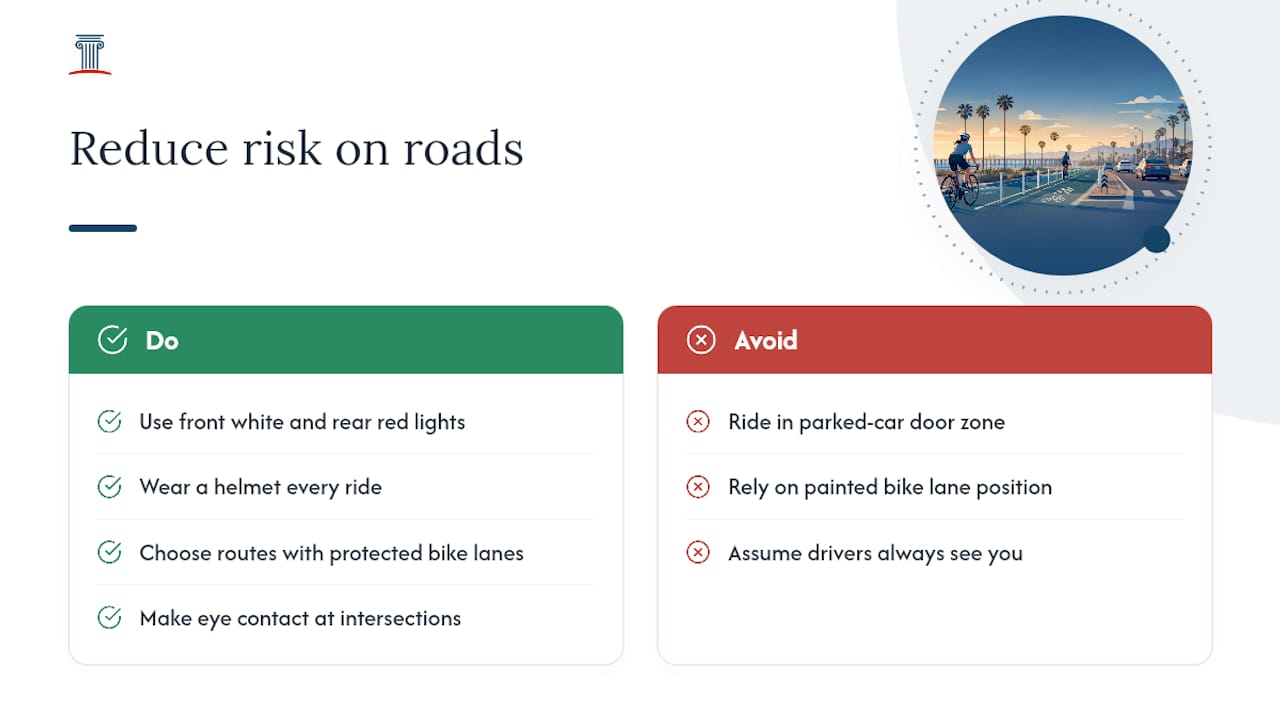
Ride with a front white light and rear red light during early morning or evening hours, when several reported Huntington Beach crashes have occurred. Visibility gaps at dawn are a recurring factor in local collision reports, and a $15 light kit is cheap insurance against a driver who simply doesn’t see you.
Avoid riding in a bike lane’s door zone next to parked cars, and watch for vehicles making right turns across your path at intersections, one of the most common ways cyclists get hit even when riding legally. Position yourself where drivers expect to look for you, not where the paint happens to be.
Wear a helmet every ride, no exceptions. Head trauma shows up repeatedly in local injury reports, and a helmet doesn’t prevent a crash but it changes the outcome when one happens.
Choose routes with dedicated bike lanes over PCH where possible, especially near Newland and other stretches that have seen multiple documented incidents. Beach Boulevard and inland routes through residential neighborhoods often carry less high-speed vehicle traffic.
Finally, assume every driver at an intersection hasn’t seen you. Make eye contact when you can, and never assume a car is yielding just because you have the right of way. That habit alone prevents a large share of the intersection collisions that show up in Huntington Beach crash reports.
What Bicycle Laws and Ordinances Apply in Huntington Beach?
California’s Vehicle Code sets the statewide baseline: cyclists have the same rights and responsibilities as drivers, must ride with traffic flow, and are required to use a bike lane when one is present and safe to use, with reasonable exceptions like avoiding hazards or preparing to turn.
Huntington Beach layers on local infrastructure decisions that affect cyclist safety directly. The city has continued expanding its beach-adjacent bike path network separate from PCH vehicle lanes, giving riders an alternative to sharing space with car traffic along the coast. Where cyclists must use PCH itself, the roadway includes marked bike lanes, though lane width and buffer space from vehicle traffic vary by segment.
Local ordinances also address bicycle equipment and conduct: lights are required for nighttime riding, and riding under the influence carries the same basic legal exposure as impaired driving, though enforcement and penalties differ. Cyclists riding on sidewalks in commercial zones near the pier can also run into local restrictions that vary by block, so checking posted signage matters more in Huntington Beach’s dense downtown corridor than in quieter residential areas.
None of these local rules override the core civil liability question after a crash. Whether a cyclist was technically following every ordinance affects the comparative negligence analysis, but it doesn’t determine whether a driver who caused the crash bears responsibility for the damages.
What Compensation Do Bicycle Injury Cases Typically Involve?
Compensation in California bicycle injury cases depends heavily on the severity of the injury, the strength of liability evidence, and available insurance coverage, so there’s no single “average” figure that applies across cases. What’s consistent is the structure of what gets claimed.
Economic damages form the foundation: emergency treatment, surgery, imaging, physical therapy, prescription costs, and lost income during recovery. Cases involving spinal fractures or extended hospitalizations, the kind of injuries repeatedly documented in Huntington Beach crash reports, tend to carry substantial medical costs precisely because that level of injury often requires ongoing care, not just a single hospital visit.
Non-economic damages account for pain and suffering, the disruption to daily life, and permanent limitations if the injury leaves lasting effects. In wrongful-death claims, families can also recover funeral and burial expenses along with damages tied to loss of companionship and financial support.
The comparative negligence rule directly shapes the final number. A claim with strong liability evidence and no significant cyclist fault recovers differently than one where the insurer can point to fault-sharing factors, which is why the evidence-gathering steps covered earlier aren’t just procedural boxes to check. They directly affect what a case is worth. Available insurance limits on the at-fault driver’s policy also cap what’s realistically recoverable in many cases, regardless of how strong the claim otherwise is.
How Do You Document Injuries and Damages for a Claim?
Strong documentation turns a claim from “he said, she said” into something an insurer or a court can verify line by line. Start with medical records: every ER visit, specialist referral, imaging result, and physical therapy session needs to be requested and kept in one place, not scattered across different providers’ patient portals.
Track financial losses methodically. Keep pay stubs showing pre-crash income alongside records of missed work, and if the injury affects your ability to do your job long-term, a doctor’s written opinion on future limitations becomes important for calculating lost earning capacity.
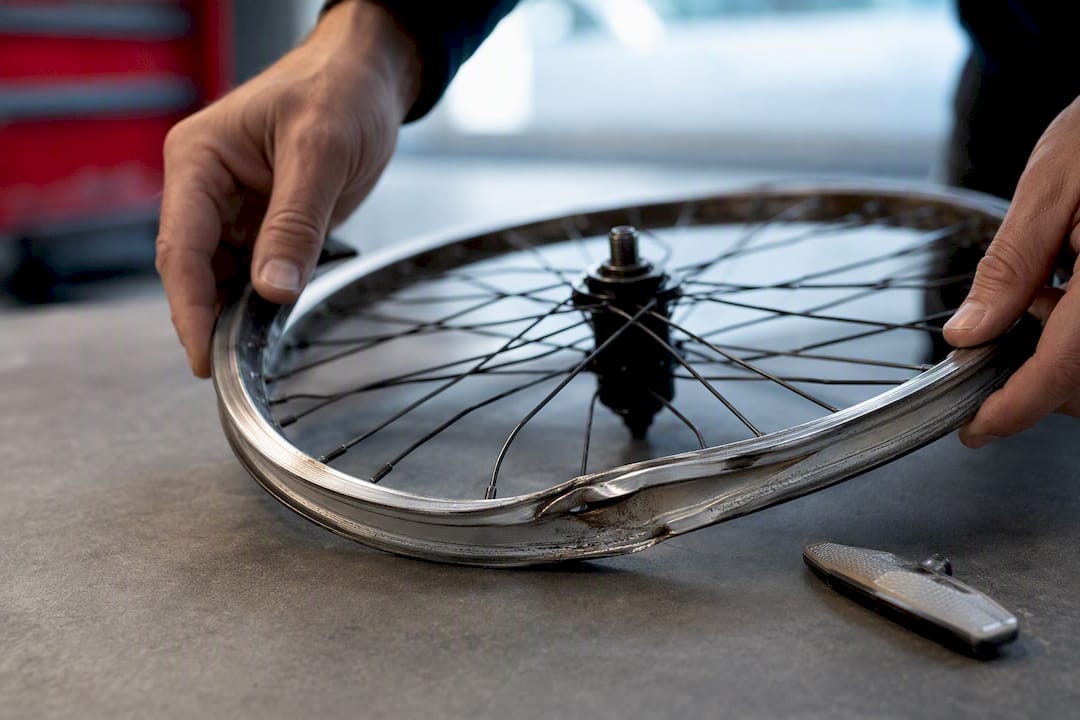
Photograph your injuries as they heal, not just immediately after the crash. Bruising, swelling, and surgical scars change over weeks, and a photo timeline shows the recovery process more convincingly than a single snapshot. Keep the damaged bicycle and any broken equipment rather than discarding them; they’re physical evidence of impact force and can support both the injury claim and a separate property damage claim.
Finally, keep a simple daily log noting pain levels, limitations on activity, and how the injury affects sleep, work, and family life. Insurers frequently discount non-economic damages when there’s no contemporaneous record supporting them, so this log fills that gap.
What Insurance Coverage Applies to a Bicycle Accident Claim?
Multiple insurance policies can come into play after a Huntington Beach bicycle crash, and knowing which one applies where speeds up the claims process considerably.
The at-fault driver’s auto liability insurance is typically the primary source of compensation, covering medical bills, lost wages, and pain and suffering up to the policy limits. If that driver is uninsured or underinsured, and hit-and-run cases sometimes fall into this category before the driver is identified, your own auto policy’s uninsured/underinsured motorist coverage may apply even though you were riding a bicycle, not driving a car.
Health insurance often covers initial emergency treatment regardless of fault, though most health insurers will assert a lien against any eventual settlement to recoup what they paid. Medical payments coverage (MedPay), if you carry it on an auto policy, can also help cover bills quickly without waiting for the liability claim to resolve.
Personal injury protection isn’t standard in California the way it is in no-fault states, but some auto policies offer optional coverage that functions similarly. Reviewing your own policy, along with the at-fault driver’s, is a step worth doing early, since coverage gaps affect how a claim gets structured from the start.
A Local Attorney’s View on Huntington Beach Bicycle Cases
Every Huntington Beach bicycle case I’ve reviewed shares a common thread: the injuries are almost always more serious than they first appear, and the evidence window closes faster than clients expect. Spinal fractures and head trauma don’t always announce themselves at the scene, and by the time symptoms surface, skid marks have faded and witnesses have moved on.
We handle these cases with a client-first approach that includes free consultations and contingency-fee representation, meaning you don’t pay unless we recover for you. Some local law firms offer bilingual services in English and Spanish to better assist clients navigating a crash’s aftermath.
— Maya Serkova
Get Help After a Bicycle Accident in Huntington Beach
Some personal injury law firms represent injured cyclists on a contingency-fee basis, meaning the legal team only gets paid when you recover compensation. That structure exists precisely because families dealing with a crash’s aftermath shouldn’t have to front legal costs while also managing medical bills and lost income.
Many law firms offer free consultations that include a straightforward review of your case, the existing evidence, and applicable deadlines, including the shorter government-claim window if a public entity was involved. From there, we move quickly to preserve evidence, request the police report, and open communication with the insurance company on your behalf so you’re not negotiating alone against an adjuster whose job is to minimize your payout.
If you or a family member was injured in a Huntington Beach bicycle crash, reach out through our personal injury practice page or call our office directly to schedule your free consultation before evidence and deadlines start working against you.
This article is general information, not a substitute for advice from a qualified lawyer. Consult a qualified legal professional about your own circumstances before acting on anything here.
Sources
- Li v. Yellow Cab Co. — Wikipedia
- Deadlines to sue someone | California Courts | Self Help Guide
- SR 1, Report of Traffic Accident Occuring in California — DMV
- Mynewsla
FAQ
What happened to the bicyclist killed on PCH in Huntington Beach?
Local reporting described a collision near Newland where prosecutors alleged a driver struck cyclists riding in a bike lane on Pacific Coast Highway, killing one rider and seriously injuring two others before the driver allegedly continued driving.
What is the most common injury for cyclists in a crash?
Head trauma, spinal fractures, and broken ribs or limbs are the injuries most frequently documented in Huntington Beach bicycle crash reports, often requiring emergency imaging and extended follow-up care.
How long do I have to file a bicycle injury lawsuit in California?
You generally have two years from the date of injury under CCP §335.1, though claims against a government entity require a formal notice within six months instead.
Does it matter if I was partly at fault for the crash?
No, California’s pure comparative negligence rule from Li v. Yellow Cab Co. still allows you to recover damages, just reduced by your percentage of fault.
Do I need to report the crash to the DMV separately from the police?
Yes, California requires an SR-1 form filed with the DMV within 10 days of any crash causing injury or death, separate from any police report.
Does Serendib Law Firm handle Huntington Beach bicycle accident cases?
Yes, Serendib Law Firm represents injured cyclists in Huntington Beach on a contingency-fee basis with free consultations and bilingual support in English and Spanish.