

Under California law, employees in Fountain Valley are protected from workplace discrimination based on a wide range of personal characteristics, and you have real, enforceable options if you believe your employer crossed that line. You can file an intake with the California Civil Rights Department (CRD) within three years of the harm, or request an immediate Right-to-Sue notice to head straight to court. Either path starts with preserving your evidence and, ideally, talking to a California employment lawyer before you sign anything your employer hands you.
TL;DR:
- Discrimination claims under FEHA apply to employers with five or more employees, but harassment protection is available regardless of company size.
- You must file your complaint with CRD within three years of the harmful incident, with an option to request an immediate Right-to-Sue notice for faster court action.
- California protects a broad range of characteristics, including race, religion, sex, age, disability, and reproductive health, even if you are perceived to belong to a protected group.
- Evidence preservation and documented internal reporting are crucial within days of discrimination to strengthen your case and address retaliation risks effectively.
- Consulting an employment lawyer early can clarify your optimal filing route, help gather strong evidence, and prevent costly mistakes before deadlines pass.
Table of Contents
- Employment Discrimination Fountain Valley CA Employee Rights: What FEHA Covers
- Which Characteristics Does California Protect at Work?
- How Do You Tell the Difference Between Types of Discrimination?
- Filing With the Civil Rights Department: Steps and Deadlines
- What Compensation Can You Recover in a Discrimination Case?
- What Should You Do Right Now If You Suspect Discrimination?
- Who Handles Your Case: Author Background and Firm Credentials
- The Real Timeline Behind a Discrimination Claim
- Talk to a California Employment Lawyer Before Your Deadline Closes
- Where to Verify Deadlines and Read the Law Yourself
- Sources
- FAQ
Employment Discrimination Fountain Valley CA Employee Rights: What FEHA Covers
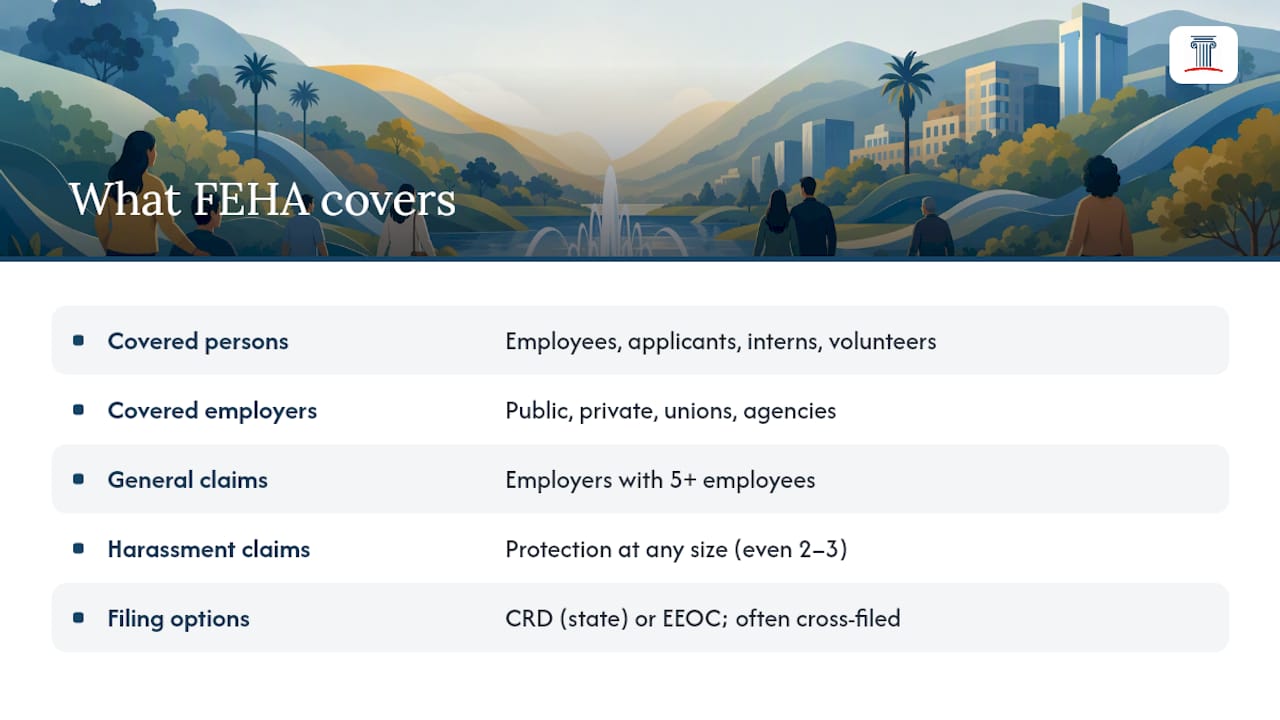
California’s Fair Employment and Housing Act, known as FEHA, is the backbone of workplace discrimination protection for anyone working in Fountain Valley. It protects employees, job applicants, interns, and even volunteers, and it applies to public agencies, private companies, labor unions, and employment agencies alike. If you clocked in this morning at a warehouse near the 405, a retail counter on Warner Avenue, or a medical office near Fountain Valley Regional Hospital, FEHA’s protections travel with you.
There’s a size threshold worth knowing. General discrimination claims under FEHA apply to employers with five or more employees. Harassment claims are different: those protections apply no matter how small the company is, even if your employer has just two or three people on payroll. That distinction trips up a lot of workers who assume a tiny company is somehow exempt from the law altogether. It isn’t, at least not when the issue is harassment.
You also have a choice most people don’t realize exists: filing at the state level with CRD, or filing federally with the Equal Employment Opportunity Commission (EEOC). The two systems overlap heavily, and in many cases a complaint filed with one agency gets cross-filed with the other automatically. Generally, FEHA offers a longer filing window and a broader list of protected characteristics than federal law, which is why most California employment lawyers steer clients toward the state route first. Federal law becomes the better fit when your employer has fewer than five employees but fifteen or more, since federal anti-discrimination statutes kick in at that lower threshold for certain claims, or when a case involves multi-state conduct that needs federal court jurisdiction.
None of this requires you to be a legal expert before you act. What it does require is knowing that the clock starts running the moment discrimination occurs, and that Fountain Valley employees have exactly the same FEHA protections as workers in Los Angeles or San Francisco. Geography doesn’t shrink your rights. It just determines which local attorneys and CRD offices you’ll be dealing with.
Which Characteristics Does California Protect at Work?
FEHA’s list of protected characteristics is longer and more detailed than most employees expect, and that breadth is exactly what makes California one of the stronger employee-protection states in the country. If your employer treated you differently because of any of the following, you may have a claim worth exploring.
- Race, color, ancestry, and national origin — including accent-based discrimination and immigration-status bias in some contexts
- Religion — covers religious dress, grooming practices, and requests for religious accommodation
- Sex, pregnancy, childbirth, and breastfeeding — denying pregnancy accommodations or pushing out a breastfeeding employee both qualify
- Gender, gender identity, and gender expression
- Sexual orientation
- Age 40 and older
- Physical or mental disability, and medical conditions
- Genetic information
- Marital status
- Reproductive health decision-making — decisions about contraception, fertility treatment, or abortion
- Military and veteran status
The full statutory list, along with employer obligations tied to it, is codified in California Government Code Section 12940.
Real-world examples help make this concrete. A supervisor who mocks an employee’s natural hairstyle or braids is very likely running afoul of race-based protections. A manager who denies a lighter-duty request during pregnancy, ignores a hijab or turban as part of religious dress, or reassigns a 52-year-old worker’s accounts to “bring in fresh energy” is treading on protected ground. FEHA also covers you if you’re perceived to belong to a protected group, even if the perception is wrong, and it protects you if you’re discriminated against because of your association with someone in a protected class, such as a spouse with a disability.
How Do You Tell the Difference Between Types of Discrimination?
Not all workplace discrimination looks the same, and the legal label attached to your situation affects how you build your case. Four categories come up most often in Fountain Valley employment claims.
- Disparate treatment happens when an employer treats you worse than similarly situated coworkers because of a protected characteristic, such as passing you over for a promotion that went to a less-qualified colleague outside your protected group.
- Disparate impact occurs when a policy that looks neutral on paper ends up harming a protected group disproportionately, like a strength test that screens out most female applicants for a job that doesn’t actually require that strength.
- Hostile work environment describes harassment severe or pervasive enough to make your workplace intimidating or abusive, whether that’s repeated slurs, unwanted touching, or a barrage of demeaning jokes tied to your religion or disability.
- Quid pro quo harassment involves a supervisor conditioning job benefits, like a raise or continued employment, on submission to unwelcome sexual advances.
Retaliation deserves its own mention because it is a common claim, and it’s separate from the underlying discrimination itself. Retaliation covers any materially adverse action taken against you because you engaged in protected activity, such as filing a complaint, reporting harassment, or supporting a coworker’s discrimination claim. That can mean termination, but it can also mean a sudden demotion, a schedule change that guts your income, exclusion from meetings, or a manufactured performance improvement plan that appears the week after you complained.
Pro Tip: If your job duties, schedule, or treatment shift noticeably within days or weeks of filing a complaint or requesting an accommodation, write down the exact dates immediately. Timing is often the strongest evidence of retaliation, and it fades from memory fast.
Small employers sometimes assume they’re insulated from all of this. They’re not. Harassment protections under FEHA apply regardless of employer size, and California’s legislature has affirmed that even a single severe incident can be enough to create a triable hostile work environment claim, depending on the totality of the circumstances.
Filing With the Civil Rights Department: Steps and Deadlines
Filing a discrimination complaint in California starts with CRD, and the process is more structured than most employees expect once they actually sit down to do it.
- Choose your filing method. The fastest route is the CRD’s online CCRS portal, though you can also file by mail or email if that suits your situation better.
- Complete the intake form. CRD’s intake form for employment claims asks for specific incident details, the protected characteristic involved, and identifying information for the people involved, including witnesses.
- Sit through the intake interview. CRD reviews your submission and conducts an interview to determine whether your complaint falls within its jurisdiction before a formal complaint is drafted.
- Decide on investigation versus immediate Right-to-Sue. You can let CRD investigate, or you can request an immediate Right-to-Sue notice and skip the agency process entirely.
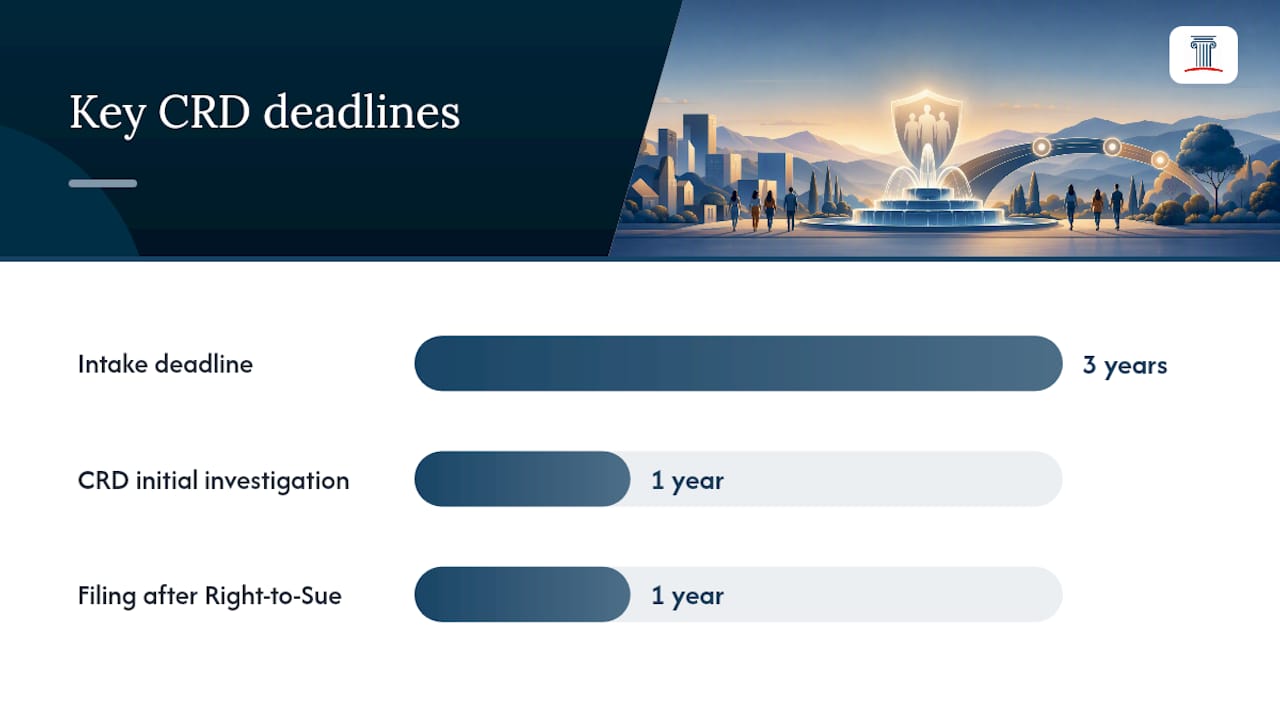
Deadlines matter enormously here. You generally must submit your intake to CRD within three years of the last date you were harmed. If you request an immediate Right-to-Sue notice, you generally have a limited time from that notice to file your lawsuit in civil court, as specified by law. Miss either window, and you may lose your ability to pursue the claim altogether.
CRD generally has a statutory period from the date a complaint is filed to complete its initial investigation, though many cases resolve faster through mediation or settlement long before that year is up.
The investigation-versus-Right-to-Sue decision is a real strategic fork, not a formality. Requesting an investigation keeps CRD in the driver’s seat, which can produce administrative findings that carry weight in later settlement talks, and it buys you time to keep gathering evidence while the case sits with the agency. Requesting immediate Right-to-Sue gets you into court faster, which matters if your case is strong and you’d rather negotiate directly or if the one-year clock after Right-to-Sue actually gives you more breathing room than the three-year intake deadline suggests. There’s no universally correct choice. It depends on how solid your documentation already is and how quickly you need resolution.
If you need language assistance or a disability accommodation to complete your filing, CRD provides interpreters and accessibility support, and you can reach the department directly at 800-884-1684 to arrange it.
What Compensation Can You Recover in a Discrimination Case?
Winning a discrimination claim in California can produce more than a single settlement check. State law allows for a genuinely broad set of remedies, and understanding them helps you set realistic expectations before you start the process.
- Back pay for wages lost between the discriminatory act and the resolution of your case
- Front pay covering future lost earnings if reinstatement isn’t practical
- Reinstatement to your former position
- Policy changes requiring the employer to fix the practice that caused the harm
- Emotional distress damages for the psychological toll of the discrimination or harassment
- Punitive damages in cases involving particularly egregious or malicious conduct
- Attorney’s fees, which can shift the financial burden of pursuing the claim away from you
These outcomes come through several different channels: a negotiated settlement, CRD-facilitated mediation, or a court judgment after litigation. Each path has a different timeline and a different amount of leverage attached to it.
Whichever path your case takes, documentation drives the outcome. Pay stubs, performance reviews, termination letters, and any written communication about the discriminatory conduct all become evidence for calculating what you actually lost, and for proving the emotional and professional toll the situation caused.
What Should You Do Right Now If You Suspect Discrimination?
The decisions you make in the first days after you notice discrimination often determine how strong your case looks months later. Here’s the order that protects you best.
- Preserve every piece of evidence immediately. Save emails, text messages, performance reviews, pay stubs, and a written timeline with exact dates for each incident. Courts and CRD investigators lean heavily on chronological detail, so vague memories of “sometime last spring” won’t carry the weight that a dated log will.
- Report internally, in writing. Tell HR or your supervisor what happened, keep a copy of whatever you send, and stick to facts rather than accusations or emotional language. A calm, dated email describing specific conduct holds up far better than a heated verbal complaint that leaves no paper trail.
- Put accommodation requests in writing too. If you’re requesting a disability accommodation or pregnancy-related leave, document the request formally and keep your medical provider’s notes on file. For pregnancy and disability claims specifically, those notes should state the recommended accommodation and any work restrictions explicitly, since that documentation becomes central to any interactive-process dispute later. Be aware of related timelines under Pregnancy Disability Leave (PDL) and the California Family Rights Act (CFRA), which run on their own separate clocks.
- Don’t sign anything you haven’t reviewed with counsel. Employers sometimes present severance agreements or releases immediately after a complaint or termination. Signing away your rights under pressure, before you understand what you’re giving up, is one of the costliest mistakes an employee can make.
Pro Tip: Keep a private, dated log outside of any company device or account. If you lose access to your work email the day you’re terminated, a personal record is often the only evidence you’ll have left.
If your employer retaliates after you raise a concern internally, that retaliation is its own separate violation, and it strengthens rather than weakens your position. A confidential consultation with an employment law attorney can help you figure out whether what you’re experiencing crosses that line, and if you’d rather read more about how retaliation claims work specifically, Serendib Law Firm’s guide on workplace retaliation in Fountain Valley, CA walks through it in detail.
Who Handles Your Case: Author Background and Firm Credentials
This article was prepared with input from an attorney who focuses on employment law matters at a firm based in Orange County representing employees across Fountain Valley and surrounding communities. The firm’s employment practice covers wrongful termination, harassment, discrimination, retaliation, wage disputes, and disability accommodation disputes, with bilingual support available in English and Spanish.
Some law firms offer free consultations and handle qualifying employment matters on a contingency-fee basis, meaning attorney’s fees may not be incurred unless the case results in a recovery. That structure matters most for employees who can’t afford hourly billing while they’re already dealing with lost income.
Reaching out to counsel makes the most sense when your evidence is complicated, your CRD deadline is approaching fast, or your employer has retaliated after you raised a concern. Waiting rarely helps in any of those scenarios, and an early conversation with an experienced employment law attorney can clarify options you may not know you have.
The Real Timeline Behind a Discrimination Claim
Most employees assume filing with CRD means a fast resolution. It doesn’t always work that way. CRD generally has up to a year to complete an investigation, and while many cases settle well before that deadline, some genuinely run the full course. That’s not a flaw in the system. It’s the price of a process thorough enough to produce findings that actually hold up.
Where early counsel earns its value is in evidence strategy, not paperwork. An attorney who reviews your documentation in week one, rather than month eleven, can flag gaps while witnesses still remember details and while relevant emails haven’t been deleted in a routine system purge. The trade-off between requesting an investigation and taking an immediate Right-to-Sue notice usually comes down to whether your case benefits more from CRD’s administrative weight or from the speed of getting into court. Neither choice is automatically better. The right one depends on how strong your file already is.
— Maya Serkova
Talk to a California Employment Lawyer Before Your Deadline Closes
Serendib Law Firm is the alternative to guessing your way through a CRD filing alone. Where the state process gives you forms and deadlines, Serendib Law Firm gives you a Fountain Valley based California employment lawyer who reviews your evidence, tells you plainly whether immediate Right-to-Sue or a full investigation fits your case better, and handles the filing details while you focus on your job and your recovery. Consultations are free and confidential, and qualifying employment matters are handled on a contingency-fee basis, so cost isn’t the barrier to getting real answers.
Bring what you already have: the dates of each incident, any emails or texts you’ve saved, pay records, and a copy of your CRD intake if you’ve already started one. From there, the firm’s employment law practice team can map out your realistic options. If your situation involves a workplace injury alongside the discrimination, or a business dispute tied to the same employer, Serendib Law Firm’s personal injury and business litigation teams handle those matters too, along with immigration law and disability and workers’ compensation claims that sometimes overlap with an employment case. Call or fill out the contact form today to get a confidential consultation scheduled before any deadline sneaks up on you.
Where to Verify Deadlines and Read the Law Yourself
If you want to confirm anything in this article directly at the source, CRD’s employment page lists protected characteristics and remedies in full, and the complaint process page walks through intake and CCRS portal steps. For the statutory text itself, Government Code Section 12940 spells out unlawful employment practices in the state’s own legal language. Federal comparators and EEOC filing information are worth reviewing too if your employer falls into a size range where federal law applies alongside FEHA.
This article is general information, not a substitute for advice from a qualified lawyer. Consult a qualified legal professional about your own circumstances before acting on anything here.
Sources
- Employment | CRD – Civil Rights Department – CA.gov
- Complaint process | CRD – Civil Rights Department – CA.gov
- Instructions for obtaining a Right-to-Sue (CRD)
- California Government Code §12940 — Unlawful employment practices
FAQ
What Is the 80% Rule in Discrimination Cases?
The “80% rule,” more accurately called the four-fifths rule, is a federal statistical guideline used to flag disparate impact. If a hiring or promotion practice selects a protected group at less than 80% of the rate of the highest-selected group, it can signal discriminatory impact worth investigating, though it’s a screening tool rather than proof on its own.
Can I Sue My Employer for Stress and Anxiety in California?
Yes. California law allows employees to recover emotional distress damages when workplace discrimination or harassment causes psychological harm, including anxiety and stress. Medical or therapy records documenting that harm strengthen the claim significantly.
What Is the Three-Year Filing Rule in California?
In employment cases, you generally must submit an intake to CRD within three years of the date you were last harmed. If you request an immediate Right-to-Sue notice instead, you typically have one year from that notice to file a lawsuit in court.
What Are Common Examples of Unfair Discrimination at Work?
Common examples include denying a pregnant employee a reasonable accommodation, mocking an employee’s religious dress or natural hairstyle, passing over a qualified older worker for promotion, and retaliating against someone for reporting harassment. Each of these can fall under FEHA’s protected categories depending on the specific facts.
Do I Need a Lawyer to File With CRD?
No, you can file an intake with CRD on your own. Many employees still consult a California employment lawyer first, since an attorney can help you decide between requesting an investigation or an immediate Right-to-Sue notice and can spot evidence gaps before deadlines close.