
TL;DR:
- Bonus clawback disputes are increasingly contested in Newport Beach due to California’s evolving legal landscape and new legislation effective in 2026. Employers face stricter rules under AB 692, including mandatory attorney review periods, prorated repayment limits, and narrowed triggering events, which protect employees from invalid clawbacks. Federal laws like Dodd-Frank further complicate matters by imposing no-fault clawback obligations on current and former executives based on financial restatements, regardless of fault.
Bonus clawback disputes are quietly becoming one of the most contested issues for finance professionals across Newport Beach. A widespread assumption in the industry is that a bonus, once paid, is permanently yours, but California’s evolving legal landscape has made that belief dangerous and costly. With new state legislation taking effect in 2026, alongside long-standing federal mandates, the rules governing clawback agreements are more layered than most executives realize. This guide gives you a clear, practical roadmap through those rules so you can protect what you’ve earned.
Table of Contents
- Understanding bonus clawbacks: Definitions and legal basics
- Recent California laws reshaping clawback agreements
- How federal rules impact Newport Beach finance executives
- Responding to a clawback demand: Best practices for Newport Beach professionals
- Why most Newport Beach finance professionals misunderstand bonus clawback risks
- Get Newport Beach legal support for bonus clawback disputes
- Frequently asked questions
Key Takeaways
| Point | Details |
|---|---|
| Earned vs. unearned bonuses | Only unearned or clearly discretionary bonuses can be clawed back under California law. |
| 2026 AB 692 changes | AB 692 adds strict review and repayment rules for new bonus agreements with clawback terms. |
| Federal clawback rules | Dodd-Frank may force finance executives to repay bonuses after company restatements, even without personal fault. |
| Strategic response | Prompt legal consultation and careful document review are essential when facing a clawback demand. |
| Written agreements matter most | Oral promises rarely protect executives in bonus disputes—demand detailed written terms. |
Understanding bonus clawbacks: Definitions and legal basics
A bonus clawback is a contractual provision that requires an employee to return all or part of a bonus payment to their employer under specific conditions. These clauses appear frequently in sign-on packages, retention agreements, performance bonuses, and incentive compensation structures common throughout Newport Beach’s asset management, banking, and financial advisory sectors.
Not all bonuses are created equal under California law. The critical legal distinction is between earned wages and discretionary bonuses. Earned wages are compensation tied to work already performed and are protected under Labor Code Section 221, which prohibits employers from deducting or reclaiming wages that belong to the employee. Discretionary bonuses, by contrast, are payments made at the employer’s sole option and without a prior contractual promise.
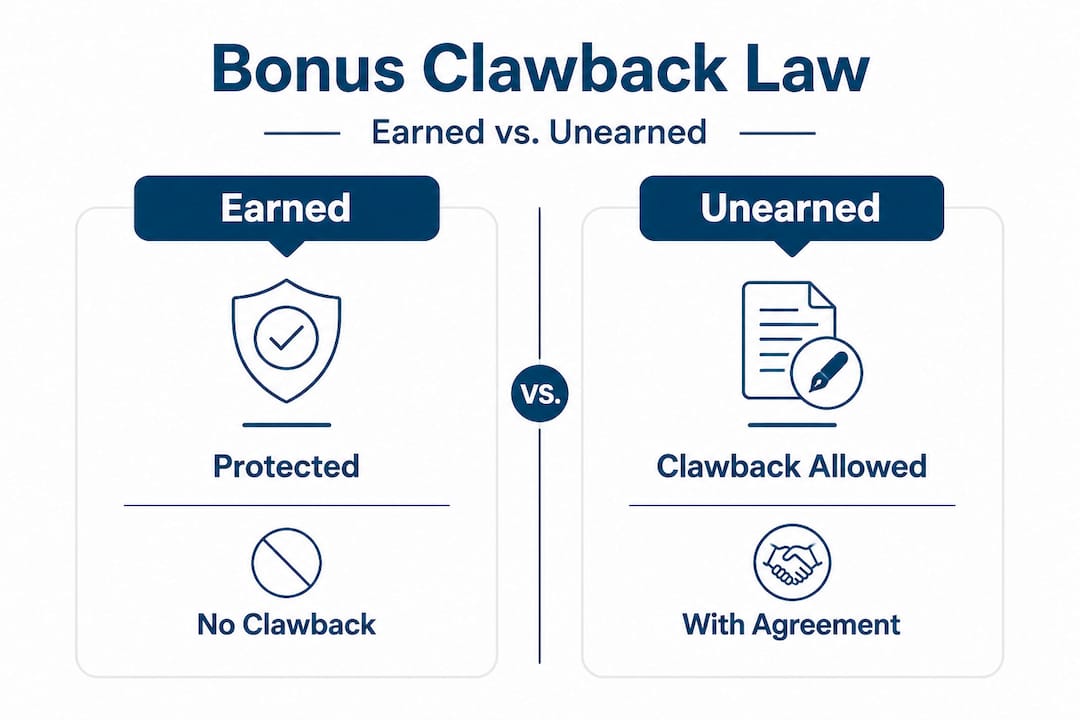
Bonus clawbacks in California are prohibited for earned wages, but allowed for unearned or discretionary types if clearly agreed in writing. This distinction sounds clean on paper but gets murky fast in high-compensation finance roles where bonuses are often performance-linked and partially discretionary at the same time.
Here is a quick breakdown of the most common bonus types and their general clawback exposure:
| Bonus type | Earned wage status | Clawback generally enforceable? |
|---|---|---|
| Sign-on bonus | Not yet earned (conditional) | Yes, if terms are in writing |
| Retention bonus | Conditional on continued service | Yes, under AB 692 terms |
| Performance bonus (formula-based) | Arguably earned upon achieving metric | Limited, depends on language |
| Discretionary annual bonus | Employer’s option | Yes, unless already paid and vested |
| Incentive compensation (public firms) | Varies, may overlap with Dodd-Frank | Yes, under federal rules |
Key legal concepts every Newport Beach finance professional should know before signing any bonus agreement:
- Labor Code Section 221 bars employers from collecting back wages already earned through completed work.
- Written agreements are required for any clawback to be enforceable under current California standards.
- Ambiguous bonus language tends to favor the employee under California’s wage-protective interpretations.
- If a bonus is tied to a specific, measurable performance trigger you’ve already hit, the employer faces a harder argument for reclaiming it.
Understanding how your specific bonus is categorized is the first and most important step when executive bonus disputes arise. If you’re working in sales or commission-heavy roles, the same analytical framework applies to commission and bonus disputes in broader Orange County contexts.
“The strength of a clawback demand depends almost entirely on whether the bonus was truly discretionary or whether the employee had a vested right to it. The written agreement is everything.” — California employment law principle
Recent California laws reshaping clawback agreements
With the foundation set, it’s crucial to see how new state legislation changes the playing field for bonus agreements.

AB 692 sets strict rules for sign-on and retention bonus clawback clauses, including a mandatory five-day attorney review period, prorated repayment requirements, and limitations on when clawbacks can be triggered. These rules became effective January 1, 2026, and they directly affect any new employment or bonus agreement signed since that date.
Here’s a side-by-side comparison to show what changed:
| Clawback clause requirement | Pre-2026 standard | Post-2026 under AB 692 |
|---|---|---|
| Attorney review period | Not required | Minimum 5 business days |
| Agreement structure | Could be buried in offer letter | Must be a separate, standalone document |
| Repayment calculation | Employer’s discretion | Prorated based on time worked |
| Interest on repayment | Sometimes included | Prohibited |
| Triggering events | Broad (any resignation) | Limited to voluntary quit or misconduct |
This is a significant shift. Before 2026, a Newport Beach finance employer could include a clawback clause tucked into a multi-page offer letter, allow no independent review time, and trigger repayment on virtually any departure. AB 692 eliminates all of that.
The most impactful changes for executives to know:
- The five-day review rule is mandatory. Your employer must give you at least five business days to have an attorney look at any clawback clause before you sign. Rushing or waiving this right can hurt you later.
- Repayment must be prorated. If you signed a two-year retention bonus and leave after 18 months, AB 692 limits what you owe. Full repayment demands are now legally suspect under most circumstances.
- Interest is off the table. Employers cannot charge interest on clawback repayment amounts, a common tactic used to inflate the financial pressure on departing employees.
- Triggering events are narrowed. Only voluntary resignation and misconduct qualify as valid triggers under the new law. Layoffs, restructurings, or terminations without cause cannot activate a valid clawback under AB 692.
- Separate agreement required. The clawback terms must live in a distinct document, not embedded in a broader employment contract. This protects transparency and informed consent.
Pro Tip: Even if your employer insists the clawback language is “standard,” always use the five-day attorney review period under AB 692. A single conversation with an attorney during onboarding can save you from a five- or six-figure repayment dispute years later. For a deeper look at how these rules fit into broader compensation structures, the executive compensation disputes guide offers specific Newport Beach context.
How federal rules impact Newport Beach finance executives
Beyond California law, federal rules add another layer of complexity for finance executives in Newport Beach.
Dodd-Frank Section 954 mandates clawbacks of incentive-based compensation received by current and former executives in the three years before a material or even an immaterial financial restatement. Critically, this is a no-fault rule, meaning it applies regardless of whether you had anything to do with the accounting error or misconduct that triggered the restatement.
This matters enormously for Newport Beach finance professionals working at publicly listed firms, regional banks, or investment companies with publicly traded securities. Here’s what the Dodd-Frank clawback regime covers:
- Who is covered: All current and former executive officers, including CEOs, CFOs, and senior vice presidents who held the title during the three-year lookback period.
- What compensation is at risk: Any incentive-based pay tied to financial metrics, stock awards, or performance bonuses connected to stated financial results.
- Triggering event: An accounting restatement, regardless of whether it was caused by fraud, error, or new accounting guidance.
- Lookback window: Three full fiscal years before the restatement date, plus any transition period.
| Rule component | California AB 692 | Dodd-Frank Section 954 |
|---|---|---|
| Fault required | Yes (voluntary quit or misconduct) | No fault required |
| Lookback period | Duration of agreement | Three years prior to restatement |
| Scope | All employees with sign-on/retention bonuses | Current and former executive officers |
| Triggering event | Resignation or misconduct | Financial restatement |
| Interest charged | Prohibited | Not restricted federally |
“Under Dodd-Frank’s no-fault standard, even a CFO who had no knowledge of an accounting irregularity can face a clawback demand for three years of incentive pay. The risk is real and often underestimated.” — Federal securities regulation principle
For executives at public finance companies in the Newport Beach area, the practical risk is that state and federal rules can operate simultaneously. A departure that qualifies as a non-triggering event under AB 692 could still expose you to a Dodd-Frank clawback if a restatement follows months after you’ve left. These intersecting exposures deserve careful attention, and understanding executive pay disputes examples from comparable contexts can illuminate what real disputes look like when both frameworks apply.
Responding to a clawback demand: Best practices for Newport Beach professionals
Understanding your rights is vital, but knowing how to strategically respond to a clawback demand can change the outcome.
Employees can argue that earned wages are protected under state law, and AB 692 puts real limits on employer leverage in sign-on and retention clawback situations. The moment you receive a clawback demand, your response strategy begins. Here’s a concrete, step-by-step approach:
- Do not respond immediately. A knee-jerk written reply can inadvertently acknowledge obligations you don’t legally have. Take 24 to 48 hours to gather documents first.
- Locate and review your full employment agreement. This includes the original offer letter, any separate bonus agreement, and any amendments signed during your tenure.
- Identify the specific bonus type. Was it a sign-on bonus, a retention bonus, a performance-tied award, or discretionary? The classification drives your legal defense.
- Confirm whether AB 692 applies. If your agreement was signed on or after January 1, 2026, the new prorated, no-interest, narrow-trigger requirements apply. If the agreement predates 2026, earlier law governs, though protections still exist.
- Respond in writing. Once you’ve consulted an attorney, all communications should be in writing. Verbal discussions about repayment create ambiguity and rarely benefit the employee.
- Assert your statutory rights proactively. If the employer’s demand doesn’t comply with AB 692’s format or trigger requirements, that noncompliance may render the clawback unenforceable entirely.
Additional tactical considerations when defending against a clawback demand:
- Check whether you were terminated without cause rather than resigning. AB 692 only allows clawbacks on voluntary departures and misconduct, not involuntary terminations.
- Review whether the employer followed all procedural requirements, including the five-day review period when the agreement was signed.
- Assess whether the bonus was already fully vested or tied to a performance milestone you had already achieved.
- Watch for retaliation. If you push back on a clawback and face adverse employment consequences, that may give rise to a separate claim. The attorneys at our Orange County team handle exactly these situations.
Pro Tip: Keep every email, pay stub, performance review, and document related to your bonus payment organized and easily accessible. In clawback disputes, the factual record of what you were promised, what you achieved, and when payment occurred is often more decisive than the legal argument itself. Executives who have proactively reviewed their executive employment contracts tend to enter disputes with far stronger positions.
Why most Newport Beach finance professionals misunderstand bonus clawback risks
Here’s the honest truth that rarely appears in standard legal guides: the biggest bonus clawback mistakes are made during onboarding, not during disputes.
After working with finance executives across Orange County, we’ve seen a consistent pattern. When a new offer lands, especially a compelling one with a generous sign-on component, the instinct is to sign quickly. The bonus feels like a gift, not a liability. Nobody reads a retention clawback clause the same way they’d read a non-compete provision. The psychological framing is all wrong.
Verbal promises are another persistent trap. In the finance world, relationships and handshakes still carry significant cultural weight. A hiring manager may verbally assure you that “we never enforce these clauses” or that the clawback is a formality for HR compliance. That assurance is worthless in litigation. California courts look at written agreements, not verbal understandings, when determining clawback obligations.
What we’ve observed with bonus dispute cases across Newport Beach is that experienced, sophisticated executives frequently underestimate how fast the rules evolve. The transition from pre-2026 clawback standards to AB 692’s protective framework happened within a single calendar year. Executives who negotiated their agreements in late 2025 are under entirely different rules than those who signed identical-looking clauses in early 2026.
The deeper lesson is this: treat every bonus clause as a potential litigation event from day one, not as a reward guarantee. That mental shift changes how you negotiate, what you document, and when you seek legal input. The professionals who avoid costly disputes aren’t necessarily luckier. They’re simply the ones who asked the right questions at the beginning of the relationship, before the bonus was ever paid.
Get Newport Beach legal support for bonus clawback disputes
Clawback disputes can move quickly, and the window to assert your strongest defenses is often narrower than people expect. If you’ve received a demand letter, discovered troubling language in an older agreement, or are about to sign a new bonus arrangement, getting legal eyes on the situation early is the highest-value step you can take. The Newport Beach employment law attorneys at Serendib Law Firm understand the layered interplay between California wage law, AB 692’s 2026 requirements, and federal Dodd-Frank obligations facing finance professionals. For those based further south in Orange County, the Lake Forest employment attorneys on our team are equally equipped to handle high-stakes compensation disputes. Whether your matter is headed toward negotiation or employment arbitration, we offer confidential consultations to help you understand exactly where you stand before committing to any course of action.
Frequently asked questions
Are all bonus clawbacks illegal in California finance roles?
No. Bonus clawbacks are prohibited on earned wages, but California law allows clawbacks on unearned or discretionary bonuses when the terms are clearly set out in writing and the agreement meets applicable legal requirements.
What is the five-day attorney review under AB 692?
AB 692 requires employers to provide at least five business days for an employee to have a lawyer review any sign-on or retention bonus agreement that contains clawback terms before the employee signs. Skipping this step can affect the enforceability of the entire clawback clause.
Who has to repay bonuses under Dodd-Frank in finance firms?
Current and former executives at publicly listed companies may be required to repay incentive-based compensation tied to financial metrics if the company later restates its financials, and this obligation applies regardless of whether the executive was personally at fault.
What if I disagree with a clawback demand?
Start by reviewing your full employment agreement and identifying the specific type of bonus at issue, then consult a qualified employment attorney who can assess whether the demand complies with AB 692 or other applicable law and help you respond strategically to protect your interests.
Recommended
- Executive Pay Disputes: Newport Beach Lessons From Goldman Sachs | Serendib Law Firm
- Executive Compensation Disputes: Newport Beach Guide 2026 | Serendib Law Firm
- Executive Bonus Disputes: Protecting Newport Beach Contracts | Serendib Law Firm
- Experienced Newport Beach Employment Law Attorneys
- Executive disputes at Century City firms: A practical guide – Law Office of Brian Y. Shirazi, PC