
Most Villa Park employees who have worked for their employer for more than 12 months, logged at least 1,250 hours in the past year, and work for a company with five or more employees are protected under the California Family Rights Act. If that describes you, your first move is simple: notify your employer in writing and start saving every medical certification and email tied to your leave.
TL;DR:
- Employees working more than 12 months and at least 1,250 hours in the past year for a business with five or more employees qualify for CFRA protections, unlike federal FMLA which requires 50 employees within 75 miles.
- CFRA covers leave for personal health issues, caring for designated family members, and bonding with a new child, allowing for up to 12 weeks off per year, including intermittent leave if necessary.
- Proper notification—at least 30 days’ notice for foreseeable leave and prompt communication for unexpected needs—is essential to ensure your leave is designated correctly and your job is protected.
- Employers must restore employees to the same or a comparable role after CFRA leave; retaliation or termination shortly after returning can be challenged as unlawful.
- Document all leave-related communications and certifications, and consult an employment lawyer if your leave is denied, delayed, or results in retaliation to protect your rights effectively.
Table of Contents
- Why CFRA matters more in Villa Park than many workers realize
- Do you qualify? An eligibility checklist for Villa Park workers
- What CFRA leave actually covers and how much you get
- CFRA, FMLA, PFL, and SDI: who protects your job and who pays you
- Notice, certification, and what your employer owes you in response
- What happens when leave ends, and what to do if your rights are violated
- How to request CFRA leave without losing your protections
- When a CFRA dispute calls for an employment lawyer
- Get help from Serendib Law Firm with your CFRA claim
- Sources
- FAQ
Why CFRA matters more in Villa Park than many workers realize
CFRA gives eligible employees up to 12 workweeks of job-protected leave in a 12-month period, and it applies whether you work for a large employer or a small business down the street in Villa Park. Two changes reshaped who qualifies. The law now covers a “designated person,” a category that reaches beyond blood relatives and spouses to include the people who actually function as family for many workers. Just as significant, CFRA now applies to private employers with five or more employees, a threshold that pulled a huge number of small Villa Park businesses into coverage that used to be reserved for larger companies. That five-employee rule matters because federal FMLA still requires 50 employees within 75 miles, a much higher bar. Many employees assume that because their employer is small, they have no leave rights. Under CFRA, that assumption is often wrong.
Do you qualify? An eligibility checklist for Villa Park workers
Before you request leave, confirm three things. Each one has a specific test, and missing any one of them can delay or derail your request.
- 12 months of employment: the months do not need to be consecutive, but they must total more than a year with the same employer.
- 1,250 hours worked: measured in the 12 months immediately before your leave begins, this typically works out to about 24 hours a week on average.
- Employer size: your employer must have five or more employees, counted the way the CRD guidance directs, including part-time staff.
A seasonal worker who was laid off and rehired within the same year may still meet the 12-month threshold if the employer counts prior service. A part-time employee working 25 hours a week for a full year likely clears the 1,250-hour mark. A recent hire, even one working full time, generally will not qualify until the 12-month mark passes. If your employer disputes your hours, payroll records and timecards are usually enough to settle the question.
What CFRA leave actually covers and how much you get
CFRA leave is not limited to your own illness. Eligible employees can take leave for:
- Your own serious health condition that prevents you from doing your job.
- Caring for a spouse, parent, child, sibling, grandparent, grandchild, domestic partner, or designated person with a serious health condition.
- Bonding with a new child within one year of birth, adoption, or foster placement.
The total allowance is 12 workweeks in a 12-month period, and it does not have to be taken in one block. Intermittent or reduced-schedule leave is allowed when medically necessary, so a parent managing a child’s ongoing treatment might take leave in single days spread across several months rather than all at once. Bonding leave works differently: it must be used within the first year after the child arrives, and once that window closes, unused CFRA bonding time is gone.
CFRA, FMLA, PFL, and SDI: who protects your job and who pays you
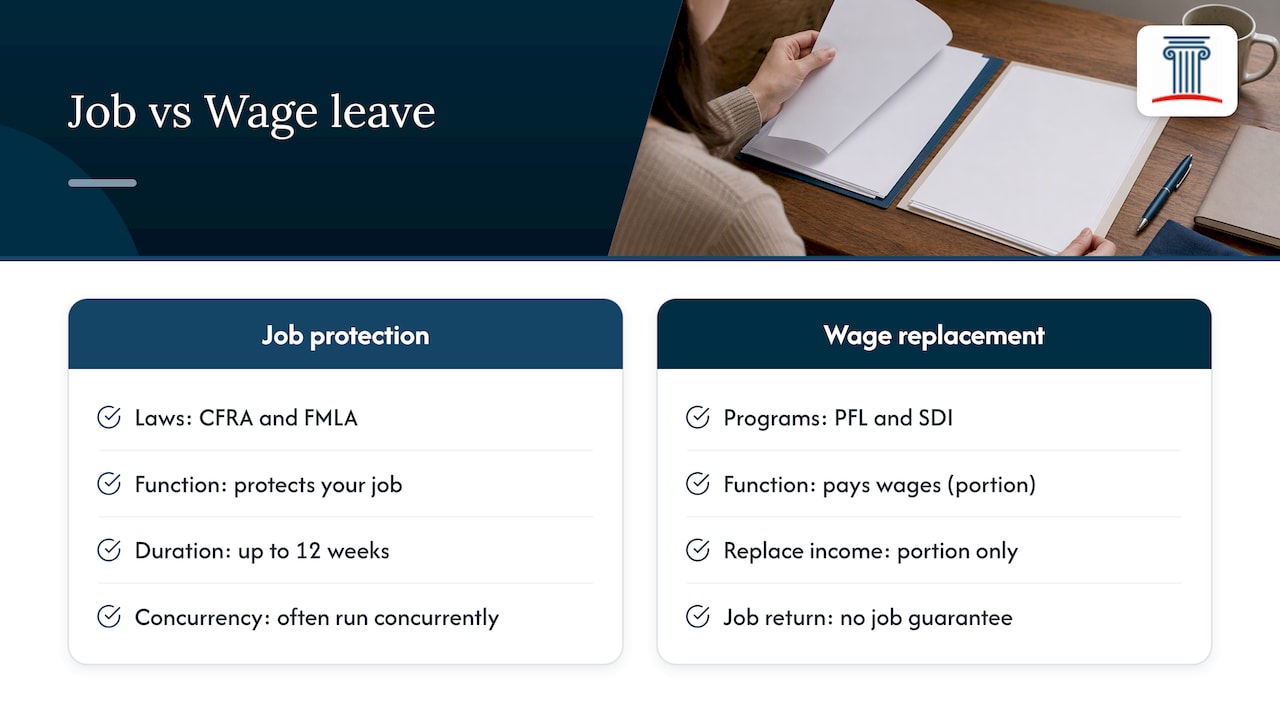
CFRA and FMLA protect your job. Paid Family Leave and State Disability Insurance pay your wages. These are separate systems, and conflating them is one of the most common and costly mistakes employees make. PFL and SDI can replace a portion of your income while you are out, but neither one guarantees you a job to come back to. CFRA and FMLA often run concurrently, since both allow up to 12 weeks and cover many of the same situations, though the employer-size rules differ. Pregnancy disability leave is treated separately from CFRA bonding leave, so a new mother may be entitled to both, one after the other. Before you rely on any of this, ask your employer in writing to confirm that your absence has been designated as CFRA, FMLA, or both. Our overlapping leave requests guide breaks down how the two laws interact in more detail.
Notice, certification, and what your employer owes you in response
You do not need to invoke “CFRA” by name to trigger your rights, but the timing of your notice matters.
- Give at least 30 days’ notice when the need for leave is foreseeable, such as a scheduled surgery or a known due date.
- When the need is not foreseeable, notify your employer as soon as practicable, even if that means a same-day phone call.
- Once informed, your employer is expected to respond promptly, generally within five business days, confirming whether the leave qualifies.
- Your employer can require medical certification from a health care provider, but that certification only needs to confirm the condition and expected duration, not disclose your specific diagnosis.
Employers who drag their feet on designation or who press for more medical detail than the law allows are stepping into risky territory, and documenting every exchange protects you if that becomes a dispute.
What happens when leave ends, and what to do if your rights are violated
When your CFRA leave ends, you are entitled to return to the same position or a comparable one, meaning equivalent pay, benefits, shift, and location. Retaliation shows up in familiar patterns: a sudden negative performance review right after you return, a demotion dressed up as a “reorganization,” or termination timed suspiciously close to your leave request.
- Save every notice, denial, or designation letter your employer sends you.
- Keep copies of your medical certifications and any correspondence about your return date.
- Write down the timeline of events, including who said what and when, while it is fresh.
Many retaliation complaints filed with the Labor Commissioner’s Office must be submitted within the time limit allowed after the adverse action, so waiting to gather evidence can cost you your claim. You can file a retaliation complaint with the DLSE, pursue a complaint through the CRD, or, for employers with 5 to 19 employees, request mediation through the CRD’s small-employer program before litigation. For Villa Park residents dealing with disability-related leave questions, our Villa Park medical-disability leave page covers related scenarios in more depth.
How to request CFRA leave without losing your protections
Requesting leave the right way from the start prevents most disputes before they happen.
- Notify your employer in writing, even if you also tell a supervisor verbally, and include your expected start date and duration.
- Ask specifically whether the absence will be designated as CFRA, FMLA, or both.
- Submit any required medical certification promptly, and keep a copy for yourself.
- Save all employer responses, denials, or requests for more information.
- Contact the EDD for PFL or SDI wage benefits once your leave is confirmed, and separately reach out to Serendib Law Firm or file with the DLSE or CRD if your employer denies, delays, or retaliates against your leave request.
Pro Tip: Keep a simple folder, physical or digital, with every leave-related document in one place from day one. It turns a messy dispute into a five-minute conversation with an attorney.
When a CFRA dispute calls for an employment lawyer
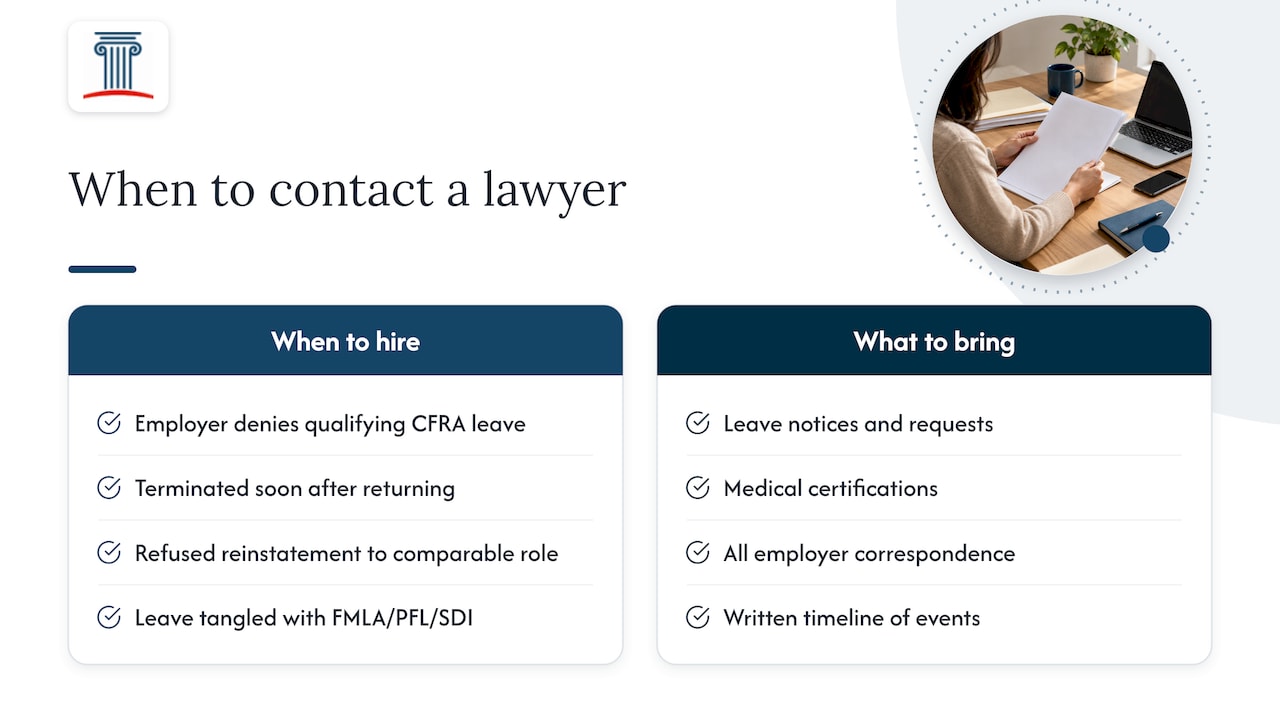
Most CFRA requests go smoothly when employees document everything and employers follow the rules. But some situations call for more than a checklist. If your employer denies a leave request that clearly meets CFRA’s criteria, terminates you shortly after you return, refuses to reinstate you to a comparable role, or tangles your leave up in overlapping FMLA, PFL, and SDI issues, it is worth getting an outside opinion before the deadline to act passes.
An experienced employment law firm in Orange County handles matters including retaliation, wrongful termination, and leave disputes for workers across the region. Before a consultation, gather your leave notices, medical certifications, employer correspondence, and a written timeline of events. A free consultation with an attorney who understands both CFRA and the practical realities of California workplaces often reveals options an employee would not have found alone.
— Maya Serkova
Get help from Serendib Law Firm with your CFRA claim
If your employer denied leave you were entitled to, delayed reinstatement, or retaliated after you returned, you do not have to sort it out alone. Some firms offer free consultations in English and Spanish and represent employees across Orange County, including Villa Park. Reach out through our contact page or learn more about our employment law services to talk through your situation and next steps.
This article is general information, not a substitute for advice from a qualified lawyer. Consult a qualified legal professional about your own circumstances before acting on anything here.
Sources
- Family Care and Medical Leave: Quick Reference Guide
- Paid Family Leave (EDD)
- Family and Medical Leave Act (DOL)
- Retaliation and Discrimination Complaints — Labor Commissioner’s Office (DLSE)
FAQ
Can my employer deny my CFRA leave?
An employer can deny CFRA leave only if you do not meet the eligibility requirements, such as the 12-month, 1,250-hour, or five-employee thresholds. If you meet all three and your reason for leave qualifies, a denial may be unlawful, and you can challenge it through the CRD or DLSE.
What are the leave requirements for CFRA leave in California?
You must have worked for your employer for more than 12 months, logged at least 1,250 hours in the prior year, and your employer must have five or more employees. Eligible employees can then take up to 12 workweeks of job-protected leave, as outlined in the CRD’s quick reference guide.
What is the 7 minute rule in California?
The “7 minute rule” refers to timekeeping rounding practices for tracking hours worked, not to CFRA leave itself, and it is not addressed in CFRA eligibility guidance. If you are trying to confirm whether you meet the 1,250-hour CFRA threshold, your payroll records and timecards are the more reliable source.
Can an employee be terminated while on medical leave in California?
Generally, no, if the leave qualifies under CFRA or FMLA, since both laws protect your job and require reinstatement to the same or a comparable position. Termination during protected leave, or shortly after returning, can be evidence of retaliation, which you can report to the Labor Commissioner’s Office within the applicable filing window.