

If you work in Orange and meet basic service requirements, the California Family Rights Act likely protects your job for job-protected leave while you handle a serious health condition, care for family, or bond with a new child. That protection is unpaid by default, so you will want to file separately with the EDD for wage replacement. Right now, the most important move is simple: notify your employer in writing, name “CFRA” specifically, state your qualifying reason, and keep a copy of everything you send and receive.
TL;DR:
- CFRA provides up to 12 weeks of job protection for eligible employees in Orange, but workers must meet service, hours worked, and employer size requirements.
- Employees need to notify their employer in writing, specifically referencing CFRA, and keep detailed records of all communications to safeguard their rights.
- CFRA’s family definitions include broader categories, such as a ‘designated person,’ and can be used sequentially with PDL and FMLA, especially during pregnancy-related leave.
- Applying for EDD benefits and CFRA leave are separate processes; employees should file both simultaneously to maintain income and job protection.
- Proper documentation, including notices, medical certifications, and a detailed leave timeline, is crucial for protecting rights and preparing for legal support if issues arise.
Table of Contents
- Quick Overview: What CFRA Is and How It Relates to FMLA and PDL
- Do You Qualify? Eligibility Checklist for CFRA Leave in Orange
- What Qualifies for CFRA Leave, and Who Counts as Family?
- How Much Leave Do You Get, and How Does It Interact With FMLA and PDL?
- Notice, Medical Certification, and Employer Deadlines
- Pay and Benefits: How CFRA, EDD Paid Family Leave, and SDI Fit Together
- How to Request CFRA Leave in Orange: 5 Steps and a Documentation Timeline
- When Local Legal Help Makes Sense for Orange Employees
- Editorial Take: Why Fast Documentation Beats Perfect Knowledge of the Law
- Get Help From Serendib Law Firm
- Where to Verify These Rules Yourself
- Sources
- FAQ
Quick Overview: What CFRA Is and How It Relates to FMLA and PDL
CFRA stands for the California Family Rights Act, and it guarantees up to 12 workweeks of job-protected leave for eligible employees. The California Civil Rights Department enforces it, and the law says that when state and federal protections both apply, you get whichever one treats you better. Orange employees often deal with three overlapping systems, so it helps to know how each one works before you request time off.
- CFRA is California’s job-protection law, run through the CRD.
- FMLA is the federal equivalent, enforced by the U.S. Department of Labor, and often runs at the same time as CFRA.
- PDL (Pregnancy Disability Leave) is a separate California entitlement for pregnancy-related conditions, distinct from CFRA bonding time.
Because none of these programs pay wages on their own, Orange workers usually need to pair a CFRA request with an EDD claim to keep income flowing during leave.
Do You Qualify? Eligibility Checklist for CFRA Leave in Orange
Before you draft a leave request, run through this quick self-check. California Government Code §12945.2 sets the legal floor, and most Orange employers, from retail chains to local manufacturing shops, fall under it.
- Service time. You generally need at least a year with your current employer, though the months do not have to be consecutive.
- Hours worked. You generally must have worked a minimum number of hours in the 12 months before your leave starts, with some special rules for certain airline and flight crew employees.
- Employer size. Your employer needs to have a minimum number of employees. California counts employees nationwide, not just at your Orange location, so a small local office tied to a larger company usually still qualifies.
- Paper trail. Pull your hire letter, recent pay stubs, and your work schedule. These documents settle eligibility disputes faster than memory ever will.
If you are close to the 1,250-hour line, ask HR for your timekeeping records rather than guessing. Employers sometimes miscalculate this number, and it is worth checking before you assume you are ineligible.
What Qualifies for CFRA Leave, and Who Counts as Family?
CFRA covers more ground than most employees expect, and its family definitions run wider than the federal FMLA. The law permits leave for your own serious health condition, caregiving, or new-child bonding, and bonding leave must be used within one year of the birth, adoption, or foster placement.
Qualifying reasons include:
- Your own serious health condition that keeps you from performing your job.
- Caring for a covered family member with a serious health condition.
- Bonding with a new child through birth, adoption, or foster placement, within the first year.
Covered family members go beyond the obvious. CFRA includes a child (of any age, including adult children and children of a domestic partner), spouse, domestic partner, parent, parent-in-law, grandparent, grandchild, sibling, and a “designated person,” meaning any individual related by blood or whose relationship is equivalent to a family relationship. That designated-person category is one of CFRA’s more protective features, since FMLA has no equivalent category at all.
How Much Leave Do You Get, and How Does It Interact With FMLA and PDL?
Eligible employees get job-protected leave within a total period allowed by law, though employers can measure that year in different ways (rolling backward from the request date is the most common method in Orange County workplaces).
- Leave can be taken intermittently or on a reduced schedule when a doctor certifies it as medically necessary.
- Employers may account for intermittent leave in the smallest increment their payroll system allows, often as little as an hour.
- PDL is a separate entitlement, providing up to four months for pregnancy-related disability, and it does not use up your CFRA bonding time.
- CFRA bonding leave typically follows PDL rather than overlapping with it, so a new parent may use both protections in sequence rather than choosing one.
- FMLA generally runs concurrently with CFRA, except during the PDL period, when FMLA can run alongside PDL while CFRA is preserved separately for bonding afterward.
That sequencing distinction trips up a lot of employees. A pregnant worker in Orange could use PDL first, then still have a full 12 weeks of CFRA bonding leave waiting afterward.
Notice, Medical Certification, and Employer Deadlines
Timing rules cut both ways under CFRA, and missing a deadline on either side can create real problems.
- Give 30 days’ notice when your leave is foreseeable, such as a scheduled surgery or an expected due date.
- Notify “as soon as practicable” when the need is sudden, like an unexpected medical emergency.
- Expect a certification request. Employers can ask a health care provider to certify the need for leave, but they cannot demand a written diagnosis, only enough detail to confirm the leave qualifies.
- Return certification promptly, typically within 15 calendar days of the request, unless it is not practicable despite your diligent, good-faith efforts.
- Watch for your employer’s designation notice. Once your employer has enough information to know the leave qualifies under CFRA or FMLA, it generally must notify you within five business days.
Pro Tip: Send your leave notice by email instead of a verbal conversation, and put the word “CFRA” directly in the subject line. That single word creates a timestamped record that your employer received formal notice, which matters enormously if a dispute comes up later.
Pay and Benefits: How CFRA, EDD Paid Family Leave, and SDI Fit Together
CFRA protects your job and keeps your employer-provided group-health coverage active while you’re out, but it does not put money in your bank account. That is where EDD steps in.
- CFRA guarantees reinstatement to the same or a comparable position, plus continued health coverage during leave.
- EDD’s Paid Family Leave program provides partial wage replacement for bonding or caregiving leave.
- State Disability Insurance (SDI) covers your own serious health condition instead, including pregnancy disability.
- Receiving PFL or SDI benefits does not by itself protect your job. You still need to request CFRA (or FMLA) separately with your employer.
Applying for EDD benefits and requesting CFRA leave are two different processes that happen to run on parallel tracks. Filing one does not automatically trigger the other, so both need to happen.
Coordinate the two by submitting your CFRA notice to your employer first, then filing your EDD claim once your leave dates are set, and keep the EDD confirmation number alongside your other leave records.
How to Request CFRA Leave in Orange: 5 Steps and a Documentation Timeline
Here is the practical sequence Orange employees should follow, start to finish.
- Send written notice naming “CFRA.” Email your supervisor or HR, state your qualifying reason, and request the specific dates if you know them. Keep a copy in a personal folder, not just your work inbox.
- Handle medical certification. If your employer requests it, get the form to your provider immediately and track the 15-day return deadline.
- File for EDD wage replacement if you need income. Apply for PFL or SDI online and save your confirmation number and claim ID.
- Build a simple timeline document. List your hire date, hours worked, notice date, certification exchange dates, and planned leave dates in one place. This single document is often the first thing an attorney or a CRD intake worker will ask to see.
- If you’re denied or face retaliation, gather everything now. Save emails, performance reviews, schedules, and the names of coworkers who witnessed relevant conversations, then consider filing with the CRD or speaking with an employment lawyer.
Pro Tip: Treat your leave timeline like a legal exhibit from day one, even if you never end up needing it. A dated, factual record beats a reconstructed memory every time a dispute reaches a lawyer’s desk.
When Local Legal Help Makes Sense for Orange Employees
Some CFRA situations resolve cleanly with a well-documented request. Others do not. A denial that contradicts your eligibility, a termination shortly after you return, or a demotion that follows your leave request are all signs the situation has moved past a paperwork problem and into a legal one.
Legal firms sometimes offer free initial consultations and bilingual support to employees facing these situations. Bring your leave timeline, all written communications with your employer, medical certification paperwork, and the names of any coworkers who can speak to what happened. That intake package is usually enough for an attorney to give you a clear read on your options.
Editorial Take: Why Fast Documentation Beats Perfect Knowledge of the Law
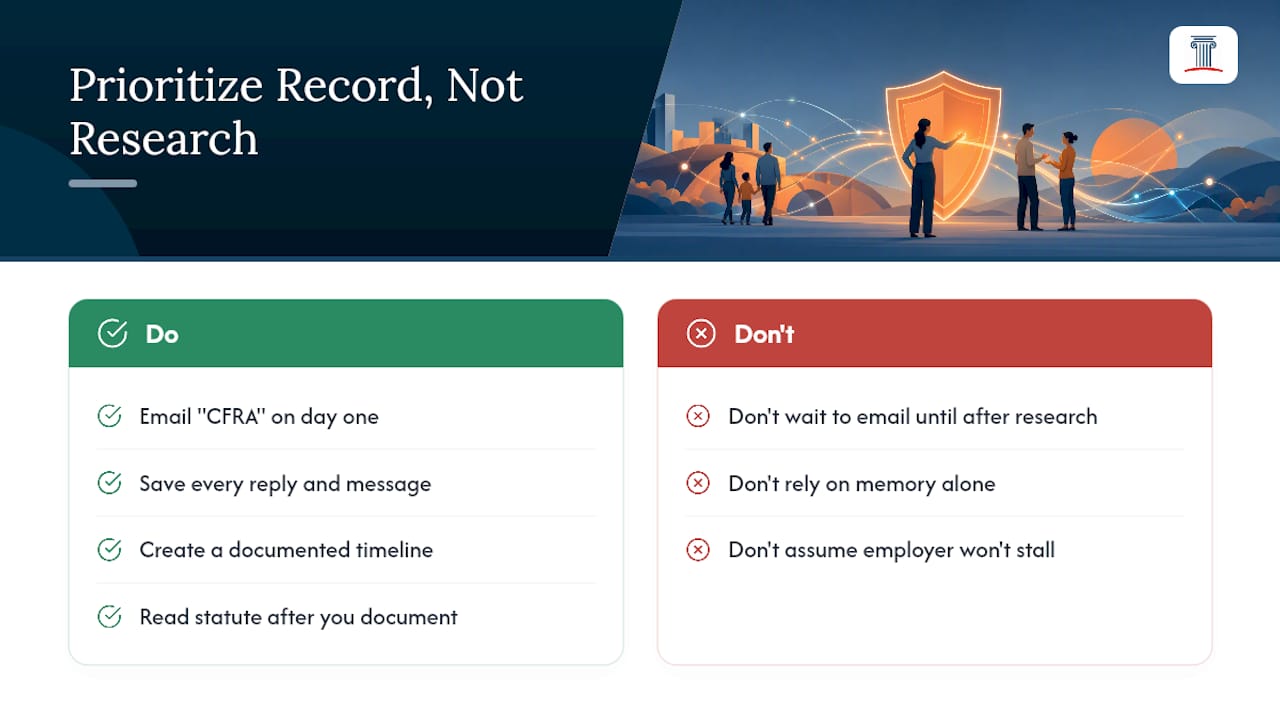
The conventional advice on CFRA leave treats it like a legal puzzle: memorize the statute, know every deadline, cite the right code section to HR. In practice, that is not what protects employees in Orange. What protects them is speed and paper. An employee who sends one clear email naming “CFRA” on day one, then keeps every reply, walks into any dispute in a stronger position than someone who understood the law perfectly but never wrote anything down.
The gap between what CFRA promises and what actually happens on the ground usually comes down to proof, not entitlement. Employers rarely deny leave outright when the paperwork is clean. They stall, ask for clarification, or let a designation notice slip past its deadline, and those small failures are exactly what a documented timeline catches. If you take one thing from this article, prioritize the record over the research. Read the statute if you want to, but send the email first.
— Maya Serkova
Get Help From Serendib Law Firm
Local law firms can provide alternatives to navigating CFRA disputes alone by offering consultations with attorneys experienced in employment leave cases and bilingual communication.
Intake starts with a review of your documents: your timeline, your written notices, any medical certification paperwork, and your employer’s response. From there, the firm will tell you plainly whether your situation calls for a CRD complaint, a demand letter, or continued negotiation. Learn more about how the firm handles leave and retaliation cases on its employment law practice page, or go straight to scheduling a consultation if your leave has already been denied or you’ve faced retaliation after returning to work. The firm also handles personal injury, business litigation, immigration matters, and cases involving disability and workers’ compensation when a leave dispute overlaps with a workplace injury.
Where to Verify These Rules Yourself
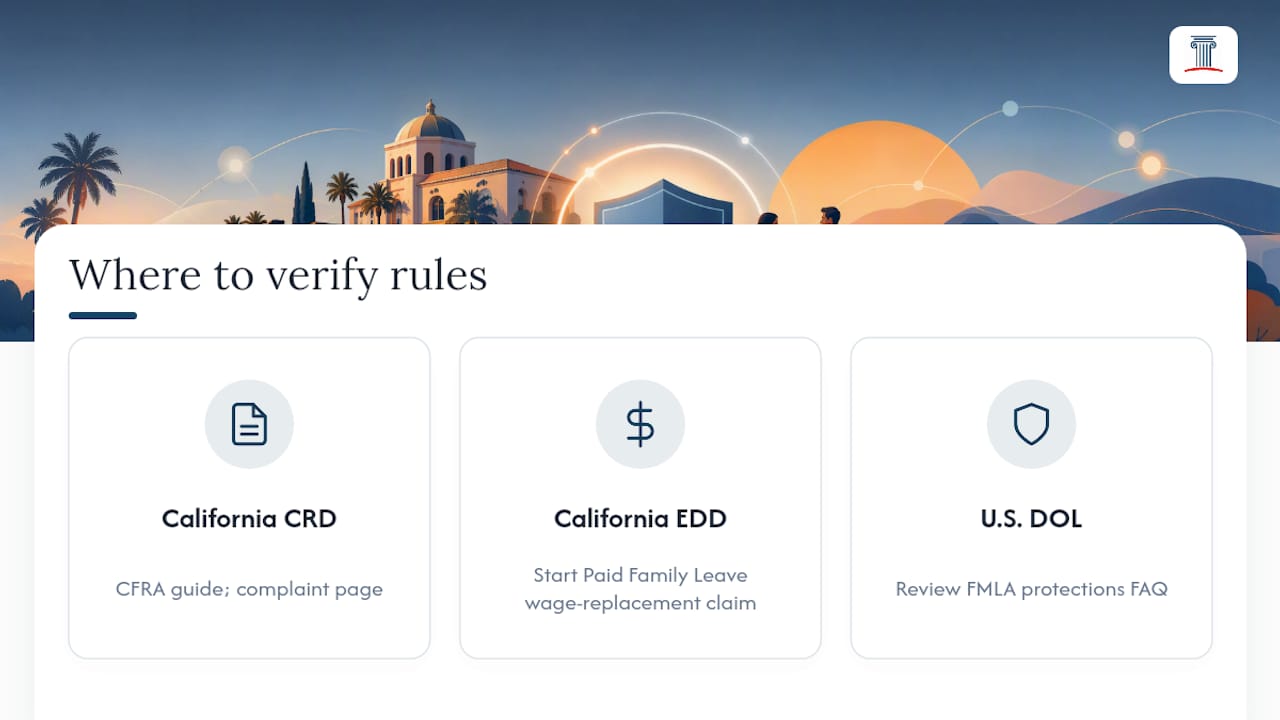
Confirm eligibility rules directly through the CRD’s Family Care and Medical Leave guide or file a complaint through its complaint process page. Start a wage-replacement claim through EDD’s Paid Family Leave program, and review federal protections in the DOL’s FMLA FAQ.
This article is general information, not a substitute for advice from a qualified lawyer. Consult a qualified legal professional about your own circumstances before acting on anything here.
Sources
- Family Care and Medical Leave | California Civil Rights Department (CRD)
- Paid Family Leave (PFL) | Employment Development Department (EDD)
- California Government Code §12945.2
- FMLA Frequently Asked Questions | U.S. Department of Labor
FAQ
Can My Employer Deny My CFRA Leave?
An employer can deny CFRA leave if you don’t meet the eligibility requirements, such as the 12-month service or 1,250-hour threshold, or if your reason doesn’t qualify under the law. If you believe a denial was wrongful, California Government Code §12945.2 outlines employer obligations you can compare your situation against, and a free consultation with an employment lawyer can clarify whether the denial was lawful.
How Long Is My Job Protected Under CFRA?
CFRA protects your job for up to 12 workweeks within a 12-month period, and your employer must return you to the same or a comparable position when your leave ends. Group-health coverage continues during that window as well, under the same terms as if you had kept working.
Can I Be Fired While on CFRA Leave?
You cannot legally be fired simply for taking CFRA leave, but an employer can still terminate you for reasons unrelated to the leave, such as a layoff that would have happened regardless. If you’re let go shortly after requesting or returning from leave, save your documentation and consider reaching out to Serendib Law Firm for a free consultation to review whether retaliation played a role.
Is CFRA Better Than FMLA?
CFRA is often more protective than FMLA for California workers because it recognizes a broader range of family members, including a designated person, a category FMLA does not include. The two laws frequently run concurrently, so you typically don’t choose between them. You get whichever protection covers more of your situation.