
Employment discrimination in Orange, CA is defined as any adverse treatment of an employee based on a protected characteristic such as race, gender, age, disability, or national origin. California’s Fair Employment and Housing Act (FEHA) and federal laws like Title VII of the Civil Rights Act both apply to workers in Orange, and together they form one of the strongest employee protection frameworks in the country. If you work in Orange and believe your employer has treated you unfairly because of who you are, the law is on your side. Understanding that is the first step toward doing something about it.
What types of workplace discrimination are prohibited in Orange, CA?
FEHA applies to public and private employers with five or more employees, covering the vast majority of workplaces in Orange. That threshold is lower than federal law, which means more Orange employees are protected under California law than they might realize.
The protected categories under FEHA and Title VII are broad. They include:
- Race and color — treating someone differently because of their racial background or physical appearance tied to race
- Sex and gender identity — covering gender expression, transgender status, and pregnancy
- Sexual orientation — including gay, lesbian, and bisexual employees
- Age — protecting workers 40 and older from age-based adverse treatment
- Disability — physical and mental conditions, including the obligation to provide reasonable accommodations
- Religion — requiring employers to accommodate sincerely held religious beliefs
- National origin — protecting employees from discrimination based on their country of origin or ancestry
- Pregnancy and related conditions — including childbirth and medical conditions tied to pregnancy
Discrimination does not only happen at the point of hiring. It shows up in promotions, pay decisions, job assignments, performance reviews, and terminations. A warehouse supervisor in Orange who consistently passes over Latino employees for promotion, or a tech firm that pays women less than men for identical work, is engaging in actionable discrimination under California law.
Harassment is a separate but related form of discrimination. A hostile work environment created by slurs, offensive jokes, or unwanted physical contact based on a protected characteristic is illegal. So is quid pro quo harassment, where a supervisor conditions job benefits on sexual favors.

Pro Tip: If your employer has five or more employees and you work in Orange, you are almost certainly covered by FEHA. Do not assume your workplace is too small for the law to apply.
How does the complaint and enforcement process work?
Filing a discrimination complaint in Orange, CA involves two separate systems: the California Civil Rights Department (CRD), formerly known as the Department of Fair Employment and Housing (DFEH), and the federal Equal Employment Opportunity Commission (EEOC). Understanding how they interact is critical.
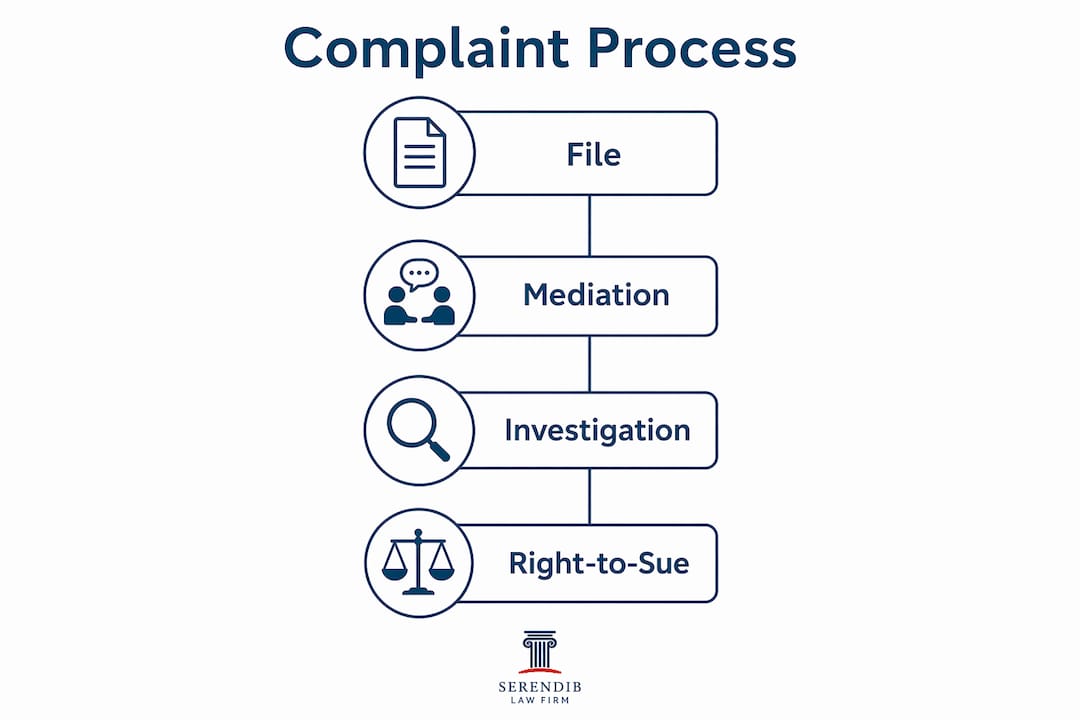
Here is how the process generally works:
- File with the CRD or EEOC. You start by submitting a complaint to one of these agencies. California has a work-sharing agreement with the EEOC, so filing with one typically cross-files with the other automatically.
- Investigation begins. The agency reviews your complaint, may request a response from your employer, and can conduct interviews or request documents.
- Mediation may be offered. Both the CRD and EEOC offer voluntary mediation as a faster resolution path. Mediation is confidential and does not waive your right to proceed if it fails.
- Determination is issued. The agency decides whether there is sufficient evidence to support your claim. A finding of no violation does not prevent you from pursuing a lawsuit.
- Right-to-sue notice is issued. This notice is your authorization to file a civil lawsuit. Employees have one year after receiving a CRD right-to-sue notice to file a lawsuit in California court.
On the federal side, the EEOC process includes filing, possible mediation, investigation, and a right-to-sue notice that triggers a 90-day window to file a federal lawsuit. Missing that window forfeits your federal claim entirely.
Timing matters significantly. EEOC filing deadlines are 180 days from the discriminatory act, extended to 300 days in states like California that have their own fair employment agency. That extension exists because California is a “deferral state,” meaning the EEOC defers to the CRD’s jurisdiction first. The practical effect is that Orange employees have more time to file federal charges than workers in states without their own anti-discrimination laws.
One procedural detail most employees miss: including supervisors and parent companies in your CRD complaint from the start is critical. If you omit a party at the administrative stage, you may lose the ability to name them in a lawsuit later.
Pro Tip: Never delay filing with the CRD or EEOC while waiting to see if your employer fixes the problem internally. Administrative filing preserves your legal deadlines. HR complaints do not.
What legal protections and remedies are available to you?
California law gives Orange employees meaningful remedies when discrimination is proven. These are not symbolic. They are designed to make you whole and deter future misconduct.
Available remedies under FEHA include:
- Back pay — wages and benefits you lost because of the discriminatory act
- Front pay — future earnings if reinstatement to your position is not practical
- Reinstatement — return to your former position if you were wrongfully terminated or demoted
- Compensatory damages — compensation for emotional distress, humiliation, and harm to your reputation
- Punitive damages — available when the employer’s conduct was malicious or oppressive
- Attorneys’ fees — FEHA allows prevailing employees to recover legal fees, which removes a major financial barrier to bringing claims
Retaliation is its own protected category. FEHA and Labor Code § 132a prohibit employers from taking adverse action against you for filing a complaint, cooperating with an investigation, or opposing discriminatory practices. If your employer demotes you, cuts your hours, or creates a hostile environment after you report discrimination, that retaliation is a separate legal violation on top of the original claim.
Supervisor liability is a feature of California law that federal law does not fully replicate. Under FEHA, supervisors can face individual liability for harassment they personally engage in. This means the person who harassed you can be named as a defendant alongside your employer, not just the company itself.
Consulting an Orange workplace discrimination lawyer early in the process is not just advisable. It is often the difference between a well-preserved claim and one that collapses on procedural grounds.
How can you protect your rights and strengthen a discrimination claim?
The strength of a discrimination claim often comes down to documentation. Agencies and courts look for a coherent, specific narrative supported by evidence. Vague recollections rarely hold up against a well-prepared employer defense.
Here is what you should do starting today:
- Write everything down. Record dates, times, locations, what was said, and who witnessed it. Do this immediately after each incident while details are fresh.
- Save all communications. Emails, texts, performance reviews, and written warnings are evidence. Forward work emails to a personal account if your employer’s policy allows it, or print copies.
- Document your internal complaints. If you report discrimination to HR, do it in writing. A verbal complaint is harder to prove than an email with a timestamp.
- Request accommodations in writing. If you have a disability or a religious practice requiring accommodation, submit your request in writing and keep a copy of the employer’s response.
- Identify witnesses. Colleagues who observed discriminatory conduct can be critical to corroborating your account.
Contemporaneous documentation creates a coherent narrative that CRD investigators and judges can follow. A single well-documented incident is often more persuasive than a pattern of incidents recalled from memory months later.
There are applicable statutes of limitations that vary by claim type and circumstance and should be evaluated on a case-by-case basis with an attorney. One important nuance: the continuing violation doctrine may extend your filing window when discrimination is ongoing or systemic rather than a single isolated act. This is particularly relevant in hostile work environment cases where harassment builds over time.
Pro Tip: Do not rely on HR to protect you. HR works for your employer, not for you. File internally to create a record, but consult an employment law attorney before assuming the internal process will resolve your situation.
Key takeaways
Employment discrimination in Orange, CA is illegal under both FEHA and federal law, and employees who act promptly with strong documentation have the best chance of a successful outcome.
| Point | Details |
|---|---|
| FEHA coverage threshold | Employers with 5 or more employees in Orange are subject to California’s anti-discrimination law. |
| Dual filing systems | Filing with the CRD and EEOC involves different deadlines and procedural rules that must be tracked separately. |
| Supervisor liability | Under FEHA, individual supervisors can be named as defendants in harassment claims, not just the employer. |
| Documentation is decisive | Written records of incidents, complaints, and accommodation requests form the backbone of a strong claim. |
| Retaliation is a separate violation | Adverse action taken after you report discrimination is its own legal claim under FEHA and the Labor Code. |
What I have learned from watching employees navigate this process
After working with employees across Orange County, including many in the city of Orange itself, I have seen one pattern repeat more than any other: employees wait too long. They give their employer the benefit of the doubt. They hope HR will fix it. They worry about being seen as difficult. By the time they call an attorney, weeks or months have passed, key witnesses have left the company, and emails have been deleted.
The uncomfortable truth is that most employers are not going to fix a discrimination problem voluntarily, especially if the person causing it is a valued manager or a high performer. The internal complaint process exists to protect the company legally, not to protect you. Filing internally is still worth doing because it creates a record, but it should happen alongside, not instead of, consulting an attorney.
I also see employees underestimate the complexity of dual-filing with the CRD and EEOC. Many employees lose valid FEHA claims by missing the one-year deadline to file a lawsuit after receiving a right-to-sue notice. That deadline does not pause while you decide what to do. It runs whether you are ready or not.
The good news is that California law genuinely favors employees. FEHA’s protections are broader than federal law, the damages available are real, and attorneys’ fees provisions mean that qualified attorneys will take strong cases on contingency. You do not need to be wealthy to fight back. You need to act, document, and get the right legal guidance before the clock runs out.
How Serendib law can help you fight back
Serendib law represents employees in Orange, CA who are facing workplace discrimination, harassment, and retaliation. The firm’s attorneys understand the specific procedural requirements of FEHA and federal law, and they work directly with clients to build documented, well-timed claims. Free consultations are available, and select cases are handled on a contingency basis, meaning you pay nothing unless you recover. If you believe your employment rights in Orange have been violated, the time to act is now. You can also review the full range of California employment law claims to understand where your situation fits.
FAQ
What is employment discrimination under California law?
Employment discrimination is defined as adverse treatment of an employee based on a protected characteristic such as race, gender, age, disability, or national origin. FEHA and Title VII both prohibit this conduct in Orange, CA workplaces with five or more employees.
How do I report workplace discrimination in Orange, CA?
You file a complaint with the California Civil Rights Department or the EEOC. California’s work-sharing agreement with the EEOC means filing with one agency typically cross-files with the other automatically.
What happens after I receive a right-to-sue notice?
A CRD right-to-sue notice gives you one year to file a civil lawsuit in California court. A federal EEOC right-to-sue notice gives you 90 days to file in federal court. Missing either deadline forfeits your right to sue.
Can my supervisor be personally sued for harassment?
Yes. Under FEHA, supervisors who personally engage in harassment can face individual liability and be named as defendants in a lawsuit, separate from the employer’s liability.
Does filing an HR complaint protect my legal deadlines?
No. An internal HR complaint does not stop the clock on your CRD or EEOC filing deadlines. You must file with the appropriate agency to preserve your legal rights, regardless of any internal process your employer runs.