
California’s Fair Employment and Housing Act (FEHA) is the primary legal shield protecting employees in Costa Mesa, CA against workplace discrimination, harassment, retaliation, and wrongful termination. Costa Mesa, a city in Orange County with a population of 111,918 as of the 2020 census, sits within one of Southern California’s most economically active regions, where retail, commerce, and light manufacturing drive employment across thousands of workplaces. If you work in Costa Mesa and face a workplace dispute, California law gives you multiple enforcement tracks, procedural rights, and legal remedies worth understanding before you act. The California Civil Rights Department (CRD) and the Labor Commissioner’s Office are the two state agencies most directly relevant to your situation, and knowing which one handles your claim is the first decision that matters.

What are the first steps to take when facing a workplace dispute in Costa Mesa?
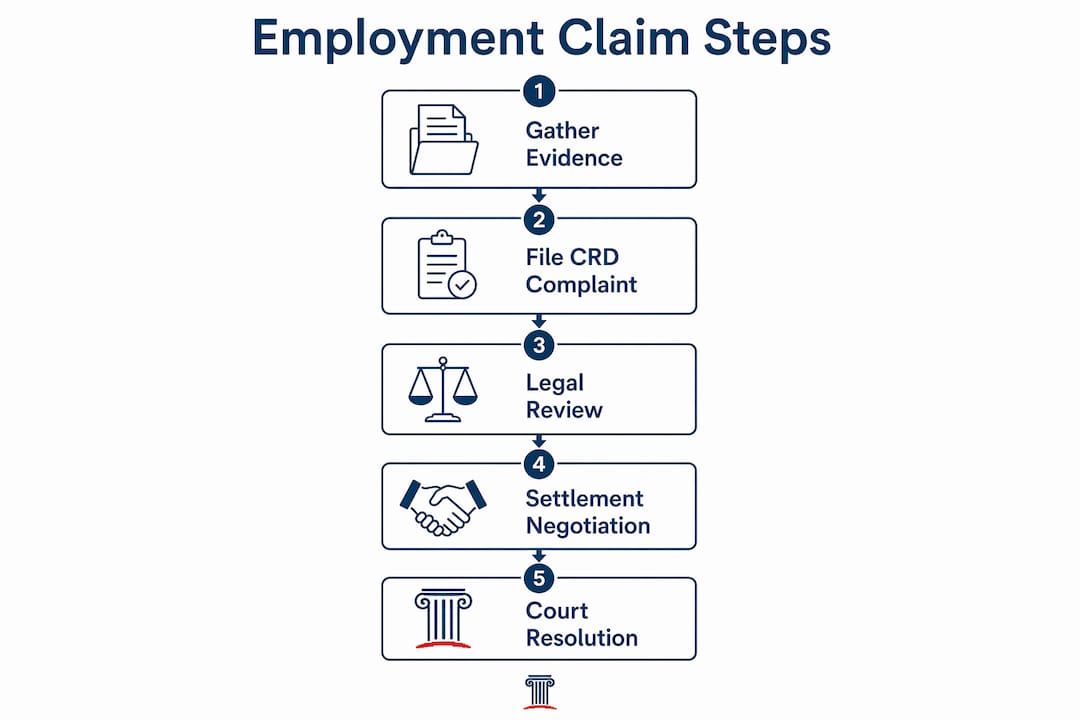
The single most important action you can take after experiencing a workplace violation is to document everything immediately. Courts and administrative agencies rely on written records, and your memory of events will fade faster than you expect. Here is how to start:
- Write down every adverse action with dates, times, locations, and the names of everyone involved. Save emails, texts, performance reviews, and any written communications that relate to the dispute. If your employer took action verbally, write a contemporaneous note the same day.
- Identify which enforcement track applies to your claim. FEHA covers discrimination, harassment, and retaliation based on protected characteristics such as race, gender, disability, age, religion, and sexual orientation. Wage theft, unpaid overtime, and meal break violations fall under the Labor Commissioner’s jurisdiction. Choosing the wrong track wastes time and can cost you your filing window.
- File an administrative complaint with the California Civil Rights Department (CRD) if your claim falls under FEHA. FEHA requires administrative filing with the CRD before you can file a civil lawsuit for discrimination or harassment. This step is mandatory, not optional.
- Request a right-to-sue notice from the CRD promptly. Waiting passively for the CRD to complete its investigation can be risky. Administrative and civil deadlines are separate clocks, and letting the investigation run without requesting your notice can shrink the window you have to file in court.
- Understand that not all claims require administrative exhaustion. Whistleblower retaliation claims under California Labor Code section 1102.5 do not require CRD filing and can go directly to civil court. This distinction matters enormously for how fast you can move.
Costa Mesa employees can access CRD filing portals online through the California Civil Rights Department’s website, or visit regional offices serving Orange County. The city’s location within Orange County also connects you to local legal aid organizations and the Orange County Bar Association’s referral services.
Pro Tip: Keep a dedicated folder, physical or digital, where you store every piece of evidence related to your dispute. Label each document with the date you received or created it. This habit has saved more employment cases than any single legal argument.
How do statutes of limitations and timing affect employment claims in Costa Mesa, CA?
Timing is where most employment claims are won or lost before they ever reach a courtroom. California employment law operates on multiple deadline clocks running simultaneously, and missing any one of them can end your case regardless of how strong your underlying facts are.
- Administrative filing deadlines under FEHA apply to discrimination, harassment, and retaliation claims based on protected characteristics. These deadlines are measured from the most recent unlawful act, not from when you first noticed a problem. Consulting an attorney early gives you the clearest picture of where your clock stands.
- Civil lawsuit deadlines begin after you receive your right-to-sue notice from the CRD. Once that notice arrives, you have a separate, shorter window to file in court. Missing this deadline is fatal to your FEHA claim even if your administrative complaint was filed on time.
- The continuing violation doctrine is one of the most powerful tools available to harassment victims. This doctrine allows harassment claims to include related acts that occurred outside the standard filing period, as long as at least one act falls within the filing window. For employees who endured a pattern of harassment over months or years, this doctrine can dramatically expand the scope of recoverable harm.
- Claims against public entities in Costa Mesa carry additional requirements. If your employer is a city department, school district, or other public agency, the Government Claims Act imposes a six-month filing requirement that is separate from and shorter than standard FEHA deadlines. Missing it can be fatal to your claim.
- Procedural deadlines inside active litigation are equally unforgiving. California’s five-year rule requires that cases be brought to trial within five years of filing. Failure to manage this deadline can result in mandatory dismissal, even when the merits of your case are strong.
“Effective deadline management, including requesting right-to-sue notices at the right moment, is one of the most consequential decisions in any California employment case. Waiting passively for an agency investigation to conclude can cost you the right to sue entirely.”
The realistic timeline for a contested employment case in California runs long. Most retaliation cases take roughly two to three years after the civil complaint is filed to reach resolution, with settlements typically occurring between 18 and 30 months in. Plan financially and evidentially for a prolonged process, not a quick resolution.
What legal remedies and complaint avenues are available to employees in Costa Mesa?
Costa Mesa employees have access to several distinct legal pathways depending on the nature of their workplace dispute. Understanding which remedy fits your situation determines both the process you follow and the compensation you can recover.
| Claim type | Governing law | Filing body | Direct civil suit? |
|---|---|---|---|
| Discrimination, harassment | FEHA | California Civil Rights Department (CRD) | No. Administrative exhaustion required first. |
| Retaliation (protected activity) | FEHA | CRD | No. Must file with CRD and obtain right-to-sue notice. |
| Whistleblower retaliation | Labor Code § 1102.5 | Superior Court | Yes. No administrative filing required. |
| Wage theft, unpaid overtime | Labor Code | Labor Commissioner | Yes, or file civil suit directly. |
| Public entity employer | Government Claims Act | Relevant public entity, then court | No. Government claim required within six months. |
FEHA claims can recover lost wages, emotional distress damages, punitive damages in egregious cases, and attorney’s fees. Labor Code wage claims recover unpaid wages, penalties, and interest. The distinction between these tracks is not academic. Filing a wage claim with the CRD instead of the Labor Commissioner, or vice versa, can delay your case by months.
Settlement is the most common outcome in California employment disputes. Cases that settle early tend to resolve at lower values, while cases that survive summary judgment and approach trial often command significantly higher settlements. Trials add six to twelve months beyond the summary judgment phase, according to California case timeline data. An experienced Orange County employment attorney can assess whether early settlement or litigation is the stronger strategy for your specific facts.
Pro Tip: Before accepting any settlement offer from your employer, have an attorney review it. Many settlement agreements include broad release language that waives claims you did not know you had, including future retaliation claims.
How to find and work with employment law attorneys specializing in Costa Mesa, CA workplace claims
Selecting the right attorney is the decision that most directly affects your outcome. Orange County has a substantial pool of employment lawyers, but not all of them have meaningful experience with the specific claims and procedural requirements that apply to Costa Mesa workers.
Here is what to look for and how to work effectively with counsel once you find them:
- Specialization in plaintiff-side employment law. Attorneys who represent both employers and employees often have conflicts of interest and divided expertise. Look for a firm that exclusively or primarily represents employees. Their entire practice is built around winning for workers, not defending management decisions.
- Familiarity with FEHA, Labor Code section 1102.5, and Orange County court procedures. These are the statutes most likely to govern your claim. An attorney who can explain the difference between FEHA exhaustion and direct civil filing without hesitation has the depth you need.
- A track record with cases similar to yours. Discrimination, harassment, retaliation, and wrongful termination each have different evidentiary demands. Ask specifically about experience with your claim type, not just employment law generally.
- Transparent fee arrangements. Many plaintiff employment attorneys work on contingency, meaning they collect a percentage of your recovery rather than hourly fees. This aligns their incentives with yours and makes legal representation accessible even if you are currently out of work.
- Bilingual capability if needed. A significant portion of Costa Mesa’s workforce is Spanish-speaking. Firms with bilingual attorneys, like those at Serendib law, remove a critical communication barrier during what is already a stressful process.
Once you retain counsel, your job is to be responsive and organized. Provide every document you have collected. Respond to attorney requests quickly. Understand that employment disputes in California routinely run two to three years, and your attorney needs your active participation throughout that period to build the strongest possible case. Costa Mesa employees can also consult experienced local attorneys who understand the specific dynamics of Orange County workplaces and courts.
Key takeaways
Costa Mesa employees facing workplace disputes must act quickly, document thoroughly, and choose the correct enforcement track under California law to preserve their legal rights.
| Point | Details |
|---|---|
| FEHA requires administrative filing | File with the California Civil Rights Department before pursuing a civil lawsuit for discrimination or harassment. |
| Request your right-to-sue notice actively | Do not wait passively for CRD investigations to conclude. Request the notice to protect your civil filing window. |
| Continuing violation doctrine helps harassment victims | Related acts outside the standard filing period can be included if at least one act falls within the window. |
| Whistleblower claims bypass the CRD | Labor Code § 1102.5 retaliation claims go directly to civil court without administrative exhaustion. |
| Most cases take two to three years | Plan financially and evidentially for a prolonged resolution, with settlements most common between 18 and 30 months. |
What I have learned from watching employees navigate Costa Mesa workplace disputes
After working closely with employees across Orange County, the pattern I see most often is not a lack of rights. It is a lack of awareness that the clock is already running. Employees spend weeks or months hoping the situation will improve, talking to HR, waiting for internal investigations, and by the time they consult an attorney, their filing window has narrowed significantly.
The second most common mistake is assuming that all workplace claims work the same way. A harassment claim under FEHA and a whistleblower retaliation claim under Labor Code section 1102.5 look similar on the surface but follow completely different procedural paths. Filing the wrong way does not just slow you down. It can eliminate your claim entirely.
What actually works is early action combined with disciplined documentation. Employees who come in with organized records, a clear timeline, and a willingness to engage with the process consistently achieve better outcomes than those with stronger underlying facts but poor documentation. Costa Mesa’s workforce is diverse and economically active, and the legal protections available here are genuinely strong. The gap between having rights and enforcing them is almost always procedural, not substantive. Close that gap by moving early, choosing the right enforcement track, and working with counsel who knows workplace retaliation claims and the Orange County court system.
How Serendib law helps Costa Mesa employees fight back
Serendib law represents employees across Costa Mesa and Orange County in discrimination, harassment, retaliation, and wrongful termination cases. The firm handles the full arc of a case, from initial CRD complaint filing through civil litigation and settlement negotiation, with bilingual attorneys available in English and Spanish. If you are facing a workplace dispute and need to understand your options, Serendib law offers free consultations and contingency-based representation in qualifying cases. Review the firm’s detailed breakdown of California employment law claims to understand which claim type fits your situation, or contact the team directly to discuss your case with an attorney who works exclusively for employees.
FAQ
What does FEHA protect employees from in Costa Mesa?
FEHA protects Costa Mesa employees from workplace discrimination, harassment, and retaliation based on protected characteristics including race, gender, disability, age, religion, and sexual orientation. It applies to employers with five or more employees for most harassment claims and fifteen or more for discrimination claims.
Do I have to file with the CRD before suing my employer?
For FEHA discrimination and harassment claims, yes. Filing an administrative complaint with the California Civil Rights Department and obtaining a right-to-sue notice is mandatory before you can file a civil lawsuit. Whistleblower retaliation claims under Labor Code section 1102.5 are an exception and can go directly to court.
How long does a California employment case typically take?
Most contested employment cases in California take two to three years from civil complaint filing to resolution. Settlements most commonly occur between 18 and 30 months in, while cases that go to trial take longer.
What is the continuing violation doctrine and how does it help me?
The continuing violation doctrine allows harassment victims to include related acts that occurred outside the standard filing period, as long as at least one act falls within the filing window. This is especially useful for employees who experienced a prolonged pattern of harassment.
Can I file a wage claim and a discrimination claim at the same time?
Yes, but they go through different agencies. Wage claims are handled by the California Labor Commissioner, while discrimination and harassment claims go through the CRD. An employment attorney can help you coordinate both tracks without missing deadlines or creating procedural conflicts between the two cases.