
Employment discrimination is defined as illegal, unfavorable treatment of an employee based on a protected characteristic such as race, gender, age, disability, or national origin. Westminster, CA employees are protected by California’s Fair Employment and Housing Act (FEHA), one of the strongest workplace discrimination laws in the country. The Civil Rights Department (CRD) enforces these protections at the state level, and Serendib Law Firm helps Westminster workers understand and act on their rights. If you believe your employer has treated you unfairly because of who you are, California law gives you real tools to fight back.
What forms of workplace discrimination are unlawful in Westminster, CA?
California’s FEHA protects employees from discrimination based on a wide range of characteristics. These protections go further than federal law in several important ways. Westminster workers benefit from some of the broadest workplace protections in the United States.
FEHA’s protected categories include:
- Race, color, and ancestry
- National origin and ethnicity
- Sex and gender identity
- Sexual orientation
- Age (40 and older)
- Physical and mental disability
- Religion and creed
- Marital and familial status
- Reproductive health decisions
- Veteran or military status
FEHA’s protective scope extends beyond federal law, covering reproductive health decisions, gender identity, and veteran status that federal statutes do not always address. That broader reach matters for Westminster employees who may not realize they have state-level protections even when federal law falls short.
Unlawful discrimination shows up in many forms. Employers cannot refuse to hire you, deny a promotion, cut your pay, or fire you because of a protected characteristic. Harassment based on a protected class, such as repeated offensive comments about your religion or ethnicity, also qualifies as discrimination when it creates a hostile work environment. California Labor Code section 1197.5 specifically prohibits paying different wages based on sex, race, or ethnicity for substantially similar work. That means a pay gap tied to your identity is not just unfair. It is illegal.
Subtle discrimination is often harder to spot but equally unlawful. Being passed over for assignments, excluded from meetings, or given unfair performance reviews because of your background all qualify. Retaliation against you for complaining about discrimination is also prohibited under California law.

Pro Tip: Keep a written record every time you experience treatment that feels tied to your identity. Even small incidents can build a pattern that supports a legal claim.
How do you recognize and document workplace discrimination effectively?
Recognizing discrimination at work starts with noticing patterns, not just isolated incidents. A single harsh comment may be rude. A repeated pattern of exclusion, pay cuts, or negative reviews tied to your race, gender, or disability is a legal problem. Westminster employees who learn to spot these patterns early are in a much stronger position when they decide to act.
Follow these steps to document workplace discrimination properly:
- Write down every incident. Record the date, time, location, what was said or done, and who was present. Do this as soon as possible after each event while details are fresh.
- Save all written communications. Keep copies of emails, text messages, performance reviews, and any written warnings that relate to the discriminatory treatment.
- Identify witnesses. Note the names of coworkers or supervisors who saw or heard the discriminatory behavior. Their accounts can corroborate your claim.
- Collect company policies. Gather your employee handbook, any anti-discrimination policies, and job descriptions. These documents help show when your employer violated its own rules.
- Report internally when safe. File a complaint with your HR department or a supervisor above the offending party. Keep a copy of anything you submit and note the date you reported it.
- Consult an attorney before filing externally. An employment attorney can review your documentation and advise you on the strongest path forward before you file with any government agency.
Reporting internally first is not always required, but it creates a paper trail that strengthens your case. If your employer retaliates against you after you report, that retaliation itself becomes additional evidence of wrongdoing.
Pro Tip: Store copies of your documentation outside of your work devices, such as in a personal email account or a secure cloud folder. Employers sometimes restrict access to work systems after a complaint is filed.
What is the process for filing an employment discrimination complaint in Westminster, CA?
Filing a discrimination complaint in California follows a specific sequence. Skipping steps can permanently close off your legal options. Westminster employees need to understand this process before taking action.
The role of the CRD and EEOC
The Civil Rights Department is California’s primary agency for handling workplace discrimination complaints under FEHA. The Equal Employment Opportunity Commission (EEOC) handles federal discrimination claims. Both agencies investigate complaints, and filing with both preserves your options under state and federal law.
State FEHA claims carry a three-year statute of limitations from the last harmful act. Federal EEOC filings operate under a much shorter 300-day deadline. That gap is significant. Filing only with the EEOC and missing the CRD deadline can strip you of your stronger California protections.
Steps in the complaint process
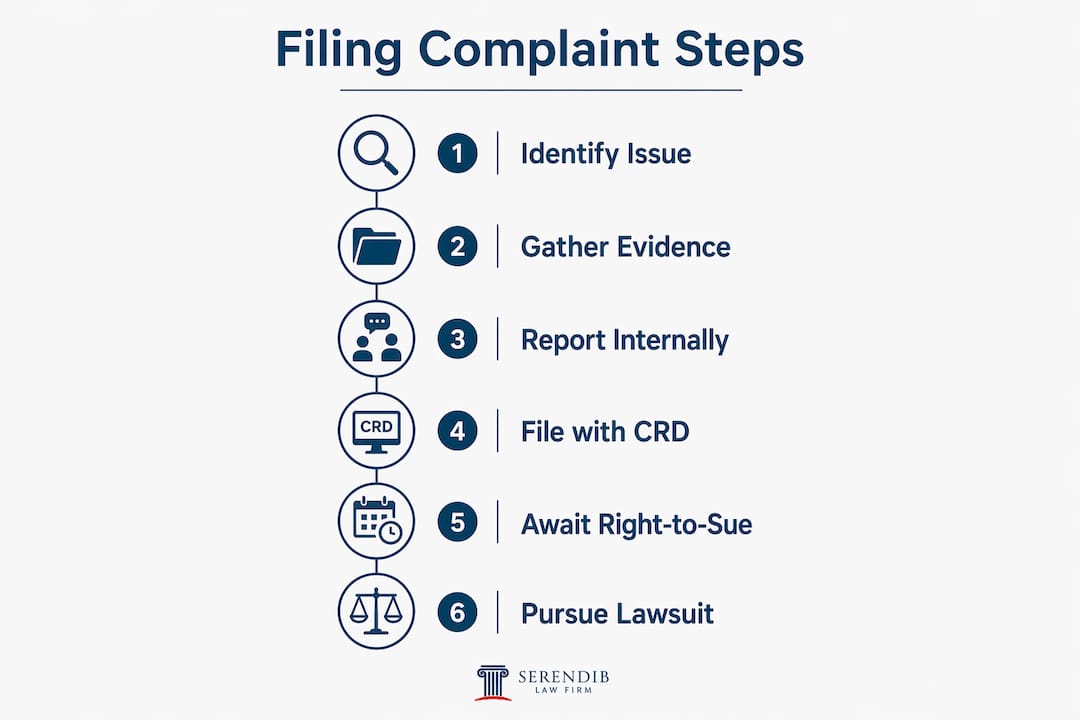
- File with the CRD. Submit your complaint online, by mail, or in person. Describe the discriminatory acts, the protected characteristic involved, and the employer’s response.
- Await investigation. The CRD typically completes investigations within one year of the complaint filing date. The department has enforcement powers and can file a civil complaint on your behalf if the evidence supports it.
- Obtain a right-to-sue notice. You must receive a right-to-sue notice from the CRD before you can file a civil lawsuit under FEHA. Missing this step permanently bars your FEHA claim. This is one of the most common and costly procedural errors employees make.
- File your lawsuit within the deadline. After receiving the right-to-sue notice, courts strictly enforce the 90-day deadline to file a civil lawsuit. Missing it ends your case.
- Work with an attorney throughout. Serendib Law Firm guides Westminster employees through each of these steps, from filing the initial complaint to preparing for litigation.
The table below summarizes the two main complaint pathways:
| Agency | Covers | Key Requirement |
|---|---|---|
| California CRD | State FEHA claims | Right-to-sue notice required before lawsuit |
| Federal EEOC | Federal civil rights laws | Shorter filing window than FEHA |
Lawsuits are only possible after you complete the administrative process. Courts will dismiss cases filed without the proper right-to-sue notice. That procedural reality makes early legal guidance from a qualified attorney one of the most practical steps you can take.
What legal protections and remedies are available for discrimination victims in Westminster, CA?
California law gives discrimination victims meaningful remedies, not just symbolic ones. FEHA allows courts to order a range of relief designed to make you whole after unlawful treatment. Westminster employees who successfully pursue claims can recover real compensation.
Available remedies under FEHA include:
- Reinstatement. If you were wrongfully terminated, a court can order your employer to give you your job back.
- Back pay. You can recover wages and benefits lost because of the discriminatory act.
- Emotional distress damages. California courts recognize the psychological harm discrimination causes and award compensation for it.
- Punitive damages. In cases of especially egregious employer conduct, courts can award additional damages to punish the employer.
- Attorney’s fees. Prevailing employees can recover their legal costs, which removes a major financial barrier to pursuing a claim.
California law also prohibits retaliation against employees who file discrimination complaints or participate in related investigations. Retaliation includes demotion, termination, pay cuts, or any other adverse employment action linked to your complaint. If your employer retaliates, that act creates a separate legal claim on top of the original discrimination case.
Serendib Law Firm represents Westminster employees in employment discrimination claims across all of these remedy categories. The firm’s attorneys work to identify every form of compensation you may be entitled to under California law.
Understanding your California employee rights under FEHA is the first step toward recovering what you lost. The law is on your side. The process simply requires following it correctly.
Key Takeaways
California’s FEHA gives Westminster employees some of the strongest workplace discrimination protections in the country, but those protections only work when you follow the correct legal process.
| Point | Details |
|---|---|
| FEHA covers broad protected classes | Race, gender, disability, veteran status, and reproductive health decisions are all protected under California law. |
| Documentation is your foundation | Record every incident with dates, witnesses, and communications to build a credible legal record. |
| CRD complaint comes first | You must file with the CRD and receive a right-to-sue notice before any civil lawsuit is possible. |
| File with both CRD and EEOC | State and federal deadlines differ significantly, so filing with both agencies preserves all your legal options. |
| Remedies include real compensation | Back pay, emotional distress damages, reinstatement, and attorney’s fees are all available under FEHA. |
What I’ve learned about discrimination claims that most articles won’t tell you
After years of watching discrimination cases succeed and fail, the pattern is clear. The employees who lose are rarely the ones with weak facts. They are the ones who waited too long, reported to the wrong person, or assumed the process would be simple.
The biggest mistake I see is treating the complaint process as a formality. Employees file with the CRD, assume the agency will handle everything, and then miss the right-to-sue window because no one told them it was coming. That 90-day clock after receiving the notice is not a suggestion. Courts dismiss cases over it without exception.
The second mistake is underestimating subtle discrimination. Westminster has a diverse workforce, and bias does not always arrive with a slur or an obvious act. It shows up in who gets promoted, who gets the good assignments, and whose complaints get investigated seriously. Those patterns are harder to prove, but they are provable with the right documentation strategy.
Early consultation with a Westminster employment attorney changes the outcome in a measurable way. Not because attorneys are magic, but because they know which procedural steps matter and when. The law gives you strong rights. Using them correctly is the part that requires help.
— Maya Serkova
Serendib Law Firm is ready to help Westminster employees
Serendib Law Firm focuses on employment law for workers across Orange County, including Westminster. The firm’s attorneys handle discrimination cases involving race, gender, disability, retaliation, and wrongful termination. Serendib Law Firm offers free consultations and takes select cases on a contingency basis, meaning you pay nothing unless you win. The team is bilingual in English and Spanish, making legal support accessible to Westminster’s diverse community. If you are facing workplace bias and need clear answers about your options, contact Serendib Law Firm today to speak with an attorney who represents employees, not employers.
FAQ
What is employment discrimination under California law?
Employment discrimination is illegal treatment of an employee based on a protected characteristic such as race, gender, age, or disability. California’s FEHA defines and prohibits this conduct for employers with five or more employees.
What agency handles discrimination complaints in Westminster, CA?
The California Civil Rights Department (CRD) handles state-level discrimination complaints under FEHA. The federal EEOC handles claims under federal civil rights laws, and filing with both agencies is advisable.
Do I need a right-to-sue notice before filing a lawsuit?
Yes. California law requires employees to obtain a right-to-sue notice from the CRD before filing a civil lawsuit under FEHA. Skipping this step permanently bars the claim.
What happens if my employer retaliates after I file a complaint?
Retaliation is separately prohibited under California law. Adverse actions like demotion, termination, or harassment linked to your complaint create an additional legal claim against your employer.
How long do I have to file a discrimination complaint in California?
Applicable statutes of limitations vary by claim type and agency, and should be evaluated on a case-by-case basis with an attorney. State and federal deadlines differ significantly, so early legal consultation is critical.