

Employment discrimination is defined as adverse treatment of an employee based on a protected characteristic such as race, sex, disability, age, or national origin. If you work in La Habra, CA and believe your employer has treated you unfairly for any of these reasons, California law gives you clear and powerful rights to fight back. The California Fair Employment and Housing Act (FEHA) and federal statutes like Title VII of the Civil Rights Act, the Americans with Disabilities Act (ADA), and the Age Discrimination in Employment Act (ADEA) all apply to workers in La Habra. Understanding your options under these laws is the first step toward protecting your livelihood and your dignity.
What legal protections do La Habra employees have against workplace discrimination?
California offers some of the strongest workplace discrimination protections in the country. FEHA applies to employers with 5 or more employees, which means most businesses in La Habra are covered. Federal laws like Title VII and the ADA generally apply to employers with 15 or more employees, but FEHA fills the gap for smaller workplaces.
FEHA prohibits discrimination based on a wide range of protected categories. California law covers race, color, ancestry, national origin, sex, disability, age, sexual orientation, marital status, and source of income, among others. That list goes well beyond what federal law requires, giving La Habra employees broader protection than workers in many other states.

The California Fair Chance Act adds another layer of protection. This law limits when employers can ask about criminal histories and requires an individualized assessment before denying a job based on a past conviction. That matters for La Habra job seekers who might otherwise be screened out unfairly before they even get a chance to interview.
Protected categories under California FEHA include:
- Race, color, and ancestry
- National origin and immigration status
- Sex, gender identity, and gender expression
- Pregnancy and related medical conditions
- Disability (physical and mental)
- Age (40 and older)
- Sexual orientation and marital status
- Religion and source of income
Pro Tip: If you work for a small La Habra employer with fewer than 15 employees, do not assume federal law protects you. FEHA’s lower threshold of 5 employees means you likely still have strong state law protections. Consult a California employment attorney to confirm your coverage.
What are common types of workplace discrimination in La Habra?
Discrimination takes many forms, and not all of them are obvious. Recognizing the pattern in your own situation is critical before you take any legal steps.
Race, national origin, and color discrimination show up in hiring decisions, promotions, pay disparities, and hostile work environments. A La Habra warehouse worker passed over for promotion repeatedly while less experienced white colleagues advance has a potential race discrimination claim worth investigating.
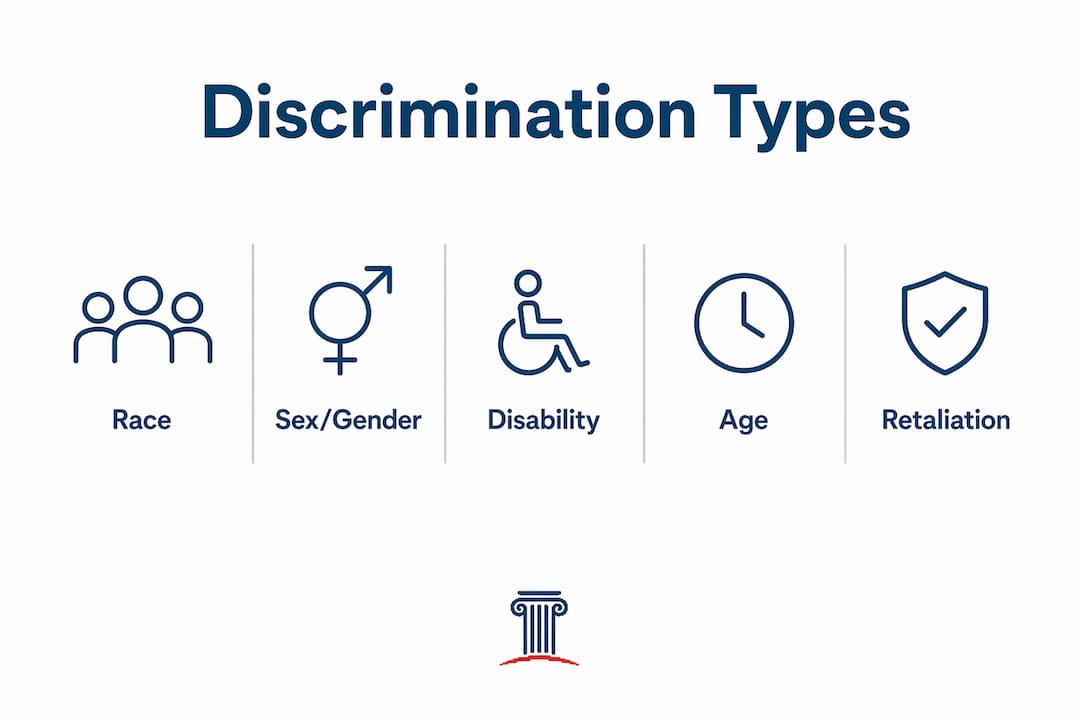
Sex and gender discrimination includes unequal pay, denial of promotions, and sexual harassment. Pregnancy discrimination is a specific and common form. California law protects employees from adverse actions related to pregnancy, childbirth, and related medical conditions, including the right to reasonable accommodation and protected leave.
Disability discrimination is one of the most nuanced areas. A 2026 appellate ruling clarified that erratic behavior alone is not enough for an employer to assume a disability exists. Formal knowledge of the disability is required before the employer’s duty to accommodate is triggered under FEHA. This cuts both ways: employers cannot ignore a clearly disclosed disability, but they also cannot be held liable for failing to accommodate a condition they had no real reason to know about.
Age discrimination hits workers 40 and older the hardest. In La Habra’s retail and service sectors, older employees sometimes face pressure to resign, reduced hours, or exclusion from training programs offered to younger colleagues. These patterns can support an ADEA or FEHA claim.
Retaliation is one of the most common claims filed. FEHA prohibits retaliation against any employee who reports discrimination, files a complaint, or participates in an investigation. Demotion, termination, schedule cuts, and hostile treatment after a complaint are all forms of unlawful retaliation. You can review a full breakdown of types of employment claims recognized under California law to see where your situation fits.
How can La Habra employees legally respond to discrimination?
Taking action against workplace discrimination requires a clear, methodical approach. Acting without a plan can weaken your claim. Here is the process that gives you the strongest foundation.
Document everything immediately. Write down dates, times, locations, and the names of anyone present during discriminatory incidents. Save emails, texts, performance reviews, and scheduling records. Strong discrimination claims rely on cumulative evidence rather than a single smoking gun. A pattern of biased scheduling, exclusion from meetings, or sudden negative performance reviews after a complaint carries real legal weight.
Identify witnesses. Colleagues who observed discriminatory conduct can provide critical support. Ask them to write down what they saw while the memory is fresh. Witness accounts are among the most persuasive forms of evidence in discrimination cases.
Report internally if it is safe to do so. Many employers have HR departments or written complaint procedures. Filing an internal complaint creates a paper trail and puts the employer on notice. However, internal reporting alone is not enough if the employer fails to act.
File a complaint with the California Civil Rights Department (CRD) or the federal Equal Employment Opportunity Commission (EEOC). Filing a complaint triggers an agency investigation and opens the door to mediation. The CRD handles FEHA claims, while the EEOC handles federal claims. Both agencies can investigate and facilitate resolution without requiring you to file a lawsuit immediately.
Consult a discrimination law attorney before filing. Applicable statutes of limitations govern how long you have to file, and those deadlines vary by claim type and circumstance. A lawyer can evaluate your specific situation and advise you on timing, evidence, and strategy.
Pro Tip: Never delete any communication from your employer, even messages that seem unrelated to your complaint. Metadata and message chains often reveal patterns that are invisible when you look at individual messages alone.
Employees in La Habra can also find detailed guidance on filing legal complaints for employment discrimination through resources covering the broader Orange County area.
What legal remedies can La Habra employees expect if discrimination is proven?
When discrimination is proven, California law provides meaningful financial and structural remedies. The outcome depends on the strength of your evidence, the severity of the conduct, and whether your employer acted with malice or reckless disregard for your rights.
Legal remedies available to employees include:
- Back pay: Wages and benefits lost because of the discriminatory act, including missed raises and bonuses.
- Emotional distress damages: Compensation for psychological harm, anxiety, and suffering caused by the discrimination.
- Punitive damages: Available in cases of egregious or malicious conduct, designed to punish the employer and deter future violations.
- Reinstatement: A court order requiring your employer to restore your job or position.
- Policy changes: Employers may be required to update hiring practices, training programs, or accommodation procedures.
A concrete example of what these remedies look like in practice: a 2026 Fair Chance Act violation resulted in a $93,000 settlement for a single job applicant, along with required policy reforms for the employer. That outcome shows that California agencies take these violations seriously and that real compensation is achievable.
| Remedy type | What it means for you |
|---|---|
| Back pay | Recovers lost wages from the date of the discriminatory act |
| Emotional distress damages | Compensates for psychological and personal harm |
| Punitive damages | Penalizes employers for intentional or malicious conduct |
| Reinstatement | Restores your job if termination was discriminatory |
| Policy reform | Forces employer to change practices that caused the harm |
Legal representation significantly improves outcomes. Employers and their attorneys are experienced at minimizing liability. Having a La Habra employment attorney on your side levels the playing field and increases the likelihood of a favorable settlement or verdict.
Key Takeaways
California employees in La Habra have access to some of the strongest anti-discrimination protections in the nation, and acting promptly with documented evidence is the most effective path to a successful claim.
| Point | Details |
|---|---|
| FEHA covers most La Habra employers | State law applies to employers with 5 or more employees, broader than federal thresholds. |
| Cumulative evidence wins cases | Build your claim with emails, witnesses, and patterns rather than relying on one incident. |
| Retaliation is separately protected | Reporting discrimination is legally protected; adverse actions after a complaint are their own claim. |
| Remedies include money and policy change | Proven claims can recover back pay, damages, and force employer reforms. |
| Consult a lawyer before filing | Statutes of limitations vary; an attorney evaluates your deadlines and strategy before you act. |
What I have learned from employment discrimination cases in La Habra
Most employees who come to me with discrimination concerns share one frustrating experience: they waited too long. They hoped the situation would improve. They worried about retaliation. They second-guessed whether what happened to them was “bad enough” to qualify legally. By the time they reached out, evidence had disappeared and witnesses had moved on.
The biggest misconception I see is that discrimination must be obvious and intentional to be actionable. California law does not require you to prove that your employer hated you. A pattern of biased decisions, even ones that look neutral on the surface, can establish a claim. Disparate impact, where a policy disproportionately harms a protected group, is a recognized legal theory under both FEHA and federal law.
The disability accommodation area is where I see the most confusion. Employees often assume their employer should “just know” about their condition based on visible symptoms. The 2026 appellate ruling on erratic behavior clarified that formal disclosure is what triggers the employer’s legal duty. That means documenting your disclosure in writing, not just mentioning it verbally, is critical.
My practical advice is simple. Write everything down the day it happens. Report it internally in writing. Then call a lawyer before you file anything with a government agency. The filing process has procedural rules that can affect your rights, and getting that guidance early costs you nothing at a firm like Serendib law that offers free consultations.
How Serendib law helps La Habra employees pursue discrimination claims
Serendib law is an Orange County law firm with deep experience in California employment law, representing employees in La Habra and across the region. The firm handles discrimination, harassment, retaliation, and wrongful termination cases, offering free consultations so you can understand your rights before committing to anything. Serendib law’s attorneys are bilingual in English and Spanish, making legal help accessible to more of the La Habra community. If you believe your employer has violated your rights, you can review your California employment rights and then reach out directly to speak with an attorney. Contact Serendib law through the employment law contact page to schedule your free consultation today.
FAQ
What is employment discrimination under California law?
Employment discrimination is adverse treatment of an employee based on a protected characteristic such as race, sex, disability, or age. FEHA and federal statutes like Title VII prohibit this conduct for most La Habra employers.
Does FEHA cover small employers in La Habra?
FEHA applies to employers with 5 or more employees, which covers most businesses in La Habra. Federal laws generally require 15 or more employees, so state law fills a critical gap for workers at smaller companies.
What evidence do I need for a discrimination claim?
Strong claims rely on cumulative evidence including emails, texts, witness accounts, and patterns of biased decisions rather than a single incident. Document every relevant event with dates, names, and details as soon as it happens.
Can my employer fire me for reporting discrimination?
Retaliation against employees who report discrimination is prohibited under FEHA. Termination, demotion, or hostile treatment after a complaint is itself an unlawful act and can form the basis of a separate legal claim.
How long do I have to file a discrimination complaint in La Habra?
Statutes of limitations apply to discrimination claims and vary depending on the type of claim and the agency involved. Consult a discrimination law attorney promptly to evaluate your specific deadlines before taking any formal steps.