

TL;DR:
- Reporting a workplace injury in Buena Park must be done within 30 days, with written documentation.
- Employers have specific legal obligations, including timely form provision and reporting serious injuries to Cal/OSHA.
- Workers are protected from retaliation; thorough documentation and persistence improve claim success.
Many Buena Park employees assume that reporting a workplace injury is as simple as telling a supervisor and waiting for help to arrive. In reality, the process involves specific timelines, written documentation requirements, and legal obligations on both sides. Missing a single step, or allowing your employer to miss one, can quietly erode your right to full compensation. This guide walks you through every stage of the process: how to report correctly, what your employer must do by law, what delays and denials look like, and how California law shields you from retaliation when you speak up.
Table of Contents
- Understanding injury reporting requirements in Buena Park jobs
- Employer responsibilities after injury reporting
- Common employer response issues and delays in Buena Park
- Employee protections against retaliation after injury reporting
- Why documentation and persistence are your strongest tools
- Connect with expert legal support in Buena Park
- Frequently asked questions
Key Takeaways
| Point | Details |
|---|---|
| Timely injury reporting | Reporting workplace injuries quickly and thoroughly protects your claim and legal rights. |
| Employer compliance | Employers must follow strict reporting requirements and cannot delay or neglect official notifications. |
| Protection from retaliation | Employees are safeguarded from retaliation for injury reporting under California law. |
| Document everything | Keeping detailed records of communications and actions is essential for claim success. |
| Seek expert help | Consult experienced employment attorneys if you face complications or retaliation after reporting. |
Understanding injury reporting requirements in Buena Park jobs
The moment you are injured at work, a clock starts ticking. Most employees do not realize how structured and time-sensitive the reporting process actually is, and that lack of awareness can cost them.
Who to notify and how to do it
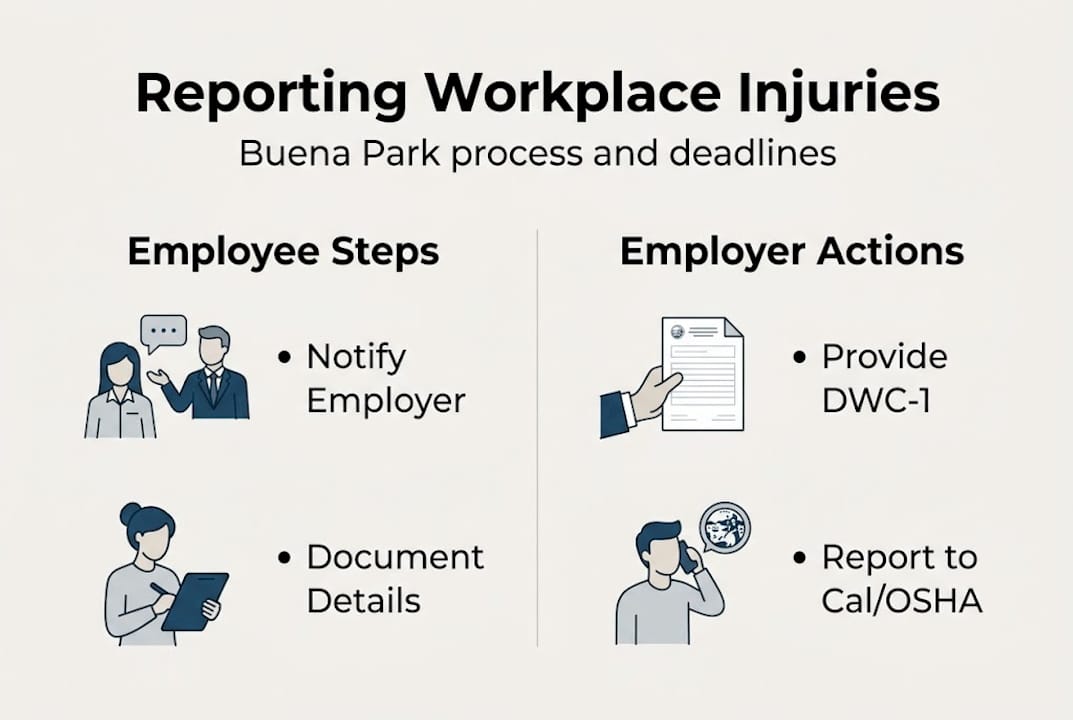
Your first step is to notify your employer. California law requires you to report your injury to your employer within 30 days of the incident. Verbal notification is a starting point, but written notification is far stronger. Put it in writing, even if that means sending a follow-up email after your verbal report. Written records are harder to dispute and create a clear paper trail.
After you notify your employer, they are required to provide you with a DWC-1 claim form (the official California workers’ compensation claim form) within one working day. You fill it out, return it to your employer, and keep a copy for yourself. That form triggers the formal claims process.
Key reporting timelines at a glance
| Milestone | Timeline |
|---|---|
| Employee reports injury to employer | Within 30 days of incident |
| Employer provides DWC-1 claim form | Within 1 working day |
| Employer forwards claim to insurer | Within 1 working day of receiving completed form |
| Insurer provides initial response | Within 14 days |
| Insurer makes final accept/deny decision | Within 90 days |
Understanding these timelines matters because the 90-day decision window is critical: if the insurer takes no action within 90 days, the claim may be automatically accepted, with limited exceptions.
Documentation essentials
From day one, treat every piece of paper and every message as potential evidence. Here is what you should collect and preserve:
- A written copy of your initial injury report
- Your completed DWC-1 claim form and the employer’s signed acknowledgment
- All medical records, treatment notes, and doctor’s instructions
- Photographs of the injury site and any equipment involved
- Witness names and contact information
- Every email, text, or letter exchanged with your employer or their insurer
Knowing your workers’ rights in Buena Park before an injury happens is ideal, but even if you are already in the middle of a claim, getting informed now can still protect your outcome.
Pro Tip: Start a dedicated folder, either physical or digital, the day you are injured. Label every document with the date and a brief description. This simple habit has helped workers win claims that might otherwise have been dismissed for lack of evidence.
Employer responsibilities after injury reporting
Once an injury is reported, employers have specific legal obligations. Here is what employees should expect from their employers after submitting a report.

Employers in California carry a significant legal burden when a worker is injured. Failing to meet these obligations is not just a procedural error. It can expose the employer to fines, penalties, and civil liability.
What employers must do by law
California law is clear about employer duties after an injury report:
- Provide the DWC-1 claim form within one working day
- Forward the completed claim form to their workers’ compensation insurer within one working day
- Authorize up to $10,000 in medical treatment while the claim is being investigated
- Post a notice in the workplace informing employees of their rights under workers’ compensation
- Report serious injuries, illnesses, or deaths to Cal/OSHA immediately or within the required timeframe
The requirement to report serious injuries to Cal/OSHA within specified times is not optional. Serious injuries include hospitalization, loss of a body part, disfigurement, or any condition requiring inpatient care beyond emergency treatment.
Employer response vs. legal requirements: a comparison
| Situation | Legal requirement | Common employer failure |
|---|---|---|
| Injury reported verbally | Provide DWC-1 within 1 day | Delay or claim they never received notice |
| Claim form submitted | Forward to insurer within 1 day | Hold the form or “lose” paperwork |
| Serious injury occurs | Report to Cal/OSHA immediately | Fail to report or classify injury as minor |
| Employee asks about rights | Post and provide written notice | Ignore or downplay employee’s inquiry |
| Medical care needed | Authorize up to $10,000 immediately | Refuse or delay authorization |
Consequences for missed deadlines
When employers miss these deadlines, the consequences are real. Cal/OSHA can issue citations and fines. The Workers’ Compensation Appeals Board can impose penalties. In some cases, an employer’s failure to carry workers’ compensation insurance at all can result in criminal charges.
If your employer has terminated you or threatened your job after you filed a claim, that is a separate and serious legal issue. Understanding your rights around termination after workers’ compensation claims is essential, because retaliation in any form is illegal under California law.
Common employer response issues and delays in Buena Park
Now, let us look at what can go wrong with employer responses and how these issues can affect your workers’ compensation claim.
Even when employees do everything right, the claims process can stall. Delays, denials, and communication gaps are frustratingly common, and they are sometimes intentional.
The most frequent response problems
- Claim denial without proper investigation. Some insurers deny claims quickly, hoping employees will not appeal. A denial is not the end of the road. You have the right to challenge it.
- Partial payment offers. Insurers may offer a settlement far below what your injury is worth, particularly if they believe you are unrepresented and unfamiliar with the process.
- Communication blackouts. Days or weeks pass with no update from the insurer. This is a delay tactic that can work against you if you do not respond assertively.
- Misclassification of injury severity. Employers sometimes classify a serious injury as minor to avoid Cal/OSHA reporting requirements and reduce their liability exposure.
- Pressure to return to work early. Returning before you are medically cleared can worsen your injury and may reduce your long-term compensation.
How automatic acceptance works
The 90-day decision rule is one of the most powerful protections in California workers’ compensation law. If the insurer does not accept, deny, or formally delay the claim within 90 days of receiving the completed DWC-1 form, the claim is presumed compensable. That means it is treated as accepted. There are exceptions, such as fraud, but the default favors the worker.
“Silence from an insurer is not neutrality. After 90 days without a decision, that silence can become legal acceptance of your claim.”
If your employer is engaging in delay tactics or retaliating against you for filing, understanding handling employer retaliation is your next critical step. You should also review wrongful termination guidance if your job has been threatened.
Pro Tip: Every time you call your insurer or employer, follow up with a written summary of the conversation via email. Start it with: “Per our conversation today…” This creates a dated record that is extremely useful if the claim is disputed later.
Employee protections against retaliation after injury reporting
Facing a negative reaction or retaliation after reporting a workplace injury is a real risk. Let us clarify what is illegal and how you are protected.
California law does not just encourage fair treatment after an injury report. It mandates it. Employers who retaliate against workers for filing claims face serious legal consequences.
What retaliation looks like
Retaliation is not always obvious. It rarely comes as a direct statement. More often, it looks like this:
- Sudden termination shortly after filing a claim
- Reduction in hours or shift changes that affect income
- Demotion or removal of responsibilities without cause
- Increased scrutiny, write-ups, or manufactured performance issues
- Hostile treatment from supervisors or coworkers encouraged by management
- Being passed over for promotions you were previously on track to receive
- Threats, intimidation, or pressure to withdraw the claim
The law and its penalties
Retaliation for reporting an injury is illegal under California Labor Code §132a. This statute carries criminal penalties for employers found guilty of discrimination or retaliation against an injured worker. Penalties can include fines, increased compensation for the affected worker, and reinstatement of employment.
“Labor Code §132a exists because lawmakers recognized that without strong penalties, employers would routinely punish workers for exercising their legal rights. The law has teeth, and workers should use them.”
The protection covers not just termination but any adverse employment action taken because of the injury report. Even subtle forms of punishment, like being left off a preferred schedule, can qualify as retaliation if the timing and context point to the claim as the cause.
What to do if retaliation occurs
Start by documenting everything immediately. Write down dates, times, what was said, and who witnessed it. Then seek legal guidance without delay. You can find workplace retaliation guidance that applies directly to your situation, and you should also review workers’ comp retaliation protections specific to injury claims. If your injury report was related to a safety concern you raised, additional protections under retaliation after safety reports may also apply to your case.
Acting quickly matters. Delay weakens your position and can make it harder to connect the retaliation to the original injury report.
Why documentation and persistence are your strongest tools
Having reviewed the protections and processes, here is what years of handling workplace injuries in Buena Park have revealed about securing your rights.
Most employees who struggle with their workers’ compensation claims share one thing in common: they underestimated how much their own records would matter. They assumed the system would work automatically, that the insurer would be fair, and that their employer would follow the law. Sometimes that is true. Often, it is not.
The workers who come out ahead are almost always the ones who treated their claim like a legal case from day one. They saved every email. They wrote down every conversation. They followed up in writing after every phone call. They did not wait for the system to move. They pushed it.
Persistence is not aggression. It is simply refusing to let your claim disappear into a pile of unanswered paperwork. The insurer is counting on you to get tired and give up. Do not.
Working with local employment law experts can shift the dynamic entirely. When an employer or insurer knows you have legal representation, the tone of the process often changes. Deadlines get met. Calls get returned. Offers improve. That is not a coincidence.
Connect with expert legal support in Buena Park
If you are dealing with a delayed claim, an unresponsive insurer, or an employer who has made your work life difficult since you reported an injury, you do not have to navigate that alone. The attorneys at Serendib Law Firm offer personalized guidance for workers facing exactly these challenges. Whether you need help understanding your options or are ready to take legal action, employment law support in Buena Park is available to you. You can also connect with workers’ compensation experts for claim-specific guidance, or reach out to La Habra employment attorneys serving the broader Orange County region.
Frequently asked questions
How long do insurers have to respond to workplace injury claims in Buena Park?
Insurers must make a decision to accept, deny, or delay a claim within 90 days of receiving the completed DWC-1 form, with an initial response often expected within 14 days; failure to act within 90 days typically results in automatic claim acceptance.
What should I do if my employer does not report my injury to Cal/OSHA?
If your employer fails to report serious injuries to Cal/OSHA as required, you should contact Cal/OSHA directly to file a report and consider consulting an employment attorney to protect your rights.
Can my employer retaliate against me for reporting a workplace injury?
No. Retaliation is illegal under California Labor Code §132a, and employers found guilty of retaliating against injured workers face criminal penalties, fines, and potential reinstatement orders.
What documents should I keep when reporting a workplace injury?
Keep copies of your DWC-1 claim form, all medical records and treatment notes, written injury reports, photographs, witness information, and every piece of written communication with your employer and their insurer.
What are my options if my claim is delayed or denied?
You can formally appeal the denial, document all interactions with your employer and insurer, and consult a workers’ compensation attorney; if the insurer has taken no action within 90 days, automatic acceptance rules may apply to your claim.