

If you were hurt in a motorcycle crash in Placentia, contact an experienced local personal injury attorney right away. Get medical care first, then move fast: California law allows you a limited time to file suit, but a DMV SR-1 report must be filed promptly as required by law, and claims against a government entity require notice within a limited time period. Some local personal injury attorneys offer free consultations and bilingual, contingency-fee representation, so calling costs may vary.
TL;DR:
- Motorcycle accident claims in California are based on fault and comparative negligence, which can reduce your payout if you’re partially responsible for the crash.
- Collecting evidence quickly by photographing the scene, preserving damaged gear, and obtaining surveillance footage is crucial for a strong claim.
- Filing a DMV SR-1 report within 10 days is mandatory if injuries, death, or over $1,000 property damage occur, to avoid license suspension.
- Deadlines for legal action include a two-year limit for lawsuits and a six-month notice period for claims against government entities, making prompt legal advice essential.
- Engaging an experienced local attorney early improves the chances of preserving evidence, handling negotiations, and maximizing your compensation.
Table of Contents
- How Motorcycle Injury Claims Work in California and What Placentia Riders Should Expect
- What To Do at the Scene and in the Days After a Placentia Crash
- What Compensation Can Cover After a Motorcycle Crash
- Deadlines That Can End Your Right to Compensation
- How To Preserve Evidence and Handle Insurance Adjusters
- Why Serendib Law Firm Handles Placentia Motorcycle Injury Claims
- A Rider’s Perspective on the Mistakes That Cost Claims
- Get a Free Consultation and Start Protecting Your Claim Today
- Sources
- FAQ
How Motorcycle Injury Claims Work in California and What Placentia Riders Should Expect
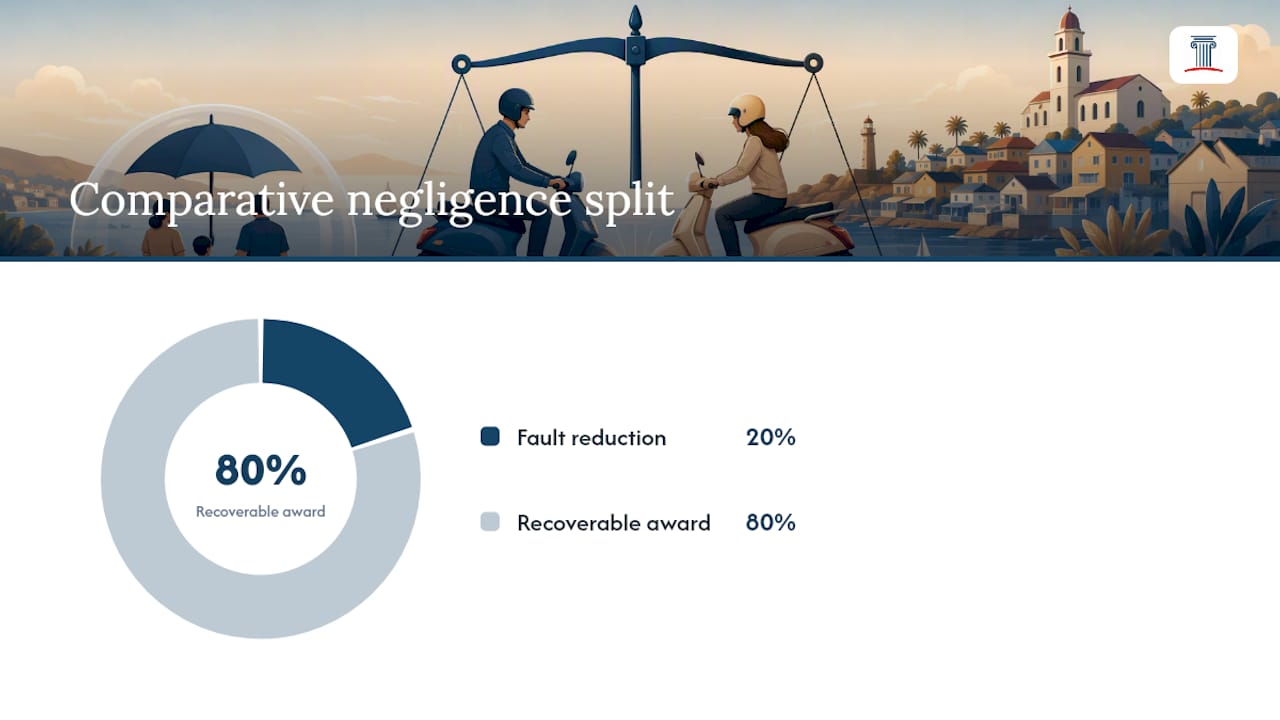
California runs on a fault-based system with pure comparative negligence, meaning you can still recover damages even if you were partly at fault, though your payout shrinks by your percentage of fault. If a jury finds you 20% responsible for a collision at the intersection of Bradford Avenue and Crowther Avenue, your award drops by that same 20%. Insurance adjusters know this rule well and use it aggressively, especially against motorcyclists, where anti-rider bias often creeps into fault assessments even when the rider did nothing wrong.
Every Motorcycle Accidents Placentia CA Injury Claims case rests on four legal elements your attorney must prove: duty of care, breach of that duty, causation, and actual damages. The at-fault driver owed you a duty to drive safely, breached it through some careless or reckless act, and that breach directly caused your injuries and losses. Skip any one of these elements and the claim collapses, which is why early evidence gathering matters so much.
A typical claim moves through recognizable stages:
- Investigation: your attorney gathers police reports, medical records, photos, and witness statements while evidence is still fresh.
- Treatment and documentation: you continue medical care, building a paper trail that ties your injuries to the crash.
- Demand package: your lawyer compiles damages into a formal demand letter to the at-fault insurer.
- Negotiation: insurers counter, and back-and-forth bargaining determines whether the case settles.
- Litigation, if necessary: unresolved claims proceed to a lawsuit, discovery, and potentially trial.
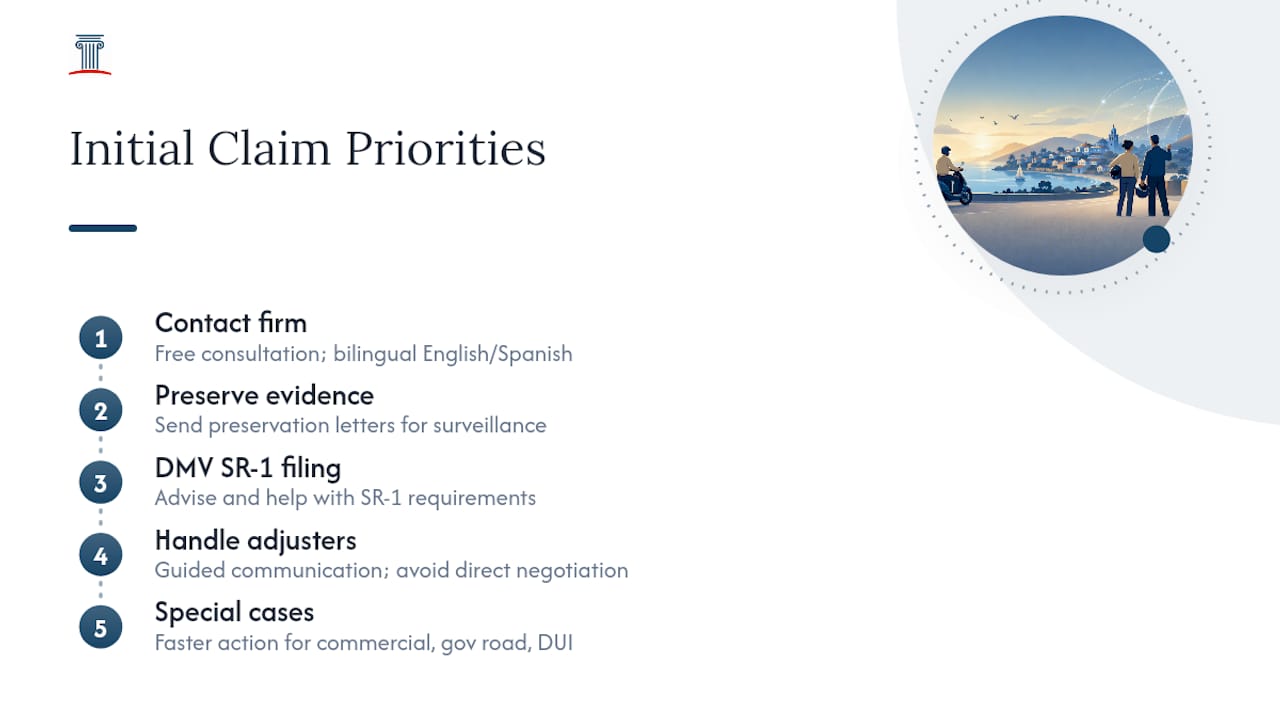
Attorneys handling motorcycle crashes near Placentia move quickly on preservation letters to secure nearby surveillance footage, since video from traffic and business cameras is often overwritten within 30 to 90 days. They also coordinate with accident reconstruction experts and manage every insurer communication, so you’re not left guessing what to say or sign.
What To Do at the Scene and in the Days After a Placentia Crash
The choices you make in the first hours after a crash shape the entire claim that follows. Here’s the order that protects both your health and your legal position:
- Call 911 immediately. A police response creates an official report and gets paramedics moving toward you.
- Get medical attention, even if you feel fine. Adrenaline masks pain, and gaps in treatment give insurers an opening to argue your injuries aren’t crash-related.
- Photograph everything. Wide shots of the scene, vehicle positions, skid marks, traffic signals, and road conditions, plus close-up shots of your injuries and gear damage.
- Exchange information. Names, phone numbers, insurance details, and license plates from every driver involved.
- Collect witness contacts. A bystander’s phone number today can become the testimony that wins your case later.
- Get the police report number before you leave the scene or as soon as it’s available.
- Preserve your helmet and riding gear. Do not repair, clean, or discard them. NHTSA guidance treats damaged gear as physical evidence of impact forces, and repairing it destroys that proof.
- Ask nearby businesses about security cameras. Footage from a gas station or storefront near Crowther Avenue or Yorba Linda Boulevard can capture the entire collision.
- File a DMV SR-1 within 10 days if the crash involved injury, death, or more than $1,000 in property damage, as required under California law.
- Notify your own insurer, but decline recorded statements to any other driver’s carrier until you’ve talked to an attorney.
Pro Tip: Keep your damaged helmet and jacket in a closet, not the garage or trash. Adjusters sometimes ask to inspect gear months into a claim, and if it’s gone, you’ve lost a piece of evidence that photos alone can’t fully replace.
What Compensation Can Cover After a Motorcycle Crash
Motorcycle injuries tend to run more severe than car accident injuries because riders lack the metal cage and airbags that protect drivers. That reality shows up directly in what a claim is worth once medical bills, lost income, and long-term care are added up.
Damages split into two categories:
- Economic damages: emergency room and hospital bills, follow-up treatment, physical therapy, lost wages during recovery, diminished future earning capacity, and the cost to repair or replace your motorcycle.
- Non-economic damages: pain and suffering, emotional distress, and loss of enjoyment of activities you can no longer do, like riding itself.
California requires drivers to carry minimum liability insurance limits, which may not cover all damages in serious motorcycle accidents. [see minimum liability limits] Those minimums are frequently far below the actual cost of a serious motorcycle injury claim, which is why uninsured and underinsured motorist (UM/UIM) coverage often becomes the real path to full recovery.
If the at-fault driver’s policy caps out before your medical bills do, your own UM/UIM coverage can fill the gap. Medical records, wage statements, and testimony from vocational or medical experts all feed into how an attorney values pain and suffering, since these losses don’t come with a receipt the way an ER bill does.
Deadlines That Can End Your Right to Compensation
Missing a filing deadline in California doesn’t just weaken your claim. It usually kills it outright, regardless of how strong your evidence is.
- Two-year statute of limitations: California Code of Civil Procedure §335.1 gives you two years from the date of the crash to file a personal injury lawsuit. Miss it, and courts will almost certainly dismiss your case regardless of merit.
- Six-month government claim notice: if a public entity, a city road crew, Caltrans, or a municipal vehicle contributed to your crash, Government Code §911.2 requires a formal claim within six months of the incident, far shorter than the standard two years.
- 10-day DMV SR-1 reporting window: required whenever the crash caused injury, death, or property damage over $1,000. Skipping it can trigger a license suspension separate from your injury claim.
Many riders don’t realize a pothole, a malfunctioning traffic signal, or a poorly marked construction zone on a city street can turn their case into a government claim, and that six-month window closes fast. Talking to an attorney within days, not months, of your crash gives you the best shot at meeting every deadline that applies to your situation.
How To Preserve Evidence and Handle Insurance Adjusters
Insurance companies investigate motorcycle claims differently than car accident claims, often starting from an assumption that the rider was speeding, lane-splitting recklessly, or otherwise at fault. Lane-splitting itself is legal under California Vehicle Code §21658.1, but adjusters routinely raise it anyway to argue comparative negligence, even when the maneuver was performed safely.
A few practices protect your claim value from day one:
- Keep every medical appointment. Consistent treatment removes the insurer’s favorite argument: that a treatment gap means your injuries were minor or unrelated.
- Decline recorded statements to the other driver’s insurance carrier. You’re not required to give one, and anything you say can be used to minimize your claim later.
- Direct all adjuster communication to your attorney once you’ve retained counsel. This single step stops most of the pressure tactics adjusters rely on.
- Preserve your helmet, riding gear, and photos of motorcycle damage. These items corroborate the force of impact far better than a police report narrative alone.
- Request preservation letters for nearby video footage before it’s automatically deleted by a business’s security system.
Behind the scenes, an attorney working your claim issues subpoenas when a business won’t voluntarily release footage, retains accident reconstruction specialists to counter the insurer’s version of events, and brings in vocational experts if your injuries affect your ability to work. The California Department of Insurance itself advises documenting the scene and notifying insurers promptly precisely because early documentation is what separates a strong claim from a contested one.
Pro Tip: If an adjuster calls before you’ve hired an attorney, it’s fine to give your name, the date, and location of the crash. Politely decline to discuss injuries, fault, or give a recorded statement, and tell them your attorney will follow up.
Why Serendib Law Firm Handles Placentia Motorcycle Injury Claims
Motorcycle crash cases reward attorneys who move fast and know the local terrain, from which intersections in Placentia see repeat collisions to which Orange County courts and claims adjusters they’ll be dealing with. Some law firms bring that combination directly to injured riders in the area, offering contingency-fee representation, free initial consultations, bilingual service, local practice knowledge, and rapid intake actions including sending preservation letters, advising on SR-1 filing obligations, and guiding on communication with insurance adjusters.
Experienced attorneys often focus on getting injured riders the medical support and legal footing they need in the critical first days after a crash. Riders who reach out early tend to see stronger outcomes, not because the law changes, but because the evidence that wins cases is only available for a limited window. For a deeper look at how the firm approaches injury representation across the region, its personal injury practice page outlines the services available to Placentia clients specifically.
A Rider’s Perspective on the Mistakes That Cost Claims
The riders who lose the most value in a claim usually make the same three mistakes: they wait days to see a doctor, they answer an adjuster’s questions before understanding how those answers get used, and they toss a cracked helmet because it feels useless. None of these choices feel careless in the moment. They feel like moving on. But insurers read a treatment gap as doubt and a discarded helmet as a missed opportunity to prove impact force.
My honest priority list for any injured rider: treat your injuries like they matter, because they do. Say less to insurance than feels natural. And call an attorney before you’ve decided you even need one, because by the time you’re sure, the footage might already be gone.
— Maya Serkova
Get a Free Consultation and Start Protecting Your Claim Today
Handling a motorcycle claim on your own, negotiating directly with adjusters, hiring a general practice attorney, or trying to piece together deadlines from online forums may leave you bearing the burden of California’s fault rules and filing windows while still recovering. Some law firms offer free, no-obligation case reviews and contingency-fee representation, meaning you owe nothing unless compensation is recovered.
From the moment of contact, priorities often include protecting claims by sending preservation letters for nearby surveillance footage, advising on DMV SR-1 filing requirements, and guiding communication with insurance adjusters. Bilingual support in English and Spanish can help ensure language is not a barrier to obtaining assistance. If your Placentia crash involved a commercial vehicle, a government-maintained roadway, or a suspected DUI driver, the timeline for action gets even tighter, and cases involving DUI charges can carry separate bail and criminal implications worth understanding alongside your civil claim.
Visit the firm’s personal injury practice page to review how contingency representation works, or reach out directly through the Placentia-area injury attorney page to schedule your free consultation now.
This article is general information, not a substitute for advice from a qualified lawyer. Consult a qualified legal professional about your own circumstances before acting on anything here.
Sources
- California Driver Handbook — Financial responsibility, insurance requirements and collisions (DMV)
- What to do after an auto accident — California Department of Insurance
- Motorcycle helmets — NHTSA
- What to do after a motorcycle accident in California — MMG Law Firm
FAQ
What is the average settlement for a motorcycle accident in California?
Settlement values vary widely based on injury severity, available insurance coverage, and comparative fault, so there’s no single “average” figure that applies reliably to every case. An attorney can give you a realistic range only after reviewing your medical records, lost wages, and the at-fault party’s insurance limits.
How much compensation can I get for a motorcycle accident?
Compensation depends on your economic damages (medical bills, lost wages, motorcycle repair costs) plus non-economic damages like pain and suffering, and it’s also reduced by any percentage of fault assigned to you under California’s comparative negligence rule. UM/UIM coverage can increase available compensation when the at-fault driver’s policy limits fall short.
How long does it take to get a settlement from a motorcycle accident?
Timelines depend on injury severity and whether the case settles through negotiation or requires litigation, with straightforward claims resolving faster than cases involving disputed liability or long-term medical care. Cases that need to account for future medical needs often take longer to settle fairly, since rushing can undervalue long-term costs.
What happens if I miss the two-year filing deadline in California?
Missing the two-year statute of limitations generally bars you from filing a lawsuit at all, regardless of how strong your evidence is. Government entity claims have an even shorter six-month notice window, making early legal advice critical.
Do I need a lawyer for a motorcycle accident claim in Placentia?
You’re not legally required to hire one, but insurers often treat unrepresented riders differently, and Serendib Law Firm offers a free consultation with contingency-fee representation so there’s no upfront cost to finding out where you stand.