
If you were seriously injured as a pedestrian in Fullerton, the answer to your most pressing question is yes—you can often recover compensation when another party’s negligence caused your injuries. California Vehicle Code section 21950 requires drivers to yield the right-of-way to pedestrians in crosswalks, and when a driver violates that duty, they bear legal liability for the harm that follows. California’s minimum bodily injury liability insurance limits start at the legally required minimums set by the state, though catastrophic injuries routinely exceed those figures. Your immediate priorities are clear: get medical treatment, secure a police report, preserve every piece of evidence you can, and contact an experienced Fullerton personal injury lawyer for a free consultation before speaking with any insurance adjuster.
- Seek emergency or urgent medical care, even if you feel you can manage the pain.
- Call 911 at the scene and request a police report.
- Photograph the vehicle, driver, road conditions, crosswalk markings, and your visible injuries.
- Collect names and contact information from every witness present.
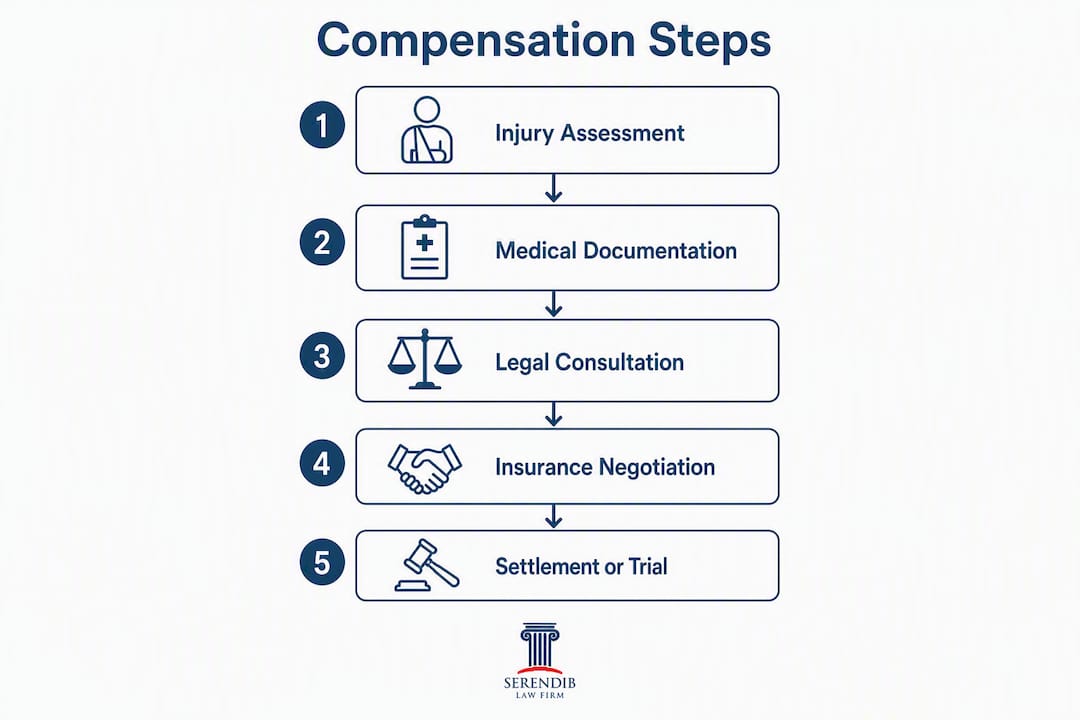
- Contact Serendib Law Firm for a free consultation before giving any recorded statement to an insurer.
Pro Tip: Most pedestrian accident cases settle through insurance negotiations rather than trial, but early legal contact is what gives you real leverage in those negotiations.
Table of Contents
- What compensation can a seriously injured pedestrian in Fullerton recover?
- How do pedestrian accidents typically happen in Fullerton?
- What California laws govern fault in a Fullerton pedestrian claim?
- What should you do after a pedestrian accident in Fullerton?
- How do insurance limits and hit-and-run situations affect your recovery?
- How do you choose the right Fullerton pedestrian injury lawyer?
- What do California’s liability minimums actually mean for your claim?
- Key Takeaways
- Why local Fullerton representation genuinely matters
- Serendib Law Firm is ready to fight for your Fullerton pedestrian injury claim
- Authoritative sources for Fullerton pedestrian injury claims
What compensation can a seriously injured pedestrian in Fullerton recover?
California law recognizes two broad categories of damages for injured pedestrians: economic and non-economic. California Courts’ personal injury self-help guide identifies medical expenses, lost earnings, future care costs, and emotional harm as the core categories — and each requires specific documentation to prove.
Economic damages are the measurable financial losses tied directly to your injury:
- Past and future medical bills (emergency care, surgery, hospitalization, physical therapy, prescription medications)
- Lost wages and reduced earning capacity if your injuries affect your ability to work
- Rehabilitation costs, including occupational therapy and assistive devices
- Future care expenses when injuries require ongoing treatment or in-home support
Non-economic damages cover the human cost that no receipt can fully capture:
- Pain and suffering, both physical and psychological
- Emotional distress and anxiety related to the accident and recovery
- Loss of enjoyment of life when injuries prevent activities you valued before
- Loss of consortium when a spouse or partner is affected by your diminished capacity
How much these damages total depends heavily on injury severity. A pedestrian with a broken wrist and a short recovery might settle for a fraction of what someone with a traumatic brain injury or spinal cord damage can recover. A case involving surgery, extended rehabilitation, and permanent limitations will typically generate a substantially larger claim than one resolved with conservative treatment alone. Punitive damages are available in California when a driver’s conduct was especially reckless or intentional, though they are awarded in a minority of cases.
Pro Tip: Ask your treating physician to document future care needs in writing, and consider requesting a vocational rehabilitation report if your injuries affect your ability to work. Those records become the foundation of your future-damages claim.
How do pedestrian accidents typically happen in Fullerton?
Fullerton’s mix of busy arterial streets, college-area foot traffic near Cal State Fullerton, and dense residential neighborhoods creates a predictable set of collision scenarios. Understanding how these accidents occur helps you identify the evidence that matters most for your claim.
Common causes include:
- Crosswalk collisions at intersections along Harbor Boulevard, Commonwealth Avenue, and Orangethorpe Avenue, where pedestrian signal timing and driver compliance are frequent issues
- Turning vehicles that fail to yield when making right or left turns at signalized intersections, often because drivers are watching oncoming traffic rather than pedestrians already in the crosswalk
- Distracted driving, including phone use, which reduces reaction time and is a leading factor in pedestrian strikes citywide
- Speeding on neighborhood streets, particularly in residential areas near schools and parks where pedestrian activity is high
- Parking lot and driveway incidents, where vehicles backing out or pulling forward strike pedestrians who are not in a marked crosswalk
The injuries that result from these collisions tend to be severe because a pedestrian has no structural protection. Lower-extremity fractures — broken femurs, tibias, and ankles — are among the most common, often requiring surgery and extended rehabilitation. Head and brain trauma ranges from concussion to severe traumatic brain injury, particularly when a pedestrian is thrown onto the hood or pavement. Spinal injuries, soft-tissue damage to the neck and back, and internal organ injuries are also frequently seen in higher-speed impacts.
The cause of the accident maps directly to the evidence you need. An intersection collision points to traffic signal data, crosswalk markings, and nearby surveillance cameras. A turning-vehicle strike calls for vehicle damage patterns, skid marks, and witness accounts of the driver’s sight lines. Identifying that evidence quickly, before it disappears, is one of the most concrete ways local Fullerton representation makes a practical difference.
What California laws govern fault in a Fullerton pedestrian claim?
California Vehicle Code section 21950 and driver duty
California Vehicle Code section 21950 is the statute at the center of most pedestrian right-of-way disputes. It requires drivers to yield to pedestrians within any marked or unmarked crosswalk at an intersection. The statute also imposes a duty of due care on pedestrians—they cannot suddenly leave a curb and walk into the path of a vehicle that is so close it is impossible for the driver to stop. In practice, this means fault is rarely all-or-nothing. A driver who ran a red light bears the primary fault; a pedestrian who crossed mid-block against traffic may share some portion.

California’s pure comparative negligence rule
California follows pure comparative negligence, which means your recovery is reduced by your percentage of fault — but never eliminated entirely. If a jury finds you 20% at fault for crossing outside a crosswalk and awards $200,000 in total damages, you recover $160,000. Even a pedestrian found 50% at fault retains the right to recover the other 50% of proven damages. That rule makes it worth pursuing a claim even when the other side argues you contributed to the accident.
Because California’s pure comparative negligence rule allows recovery regardless of shared fault, the strategic focus in most Fullerton pedestrian claims is minimizing the percentage of fault assigned to the injured person. Early evidence gathering — photos, witness statements, medical records showing the mechanism of injury — is the most effective tool for doing that.
Hit-and-run accidents and uninsured drivers
When a driver flees the scene, your path to compensation shifts. File a police report immediately, as California law requires hit-and-run reporting and the report is essential for any subsequent insurance claim. If you carry uninsured motorist (UM) coverage on your own auto policy, that coverage may apply even though you were on foot. MedPay coverage, if you have it, can help with immediate medical costs regardless of fault. Acting quickly matters because physical evidence at the scene disappears fast, and the police investigation window is narrow.
Pro Tip: Photograph the scene from multiple angles before leaving, including any debris, skid marks, or paint transfer on the road — that evidence is gone within hours and can be decisive in rebutting a partial-fault argument.
What should you do after a pedestrian accident in Fullerton?
Following a structured sequence of actions protects both your health and your legal claim. The steps below are organized chronologically.
At the scene:
- Call 911 and request both police and emergency medical services, even if your injuries seem manageable.
- Do not move unless you must for safety — document your position relative to the crosswalk or road markings.
- Photograph the vehicle, license plate, driver, road conditions, traffic signals, and your injuries.
- Collect the driver’s name, license number, insurance information, and vehicle make and model.
- Get the names and phone numbers of every witness before they leave.
Within 24–72 hours:
- Seek a full medical evaluation, even if you were discharged from the ER — some injuries, including internal bleeding and concussion symptoms, present or worsen over the following days.
- Obtain a copy of the police report from the Fullerton Police Department.
- Preserve the clothing you were wearing (do not wash it) and back up any photos or videos from your phone.
- Notify your own auto insurer of the accident if you carry UM or MedPay coverage, but avoid giving a detailed recorded statement without counsel present.
In the weeks that follow:
- Attend every medical appointment and follow your treatment plan — gaps in treatment are used by insurers to argue your injuries were not serious.
- Keep a daily journal documenting your pain levels, limitations, and how the injury affects your daily life.
- Track all out-of-pocket expenses: transportation to appointments, medications, home care, and any income you are losing.
- Direct all insurance communications to your attorney once you have retained one.
The applicable statute of limitations for your claim should be evaluated on a case-by-case basis with an attorney — do not assume you have unlimited time. Gathering evidence early strengthens your position whether the case settles or proceeds to trial.
Pro Tip: A daily symptom journal, written in your own words and dated, carries significant weight in settlement negotiations and at trial. Start it the day of the accident and update it consistently.
How do insurance limits and hit-and-run situations affect your recovery?
Insurance is almost always the first source of compensation in a Fullerton pedestrian injury claim, and understanding how the layers work helps you set realistic expectations.
The typical sequence:
- At-fault driver’s liability policy pays first, up to the policy limits.
- Underinsured motorist (UIM) coverage from your own auto policy can fill the gap when the at-fault driver’s limits are insufficient for your injuries.
- Uninsured motorist (UM) coverage applies when the at-fault driver has no insurance or flees the scene without being identified.
- MedPay coverage on your own policy covers immediate medical costs regardless of fault and can bridge the gap while liability is being determined.
- Employer vicarious liability may apply if the driver was operating a vehicle in the course of their employment at the time of the collision.
California’s minimum liability limits — $30,000 per person and $60,000 per accident — represent the floor, not a typical settlement figure for serious injuries. A single surgery can exceed that minimum, and a catastrophic injury involving long-term care will far surpass it.
| Scenario | Primary Coverage Source |
|---|---|
| At-fault driver identified, insured | Driver’s bodily injury liability policy |
| At-fault driver identified, underinsured | Driver’s liability + your UIM coverage |
| Hit-and-run, driver not found | Your UM coverage (if you carry it) |
| Immediate medical costs, any scenario | Your MedPay coverage (if applicable) |
| Driver on the job at time of accident | Employer’s commercial liability policy |
When policy limits are exhausted and injuries are severe, a lawyer may also evaluate whether other parties share liability — a municipality for a defective crosswalk, a property owner for a dangerous parking lot condition, or a vehicle manufacturer for a defect that contributed to the collision.
How do you choose the right Fullerton pedestrian injury lawyer?
Choosing counsel after a serious pedestrian injury is one of the most consequential decisions you will make. The right attorney does not just file paperwork — they build the evidentiary record, manage insurer pressure, and know when a settlement offer genuinely reflects the value of your claim versus when it falls short.
Questions to ask in a free consultation:
- How many pedestrian accident cases have you handled in Orange County, and what were the outcomes?
- Do you have trial experience in Orange County Superior Court, or does your firm primarily settle?
- How will you investigate my case, and what experts do you typically retain (accident reconstruction, medical, vocational)?
- Do you offer bilingual services in Spanish if I or my family members need them?
- What is your contingency fee percentage, and what costs am I responsible for if the case does not settle?
Understanding contingency fees: Most personal injury lawyers in California represent injured clients on a contingency basis, meaning you pay no attorney fees unless and until you recover compensation. The fee is typically a percentage of the recovery. You should ask specifically whether litigation costs (filing fees, expert witness fees, deposition costs) are advanced by the firm or billed to you as they arise, and how those costs are handled if the case does not result in recovery.
Realistic timelines: A straightforward pedestrian injury claim with clear liability and a cooperative insurer may resolve within several months. Cases involving catastrophic injuries, disputed fault, independent medical examinations, or an uninsured driver can take a year or more, particularly if the matter proceeds to trial. Your attorney should give you an honest assessment of the timeline based on the specific facts of your case, not a promise of a quick resolution.
Red flags to watch for:
- Pressure to accept a settlement before you have reached maximum medical improvement
- Vague or evasive answers about fee structures and litigation costs
- No demonstrable experience with pedestrian claims or Orange County courts
- Poor communication or delayed responses during the initial consultation itself
Pro Tip: Ask specifically whether the attorney has handled claims involving the same type of injury you suffered — a lawyer experienced with traumatic brain injury claims, for example, will know which medical experts carry the most weight with Orange County juries and adjusters.
What do California’s liability minimums actually mean for your claim?
California’s minimum bodily injury liability insurance requirements are set by the California DMV and represent the least coverage a driver is legally required to carry. They are a legal floor, not a measure of what your injuries are worth.
| Coverage Type | Minimum Required | Practical Limitation |
|---|---|---|
| Bodily injury per person | The legal minimum | Often exhausted by a single ER visit and surgery |
| Bodily injury per accident | The legal minimum | Shared among all injured parties in a multi-victim crash |
| Property damage per accident | — | Covers vehicle/property damage only |
For a pedestrian with a fractured pelvis, a hospital stay, surgery, and months of physical therapy, the $30,000 per-person minimum can be consumed before rehabilitation even begins. That gap is precisely why underinsured motorist coverage matters and why an attorney’s early policy-limits investigation is so important.
When injuries are severe, a skilled attorney will send a policy-limits demand letter early in the process to establish the insurer’s exposure and preserve the client’s right to pursue UIM coverage if the at-fault driver’s policy is insufficient. Collecting directly from an individual defendant beyond their insurance policy is possible in theory but rarely practical, as most individuals do not have significant attachable assets.
Pro Tip: Request a copy of your own auto insurance declarations page as soon as possible after the accident. Knowing your UM and UIM limits before negotiations begin lets your attorney structure the claim to maximize total recovery across all available policies.
Key Takeaways
Seriously injured pedestrians in Fullerton can recover compensation for economic and non-economic damages under California law, but the amount recovered depends on injury severity, fault allocation, and the insurance coverage available.
| Point | Details |
|---|---|
| California minimum limits are a floor | At legally required minimums, policy minimums are often exhausted by serious injury costs; UIM coverage fills the gap. |
| VEH 21950 establishes driver duty | Drivers must yield to pedestrians in crosswalks; violations support a negligence claim under California law. |
| Comparative fault reduces, not eliminates, recovery | Even if you share some fault, California’s pure comparative negligence rule lets you recover a proportionate share of damages. |
| Evidence preservation is time-sensitive | Photos, witness statements, and medical records gathered immediately after the accident are the strongest tools for rebutting partial-fault arguments. |
| Serendib Law Firm offers free consultations | The firm represents seriously injured Fullerton pedestrians on a contingency basis — no fee unless you recover. |
This article provides general legal information, not legal advice. Consult a qualified California personal injury attorney to evaluate your specific situation and applicable deadlines.
Why local Fullerton representation genuinely matters
What I see repeatedly in pedestrian injury claims is that the gap between a fair recovery and an inadequate one often comes down to how quickly and thoroughly the evidence was gathered in the first 72 hours. Fullerton has its own intersection layouts, its own police reporting procedures at the Fullerton Police Department, and its own network of nearby hospitals and trauma centers — including St. Jude Medical Center — that generate the medical records central to any serious claim. An attorney who knows those local systems can move faster and more precisely than one working from a distance.
There is also a practical reality about Orange County Superior Court that matters when a case does not settle. Juries in this jurisdiction have their own expectations, and local courtroom experience shapes how a case is framed, which experts are retained, and how liability arguments land. That is not a marketing point — it is a structural advantage in litigation.
Serendib Law Firm handles pedestrian injury claims in Fullerton on a contingency basis, offers bilingual services in English and Spanish, and provides free initial consultations so you can understand your options without any financial commitment. If you or a family member has been seriously injured, the most important step is getting an honest assessment of your claim before the evidence fades and before an insurer’s early offer shapes your expectations.
Serendib Law Firm is ready to fight for your Fullerton pedestrian injury claim
When a driver’s negligence leaves you with serious injuries, mounting medical bills, and lost income, you need more than general legal information — you need an attorney who will pursue every available source of compensation on your behalf. Serendib Law Firm represents seriously injured pedestrians in Fullerton and throughout Orange County, handling claims from initial investigation through settlement or trial. The firm works on a contingency fee basis, meaning there are no upfront costs and no attorney fees unless you recover. Bilingual services in English and Spanish are available, so language is never a barrier to getting the representation you deserve.
At your free initial consultation, bring whatever you have: the police report, any photos from the scene, your medical records and bills, and a list of your questions. The team will evaluate your claim honestly, explain how California law applies to your specific facts, and outline a strategy for pursuing full compensation. Schedule your free consultation today and let Serendib Law Firm put its local experience to work for you.
Authoritative sources for Fullerton pedestrian injury claims
- Serendib Law Firm — Fullerton Personal Injury Lawyers — Serendib Law Firm’s Fullerton practice page, describing local courtroom experience and services available to seriously injured pedestrians in Orange County.