

If you were hurt in a slip and fall accident in Placentia, California, a property owner may owe you compensation under state law. California Civil Code Section 1714 establishes that property owners must use ordinary care to keep their premises reasonably safe, and when they fail to do so, they can be held legally liable for resulting injuries. Under CACI No. 1000, four elements must be proven to establish liability:
- The defendant owned, leased, occupied, or controlled the property
- The defendant was negligent in the use or maintenance of that property
- You suffered an actual injury
- The negligence was a substantial factor in causing your harm
Common hazards that trigger these claims in Placentia include wet or slippery floors without warning signs, uneven walking surfaces, poorly maintained stairs, inadequate lighting, loose carpeting, and cluttered walkways. The statute of limitations for personal injury claims in California is generally two years from the date of injury, though exceptions exist and timelines should be evaluated on a case-by-case basis.
When property owners in Placentia, CA may be liable for slip and fall injuries
Property owners in Placentia carry a nondelegable duty of care under California law. That word “nondelegable” matters: under CACI No. 1001, an owner cannot escape liability simply by hiring a contractor to handle maintenance. If the contractor is negligent, the owner remains responsible.

How your legal status as a visitor affects the duty owed to you
California law recognizes three categories of visitors, and the duty owed to each differs meaningfully.
- Invitees (customers at a Placentia store, patients at a medical office, students at a school) receive the highest duty of care. Owners must regularly inspect for hazards, promptly fix dangerous conditions, and warn about known risks that have not yet been repaired.
- Licensees (social guests at a private residence) are owed a duty to warn about non-obvious dangers the owner knows about, along with repairs to known hazardous conditions.
- Trespassers receive the lowest protection. Owners generally must only refrain from willful or wanton harm, though if an owner knows trespassers regularly enter the property, additional warnings about artificial dangers may be required.
What evidence proves a property owner’s liability
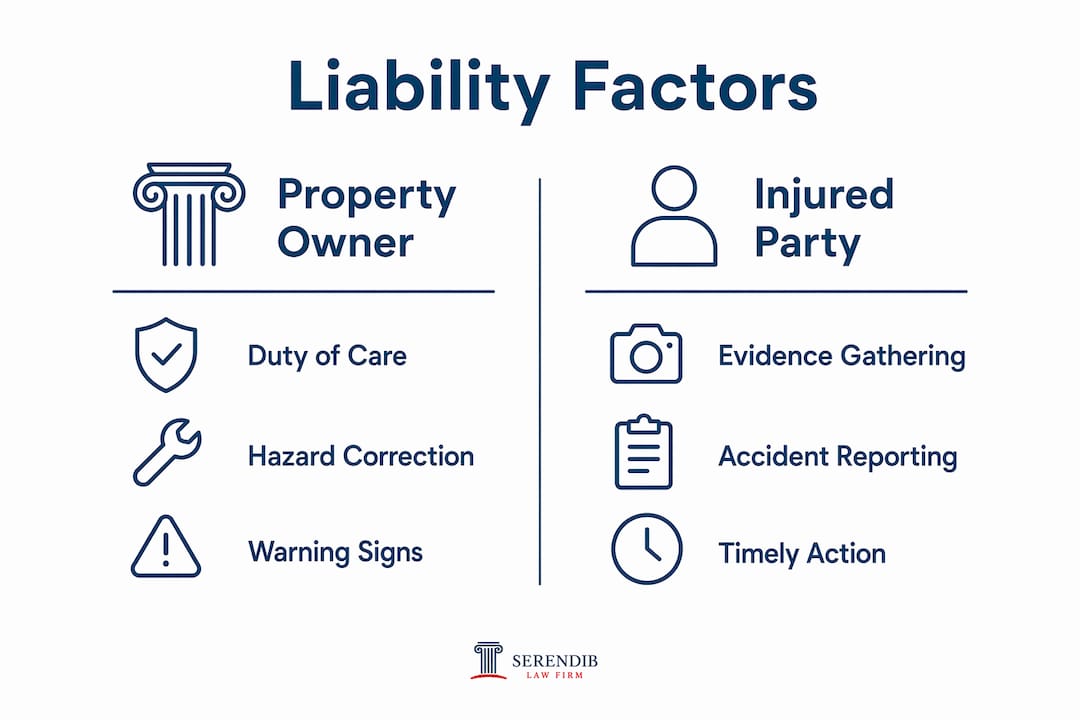
Solid documentation is the foundation of any successful premises liability claim. Photographs of the hazardous condition, surveillance footage of the accident, witness statements, maintenance and inspection records, incident reports, and medical records all help establish that the owner knew or should have known about the danger. Inspection logs are particularly telling: a property with no documented safety checks makes it far harder for an owner to argue they exercised reasonable care.
Courts apply a “reasonable person” standard, weighing how long the dangerous condition existed, whether routine safety checks would have caught it, the cost and difficulty of fixing it, and the seriousness of potential injuries. Critically, CACI No. 1001 makes clear that a property owner’s compliance with safety regulations alone does not establish due care. If circumstances required a higher degree of caution, compliance with minimum code is not a complete defense.
Defenses property owners commonly raise
Expect the property owner and their insurer to push back. Typical defenses include arguing the hazard was open and obvious, that the victim was not paying attention, or that the victim’s own negligence contributed to the accident. California follows a pure comparative negligence rule, meaning your compensation is reduced by your percentage of fault but is not eliminated entirely. A property owner might also claim the dangerous condition existed for only a brief moment, making it unreasonable to expect discovery and repair.
What compensation you may recover
If liability is established, California law allows recovery for a range of economic and non-economic damages. These include:
- Medical expenses, both current and anticipated future costs
- Lost wages and diminished earning capacity
- Pain and suffering
- Emotional distress
- Disability or disfigurement
- Reduced quality of life
The specific amount depends on the severity of your injuries and their long-term impact on your daily life.
Statute of limitations and government property claims
California Code of Civil Procedure section 335.1 sets the general two-year deadline for personal injury actions, but applicable timelines vary by circumstance and should always be evaluated individually with an attorney.
Pro Tip: If your accident happened on government-owned property in Placentia, such as a city sidewalk, park, or public building, the rules are significantly different. Under California Government Code Section 911.2, you must file an administrative claim before you can file a lawsuit, and the deadlines for doing so are much shorter than the standard two-year period. Missing this step can permanently bar your claim, regardless of how strong your case is.
For guidance on collecting evidence after a fall, the steps you take in the hours and days after an accident can make or break your case. Securing photos, getting witness contact information, and seeking immediate medical attention all strengthen your position considerably. You can also learn more about establishing negligence in California premises liability cases to understand what attorneys look for when evaluating a claim.
Serendib Law Firm is ready to fight for you in Placentia
Suffering a slip and fall injury is disorienting, and dealing with a property owner’s insurer on your own makes it harder. Serendib Law Firm represents injury victims in Placentia and throughout Orange County, bringing focused knowledge of California premises liability law and the local legal environment. We offer free consultations and handle qualifying personal injury cases on a contingency basis, meaning you pay nothing unless we recover compensation for you. Our team is bilingual in English and Spanish, so every client can communicate clearly and feel fully supported. If your accident happened at a commercial property, a residential complex, or a public space in Placentia, we want to hear from you. Contact us today to speak with a Placentia personal injury lawyer about your rights and your options.
Key Takeaways
Property owners in Placentia may be held liable for slip and fall injuries when they breach their duty of care under California Civil Code Section 1714 and that breach directly causes harm.
| Point | Details |
|---|---|
| Duty of care is nondelegable | Owners cannot shift liability to contractors; they remain responsible for unsafe conditions under CACI No. 1001. |
| Four elements must be proven | Ownership or control, negligence in maintenance, actual injury, and causation are all required under CACI No. 1000. |
| Visitor status shapes the duty owed | Invitees receive the highest protection; licensees and trespassers receive progressively less under California law. |
| Government property claims differ | Claims against city or public property in Placentia require an administrative claim first, with shorter filing deadlines under California Government Code Section 911.2. |
| Serendib Law Firm offers free consultations | The firm represents Placentia slip and fall victims on a contingency basis, with bilingual support in English and Spanish. |